
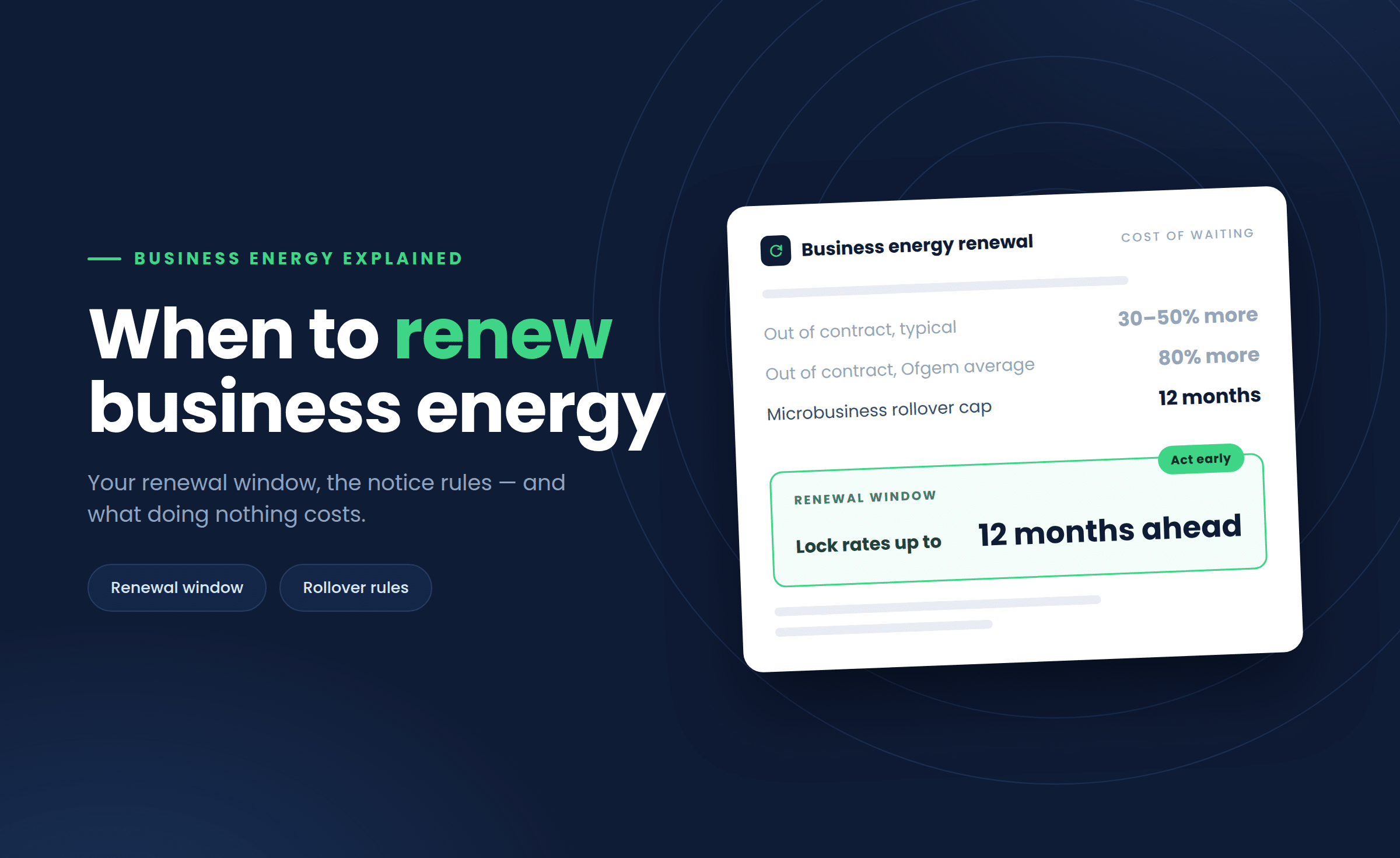
A business energy renewal is agreeing a new tariff for your gas or electricity before your current contract ends, with your existing supplier or a new one. The single biggest mistake is leaving it too late.
Renewing early gives you the pick of the market and keeps you off expensive default rates. This guide covers when your renewal window opens, the Ofgem rules that protect you, and how to review a quote before you sign.
When your window is open, the fastest way to a competitive deal is to run a business energy comparison and compare business energy suppliers in one go rather than accept whatever your supplier sends.
When should you renew your business energy contract?
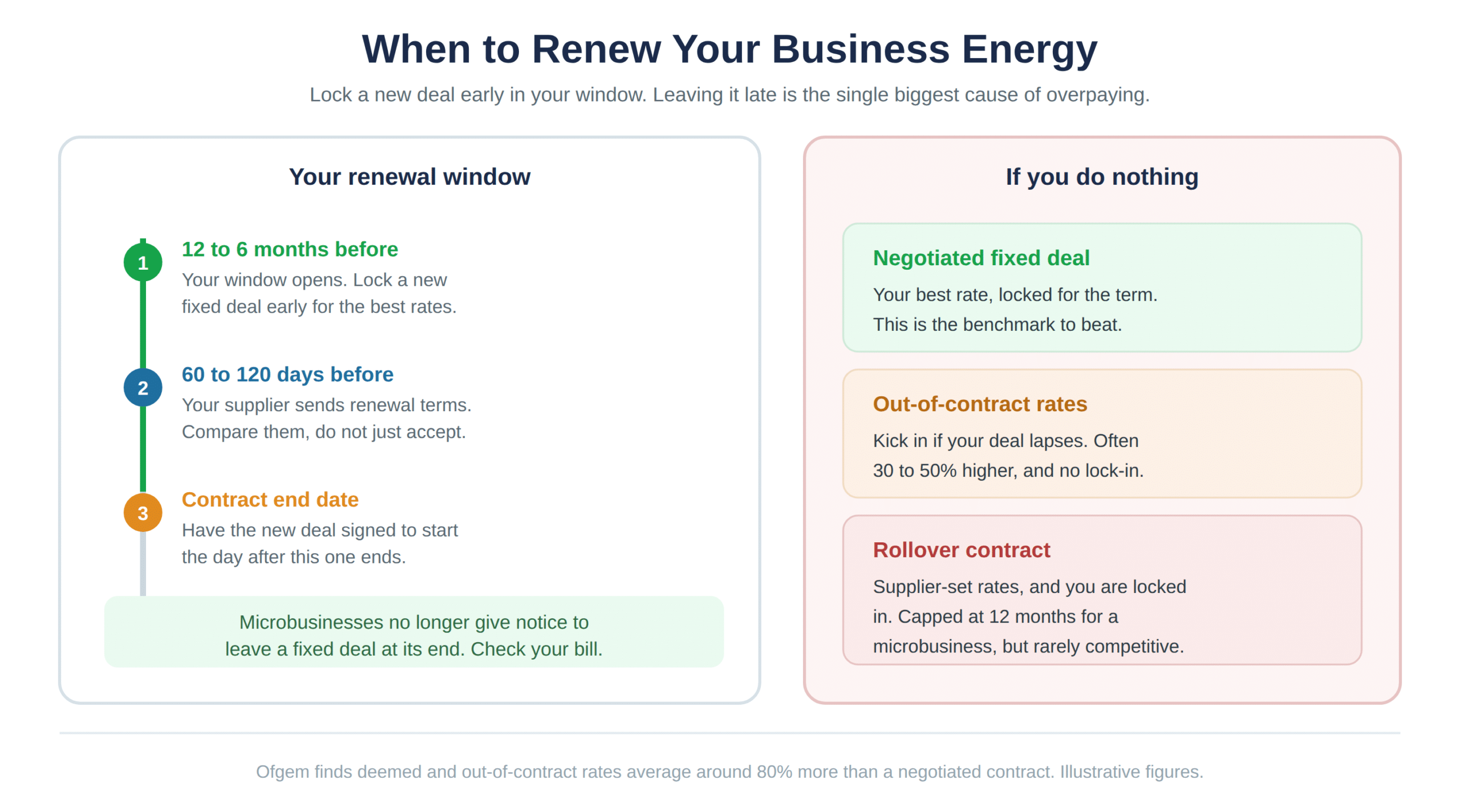
Most suppliers let you lock in new rates 6 to 12 months before your contract ends, though the exact window varies. The earlier in that window you act, the better the rates tend to be.
Your renewal window
There is no single window that fits every contract. Some suppliers quote up to 12 months ahead, while others only open the window 3 to 6 months out, and a broker can often quote earlier still.
Why acting early matters
Quotes generated in the final weeks tend to come in higher, because the supplier knows your deadline is close. Acting early also leaves time to compare the market and switch cleanly before your current deal ends.
What is the difference between a renewal window and a notice period?
Your renewal window is when you can secure new rates, while your notice period is the deadline to tell your supplier you are leaving. Most microbusinesses no longer need to give notice at all.
The notice rules
Since October 2022, Ofgem rules mean a microbusiness no longer has to give termination notice to leave a standard fixed contract at its end. The exception is an evergreen or rollover tariff, where notice can still apply.
Where to check your dates
Suppliers must print the contract end date and any notice period on every fixed-term microbusiness bill, so your latest bill is the quickest place to look. Larger firms are not covered by that rule, so check the original contract instead.
How does the business energy renewal process work?
Renewing follows the same steps whether you stay or switch: confirm your end date, gather your usage, source quotes across the market, compare like for like, then sign. Doing it in order keeps you in control.
The renewal timeline
The graphic below shows how the final year of a contract unfolds, and what happens if you let it lapse.
What you need to get quotes
Accurate quotes need a clear picture of your usage. Have your annual consumption in kWh, your MPAN and MPRN, your meter type, and your current supplier and end date to hand.
Signing and going live
Once you accept a quote, the supplier sends a contract to sign. A switch to a new supplier typically completes within five working days under Ofgem’s faster switching rules, while a renewal with your current supplier simply starts the day after your old deal ends.
What should you check before accepting a renewal quote?
Check the unit rate, standing charge, contract length, any extra charges, and the renewal terms. The lowest headline price is not always the cheapest deal once standing charges and length are factored in.
The five checks
A renewal quote can look simple, but the detail is where businesses get caught out. Run through the points below before you sign anything.
| Check | What to look for |
|---|---|
| Unit rate | The cost per kWh, the charge that scales with usage |
| Standing charge | A fixed daily fee, which hits low-usage sites hardest |
| Contract length | Usually 1 to 3 years, longer locks you in if rates fall |
| Extra charges | Capacity or pass-through costs, plus any broker commission |
| Renewal terms | The new end date, notice period and default arrangement |
Why renewal quotes are often high
Suppliers know a business that does not check the market tends to accept whatever lands in front of it. Renewal quotes are often priced above what the same supplier offers a new customer, which is why it pays to review your procurement properly each time.
What are your business energy renewal options?
When you renew you also choose a contract type. Fixed rates suit most small businesses, pass-through suits those wanting transparency, and flexible contracts suit large, high-consumption users.
The three main contract types
Each option balances certainty against flexibility differently. The table below sets out who each one suits.
| Contract type | How it works | Best for |
|---|---|---|
| Fixed rate | Unit rates and standing charge locked for the term | Most small and medium businesses wanting certainty |
| Pass-through | Wholesale cost fixed, network costs passed through | Firms wanting transparency and some variability |
| Flexible | Energy bought in tranches across the term | Large, high-consumption users with the risk appetite |
Matching the term to your plans
A longer fixed term gives more certainty but locks you in if prices fall. Match the length to how confident you are in the market and how stable your usage is.
What happens if you miss your renewal deadline?
If your contract ends with nothing in place, your supplier moves you onto a default arrangement, either out-of-contract rates or a rollover. Both are set by the supplier and cost more than a negotiated deal.
Out-of-contract rates
Out-of-contract rates apply when your fixed term ends but you stay put without signing a new deal. They are often 30% to 50% above a negotiated rate, and Ofgem finds deemed and out-of-contract prices average around 80% more.
You are not tied in on out-of-contract rates, so the priority is to sign a new deal fast.
Rollover contracts
A rollover places you on a new fixed term with your current supplier, at rates they set rather than you negotiate. For a microbusiness a rollover cannot exceed 12 months, but you are locked in for that term unless you move premises.
What can delay or block a renewal?
Unpaid bills, a failed credit check, changed business details, or a supplier objection can all hold up a renewal or switch. Most are fixable, but they all take time you will not have if you leave it late.
The common hold-ups
Suppliers will not renew or accept a switch while a balance is outstanding, and a poor credit check can raise your rate or trigger a deposit request. Changed company details or a half-hourly meter can also slow a quote down.
Why early action protects you
Sourcing quotes early in your window gives you room to fix any of these before your deadline. If an issue with your supplier cannot be resolved, our guide to switching supplier and the protections Ofgem has confirmed set out your options.
Should you renew with your current supplier or switch?
Renewing with your current supplier is simpler, but comparing the wider market almost always finds a sharper rate. The only way to know your renewal offer is competitive is to quote it against others.
Comparing the market
A renewal offer from your current supplier is a starting point, not the best you can do. Comparing business electricity rates and business gas rates quotes across suppliers is what tells you whether it is competitive.
Locking in at the right time
A renewal quote is only an offer until you sign it, and the supplier can withdraw or reprice it if the market moves. Once you are happy with a rate, sign promptly to lock it in.