
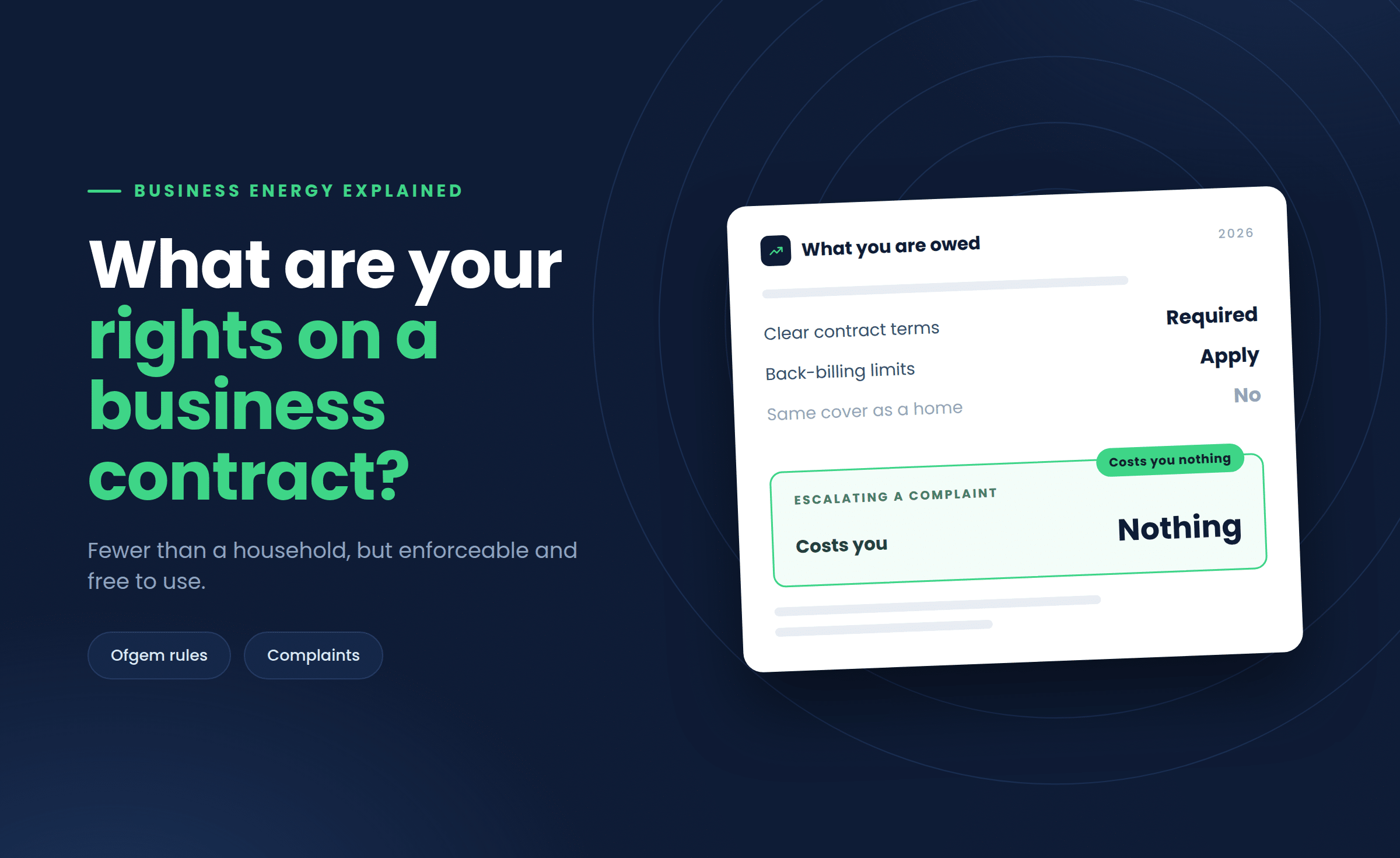
You have rights, just fewer than a domestic customer, and they come mainly from Ofgem’s supplier licence conditions and the Retail Energy Code rather than a dedicated business protection law. The clearest cover contract information, back-billing limits and complaints handling.
You might assume running a business strips away consumer-style protections. That is not quite true, though the protections that remain are narrower and less publicised, and there is no cooling-off period once you sign.
Ofgem regulates every licensed supplier’s conduct, whoever their customer is. Think of these as protections built around information and conduct, not price, since there is no business energy price cap.
| Right | Where it comes from | What it covers |
|---|---|---|
| Clear contract terms | Retail Energy Code | Plain-language terms before you sign |
| Back-billing limit | Ofgem licence conditions | No billing for errors over 12 months old |
| Complaints handling | Ofgem standards and the Energy Ombudsman | Right to escalate after eight weeks |
| Renewal notice | Ofgem micro-business rules | Renewal terms set out in good time |
What must a supplier tell you before you sign a contract?
A supplier must give clear information about the rate, contract length and any exit fees before you agree, in plain enough language that you can compare it against another offer.
Getting confirmation in writing
This applies whether you sign directly or through a broker acting under a letter of authority. The broker does not remove the supplier’s own duty to be clear about the terms.
In practice, get everything in writing, including anything confirmed verbally on a sales call, before you treat the deal as final. That should also cover your MPAN or MPRN and any Climate Change Levy rate or exemption that applies.
What rights do you have if something goes wrong during the contract?
You have the right to raise a complaint directly with your supplier, and to escalate it to the Energy Ombudsman if it is not resolved within eight weeks, or sooner if you reach deadlock.
Back-billing limits
This covers billing errors, metering disputes and poor service, not just price. If a supplier under-billed you due to a metering or estimation error, back-billing rules stop it chasing anything more than 12 months old.
So you are not exposed to years of backdated charges landing at once. Keep records and escalate as business energy complaints if the issue is not resolved.
- Keep copies: of every bill and any correspondence about disputed charges.
- Get it in writing: the complaint reference number and expected timeframe.
- Escalate at 8 weeks: to the Energy Ombudsman if it is still unresolved.
What extra protections exist for micro businesses?
Micro businesses get specific protections under the Retail Energy Code covering renewal notices, limits on some deemed terms, and clearer information duties that do not automatically extend to larger businesses.
Where the micro line sits
A micro business is one with fewer than 10 employees and turnover under £2m, or using no more than 100,000 kWh of electricity a year. Those protections sit within the Retail Energy Code, alongside wider settlement and balancing rules that affect how your bill is calculated.
Since December 2022, suppliers may also only work with brokers signed up to a redress scheme, giving micro businesses a route to challenge broker mis-selling. Larger businesses do not get that specific protection.
What rights do you have when your contract comes up for renewal?
A supplier must contact you ahead of your renewal date with the terms it is offering next, giving you time to compare rather than springing a rate change on you at the last minute.
Diarise your renewal date
How much notice varies by supplier and business size, which is why business energy renewals is worth diarising rather than relying on the supplier to chase you. Comparing business electricity rates ahead of time is the surest protection.
If you do nothing, you are not protected from a poor rate. You are simply moved onto whatever deemed or out-of-contract rate applies, which tends to run well above a negotiated price.
Where can you complain if a supplier breaches your rights?
Start with the supplier’s own complaints process in writing, then escalate to the Energy Ombudsman if it is unresolved after eight weeks, since Ofgem itself does not investigate individual disputes.
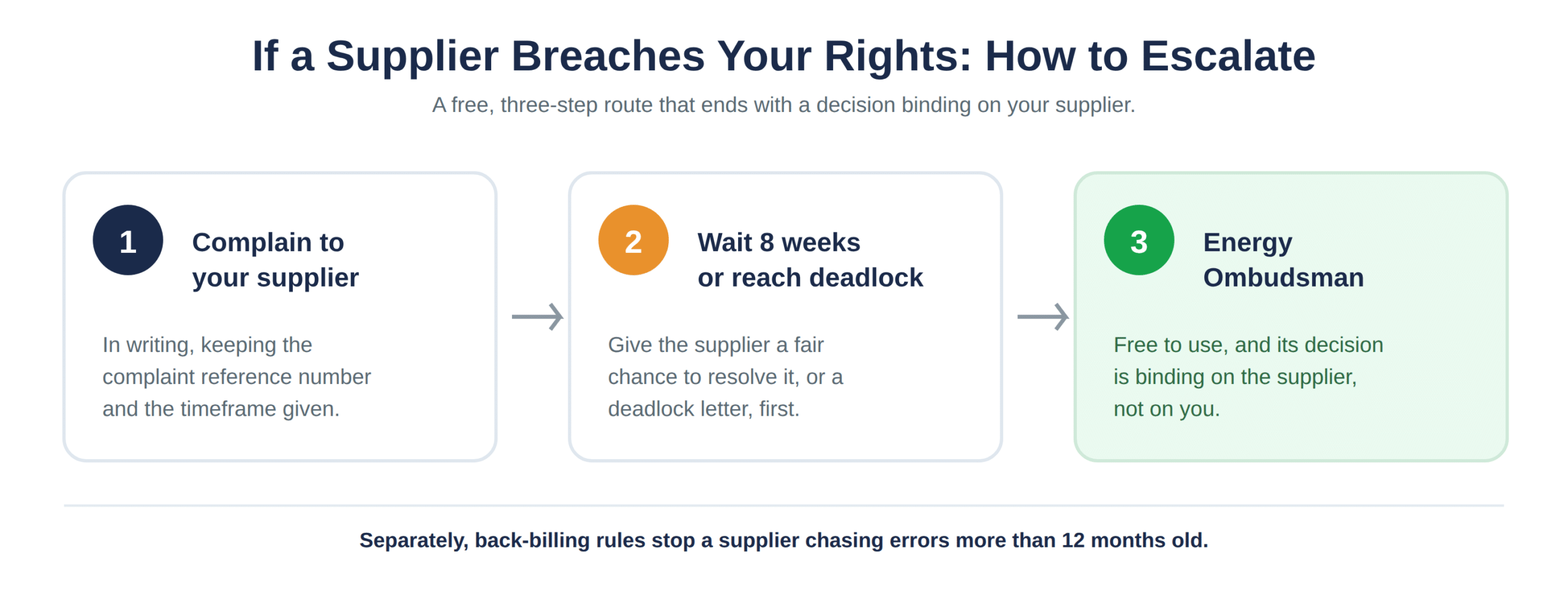
The three-step route
- Step 1: a written complaint to the supplier, keeping a reference number.
- Step 2: wait eight weeks, or reach deadlock, whichever comes first.
- Step 3: refer the case to the Energy Ombudsman, which is free to use.
Ofgem sets and enforces the rules but tracks complaint volumes rather than handling individual cases, as its business energy advice explains. Comparing a panel of business energy suppliers is the best way to avoid a poor deal in the first place.