
If you cannot pay a business energy bill, contact your supplier immediately to request a payment plan. Unlike domestic customers, businesses have no statutory protection from disconnection, and a supplier can act quickly once an account falls silent.
It happens more often than most business owners like to admit: a slow month, a big unexpected cost elsewhere, and suddenly the energy bill is the one that gets pushed back.
The instinct is often to avoid the phone call. That instinct is exactly the wrong one when it comes to business energy debt.
Suppliers have far more flexibility with business customers than most people assume, but only if you engage before the account falls into serious arrears. Silence is what turns a manageable problem into a serious one.
What are your options if you can’t pay a business energy bill?
Your main options are a negotiated payment plan with your current supplier, a prepayment or pay-as-you-go smart meter arrangement, or, for a genuinely unmanageable debt, formal debt advice before the situation escalates.
Match the option to the difficulty
| Option | Best suited to | Key consideration |
|---|---|---|
| Payment plan with your supplier | Short-term cashflow difficulty | Usually the fastest, least disruptive route |
| Prepayment / pay-as-you-go meter | Ongoing budgeting difficulty | Avoids further debt, requires topping up |
| Formal debt advice | Debt already significant or growing | Free, independent, looks at the wider finances |
| Insolvency advice | Debt threatens the business’s viability | Should involve a qualified practitioner |
The earlier you pick a lane, the more choice you will actually have. Suppliers become far less flexible once an account is several months overdue, and a business energy supplier with a dedicated business support team is generally easier to negotiate with.
How does a business energy payment plan actually work?
An energy payment plan spreads the outstanding balance, plus ongoing usage, into manageable instalments agreed directly with your supplier, usually based on an honest assessment of what the business can realistically afford each month.
Will a payment plan affect your credit rating?
- Call the right team: your supplier’s business support or credit team, not general customer service.
- Be specific: about the amount you can afford monthly, backed by a realistic figure.
- Get it in writing: confirm any agreed plan before relying on it.
Suppliers generally prefer this to chasing a debt through collections, since collections cost them money too. A plan agreed and kept to should not damage your rating the way a defaulted debt would, since the risk comes from missed instalments, not the plan itself.
Can a supplier disconnect your business for unpaid bills?
Yes. Business customers do not get the same winter disconnection protections domestic households have, so a supplier can pursue disconnection for non-payment, though it is usually treated as a last resort after other collection steps have failed.
Why suppliers hold off on disconnection
This is one of the sharpest differences between household and business energy. A homeowner in genuine hardship has specific protections during colder months, and Ofgem’s business energy advice is clear that a business, by default, does not.
In practice, disconnection is disruptive and costly for the supplier too, so most pursue a payment plan, prepayment arrangement or debt recovery process well before that point. It remains a real risk on an ignored account, though, not an empty threat.
What happens to business energy debt if it’s ignored?
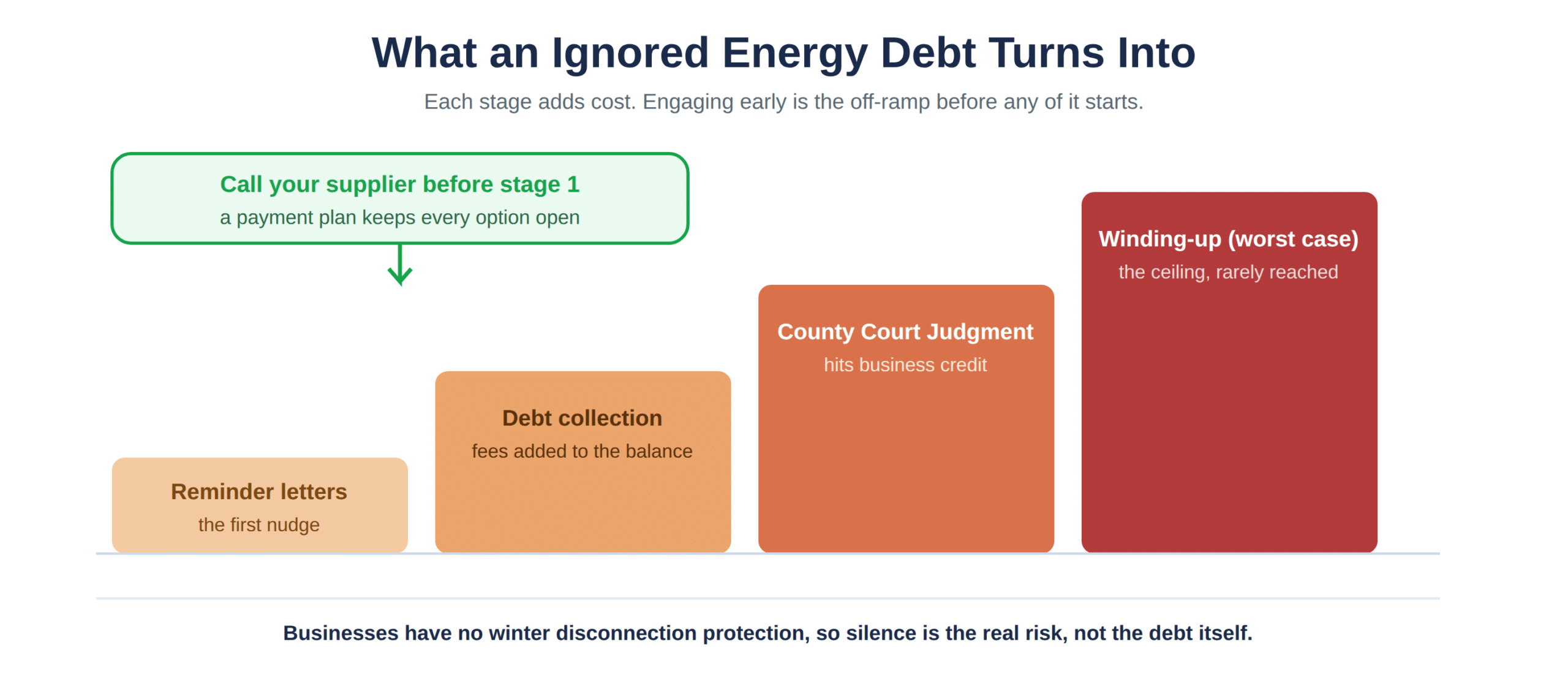
Ignored business energy debt typically escalates from reminder letters to a debt collection agency, then potentially to a County Court Judgment, which can affect the business’s credit rating and its directors’ ability to secure future finance.
Each stage adds cost
Collection fees and potential legal costs get added to what is owed, so the debt rarely stays the same size while it is being ignored.
For a limited company, a genuinely unmanageable and unresolved debt can, in the most serious cases, contribute to winding-up proceedings. That is a distant outcome for most, but it is the ceiling that makes early engagement worth the discomfort.
If the bill itself looks wrong, dispute it rather than simply not paying, since a logged dispute is treated differently from unmanaged arrears.
Where can you get help if your business is struggling with energy costs?
Free, independent support is available through Business Debtline, your local Citizens Advice, and a qualified insolvency practitioner if the wider finances are under genuine strain, alongside direct negotiation with your energy supplier.
Free routes worth using early
None of these cost anything to make initial contact. Business Debtline and Citizens Advice both offer free guidance, and the earlier you use them, the more options remain on the table.
It is also worth checking whether the underlying rate is competitive once the immediate pressure eases. Our guide to how to switch business energy supplier covers switching even when a payment plan is already in place, which some businesses do not realise is possible.