
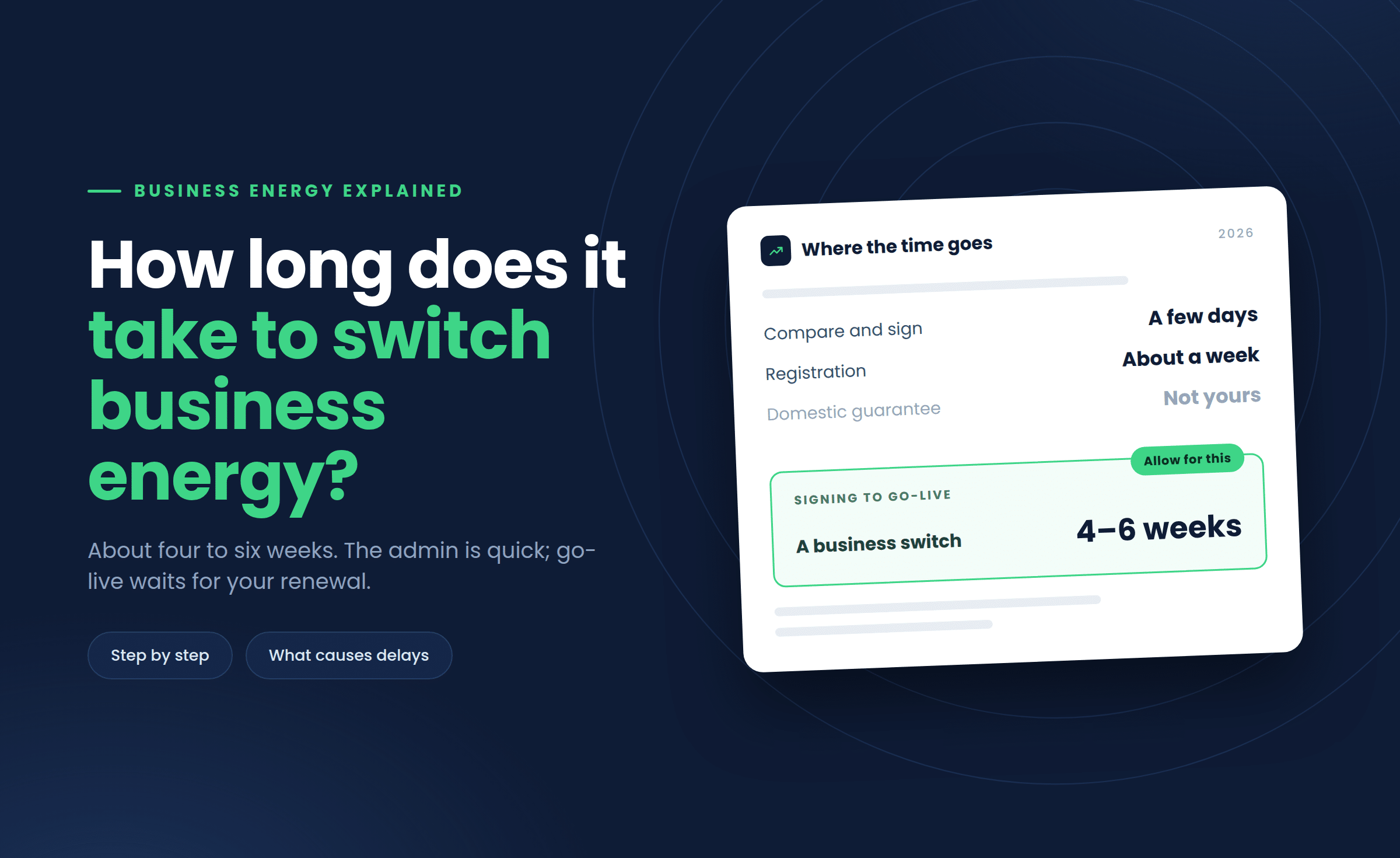
A business energy switch typically takes 4 to 6 weeks from signing a new contract to the changeover going live, though the switching mechanics themselves are quick: most of that time is because your new supply usually starts on your contract’s renewal date.
Six weeks feels long when you have just found a cheaper rate. It is not that the process is slow, but that several parties coordinate the handover, and the go-live is set to a future contract start date rather than the day you sign.
Your old supplier, your new supplier and the relevant network operator all confirm the switch behind the scenes. How long it feels also depends on your meter type and how close you are to your renewal, which our guide to the best time to switch covers in full.
What is the step-by-step business energy switching timeline?
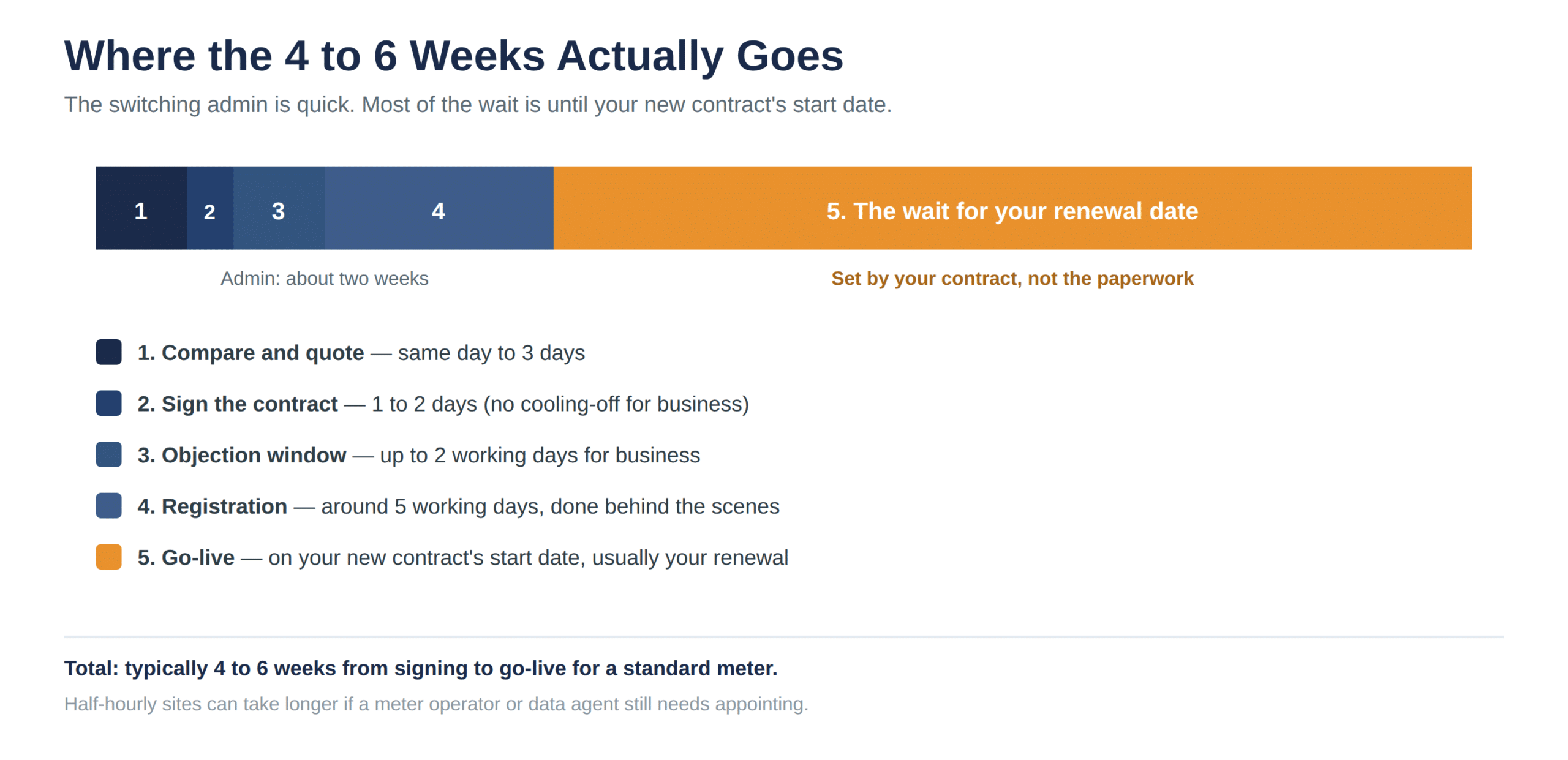
A standard switch runs through five stages: comparing quotes, signing a contract, a short objection window, meter registration, and the go-live date, with total elapsed time usually 4 to 6 weeks.
| Step | What happens | Typical timeframe |
|---|---|---|
| 1. Compare and quote | Provide a recent bill and usage to get live rates | Same day to a few days |
| 2. Sign new contract | Agree terms with your chosen supplier | 1 to 2 days |
| 3. Objection window | Old supplier can object if you are mid-contract | Up to 2 working days |
| 4. Registration | New supplier registers your MPAN or MPRN | Around 5 working days |
| 5. Go-live | New supplier starts billing from your contract start date | Usually your renewal date |
Comparing is the fast part
This is the quickest stage of the whole process. With a recent bill to hand, live quotes across a panel of 30+ suppliers come back within minutes rather than days.
Where the time actually goes
The registration itself runs to about a week behind the scenes. The rest is simply the gap between signing and your new contract’s start date, which you set when you agree the deal.
Why does switching business energy take longer than moving house?
Business meters go through extra commercial checks that domestic switches skip, and the switch goes live on a future contract date, so the elapsed time is longer even though the processing is not much slower.
The extra commercial checks
Suppliers confirm there is no outstanding contract, no debt registered against the meter, and the correct commercial classification. There is also no cooling-off period once a business contract is signed, unlike domestic, so both sides move carefully, as our guide to business energy contracts explains.
It is worth knowing that the domestic 5-working-day switch guarantee, and its compensation, does not cover businesses. Ofgem’s switching rules apply that guarantee to households only, so a business switch has no equivalent statutory deadline.
What can slow down a business energy switch?
Incomplete paperwork, an active dispute with your current supplier, or switching too close to your renewal date are the most common causes of delay, and most are avoidable with a little planning.
Common causes of delay
- Missing letter of authority: if a broker manages the switch, they need a signed letter of authority first.
- Outstanding balance: a billing dispute or debt on the account can hold things up.
- Incorrect meter details: an outdated MPAN or MPRN on file needs correcting first.
- Unresolved objection: switching within an objection period without settling the reason.
Does switching take longer on a half-hourly meter?
Sometimes, yes. Half-hourly sites, generally larger businesses using above 100,000 kWh a year, involve an extra data agent and meter operator, which can add time if those appointments are not already in place.
Why half-hourly adds parties
Half-hourly settlement data flows through Elexon’s systems rather than the simpler profile classes used for smaller sites, and our half-hourly meters guide covers how that settlement works.
If your meter operator and data agent are already appointed, a half-hourly switch runs close to the standard 4 to 6 weeks. Where a new meter or agent appointment is needed, budget several weeks more.
| Your situation | Typical timeline |
|---|---|
| Standard meter, in contract | 4 to 6 weeks to go-live |
| Half-hourly, agents already appointed | Around 4 to 6 weeks |
| Half-hourly, new agent needed | 6 weeks or more |
| New meter or reclassification | Up to 12 weeks |
| Already out of contract | Can start straight away |
What happens during the changeover itself?
On the agreed changeover date your old contract ends, your new supplier takes over billing, and a meter reading closes out the final account, with your supply never interrupted.
Your supply is never interrupted
This is worth repeating, because it worries a lot of owners: switching supplier means no physical work at your premises and no risk of losing power or gas. It is purely an administrative and billing change.
A final bill from your old supplier usually arrives within a few weeks of the changeover, based on a closing meter reading. Keep a copy for your records in case of any dispute.
Submitting your own closing read on the changeover day helps avoid an estimated final bill. It is the one small action that most often prevents a billing query later.
How can you speed up your switch?
Having a recent bill, your MPAN or MPRN and accurate consumption ready before you compare removes most of the delay from the early stages, though the registration and objection windows run on fixed timescales you cannot shortcut.
What you can control
- Have a recent bill ready: from the last three months when you compare.
- Confirm your meter type: standard, smart or half-hourly, in advance.
- Start early: compare 8 to 12 weeks before your renewal date, not after it.
Comparing a panel of business energy suppliers from a position of choice, well before renewal, is the single biggest thing you control, and Ofgem’s business energy advice sets out your rights through the process.