
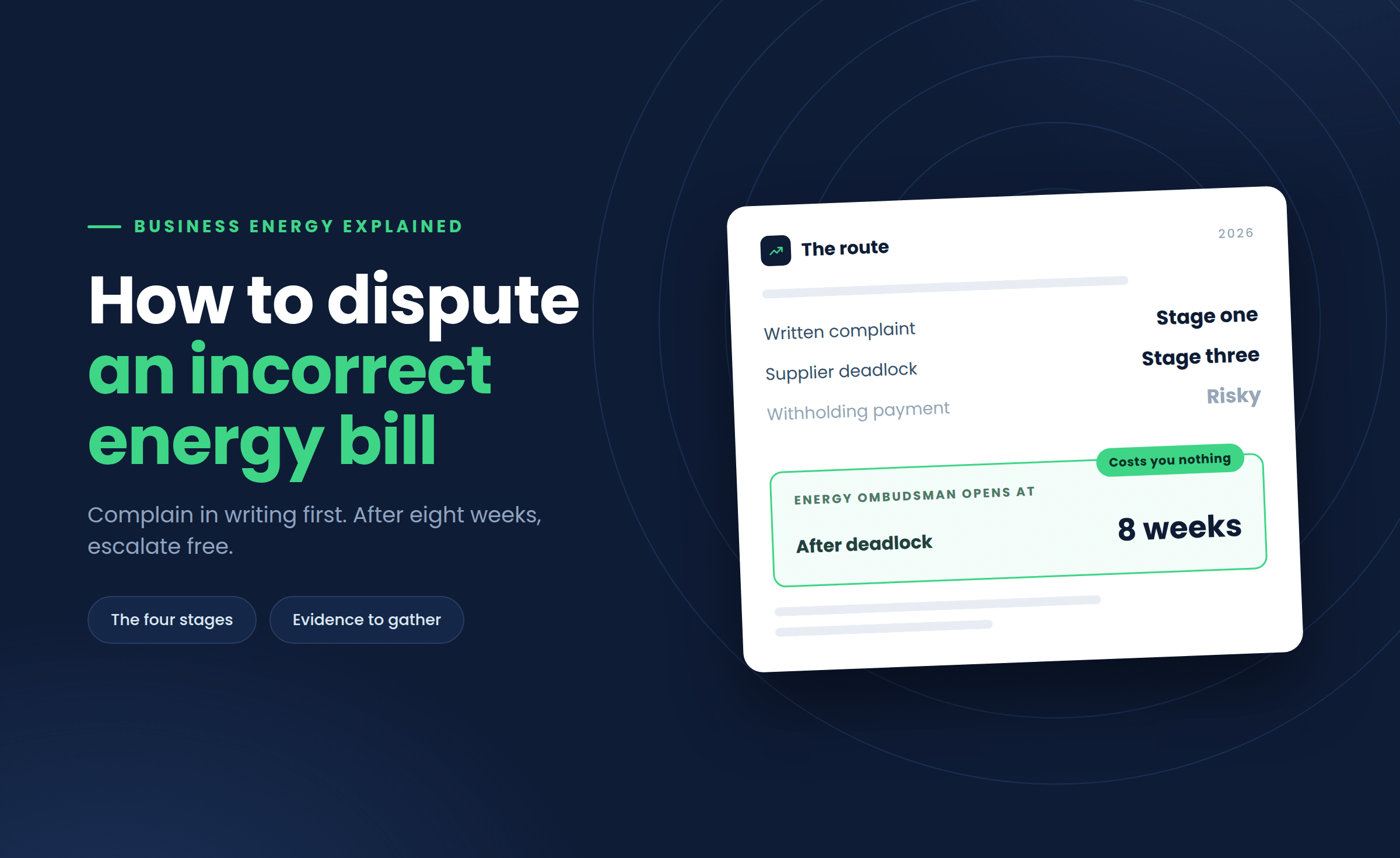
You dispute an incorrect business energy bill by raising a formal written complaint with your supplier, quoting your MPAN or MPRN, meter readings and the specific charge you are challenging. If it is not resolved within eight weeks you can escalate free of charge to the Energy Ombudsman.
Spotting a charge that does not add up is one thing. Knowing the correct steps to challenge an energy invoice without wasting weeks going in circles is another.
Business customers do not get quite the same automatic protections as households, but the dispute process itself is well established and works in your favour if you follow it properly.
Suppliers deal with disputes constantly, and most resolve cleanly once you provide clear evidence rather than a vague complaint. Vague complaints are what get parked at the bottom of a queue.
What counts as an incorrect business energy bill?
A genuinely incorrect bill includes wrong meter readings, charges for a meter or MPAN/MPRN that is not yours, duplicate invoices, an incorrect VAT rate applied, or usage wildly inconsistent with your normal pattern.
Higher is not the same as incorrect
A bill simply being higher than expected is not automatically incorrect. Our guide to why a bill suddenly rises covers the common, entirely legitimate reasons before you assume something has gone wrong.
Genuine errors usually show up as a specific mismatch: a number that does not reconcile with your own meter, a charge for a period you were not the account holder, or a rate that does not match your signed contract. Our guide to how to read a business energy bill helps you spot which.
How do you formally challenge an energy invoice with your supplier?
Raise the dispute in writing with your account number, MPAN or MPRN, the specific charge or period in question, and what you believe the correct figure should be, then ask the supplier to confirm receipt and give a timeframe.
If the supplier asks for a meter read
Phone calls are useful for a first flag, but a written record matters if the dispute drags on or needs escalating later. Keep every reference number the supplier gives you.
Provide any requested reading as soon as you reasonably can, ideally a photo of the meter display alongside the serial number. A slow response on your side is one of the most common reasons a dispute drags past the eight-week mark.
What evidence should you gather before raising a dispute?
Gather your recent bills, meter readings (photographed where possible), your signed contract confirming the agreed rate, and any correspondence relevant to the charge before you contact your supplier.
A quick evidence checklist
- Recent bills: the last 3 to 6, so a pattern is visible.
- A current reading: with photo evidence and a timestamp.
- Your signed contract: or renewal confirmation showing the agreed rate.
- Prior correspondence: any email exchange referencing the disputed charge.
Evidence turns a complaint from an opinion into something the supplier can investigate against their own systems. If a broker manages your account under a letter of authority, loop them in early so the paperwork trail stays consistent.
What happens if your supplier doesn’t resolve it in time?
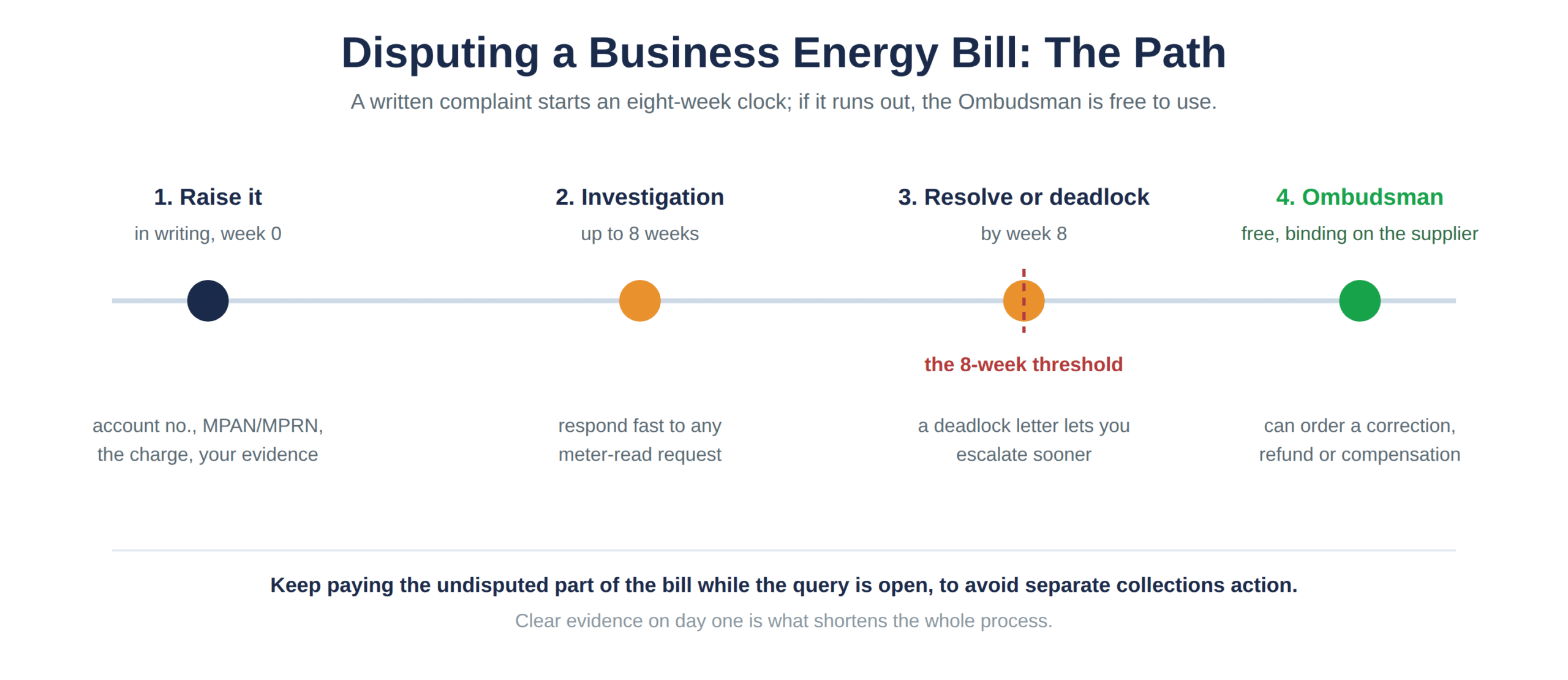
If your complaint has been with the supplier for eight weeks without resolution, or they issue a deadlock letter sooner, you can escalate free of charge to the Energy Ombudsman, which can order a correction, refund or compensation.
| Step | What to do | Typical timeframe |
|---|---|---|
| 1. Raise the complaint | Written complaint with evidence to your supplier | Immediate |
| 2. Supplier investigation | Supplier reviews meter data and account history | Up to 8 weeks |
| 3. Resolution or deadlock | Supplier resolves, or issues a deadlock letter | By week 8 |
| 4. Ombudsman escalation | Free referral if it is still unresolved | After deadlock or 8 weeks |
Escalation is a normal next step
The Energy Ombudsman is independent of every supplier and does not cost anything to use as a business customer. Its decisions are binding on the supplier if you accept them.
Escalating is not aggressive; it is simply the next stage of a process suppliers already expect, and Ofgem’s business energy advice sets out your rights. Back-billing rules also stop a supplier chasing errors more than 12 months old.
Should you keep paying while a bill is under dispute?
Keep paying the undisputed portion of the bill while the query is investigated, since non-payment can trigger separate collections action regardless of who turns out to be right about the disputed amount.
Agree a hold in writing
If your whole bill is in question, ask your supplier to confirm in writing that no collections or disconnection action will be taken while the dispute is live. Back-billing guidance from Ofgem is worth citing if old charges are involved.
Paying an estimated fair amount, based on your own meter reading rather than the disputed figure, is a reasonable middle ground. Escalate as business energy complaints if the supplier will not agree a hold.