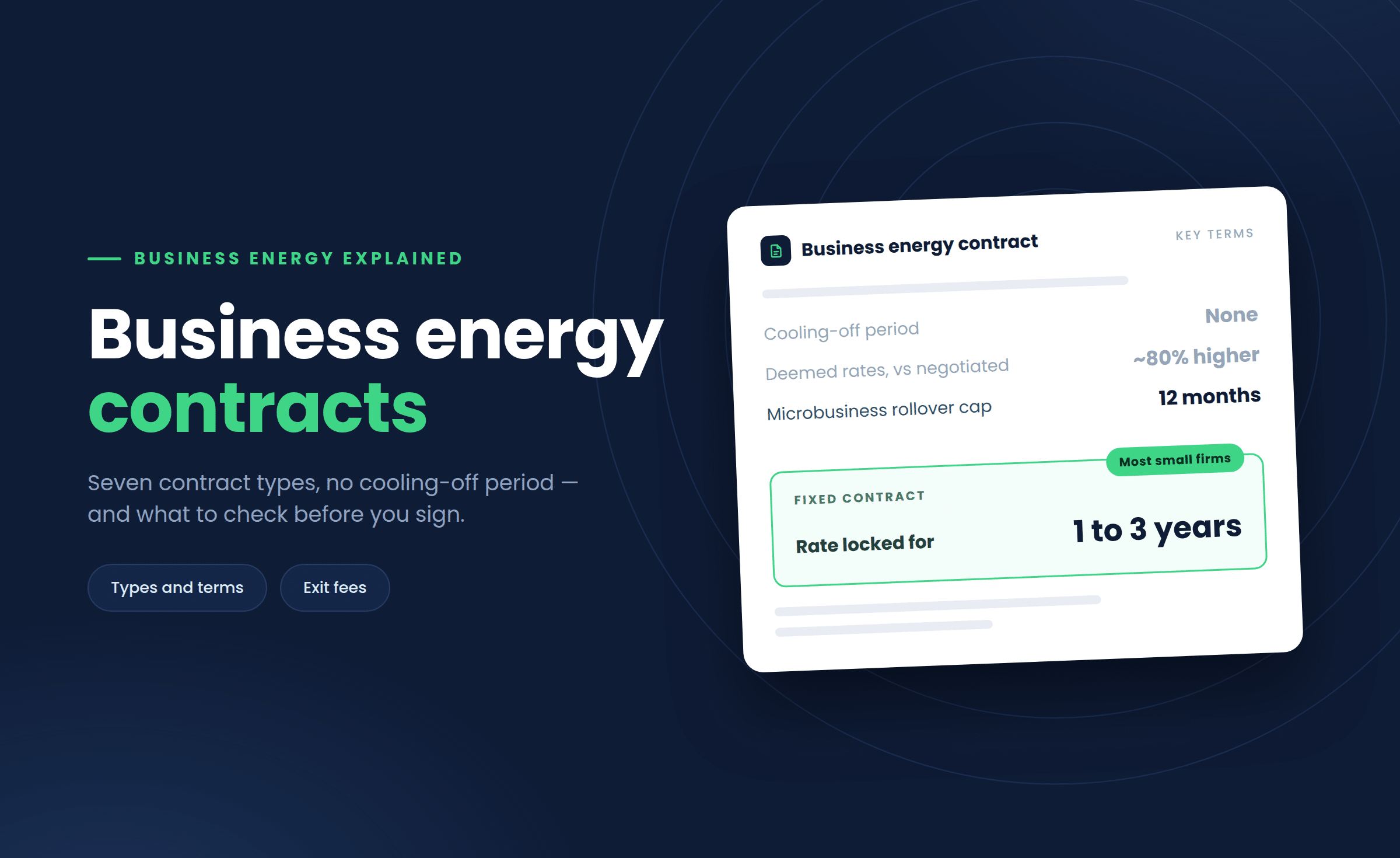

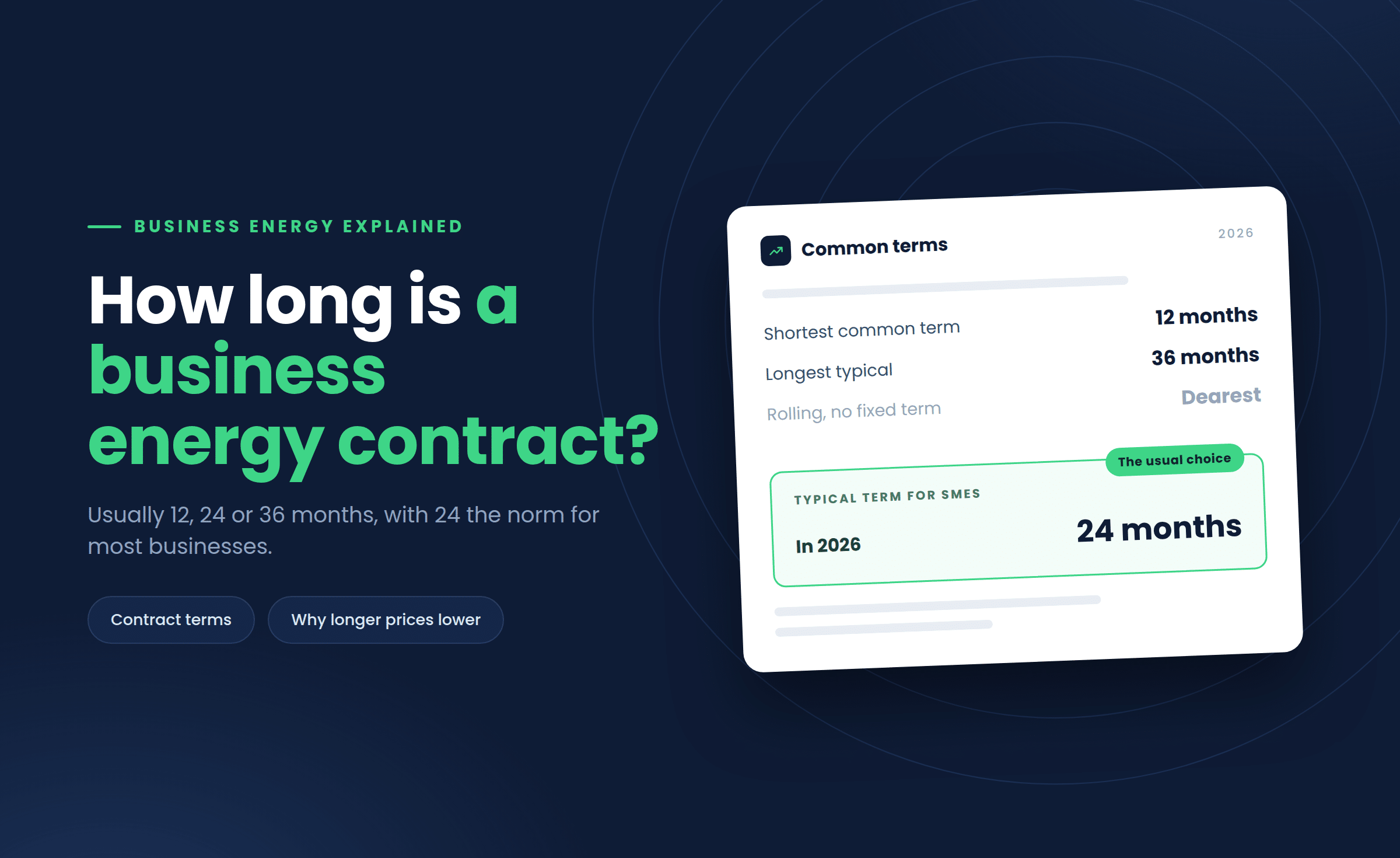
Most business energy contracts run for 12, 24 or 36 months, with 24 months the typical term for small and medium businesses in 2026. Some suppliers also offer 4 or 5 year deals for larger sites wanting long-term rate security.
In household energy, most people are used to short deals or no fixed term. Business energy works differently, and the term you pick has a direct effect on the rate you are offered.
Longer terms generally trade flexibility for a lower, more stable unit rate, while shorter terms give you room to compare again sooner, usually at a slightly higher price, as our guide to business energy contracts explains.
What’s the most common length for a business energy contract?
A 24-month fixed term is the most widely chosen length, sitting between the flexibility of a 12-month deal and the rate stability of a 3-year or longer commitment.
| Contract length | Typical use case | Rate stability |
|---|---|---|
| 12 months | Businesses wanting to switch again soon | Rate reviewed at the next renewal |
| 24 months | Most common choice for small and medium firms | Rate fixed for the full term |
| 36 months or more | Larger users locking in against volatility | The longest rate security available |
| Rolling or deemed | The default when no new contract is agreed | Rate can run 40% to 80% higher |
Typical terms by business size
- Micro and small: 12 to 24 months is most common.
- Medium: 24 to 36 months, balancing rate and flexibility.
- Large and very large: 3 to 5 years, often with half-hourly settlement and bespoke terms.
Why do longer contracts usually come with a lower unit rate?
A longer contract lets a supplier lock in its own wholesale purchasing further ahead, which usually translates into a lower rate, and it reduces the cost of re-acquiring you each year.
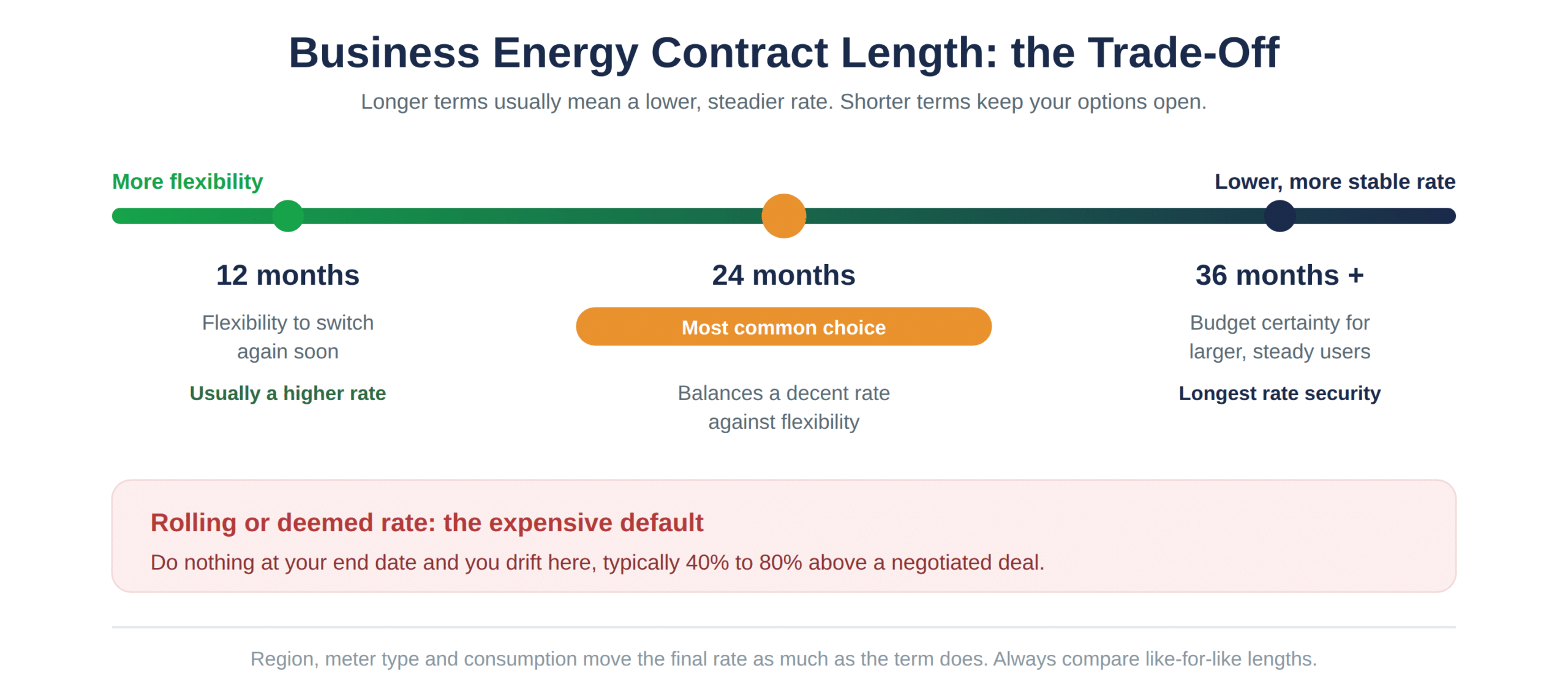
That does not make longer automatically cheaper: if wholesale prices fall after you fix for 3 to 5 years, you do not benefit until the term ends. UK average business electricity sits around 24.14p/kWh in 2026, from DESNZ data, though the best 2-year fixed deals start from around 26p/kWh, so always compare like-for-like term lengths.
Why half-hourly metered sites see different terms
Larger sites on half-hourly settlement, recorded through Elexon every 30 minutes, are priced with more granular risk data. That often means more flexible term lengths are on the table, alongside the standard 12, 24 and 36 month options.
What happens as your contract end date gets closer?
Most suppliers contact you 30 to 90 days before your end date with renewal terms, and if you do not respond you are moved onto an out-of-contract rate automatically.
Diarise your renewal date
That deemed or out-of-contract rate is typically 40% to 80% higher than a negotiated deal, which makes the weeks around your end date the most expensive time to do nothing.
- Set a reminder: three months before your end date, not the week before.
- Confirm in writing: ask your supplier for your exact renewal date and current term.
- Compare like-for-like: the same length side by side, not a 12-month quote against a 36-month one.
Diarising your date and comparing 2 to 3 months ahead avoids the gap entirely, and our guide to business energy renewals covers the process in full.
Marking the end date somewhere you will see it avoids more wasted money than almost any other decision here. Ofgem’s business energy advice also sets out your renewal rights.
Can you choose a rolling or flexible contract instead of a fixed term?
Some suppliers offer rolling or flexible contracts, usually aimed at businesses with variable usage, though they are less common and typically carry a less competitive rate than a fixed term.
| Your situation | Term worth considering |
|---|---|
| Usage or premises may change soon | 12 months |
| Want a solid rate with some flexibility | 24 months |
| Large, steady user wanting budget certainty | 36 months or more |
| Variable, hard-to-predict usage | Flexible or rolling |
When flexible makes sense
- Rolling contracts: avoid a fixed end date but rarely match fixed-term pricing.
- Flexible purchasing: suits larger, half-hourly sites that can manage risk actively.
- Most SMEs: are still better served by a standard fixed term, and your profile class feeds into whether a flexible arrangement makes sense.
A steady, predictable profile suits a fixed term far better than a flexible one. If your circumstances change, our guide on exiting a fixed-term contract covers your options.