
Notify your current supplier of your move date and closing meter readings, then arrange a live contract at the new premises before your first day there. Energy does not move with you automatically, so treat it as its own task on the moving checklist.
Moving pulls attention toward the lease, the fit-out and the removal van, and energy slides down the list. That is a mistake, because a gap in supply or a missed notification can leave you on a deemed contract paying well above a negotiated rate.
Unlike a household move, a business relocation often means a different distribution network operator, a different meter type, and sometimes a supplier already in place at the new address.
Businesses that get this right treat energy as a checklist item with its own timeline. The ones that get it wrong pay twice: for a contract they have left, and for a deemed rate they never chose.
This guide covers what to tell your current supplier, whether you can carry your contract, and how to stop the new premises defaulting to an expensive deemed rate on day one.
What do you need to tell your current supplier before you move?
Give your current supplier written notice of your move-out date, forwarding address and final meter readings, ideally four to six weeks before you leave.
What to confirm and keep
Most contracts include a notice period for ending supply, and missing it can leave you liable for charges after you leave. Our guide to change of tenancy covers the process if you are the one leaving a site.
- Move-out date: and forwarding address, confirmed in writing.
- Final readings: for every fuel and every meter, photographed as evidence.
- Notice charges: any early termination or notice fees, checked in advance.
- Broker paperwork: a fresh letter of authority for the new site, since the old one does not carry across.
Can you transfer your existing energy contract to a new address?
Not directly. Business energy contracts are tied to a specific meter, so moving premises means ending the old agreement and starting a new one, even if you stay with the same supplier.
Why rates change at a new site
Some suppliers offer a like-for-like deal at the new address to keep your custom, which is worth asking about. That is still a new contract on new terms, not a transfer of the old one.
Rates depend heavily on the new site’s meter type and expected usage, so do not assume your old rate follows you. This is the point where transferring energy is worth treating as a fresh comparison rather than a rollover.
What happens if nobody arranges a new contract before you move in?
You will be placed on a deemed contract automatically the moment you start using energy at the new site, and deemed rates run well above a negotiated deal.
Why deemed rates cost so much
A deemed contract exists so premises are never left without power while paperwork catches up. Our guide to deemed energy contracts explains why suppliers price it on the assumption you might leave at any time.
Out-of-contract and deemed rates typically sit 40% to 80% higher than a rate secured through comparison. The fix is simple: have a signed contract ready to start from your move-in date, and Ofgem guidance sets out your rights on a deemed rate in the meantime.
How do you handle a premises that already has a supplier in place?
You will usually inherit whatever contract the outgoing occupier or landlord has running until you arrange your own, so get the meter details and current supplier name before moving day.
Get the meter references early
Ask the landlord or outgoing tenant which supplier serves the site, and get the MPAN or MPRN reference before you arrive. If a fixed-term contract is running in someone else’s name, you cannot simply take it over.
Where you can, ask to see recent bills before committing to the space. Actual consumption tells you far more about likely running costs than an estate agent’s estimate.
What’s a sensible timeline for sorting energy at a new site?
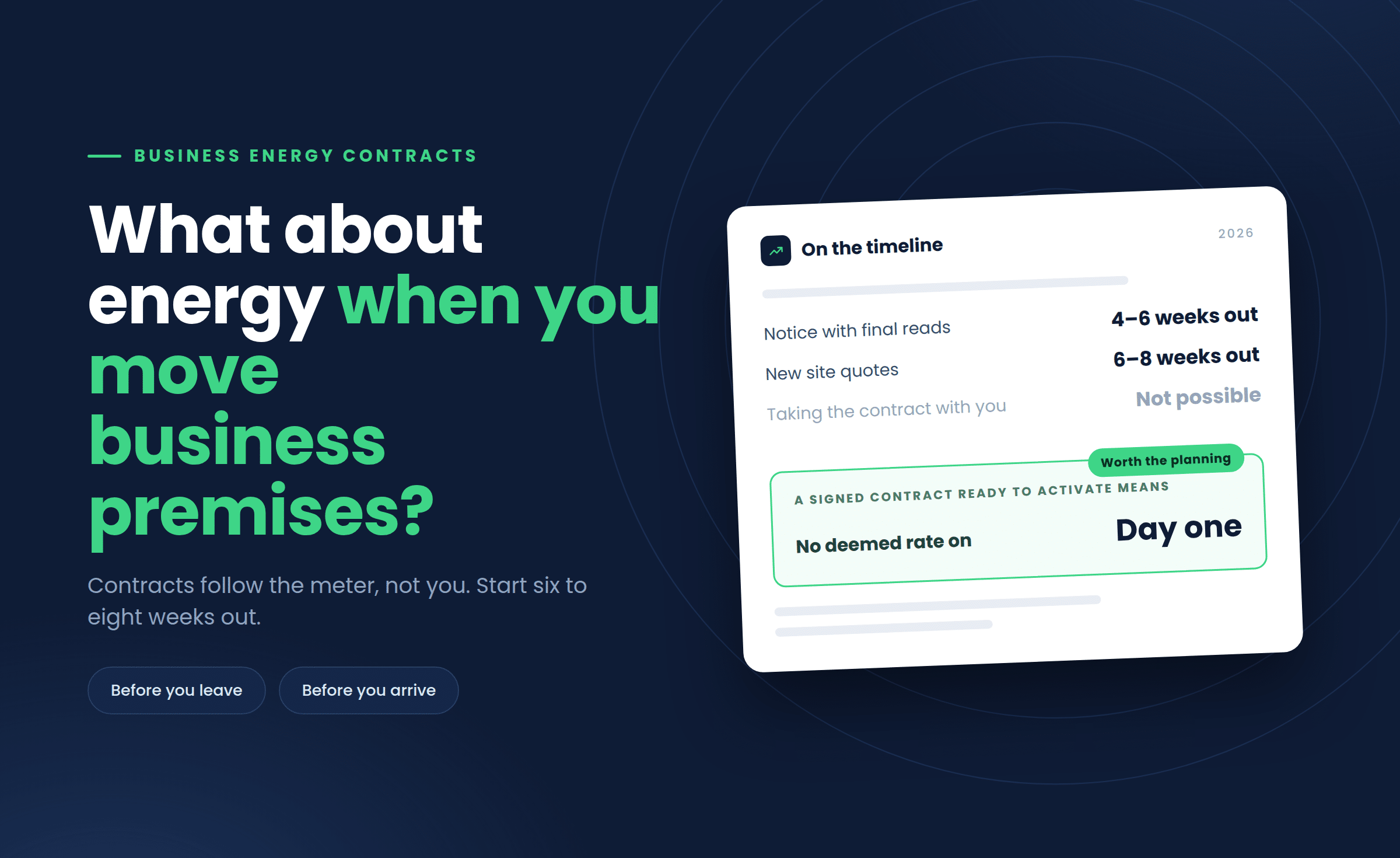
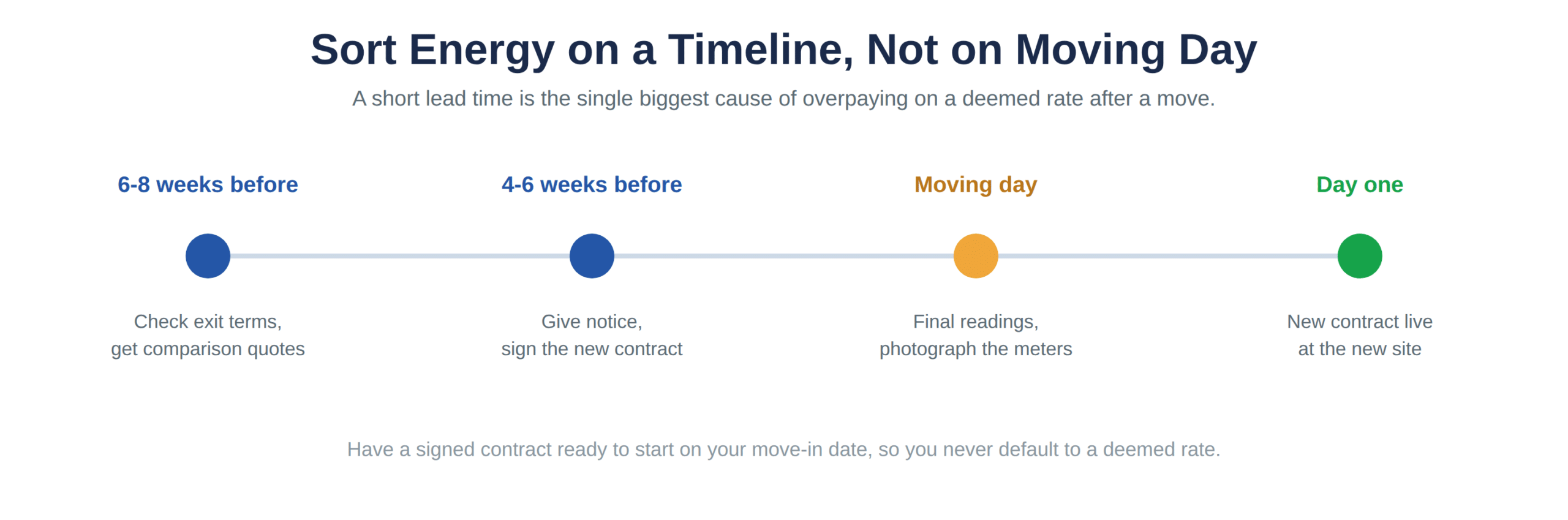
Start six to eight weeks before moving day: confirm your current contract’s exit terms, get comparison quotes for the new site, and have an agreement signed and ready to activate from day one.
If the new premises needs a half-hourly meter
| When | Energy task |
|---|---|
| 6 to 8 weeks before | Check exit terms, get comparison quotes |
| 4 to 6 weeks before | Give notice, sign the new contract |
| Moving day | Take final readings, photograph meters |
| Day one | New contract live at the new site |
Businesses that leave energy until the removal van is booked end up on whatever deal is fastest, not the one that suits their usage. Larger sites may need half-hourly meters, which take longer to install than a straight switch.
Build the move into your relocation plan the same way you would the internet connection or the signage. Citizens Advice publishes guidance if you are unsure, and it stops energy becoming a source of surprise bills.