
A change of tenancy transfers responsibility for a business energy supply from one occupier to the next. Because the contract belongs to the meter, not the business, moving premises means closing one account and opening another.
Handled well it is quick and clean. Handled badly it leaves you paying for energy you never used or stuck on expensive deemed rates, which is why Ofgem publishes guidance on getting it right.
This guide covers both sides of a move, what can go wrong, and how to line up a new deal. When you are ready, you can compare business energy suppliers for the new premises.
What is a change of tenancy in business energy?
A change of tenancy, or CoT, is the process of moving responsibility for the gas and electricity at a premises from the old occupier to the new one. It updates who is legally liable for the supply.
The contract belongs to the meter
Business energy contracts are tied to the property, not to your company. Your tariff does not travel with you, and you cannot stretch an old contract to cover a new address.
Change of tenancy or change of occupier
You may also see this called a change of occupier, or CoO. The two terms mean the same thing, and Ofgem and suppliers use them interchangeably.
Why does a change of tenancy matter?
A clean change of tenancy creates a confirmed break between accounts, so you are not billed for the other occupier’s energy. Skip it and you risk disputed final bills and open-ended deemed rates.
What goes wrong when it is missed
A missed CoT is one of the most common causes of business energy billing problems. The table below shows what a proper CoT achieves against what tends to happen without one.
| What a change of tenancy does | What happens if it is missed |
|---|---|
| Sets a clean break, with a dated reading closing one account and opening the next | Final bills arrive months later, with usage that is hard to prove after the fact |
| Stops you being billed for energy used by the other occupier | The supplier keeps billing the old occupier until told otherwise |
| Lets the incoming occupier leave deemed rates and agree a proper contract | The new occupier sits on deemed rates, as no contract is set up until the account is closed |
| Makes clear who is responsible for the supply | Any attempt to switch supplier is rejected until the CoT is done |
The no exit fee benefit
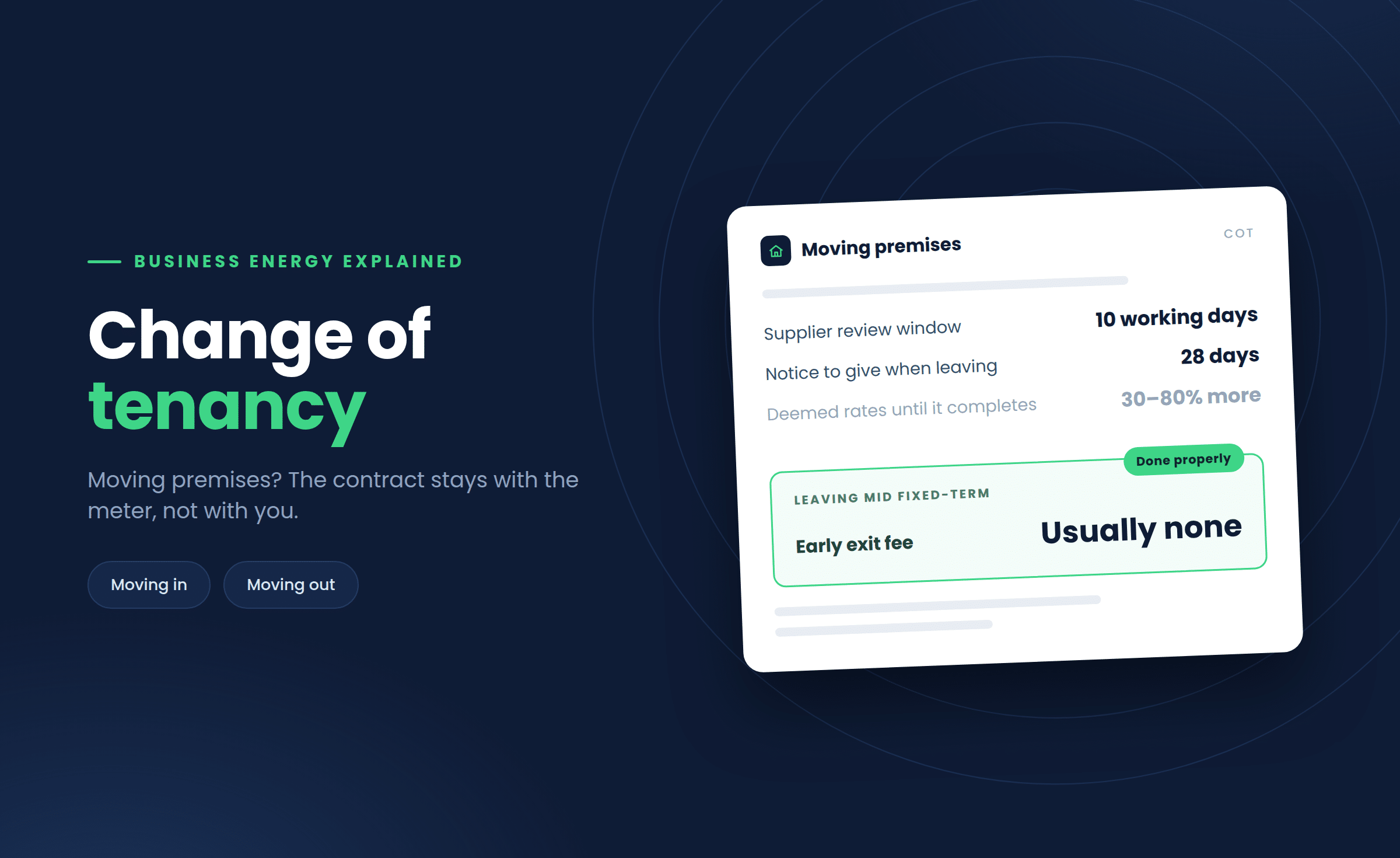
A properly processed CoT usually ends your old contract without an early exit fee, even mid fixed-term. It is treated as a natural end because you are vacating the premises, though it is worth checking your terms.
What is the incoming change of tenancy process?
Moving in means registering your business as responsible for the supply with the existing supplier, from your move-in date. The steps are the same whether you plan to stay with them or switch later.
Moving in and moving out at a glance
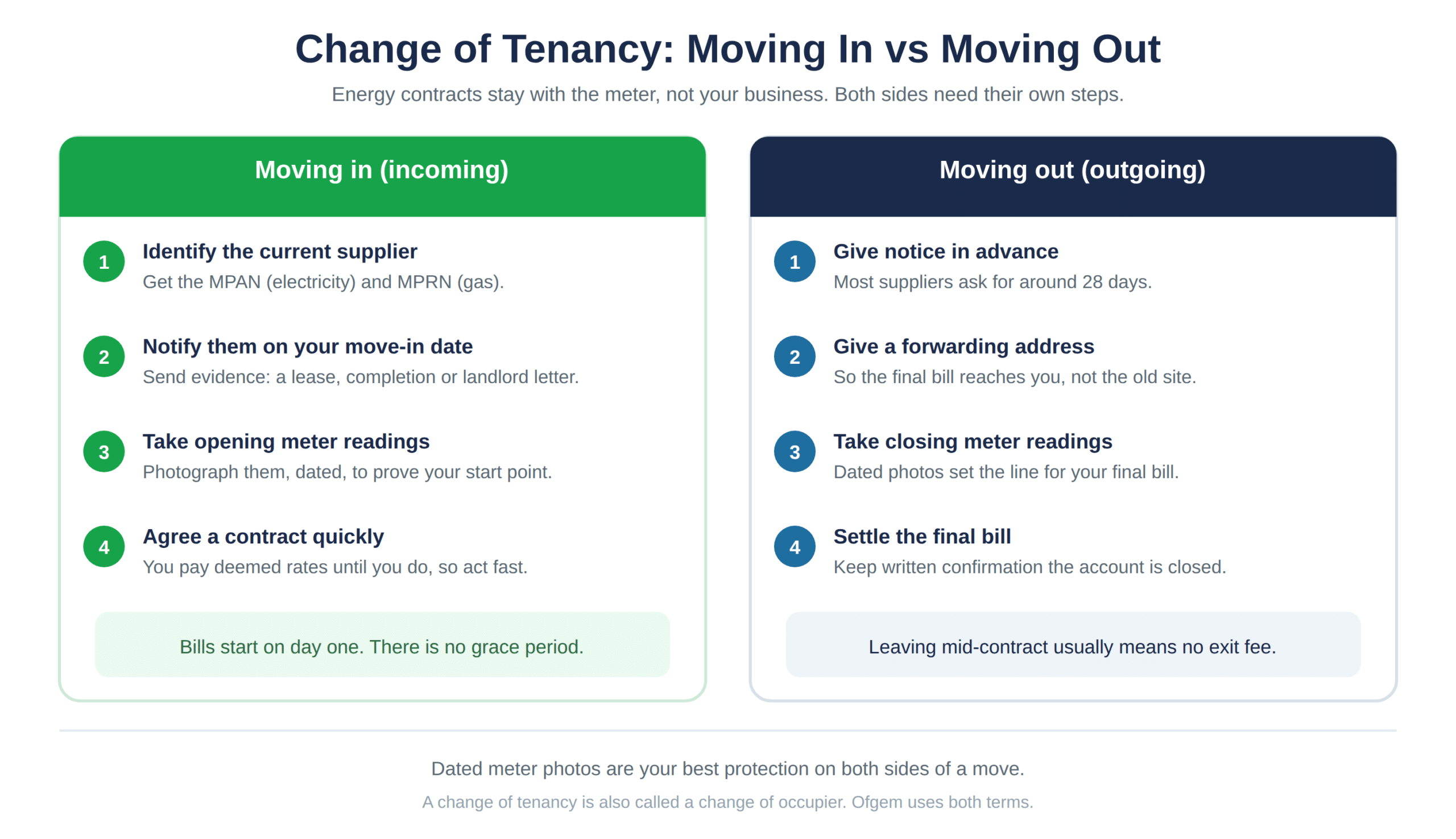
The two sides of a move mirror each other, but each has its own steps. The chart below sets them out.
Identify the supplier and notify them
First, find out who supplies the premises and note the MPAN or MPRN. Then notify that supplier on or before your move-in date, with the details of your business and the supply address.
Evidence and opening readings
Suppliers ask for proof that you are the new occupier before they act. Have the documents below ready, and take a dated meter reading on the day you take the keys.
| What to provide | Why it is needed |
|---|---|
| Signed lease, completion statement or landlord letter | Proves you are the new occupier and your start date |
| Opening meter readings, photographed and dated | Sets the line so you are not billed for prior usage |
| Business name, address and a contact | Lets the supplier open the account in your name |
What is the outgoing change of tenancy process?
Moving out means closing your account cleanly so you are not billed for the next occupier’s energy. Give notice, provide a forwarding address, submit closing readings, and settle the final bill.
Give notice and a forwarding address
Contact your supplier as soon as you have a confirmed move-out date, ideally at least 28 days ahead, as most require notice in their terms. Give a forwarding address so the final bill does not sit at the old premises.
Closing readings and the final bill
Read both meters on the day you hand back the keys and photograph them, dated. Pass on the incoming occupier’s details to the supplier if you have them.
Then settle the final bill and keep written confirmation the account is closed. If you are lining up a new site, our guide to switching supplier covers arranging a new deal.
How long does a change of tenancy take and what does it cost?
Ofgem’s guidance says suppliers review a change of tenancy within 10 working days, though it is not a penalty-backed deadline. Until it completes, the incoming occupier pays deemed rates from the move-in date.
The timescale
The 10 working day review is the timescale set out in Ofgem’s guidance, not a legally binding service level. Acceptance can take a few days or several weeks, especially if a reading or date is queried.
The cost while you wait
From day one, standing charges and any usage are billed even if you use almost nothing, so there is no grace period. Deemed rates in the meantime are often 30% to 80% higher than a negotiated deal, which is why speed matters.
What can go wrong with a change of tenancy?
Most delays come from missing evidence, a supplier missing its review window, or the previous occupier not closing their account. Late final bills and disputed readings are the other common snags.
Delays and missing evidence
The most common hold-up is the supplier asking for more evidence, usually an unsigned lease or an undated landlord letter. Respond quickly through the same channel and ask for written confirmation the file is complete.
Late final bills and back-billing
For outgoing tenants, late final bills are a known pressure point. Ofgem’s back-billing rules stop a supplier charging for energy used more than 12 months ago where it was at fault, but this protects households and microbusinesses, not larger firms.
Raising a complaint
If an issue is not resolved, complain to the supplier in writing. After eight weeks, or once you have a deadlock letter, a microbusiness can take it to the Energy Ombudsman free of charge.
Should you use a broker for a change of tenancy?
A broker can handle most of a change of tenancy for you, from identifying the supplier to chasing acceptance. You still take the meter readings, but the supplier liaison is off your plate.
What a broker handles
A broker will usually identify the existing supplier, submit the CoT notification, forward your evidence, and arrange a new contract to start the moment it completes. That keeps your time on expensive deemed rates to a minimum.
Comparing rates for the new premises
Once the account is in your name, you can compare the market for the new site. Our team can quote business electricity and business gas for premises of any size.
What about new builds, landlords and shared meters?
A brand new premises needs a new connection, not a change of tenancy. Landlords carry the supply during void periods, and a single shared meter can only hold one energy contract.
New build premises
A premises that has never had a supply is not a CoT at all. You arrange a new connection through the local network operator first, then agree a supply contract once it is live.
Landlords and void periods
While a unit is empty, the landlord or owner is liable for the supply as the occupier. A landlord can submit a CoT for a tenant, but the contract still sits with the business using the premises.
Shared and multiple meters
If a premises has one meter, only one business can hold the contract, and the occupiers split the cost privately. Where each unit has its own meter, each business runs its own CoT for its own supply.