
A business energy contract is a legally binding agreement to buy gas or electricity from a supplier at set rates for a fixed period. There is no cooling-off period and no price cap, so the terms you agree are the terms you are held to.
Getting the contract right is where most businesses save or lose money. This guide walks through every contract type, what the small print means, what happens at the end of a deal, and the Ofgem rules that protect you along the way.
When you are ready to act, you can compare business energy suppliers and lock a fixed rate before your current deal ends.
What is a business energy contract?
A business energy contract is a legal agreement between your company and a supplier to provide gas or electricity at agreed rates. It sets your unit rate, standing charge, contract length and payment terms.
Gas and electricity are always separate
There is no such thing as a dual-fuel business energy contract. Your gas and electricity are contracted, priced and billed separately, even with the same supplier.
Each contract is tied to a single supply point, identified by its MPAN for electricity or MPRN for gas. A business on multiple sites holds a separate contract for each meter.
Why the terms matter so much
Business energy is not regulated like household energy. Ofgem does not cap the unit rates a supplier can charge a business, so two firms next door can pay very different prices.
That makes the contract itself your only real protection. Reading it before you sign is the single most valuable thing you can do.
What types of business energy contract can you choose?
The main business energy contracts are fixed, variable, deemed, rollover, pass-through, flexible and green. Most small businesses are best served by a fixed contract, which locks your unit rate for the whole term.
The seven contract types compared
Each type balances price certainty against flexibility in a different way. The table below sets out how they differ.
| Contract type | Unit rate | Typical term | Early exit fee | Best for |
|---|---|---|---|---|
| Fixed | Locked for the whole term | 1 to 3 years | Yes, can be steep | Most small businesses wanting certainty |
| Variable | Moves with the market | Rolling | None | Firms expecting prices to fall |
| Deemed | Very high, set by supplier | None, rolling | None | Nobody, switch away as soon as you can |
| Rollover | Fixed, but uncompetitive | Up to 12 months | Yes | Nobody, a deal you failed to leave |
| Pass-through | Wholesale fixed, network costs vary | 1 to 3 years | Yes | Firms comfortable with some variability |
| Flexible | Bought in tranches on the market | 1 year plus | Bespoke | Large, high-consumption users |
| Green | As above, plus a green guarantee | 1 to 3 years | Yes | Firms with sustainability goals |
Fixed and variable are the two most common
A fixed contract holds your rate per kWh for the term, so you are protected from wholesale price rises. A variable, or “freedom”, tariff lets you leave at any time but usually costs more.
Suppliers put their sharpest prices into fixed deals to win new customers. A variable rate is rarely the cheapest option over a full year.
Deemed and rollover are the ones to avoid
A deemed contract applies when you use energy at a property with no agreed deal, often after moving in. A rollover applies when a fixed contract ends and you have made no new arrangement.
Both are among the most expensive rates a supplier offers. Neither should ever be a deliberate choice.
What is included in a business energy contract?
A business energy contract sets out your business details, the supply point, the rates and dates, and how you pay. The two dates that matter most are the contract end date and the termination window close date.
The key terms to check first
Most owners never read the full contract, but a few fields are worth finding every time. Focus on these before you sign.
| Contract element | What it means | Why it matters |
|---|---|---|
| Unit rate (p/kWh) | The price of each unit of energy used | The biggest driver of your bill |
| Standing charge (p/day) | A fixed daily charge, paid whatever you use | Adds up on low-usage sites |
| Contract end date | The day your agreed rates stop | Miss it and you roll onto worse terms |
| Termination notice date | The deadline to tell the supplier you are leaving | Central to switching cleanly |
| Exit fee | The cost of leaving before the end date | Can be prohibitively expensive |
| Estimated annual consumption | The supplier’s forecast of your usage | Sets your quoted price and any exit fee |
The rest of the small print
Your contract also names the legal business liable, the supply address, the meter serial number and your profile class. It confirms your payment method, expected annual cost and any deposit.
If a broker arranged the deal, the contract must also state their commission as a cash figure. We cover that rule below.
Is there a cooling-off period for a business energy contract?
No. There is no statutory cooling-off period for business energy contracts, even when you agree over the phone, and once you sign you are bound by the terms.
Verbal contracts count too
A verbal business energy contract is legally binding, as Ofgem confirms. A phone agreement takes around 20 minutes because the agent must read out every key term.
If anything is unclear on that call, ask the agent to clarify before you accept. There is no undo button afterwards.
The one limited exception
A microbusiness that signs an off-premises or distance contract can sometimes claim a 14-day cancellation right under the Consumer Contracts Regulations 2013.
This is a narrow exception, not a general right. Treat every business energy contract as binding from the moment you agree it.
What happens at the end of a business energy contract?
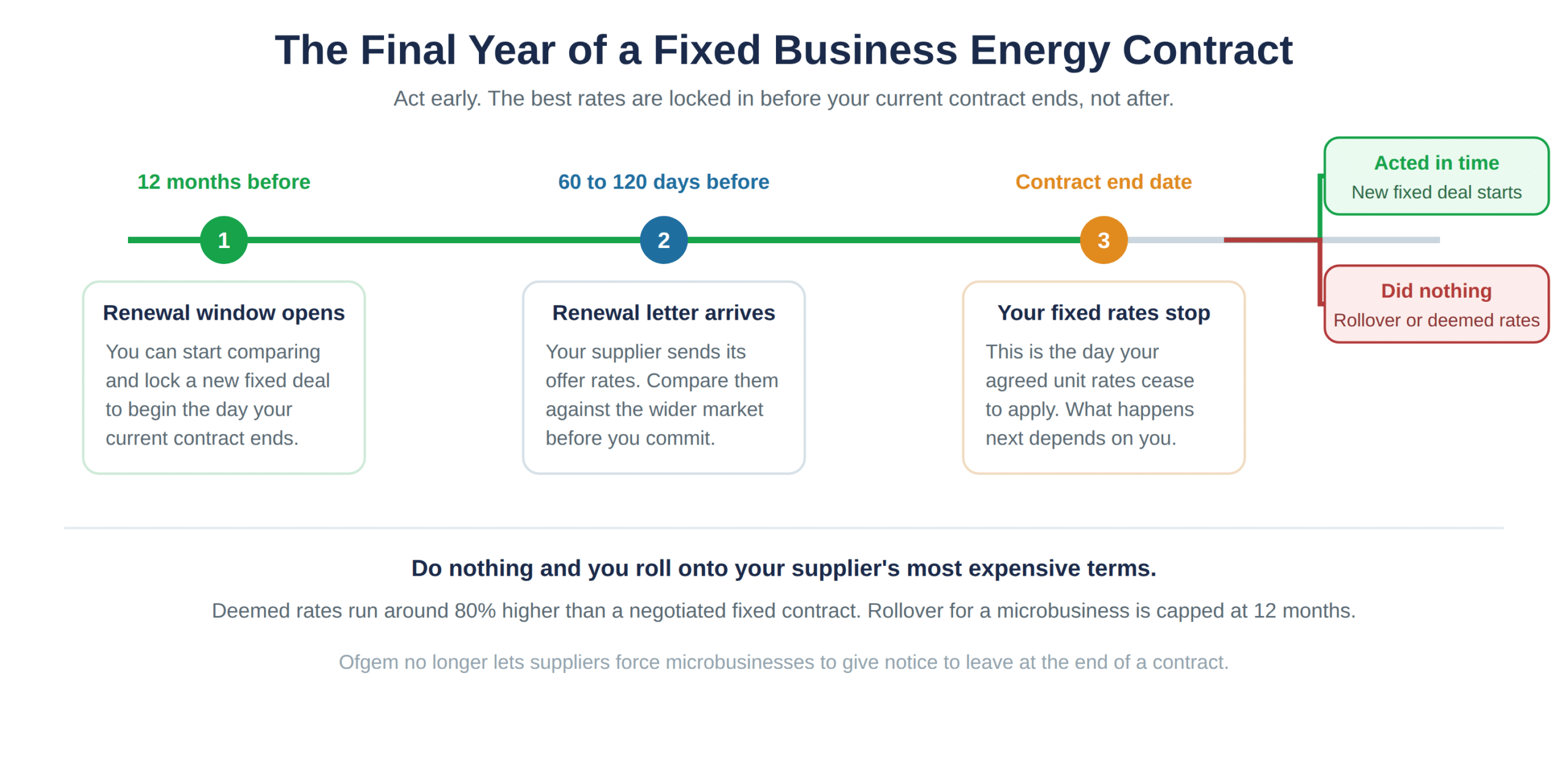
At the end of a fixed contract you either move onto a new deal you have arranged, or roll onto your supplier’s rollover or deemed rates. The rollover and deemed rates are always the more expensive outcome.
The final year, step by step
The best approach is to line up a new contract that starts the day after your current one ends. The timeline below shows how the final year unfolds.
Renewal, rollover or deemed
Most suppliers send renewal offers in the final year. Compare them against the wider market rather than accepting them by default.
If you reach the end date having done nothing, you continue on either a rollover or a standard variable rate. Your contract states which, and it is always worth acting before then to switch business energy supplier onto a competitive deal.
How do you cancel or switch a business energy contract?
You can switch freely at the contract end date. To leave early you must either pay an exit fee or qualify through a change of tenancy, and your old supplier can object to a switch if you owe money.
Leaving at the end date
Ofgem no longer lets suppliers force a microbusiness to give notice to leave at the end of a contract, as set out in its guidance for businesses. You can arrange your switch and go when the deal ends.
In practice, a broker or your new supplier serves the termination notice for you as part of arranging the switch. You rarely need to write to your old supplier yourself.
Leaving early: exit fees and change of tenancy
Leave a fixed contract early and you will face an exit fee. It is usually calculated from your remaining estimated consumption times your unit rate, plus any wholesale shortfall, so it can be expensive.
The main exception is a genuine change of tenancy. If you move out of the premises, you can end the supply without an exit fee, and the incoming occupier moves onto a deemed contract.
When a switch can be blocked
Your current supplier can object to a switch if you have outstanding debt, are still inside a fixed term, or the contract was signed by someone not authorised to do so. They must tell you if they object.
Once the reason is cleared, usually by paying what is owed, the objection is lifted and the switch proceeds.
What does Ofgem regulate on business energy contracts?
Ofgem does not cap business energy rates, but it does protect microbusinesses. It requires broker commission to be disclosed, caps rollover contracts at 12 months, and gives microbusinesses access to the Energy Ombudsman.
Are you a microbusiness?
Microbusiness protections only apply if you qualify. You are a microbusiness if you meet any one of the Ofgem thresholds below.
| Qualify as a microbusiness if you meet any one | Threshold |
|---|---|
| Employees and turnover | Fewer than 10 staff and turnover of £2 million or less |
| Electricity use | Uses 100,000 kWh of electricity a year or less |
| Gas use | Uses 293,000 kWh of gas a year or less |
The key microbusiness protections
Suppliers must show your contract end date and the notice they need on your bills. Broker commission must be disclosed to you as a cash total over the contract term.
A rollover contract cannot last more than 12 months, and a microbusiness can now take an unresolved dispute to the Energy Ombudsman for free.
Do you need a business energy broker and a Letter of Authority?
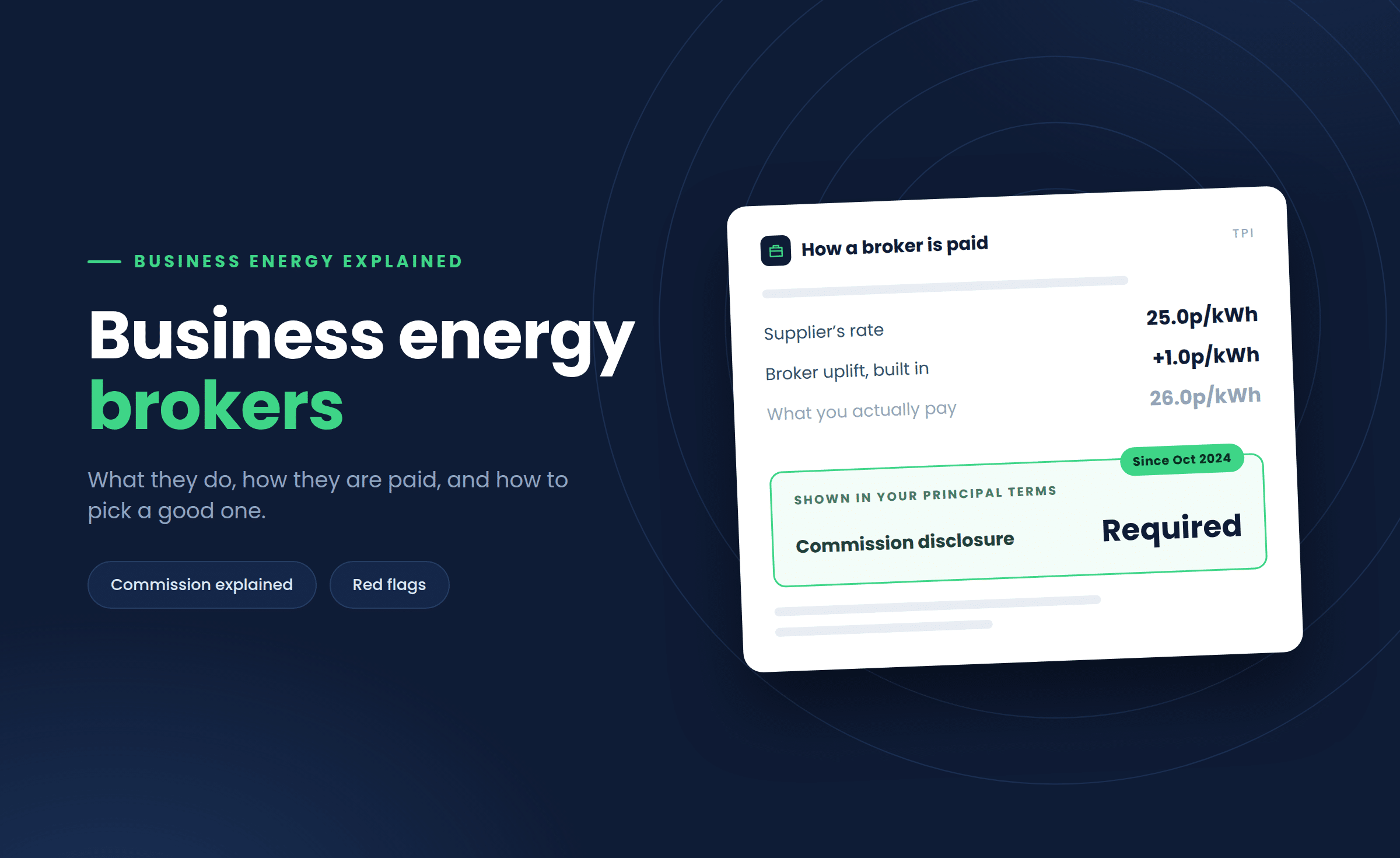
A business energy broker compares suppliers and arranges your contract for you. To act on your behalf they need a Letter of Authority, and any commission they earn must be disclosed in your contract.
What a broker does
A broker works across a panel of suppliers to find and set up your deal, which is why most small firms use one to handle their energy procurement. They also serve your termination notice as part of the switch.
Utility Saving Expert is a registered broker, and you can compare business electricity rates or business gas rates with our team.
What a Letter of Authority allows
A Letter of Authority, or LOA, gives your broker permission to speak to suppliers and gather contract details on your behalf. It does not let them sign a new contract without your say-so.
Always check what an LOA covers before you sign it. A good broker will explain exactly what permissions it grants and for how long.
Ready to review your options? Run a business energy comparison and we will find you a competitive fixed deal before your current contract ends.