
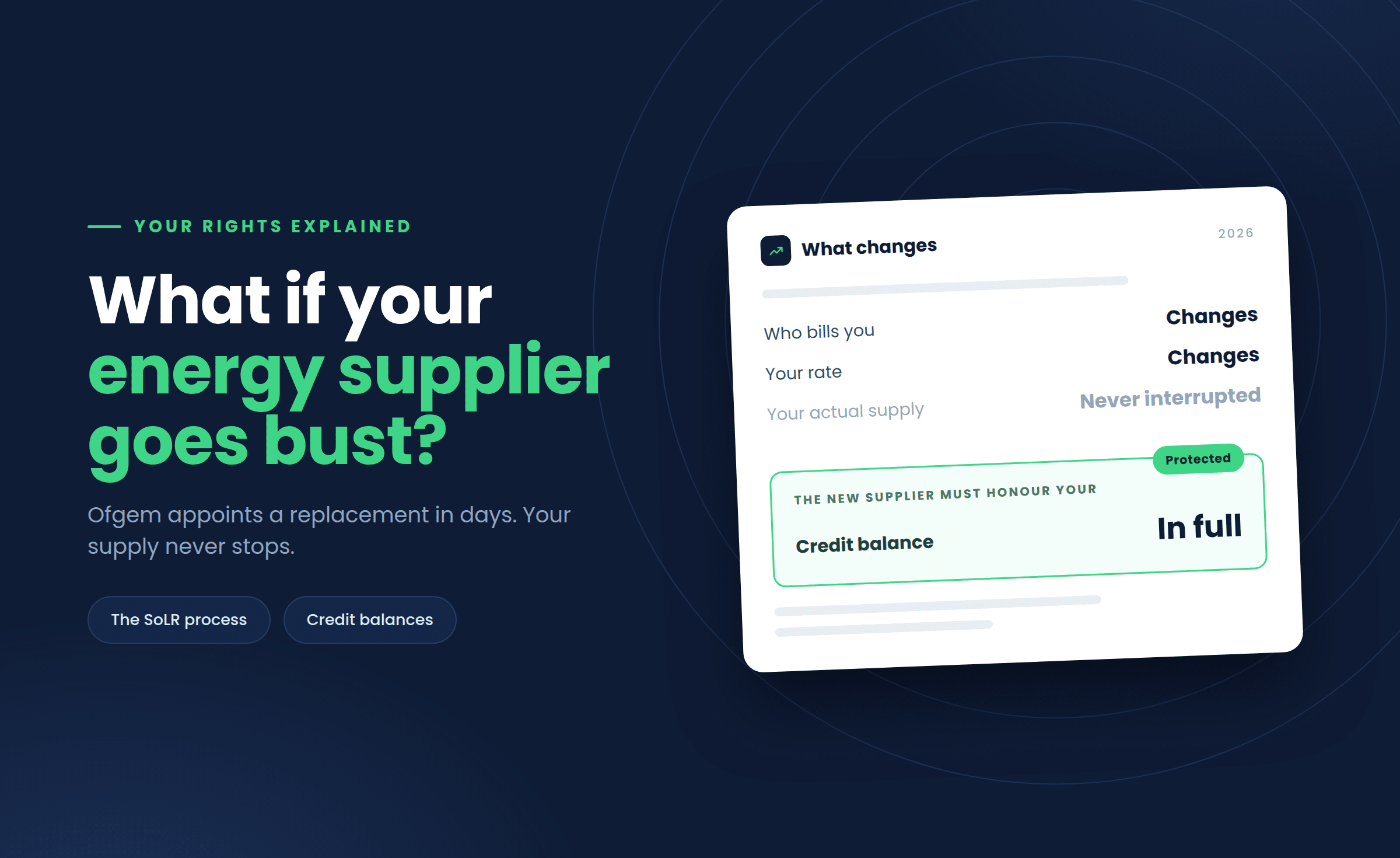
Your supply does not stop: Ofgem appoints a Supplier of Last Resort to take over your account automatically, and your gas and electricity keep flowing throughout the transfer. The main thing that changes is your rate, since you are usually moved onto a new deemed contract.
It is an unsettling thing to face, especially if you have been through it during the wave of supplier failures a few years back. The gap between hearing your supplier has failed and knowing what happens next can feel worse than it needs to.
The mechanism that protects you is well established, and it is designed specifically so supply is never interrupted.
What does change is often overlooked: your new rate, your credit balance and your contract terms all need active attention. Our tracker of failed energy companies lists who took over each supplier’s customers.
This guide covers exactly what happens step by step, what to do about your rate, and how to protect your business if a supplier looks shaky.
What happens when a business energy supplier fails?
Ofgem appoints a new supplier, known as the Supplier of Last Resort, to take over your account within days, so your gas and electricity supply is never physically interrupted.
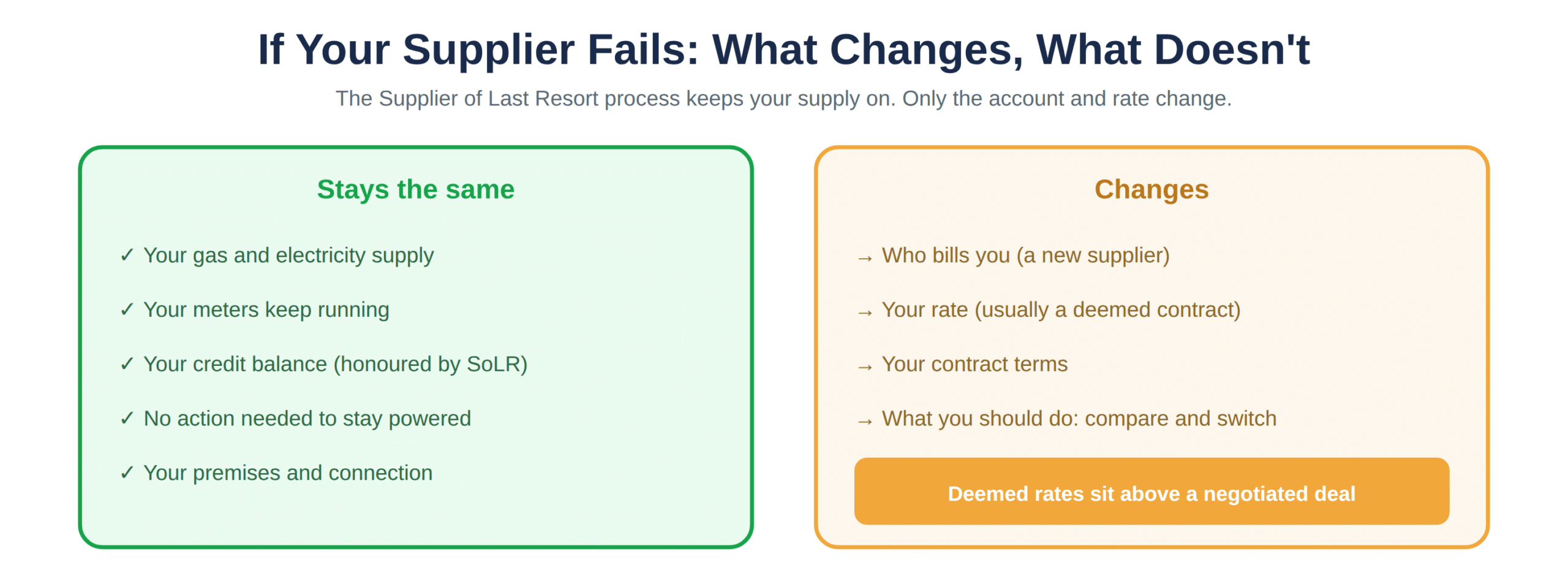
How the SoLR process runs
The process has been used repeatedly since 2021, when many suppliers ceased trading amid extreme wholesale volatility. Ofgem runs it as a well-tested mechanism, not an emergency improvisation.
- Supplier stops: the failed supplier ceases trading and Ofgem runs the SoLR process.
- New supplier appointed: sometimes within a matter of days.
- Supply continues: your gas and electricity never stop throughout.
Will you lose your credit balance if your supplier goes bust?
Under the SoLR process, Ofgem requires the new supplier to honour credit balances held with the failed supplier, though it can take time to appear and you may need to provide evidence.
Evidence to keep on hand
This is a genuine protection built into the mechanism, and it applies to business customers as well as domestic ones. The practical experience of getting the balance recognised is not always instant.
Being organised with your paperwork at this stage makes a real difference to how quickly a credit balance is sorted. A clear record of your last payments is the single most useful thing to have ready.
- Keep your bills: the last few statements from the failed supplier as evidence.
- Note the details: your account number and any recent payments made.
- Expect a wait: the new supplier verifies balances across many transferred accounts.
What rate will you pay after a Supplier of Last Resort takeover?
You are usually moved onto a deemed contract with the new supplier, which typically charges more than a negotiated fixed deal, so it is worth comparing and switching again once your supply has stabilised.
Check your rate against UK averages
A deemed contract exists so there is always a legally valid rate in place, but it is not designed to be competitive. Our guide to deemed energy contracts explains how those rates are calculated.
| Fuel | UK average (2026) | Use it to |
|---|---|---|
| Electricity | Around 24p/kWh | Check your post-transfer unit rate |
| Gas | Around 5p/kWh | Judge whether the deemed rate is fair |
These are useful benchmarks for judging whether your post-transfer rate looks reasonable. Comparing business energy prices against a recent bill quickly shows if the deemed rate needs addressing.
How do you know if your supplier is at risk of failing?
There is rarely a clean public warning, but signs like billing problems, unresponsive customer service and trade press coverage of financial difficulty are worth taking seriously.
The indirect signals worth watching
Ofgem does not publish a watchlist of at-risk suppliers, for understandable reasons around causing a run on a struggling business. That means the signals available to a customer are indirect.
- Billing changes: sudden accuracy problems or unexplained delays.
- Service drop: customer service becoming unusually hard to reach.
- Press coverage: wider industry reporting about financial trouble.
None of these guarantee a failure, and plenty of suppliers work through rough periods. It is still worth acting on a renewal if you see more than one of these signs together.
The safest protection is simply not to drift out of contract. A business already comparing at each renewal is far less exposed to whatever rate a new supplier hands it after a failure.
What should you do immediately after a supplier failure?
Wait for official contact from Ofgem or the appointed new supplier, keep your billing paperwork, and start comparing rates once your account has been formally transferred.
The right order of actions
Acting too early, before the SoLR appointment is confirmed, usually just duplicates effort. The transfer is designed to reach you directly, and Citizens Advice publishes guidance if you are unsure what to expect.
- Do not panic: supply continues throughout the transfer.
- Keep evidence: of your account and any credit balance.
- Compare once transferred: when the new supplier confirms your rate.
Once settled, treat it like any other renewal. A comparison against the business energy suppliers panel tells you quickly whether the deemed rate needs replacing.