
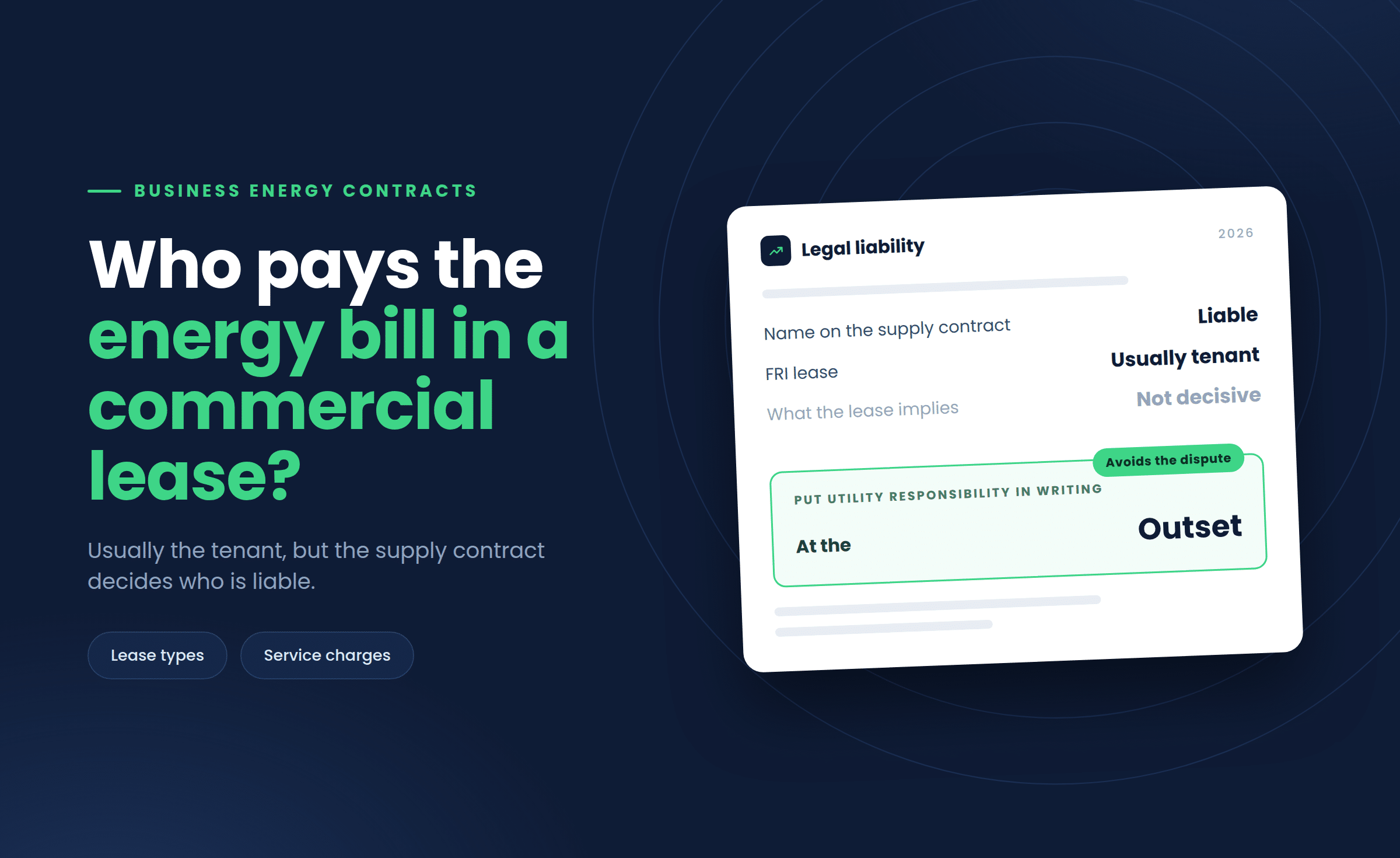
Whoever’s name sits on the energy supply contract is legally responsible for the bill, and that is determined by the lease clauses, not by who happens to occupy the space. In most commercial leases the tenant pays, but the detail depends heavily on how the lease is drafted.
Ask ten commercial tenants who pays for energy and you will get ten slightly different answers, because leases handle utilities in genuinely different ways. Some make it explicit, others bury the answer in a general outgoings clause.
That ambiguity causes real problems at three points: the start of a tenancy, a change of occupier, and the moment a dispute arises over a service charge bill.
Getting it right matters financially. A business that assumes energy is covered by rent, when it is not, can find itself facing a supplier’s deemed contract on top of everything else.
This guide covers how leases allocate energy costs, what happens when the lease is vague, and how landlords and tenants can head off disputes before they start.
What does a commercial lease usually say about energy costs?
Most commercial leases make the tenant responsible for energy used within the demised space, either through a direct supply contract in the tenant’s name or via a service charge if the landlord supplies it.
The three common arrangements
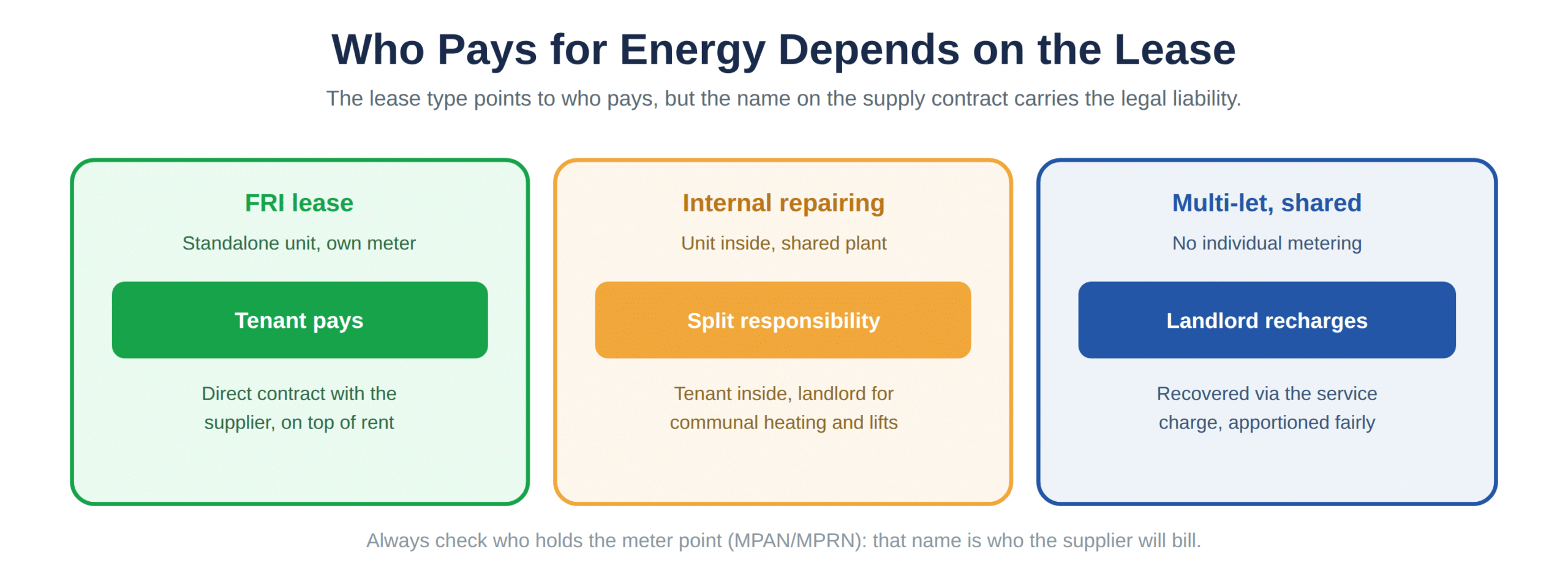
The wording varies enormously, which is why it is worth reading the utilities clause rather than assuming a standard position. A standalone unit with its own meter usually has a direct tenant contract, while a multi-let building bundles shared plant into the service charge.
- Direct supply: the tenant holds the contract and pays the supplier.
- Service charge recovery: the landlord pays and recharges a share to each tenant.
- Sub-metered: the landlord bills tenants on individual meter readings.
Who is liable if the lease is silent on utilities?
Whoever’s name is actually on the supply contract with the energy company is legally liable for the bill, regardless of what the lease implies about who should be paying.
Why the contract name beats the lease wording
A lease can say the tenant is responsible for outgoings in general terms, but if the contract is still in the landlord’s name, the supplier chases the landlord. Every change of occupier needs a proper change of tenancy handover, not an informal agreement.
If you are negotiating a new lease, ask specifically who holds the meter point administration number for the site. It is a more reliable answer than the lease’s general wording.
How does a full repairing and insuring lease affect energy responsibility?
An FRI lease shifts most running costs, including energy, onto the tenant, but responsibility still depends on how the specific clauses are drafted.
FRI versus internal repairing leases
Under an FRI lease the tenant typically covers all running costs, energy included, on top of rent. It is the most common structure for standalone commercial units on longer terms.
An internal repairing lease usually limits tenant responsibility to the inside of the unit, with the landlord covering shared plant and common parts. Energy for communal systems often sits with the landlord and is recovered through the service charge.
| Leasing scenario | Who usually pays energy |
|---|---|
| Standalone unit, own meter (FRI) | Tenant, direct supply contract |
| Internal repairing lease | Tenant inside, landlord for shared plant |
| Multi-let, shared systems | Landlord, recharged via service charge |
| Sub-metered multi-let | Tenant, billed on its own readings |
Can a landlord recharge energy costs through the service charge?
Yes, provided the lease permits it, and the recharge should reflect actual or reasonably apportioned consumption rather than an arbitrary figure.
When service-charge recovery works
It works well for shared systems like communal heating, common-area lighting or lifts, where individual metering is not practical. It works less well when tenants have wildly different usage and end up subsidising each other.
Ask for a breakdown of how the energy element is calculated, and check whether it is based on floor area, sub-metered readings, or another formula. A vague recharge with no detail is a common source of disputes.
What happens when a tenant leaves without settling the energy account?
The supplier keeps billing whoever holds the account until it is formally closed with final meter readings, so an outgoing tenant who ignores this can be chased for usage after they have left.
Closing the account cleanly
The tenant assumes moving out ends their liability, but the account stays open until someone actively closes it. Our guide to energy when moving premises sets out the notification steps in full.
- Final readings: taken on the day the tenant vacates.
- Notify the supplier: in writing, to close the account.
- Confirm the new occupier: so a fresh contract can start cleanly.
How can landlords and tenants avoid disputes over energy bills?
Put utility responsibility in writing at the outset, agree how any shared costs are calculated, and keep meter readings and invoices on file so neither party is guessing later.
A short annex prevents most disputes
Most disputes come down to ambiguity rather than dishonesty. Ofgem and Citizens Advice both publish guidance, but a lease that simply says the tenant pays outgoings leaves both sides open to disagreement.
A short annex covering meter numbers, supplier details and the recharge method removes most of that ambiguity before it becomes a problem. Ask to see the actual supply arrangement, not just the lease summary.