
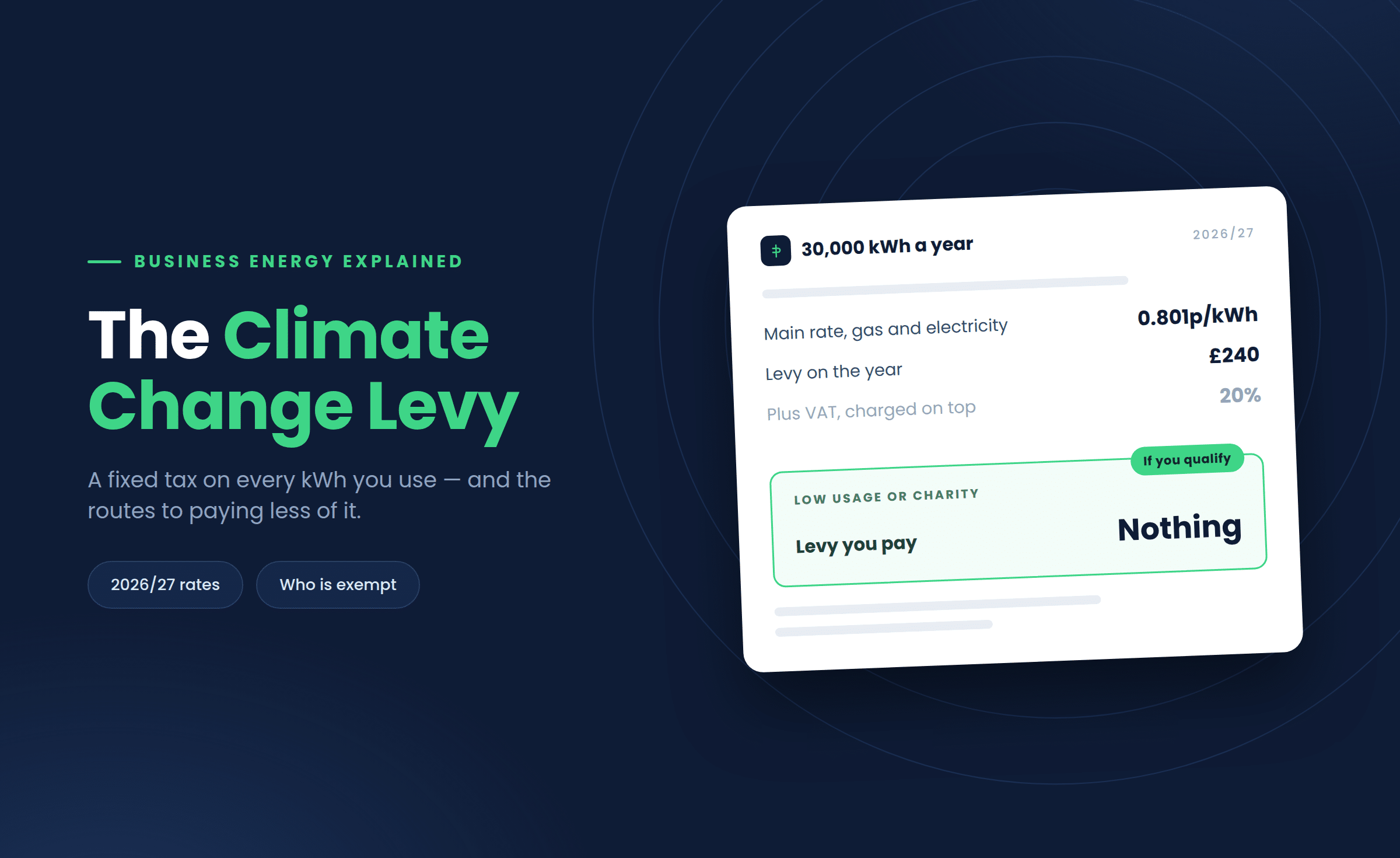
The Climate Change Levy is a government tax on the gas and electricity most UK businesses use. In 2026/27 it adds 0.801p to every kWh of energy you consume, collected by your supplier and paid to HMRC.
It sits as a separate line on your bill, and for many firms it quietly adds hundreds of pounds a year. This guide explains the current rates, who is exempt, and how to cut or remove the charge.
If your bills feel high, the levy is only part of the picture. It is always worth running a business energy comparison to make sure your underlying rates are competitive too.
What is the Climate Change Levy?
The Climate Change Levy, or CCL, is a UK tax on the electricity and gas supplied to businesses and the public sector. It is designed to encourage energy efficiency and lower carbon emissions.
Why the levy exists
The government introduced the CCL in 2001 to put a price on business energy use and nudge firms toward efficiency. The more energy you use, the more levy you pay.
Despite the name, the money is not ring-fenced for green projects. CCL receipts go into general Treasury funds, as gov.uk’s guidance on paying the levy confirms.
Main rates and Carbon Price Support are different
This guide covers the main rates that ordinary businesses pay on their gas and electricity. A separate set of Carbon Price Support rates exists, but those apply only to electricity generators, not to normal business supplies.
What are the current Climate Change Levy rates?
For 2026/27 the CCL main rate is 0.801p per kWh on both electricity and gas. The rate rises every April, and electricity and gas have been charged at the same rate since April 2024.
The rate trajectory
The rate is set by HMRC and increases each tax year, which runs from 1 April to 31 March. The current and neighbouring years are set out in the official rates table.
| Tax year (1 Apr to 31 Mar) | Electricity (p/kWh) | Gas (p/kWh) |
|---|---|---|
| 2025/26 | 0.775 | 0.775 |
| 2026/27 (current) | 0.801 | 0.801 |
| 2027/28 | 0.827 | 0.827 |
How it shows on your bill
Your supplier multiplies the rate by the number of kWh you use and lists the CCL as its own line. VAT is then charged on top of the levy, usually at 20%.
Who pays the Climate Change Levy?
The Climate Change Levy is paid by non-domestic energy users connected to the grid. Your supplier collects it on your bill and remits it to HMRC, so you never deal with the tax authority directly.
Suppliers collect and remit it
As part of their Ofgem licence, business electricity and business gas suppliers must charge the CCL and pass it to HMRC through a quarterly return.
The levy is based on your metered consumption, so accurate meter readings keep it correct. An estimated bill can over or under state the charge until it is trued up.
It also covers other fuels
The CCL applies to LPG and solid fuels such as coal as well, each with its own rate. Most businesses only meet it on their mains gas and electricity supplies.
How much does the Climate Change Levy add to your bill?
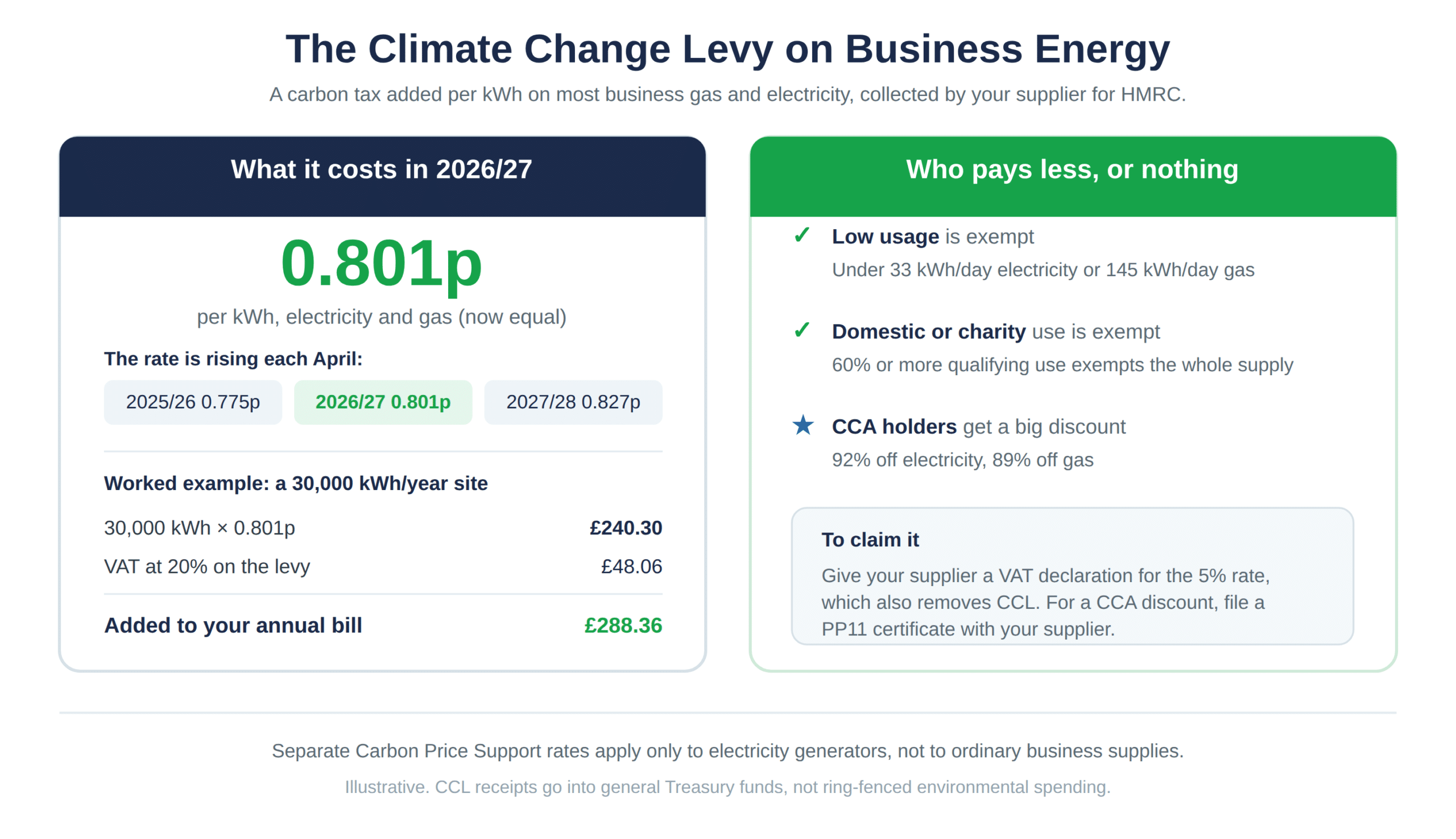
At 0.801p per kWh, the levy adds around £240 a year to a business using 30,000 kWh of electricity, before VAT. The more energy you use, the more you pay.
A worked example
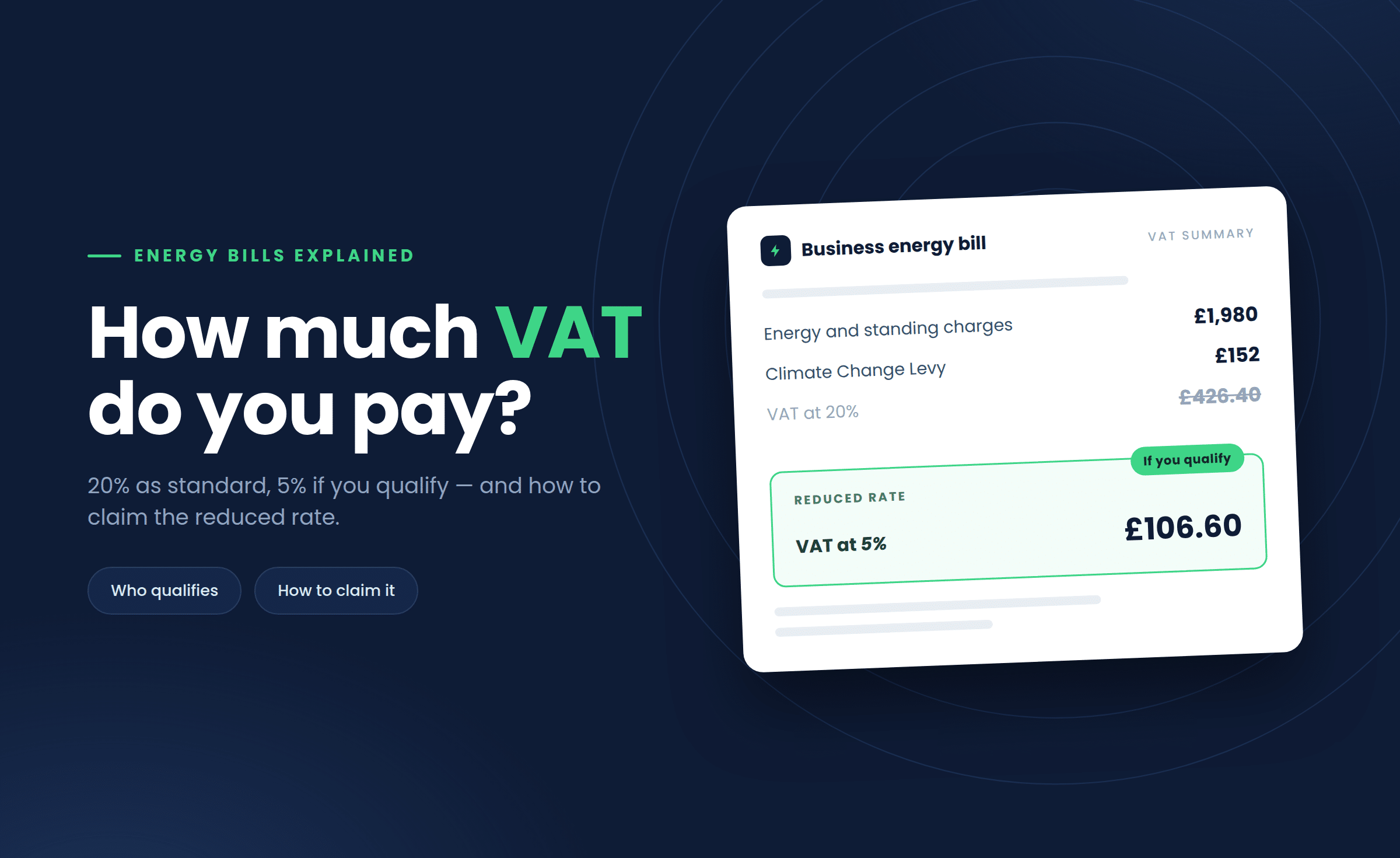
Take a small business using 30,000 kWh of electricity in 2026/27. The graphic below shows how the levy, and the VAT charged on it, reach your bill.
VAT is charged on the levy
The CCL is added to your energy charges, and VAT is then applied to the combined figure. That means a business on the standard 20% VAT rate pays a little tax on top of the tax.
Who is exempt from the Climate Change Levy?
Domestic users, charities using energy for non-business purposes, and very low-usage supplies are exempt from the CCL. These exemptions use the same qualifying-use test as the 5% reduced rate of VAT.
Low-usage supplies are exempt
A supply is treated as domestic, and so exempt, if it stays below the de minimis limits set out in HMRC’s reliefs notice. The thresholds are shown below.
| Exemption | Who qualifies | Threshold or condition |
|---|---|---|
| Low usage | Very small energy users | Under 33 kWh/day electricity or 145 kWh/day gas |
| Domestic | Homes and mixed-use sites | 60% or more domestic use exempts the whole supply |
| Charity | Charities’ non-business use | Energy used for the charity’s non-business activities |
The 60% domestic rule
If at least 60% of a supply is used for domestic or other qualifying purposes, the whole supply is treated as domestic and no CCL applies. Below 60%, only the qualifying share is relieved.
How do you claim a Climate Change Levy exemption?
For a domestic, low-usage or charity exemption, you give your supplier a VAT declaration for the 5% rate, which also removes the CCL. Other reliefs are claimed using HMRC forms PP10 and PP11.
The VAT declaration route
Suppliers add the CCL automatically, so an eligible business must tell them to stop. The same VAT declaration that secures your 5% reduced VAT rate also removes the levy on a qualifying supply.
The PP10 and PP11 forms
For other reliefs, two HMRC forms apply. PP11 is the certificate you send to your energy supplier, and PP10 is the supporting analysis you notify to HMRC.
Getting these right matters, because the supplier can only apply the reduced rate once it holds a valid certificate. Keep copies for your records.
What is a Climate Change Agreement and how much does it save?
A Climate Change Agreement, or CCA, is a voluntary deal that gives energy-intensive businesses a large CCL discount in return for meeting efficiency targets. Holders pay 92% less on electricity and 89% less on gas.
How the discount works
A CCA is administered by the Environment Agency under the national scheme. A facility commits to measuring its emissions and hitting reduction targets, and keeps the discount as long as it meets them.
Who qualifies
CCAs are aimed at eligible energy-intensive sectors such as manufacturing, food processing and data centres. Most small offices and shops will not qualify, so the exemption routes above are the more likely saving.
How can you reduce your Climate Change Levy costs?
Because the levy is charged per kWh, the surest way to cut it is to use less energy. Efficiency measures, on-site generation and, for eligible firms, a CCA all lower the bill.
Use less, generate your own
Efficient equipment and simple changes like LED lighting cut both your energy and your levy. On-site solar reduces the grid electricity you draw, and therefore the CCL on it.
Check the rest of your bill too
The levy is fixed by government, but your unit rates are not. Comparing business energy suppliers and switching to a better deal often saves far more than the levy itself, so it is worth reviewing your energy procurement regularly.