
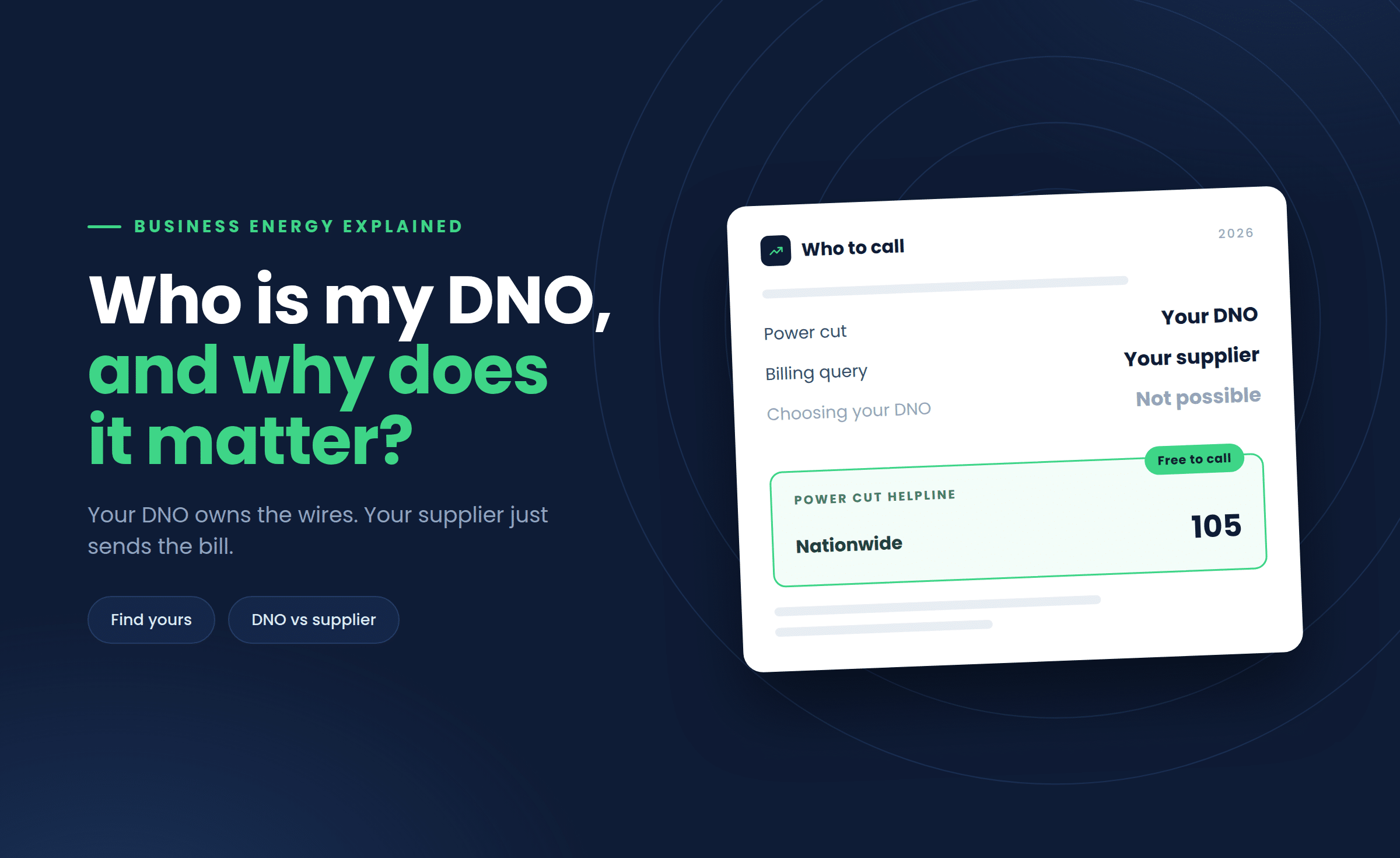
Your DNO is whichever of the six regional network groups owns the electricity cables and substations serving your postcode. You can find yours in seconds using a postcode lookup on the Energy Networks Association website.
It is one of the most searched questions in business energy, and for good reason. Your supplier sends the bill, but a completely different company owns the wires bringing the power to your building.
Most businesses never think about this split until something goes wrong: a power cut, a new connection, or a query about a charge on the bill they do not recognise.
Knowing who your DNO is means knowing exactly who to call when the fault sits with the network rather than with your electricity supplier.
How do you find your DNO by postcode?
The fastest way is to check the two-digit Distributor ID within the MPAN on a recent electricity bill, or search your postcode on the Energy Networks Association website, which routes you straight to the right company.
Three quick routes
Every business bill carries a Distributor ID buried within the MPAN. That code maps directly onto one network operator, so it is a reliable shortcut, and our guide to what an MPAN number is shows exactly where it sits.
- Check your MPAN: the two-digit Distributor ID, if you have a bill.
- Search your postcode: via the Energy Networks Association website.
- Ask your supplier: they will know instantly.
Which companies are the GB distribution network operators?
Great Britain’s electricity network is split into 14 regional licence areas, run by six corporate groups. Coverage runs roughly north to south and east to west, with no overlap between areas.
The six network groups
| Network group | Regions covered |
|---|---|
| UK Power Networks | London, South East, Eastern England |
| Northern Powergrid | North East England, Yorkshire |
| Electricity North West | North West England |
| SP Energy Networks | Central & Southern Scotland, Merseyside, Cheshire, North Wales |
| SSEN | Southern England, North Scotland |
| National Grid Electricity Distribution | South West, South Wales, East and West Midlands |
Do not confuse any of these with National Grid Electricity Transmission or NESO, which manage the high-voltage backbone, not the local wires to your building. Our guide to what a Distribution Network Operator is covers that distinction in more depth.
Why does knowing your DNO matter day to day?
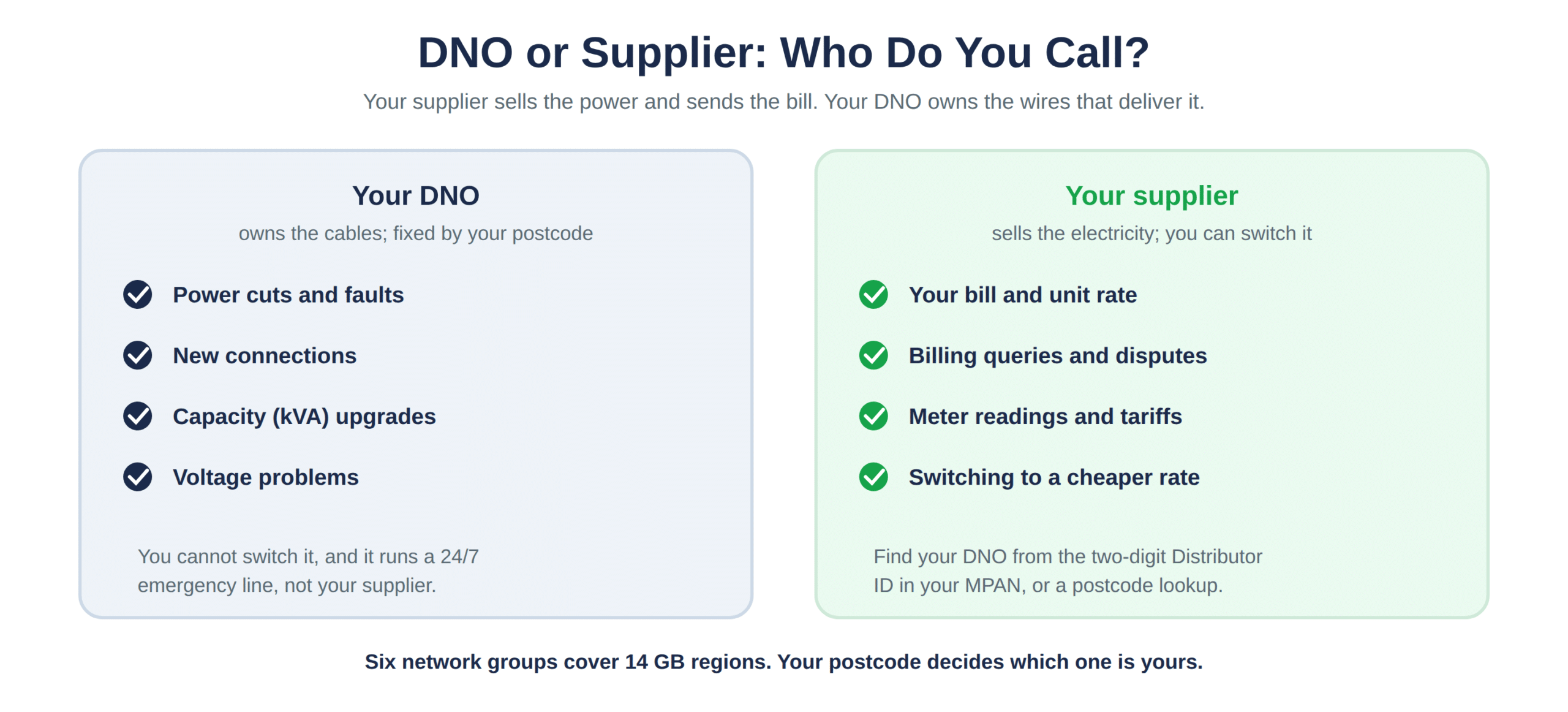
Your DNO is who you call for power cuts, new connections, capacity upgrades and voltage faults. Your supplier cannot fix any of these because they do not own or maintain the physical network.
It also sits behind your charges
Distribution Use of System charges appear on your bill to cover wear on the local network, and they vary by DNO area and time of day, as our guide to non-commodity costs explains.
Businesses expanding or fitting out a new unit deal with the DNO directly for any capacity increase, since a supplier cannot authorise physical network changes.
What’s the difference between your DNO and your energy supplier?
Your supplier sells you the electricity and sends the bill. Your DNO owns and maintains the cables, substations and infrastructure that physically deliver it to your meter.
Other roles you might encounter
You choose your supplier and can switch it whenever your contract allows. You cannot choose your DNO; it is fixed by your postcode, the same way you cannot pick which company owns the road outside, and comparing business energy suppliers only ever changes the former.
- Meter Operator (MOP): installs, maintains and tests your meter under a separate contract.
- Independent Gas Transporter (IGT): the gas equivalent of a private network owner, common on new developments.
- Ofgem: regulates both suppliers and DNOs, setting the rules both must follow.
What should you do during a power cut or a new connection request?
Call your DNO’s emergency number, not your supplier, the moment power goes out. Every DNO runs a dedicated outage line staffed around the clock.
What a new connection usually involves
For a new connection or capacity upgrade, contact your DNO directly with your site plans and expected load. Larger sites on half-hourly meters often need a formal load assessment first.
- A load assessment: based on your expected kVA demand.
- A quotation: for any reinforcement work needed to the local network.
- A timeline: which can run to several months for larger capacity increases.
Start this early if you are fitting out a new site or adding heavy equipment, since capacity upgrades rarely happen overnight. A DNO will not fast-track work around your supplier switch date.