
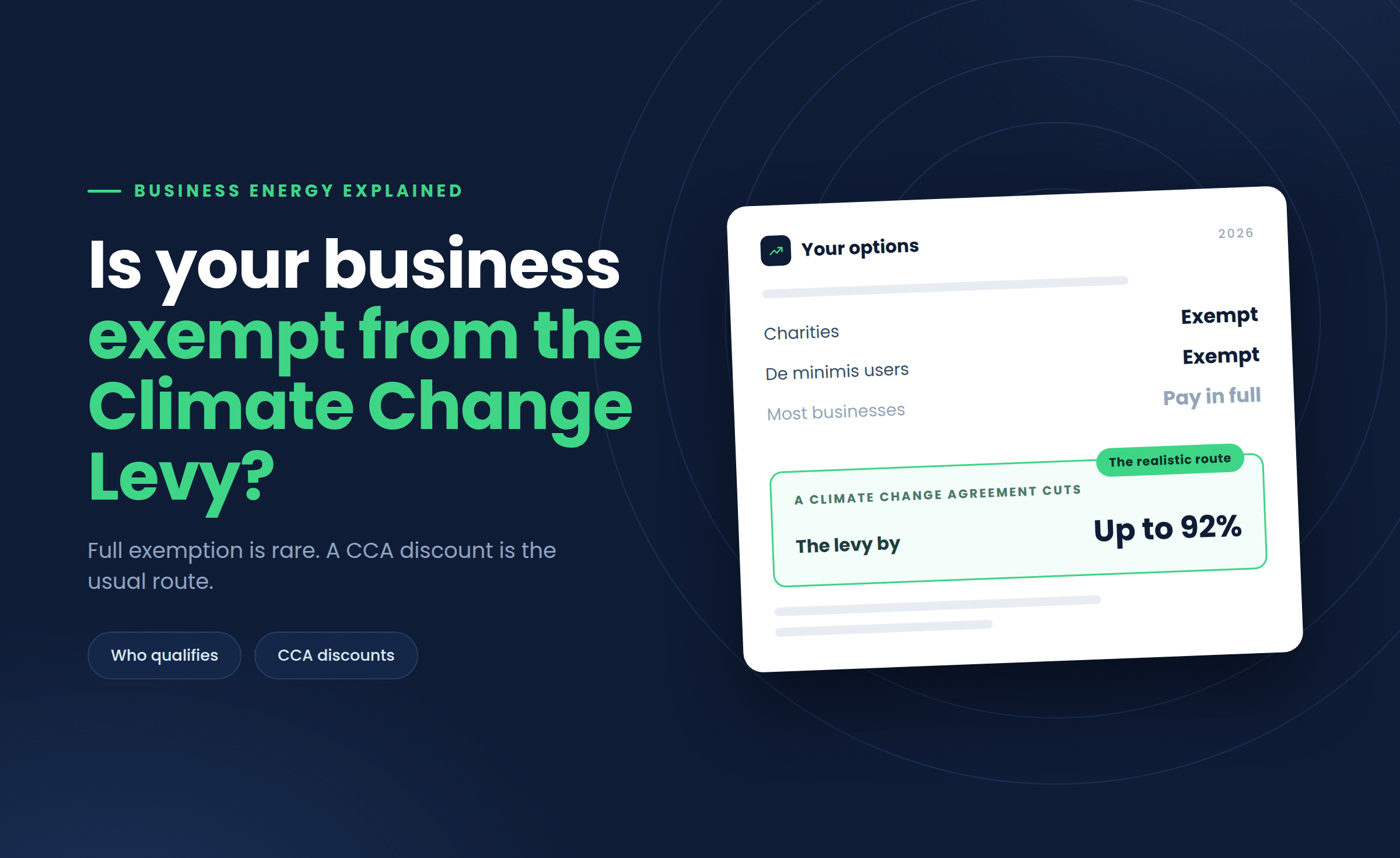
A full Climate Change Levy exemption is fairly rare and mostly limited to charities, small de minimis users and specific processes such as metal recycling, but many energy-intensive businesses cut the CCL portion of their bill substantially through a Climate Change Agreement instead.
The CCL line on a business energy bill confuses a lot of people the first time they notice it. It sits separately from the unit rate and standing charge, and nobody explains what it is actually for.
HMRC introduced the Climate Change Levy to push businesses towards more efficient energy use, and it applies to almost every commercial gas and electricity bill by default. Very few businesses escape it entirely.
There are, however, genuine routes to an exemption or a substantial discount, and they overlap with rules you may already know from VAT. Sector, usage level and how the energy is used all decide the outcome.
What is the Climate Change Levy and why is it on your bill?
The Climate Change Levy is a tax administered by HMRC and charged per kWh on the gas and electricity most businesses use, collected by your supplier and passed to the government rather than kept as profit.
A non-commodity cost on top of the unit rate
It is classed as a non-commodity cost, meaning it sits outside the wholesale energy price entirely. Even a business paying a competitive unit rate still sees this charge added on top.
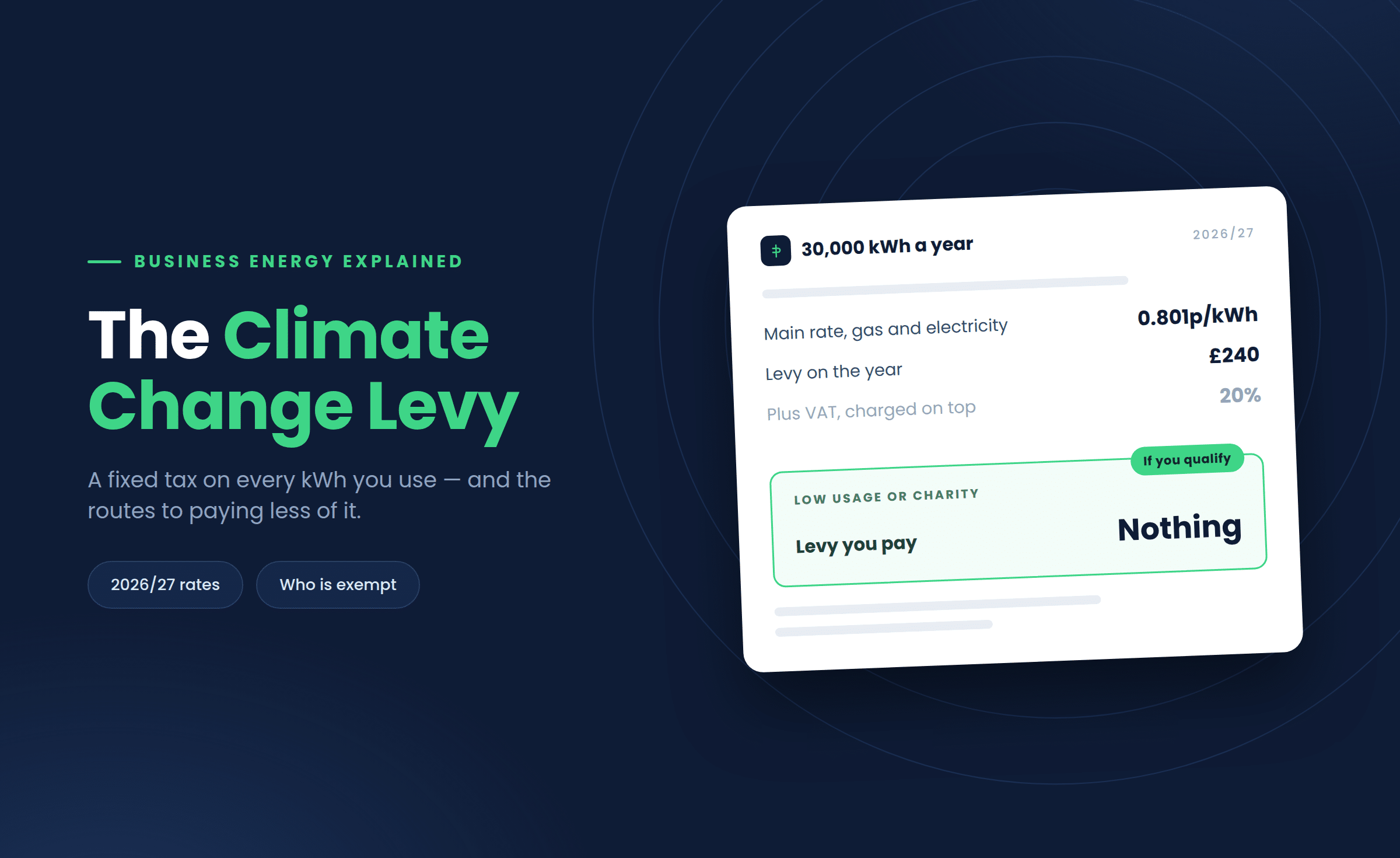
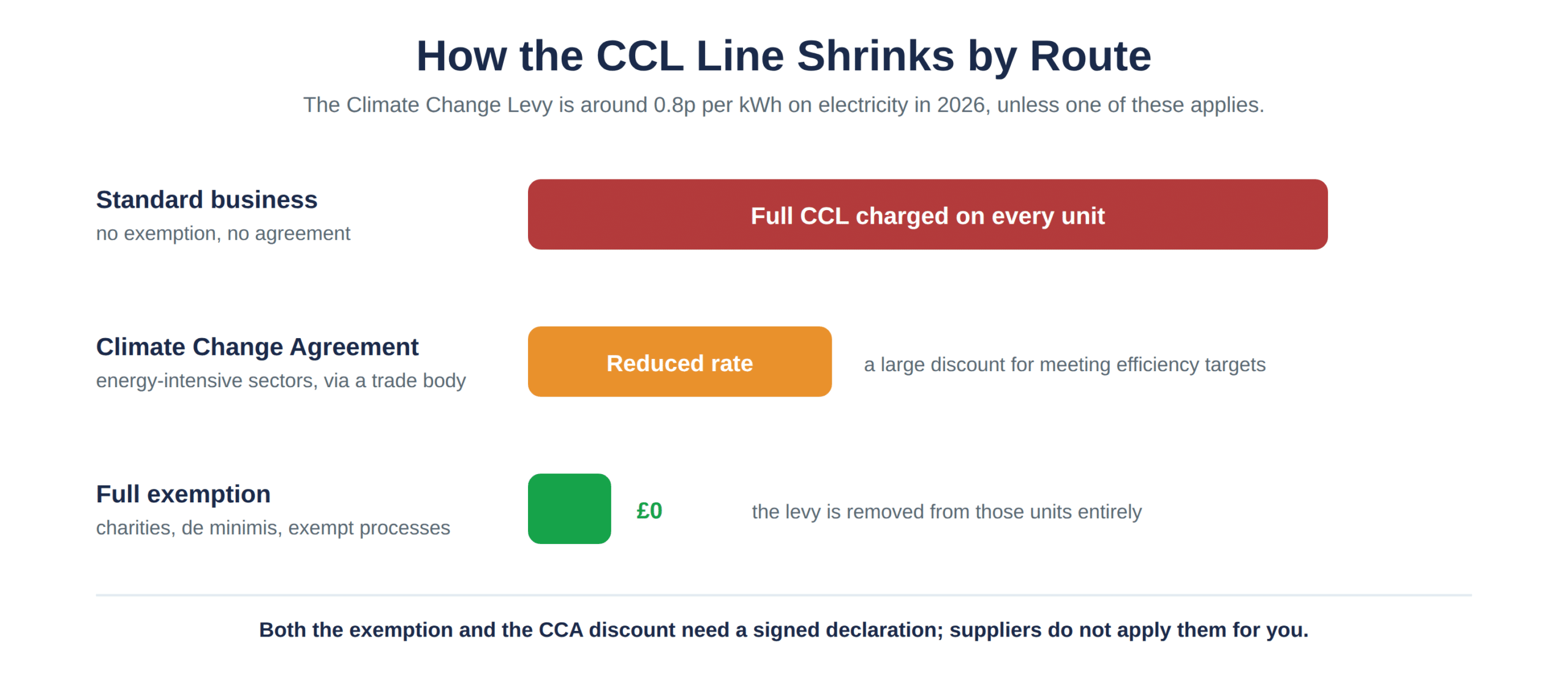
The main rate is around 0.8p per kWh on electricity in 2026, with gas charged at its own lower main rate, as the government’s CCL guidance sets out. The policy rationale does not change the fact that it lands as a real cost on real invoices.
Which businesses qualify for a full Climate Change Levy exemption?
Full exemption applies to businesses below the de minimis threshold of 33 kWh of electricity or 145 kWh of gas a day, charities using energy for non-business activities, and specific exempt processes such as certain metal recycling or mineralogical operations.
Does a small office qualify?
| Business situation | Typical CCL treatment | What to do about it |
|---|---|---|
| Standard commercial premises | Full CCL on all units | Check whether a CCA or efficiency measures apply |
| Charity, non-business use | Often exempt | Submit a supplier declaration confirming use |
| Very low usage (de minimis) | Exempt below the threshold | Confirm average daily kWh with your supplier |
| Energy-intensive sector with a CCA | Reduced rate under agreement | Check eligibility via your trade association |
| Mineralogical or metallurgical process | Usually exempt | Confirm the process qualifies with HMRC |
- Charities: and community organisations running non-business activities.
- De minimis users: whose average daily energy use sits below the threshold.
- Exempt processes: specific industrial processes recognised under HMRC guidance.
That threshold is identical to the one used for reduced VAT, which is why the two are usually claimed together. Most offices with several employees and standard equipment will not fall under it, so check your actual daily average rather than guessing from team size.
From 1 October 2026 to 31 March 2027, it is the VAT rate on qualifying electricity that drops to 0% instead of 5%, using the same de minimis and charitable-use tests. CCL treatment is unaffected, gas VAT stays at 5%, and the VAT change is due to revert on 1 April 2027 unless extended.
How does a climate change agreement discount work?
A Climate Change Agreement, negotiated through a sector trade association under a scheme overseen by the Environment Agency, gives eligible energy-intensive businesses a sizeable reduction on the CCL portion of their bills in return for meeting agreed efficiency targets.
Which sectors typically hold one
This is where the discount delivers meaningful savings, far beyond what a small office would see from de minimis rules. Foundries, cement and ceramics makers, paper mills, food and drink processors and data centres commonly participate, and the government’s CCA guidance sets out the scheme.
Eligibility runs through the relevant sector association rather than being applied for directly. If your business sits in one of these sectors, our energy procurement service can help, and it is worth asking your trade body early since target-setting takes time.
How do you claim a CCL exemption or discount from your supplier?
You submit a signed declaration to your supplier confirming your qualifying use or Climate Change Agreement reference number, and the supplier adjusts the CCL charge on future bills from the date they process it.
Often the same paperwork as VAT
This is frequently the same paperwork used for reduced VAT, since HMRC applies overlapping qualifying-use tests, and our guide to VAT on business energy bills walks through that declaration in more detail.
Suppliers vary on whether they will backdate a late declaration, so ask directly rather than assuming. A missed exemption from two years ago is very difficult to recover once the bills have already been paid.
What happens if you claim an exemption you’re not entitled to?
HMRC can recover the unpaid levy, add interest and, in serious cases, apply a penalty if an exemption or CCA discount was claimed incorrectly, whether the error was deliberate or a genuine misunderstanding.
Review it with your annual accounts
That risk is exactly why the qualifying-use percentage needs checking properly rather than assumed. A business that expands its commercial floor space might drift over the de minimis line without anyone noticing for months.
A periodic review, ideally alongside your annual accounts, catches these changes early. Checking your underlying business electricity and business gas unit rates at the same time usually finds the bigger saving.