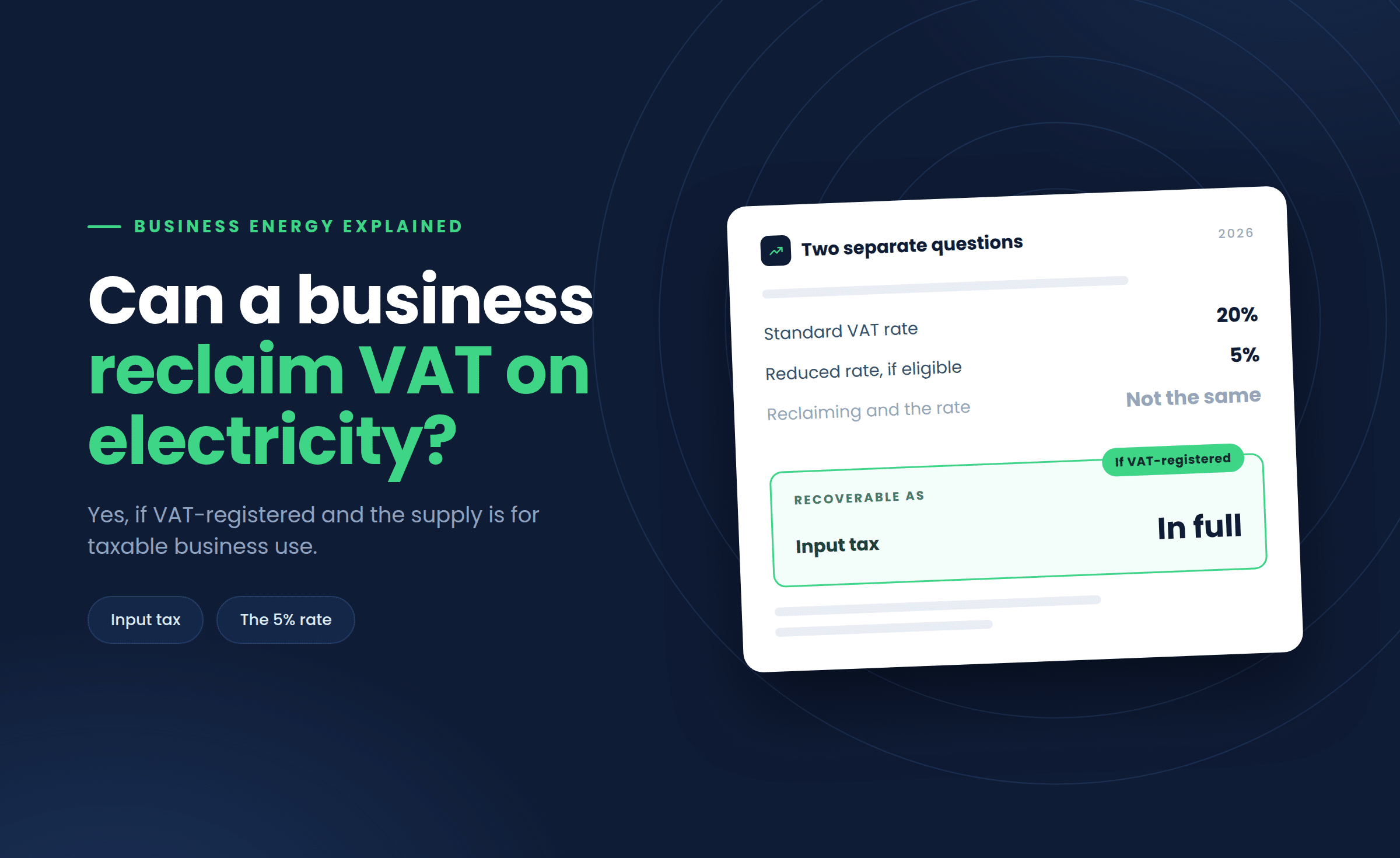

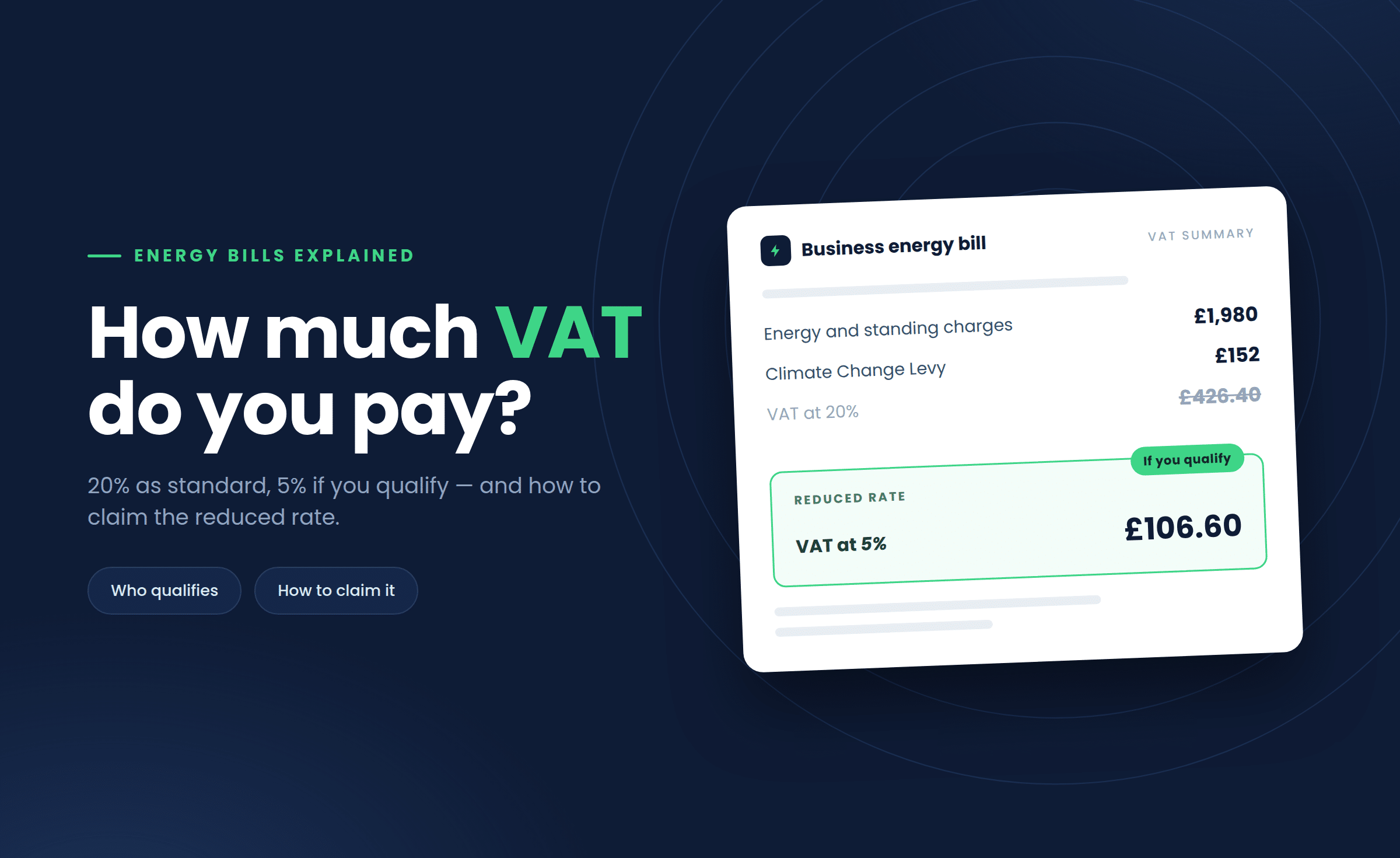
Most businesses pay 20% VAT on their gas and electricity, but many qualify for a reduced 5% rate. Low-usage sites, charities and premises used as homes pay 5% and avoid the Climate Change Levy too.
The rules are set by HMRC and applied by your supplier. Knowing where you stand can cut your bill and let you reclaim VAT you should not have paid.
This guide explains the rates, who qualifies for 5%, how to claim it and how VAT and the Climate Change Levy fit together. When you are ready, you can compare business energy on a like-for-like basis.
How much VAT do you pay on business energy?
Business gas and electricity are charged 20% VAT as standard, with a reduced 5% rate for some customers. Which rate applies depends on how much energy you use and how the premises are used.
The standard 20% rate
By default, business energy is standard-rated at 20% VAT, the same as most goods and services. This is the rate that applies to a typical office, shop or factory.
The reduced 5% rate
The reduced 5% rate applies to low-usage supplies and to energy used for homes or charities. The table below shows how the rate and the Climate Change Levy line up.
| Your situation | VAT rate | Climate Change Levy |
|---|---|---|
| Standard business use | 20% | Charged |
| Low usage (de minimis) | 5% | Exempt |
| 60% or more residential or charity use | 5% | Exempt |
| Domestic (home) use | 5% | Exempt |
Who qualifies for the reduced 5% VAT rate?
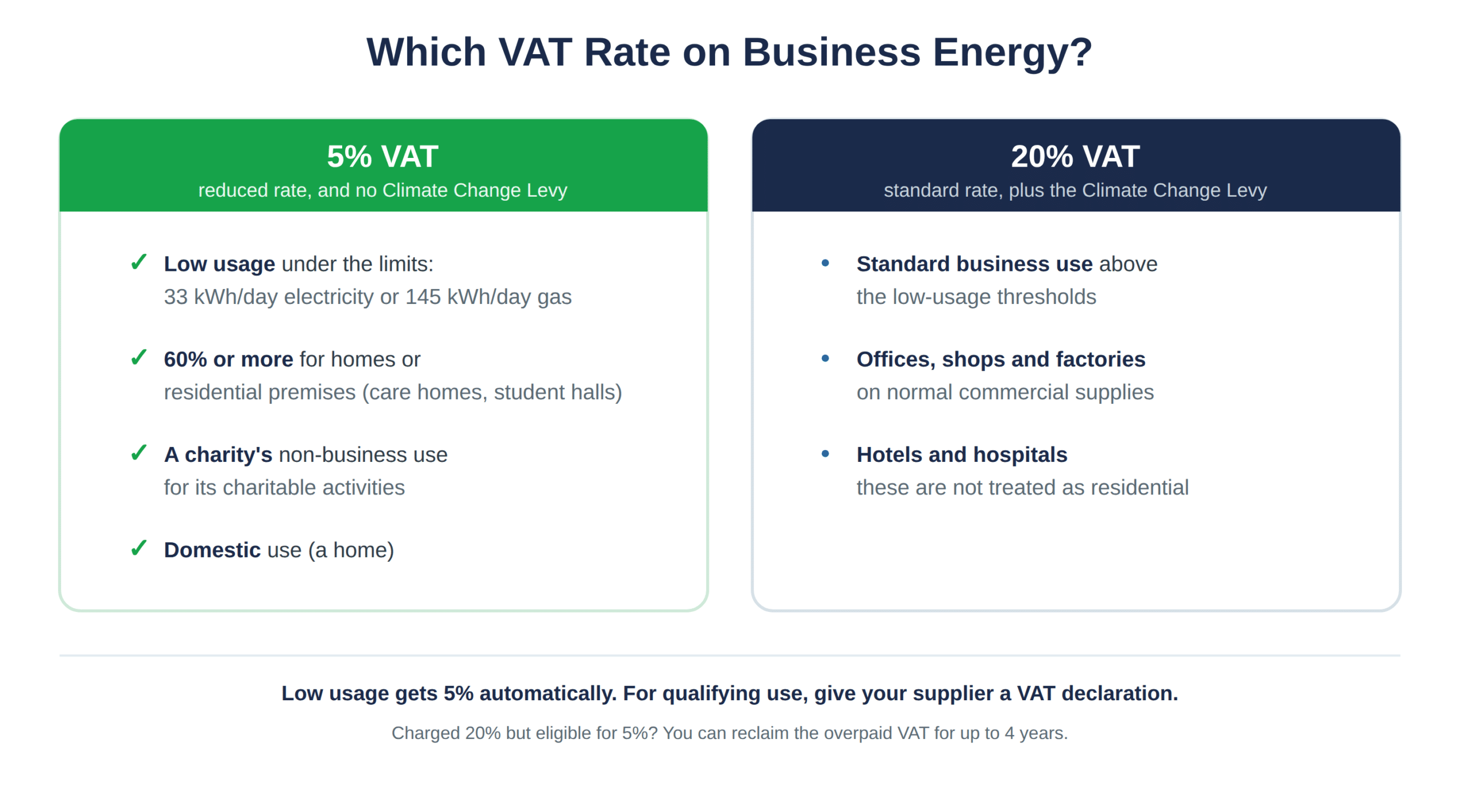
You qualify for 5% VAT if your usage is low enough, or if at least 60% of the energy is for homes or a charity’s non-business use. The chart below sums up the main cases.
Low-usage businesses (de minimis)
If your usage is at or below HMRC’s small-quantity limits, you are charged 5% automatically, whoever you are. The thresholds are set in kWh, so it helps to know your usage and profile class.
| Fuel | Per day | Per month | Per year |
|---|---|---|---|
| Electricity | 33 kWh | 1,000 kWh | 12,000 kWh |
| Gas | 145 kWh (5 therms) | 4,397 kWh (150 therms) | 52,764 kWh |
Homes and residential premises
Energy used for domestic or residential premises is qualifying use, charged at 5%. This includes care homes, children’s homes, student accommodation and self-catering holiday lets.
Watch the common trap: hotels, inns, hospitals and prisons are not treated as residential. They pay the standard 20% rate on that basis.
Charities and non-profits
A charity’s non-business use of energy also qualifies for 5%, as set out in HMRC’s fuel and power notice. A charity’s genuine business activities, such as a charity shop, stay at 20%.
What is the 60% rule for VAT on energy?
If at least 60% of a supply is for qualifying use, the whole supply is charged at 5%. Below 60%, the supply is split, with 5% on the qualifying share and 20% on the rest.
How apportionment works
For mixed premises, you work out the percentage used for homes or charitable activities. If that share is 60% or more, everything is reduced-rated, which is a valuable saving worth checking.
For example, a building that is 70% student accommodation and 30% office would be charged 5% on the whole supply. If the split were reversed, only the 30% residential share would get the reduced rate.
How much could the reduced rate save you?
How much you save depends on whether you reclaim VAT. If you do, the main gain is being exempt from the Climate Change Levy; if you do not, the 5% rate itself is a real saving.
If you reclaim VAT
A VAT-registered business recovers the VAT it pays, so 5% versus 20% is broadly neutral on that part. The real benefit of qualifying is the levy exemption and the improvement to your cash flow.
If you are not VAT-registered
If you cannot reclaim VAT, paying 5% instead of 20% is a genuine reduction in your bill. The illustrative example below shows the difference on a small electricity supply.
| Annual electricity bill (illustrative) | Standard (20%) | Reduced (5%) |
|---|---|---|
| Energy and standing charges | £2,000 | £2,000 |
| Climate Change Levy | £80 | £0 |
| VAT | £416 | £100 |
| Total | £2,496 | £2,100 |
The figures are illustrative and depend on your usage and rates. The saving here is around £396 a year, or roughly 16%.
How do you apply for the reduced VAT rate?
For low usage the 5% rate is automatic, but for qualifying use you must send your supplier a VAT declaration. If you have been overcharged, you can reclaim the difference for up to four years.
The VAT declaration
A VAT declaration is a signed certificate telling your supplier what percentage of the supply is for qualifying use. The supplier then applies 5% to that share, or to the whole supply if it is 60% or more.
Claiming back overpaid VAT
If you were eligible for 5% but paid 20%, ask your supplier to correct it and refund the difference. This can normally be backdated up to four years under HMRC’s rules on correcting VAT.
Can you reclaim VAT on business energy?
If your business is VAT-registered, you can reclaim the VAT you pay on energy as input tax, as long as it is used for your business. This is the key difference from households, which simply bear the VAT.
Reclaiming as input tax
You recover the VAT on your VAT return, whether you were charged 20% or 5%, provided you hold a valid VAT invoice. See the government’s guidance on reclaiming VAT for the detail.
Working from home and mixed use
If energy is used partly for business and partly privately, you can only reclaim the business share. A sole trader working from home apportions on a fair basis, such as the rooms and time used for work.
What is the Climate Change Levy?
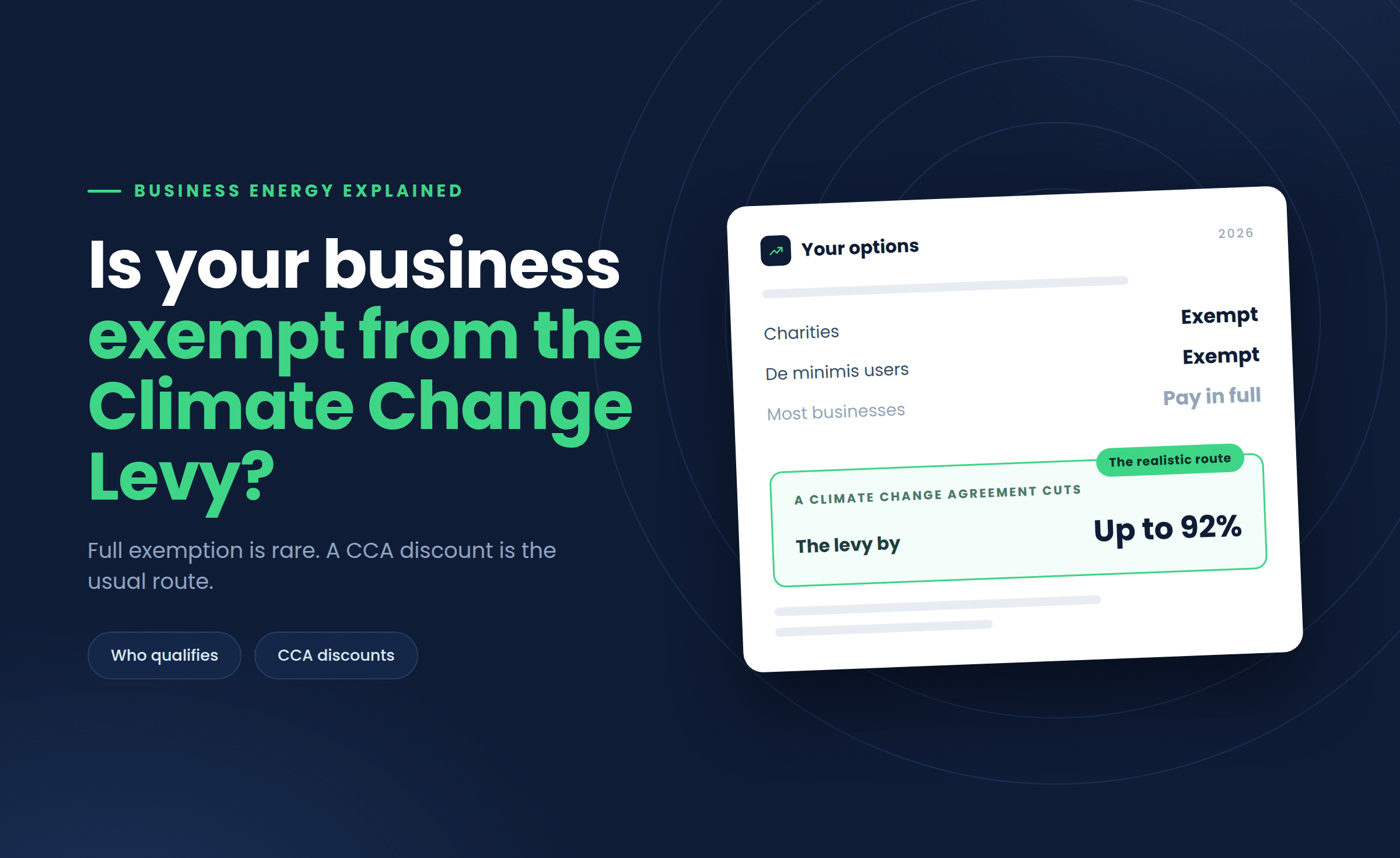
The Climate Change Levy (CCL) is a separate environmental tax on business energy, shown as its own line on the bill. If you qualify for 5% VAT, you are exempt from the CCL as well.
Current CCL rates
The main CCL rates for the 2026 to 2027 year are shown below, and they are added before VAT is calculated. They rise again in April 2027.
| Commodity | CCL rate (from 1 April 2026) |
|---|---|
| Electricity | 0.801p per kWh |
| Gas | 0.801p per kWh |
| LPG | 2.175p per kg |
When you do not pay CCL
The CCL is only charged on standard-rated business supplies. Low-usage sites, domestic use and charity non-business use are all exempt, so being on 5% VAT means no levy to pay.
What about VAT on business water and quotes?
Most businesses pay 0% VAT on water, though some industrial sectors pay 20%. Energy quotes are usually shown without VAT, which is added to your bill.
VAT on business water
Clean water supplied to most businesses is zero-rated, so offices, shops and hospitality pay no VAT on business water. Heavy-industry sectors pay 20%, as set out in HMRC’s water guidance, while sewerage is zero-rated for everyone.
How VAT appears on your bill
A business energy bill usually lists the energy and standing charges first, then the Climate Change Levy, then VAT on the total. The bill states which VAT rate has been applied, and it should match the levy.
Do quotes include VAT?
Business energy quotes and unit rates are normally shown without VAT, since most businesses reclaim it. When you compare business electricity and business gas, check whether prices are quoted with or without VAT and the levy.