
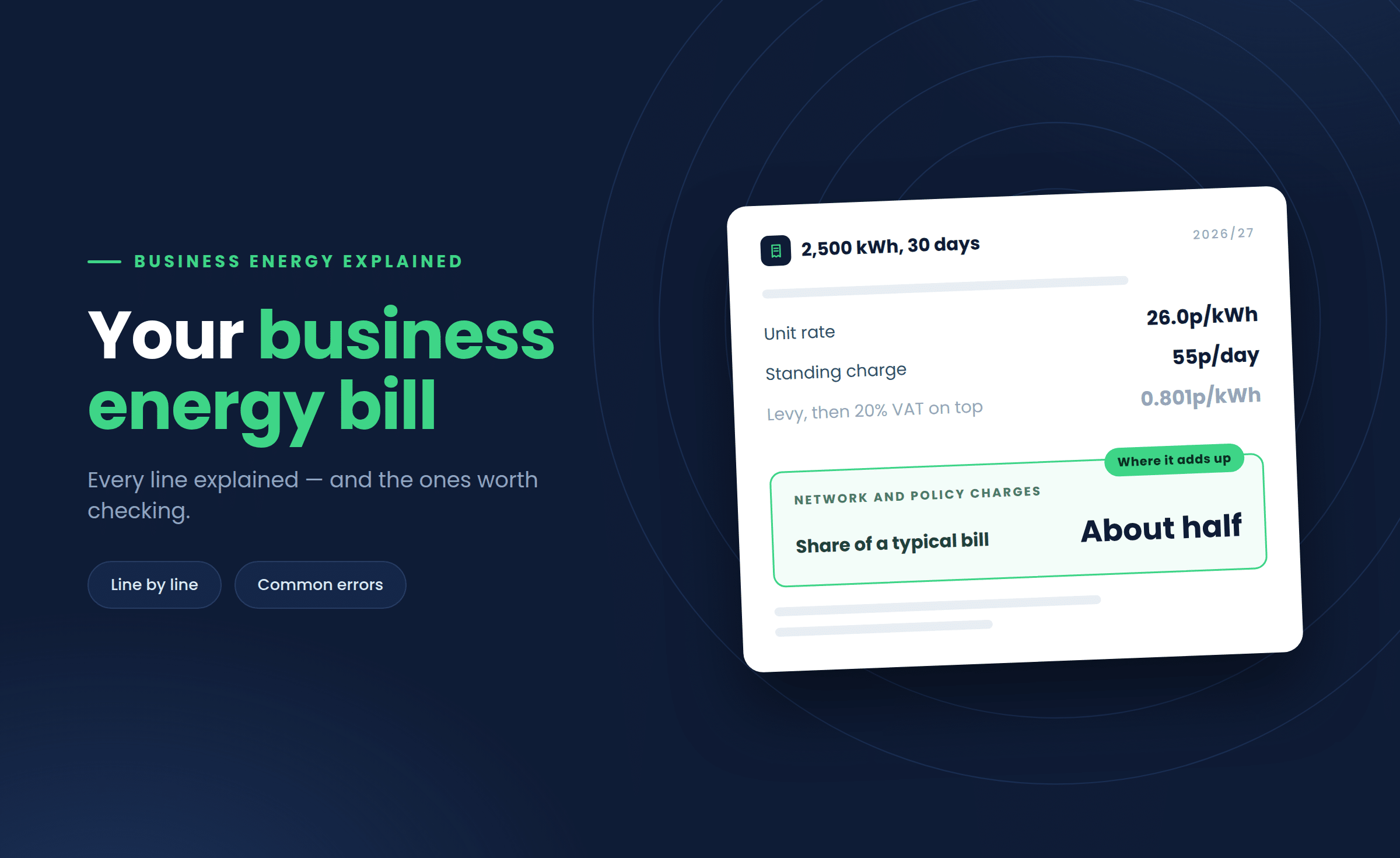
A business energy bill is your usage multiplied by a unit rate, plus a daily standing charge, the Climate Change Levy and VAT. Business bills also carry network and policy charges that a home bill does not.
Knowing what each line means helps you spot errors and check you are on the right rate. It also makes it far easier to compare quotes when your contract ends.
This guide breaks a bill down line by line, with a worked example. When you are ready, you can compare business energy to see if you are overpaying.
What are the main charges on a business energy bill?
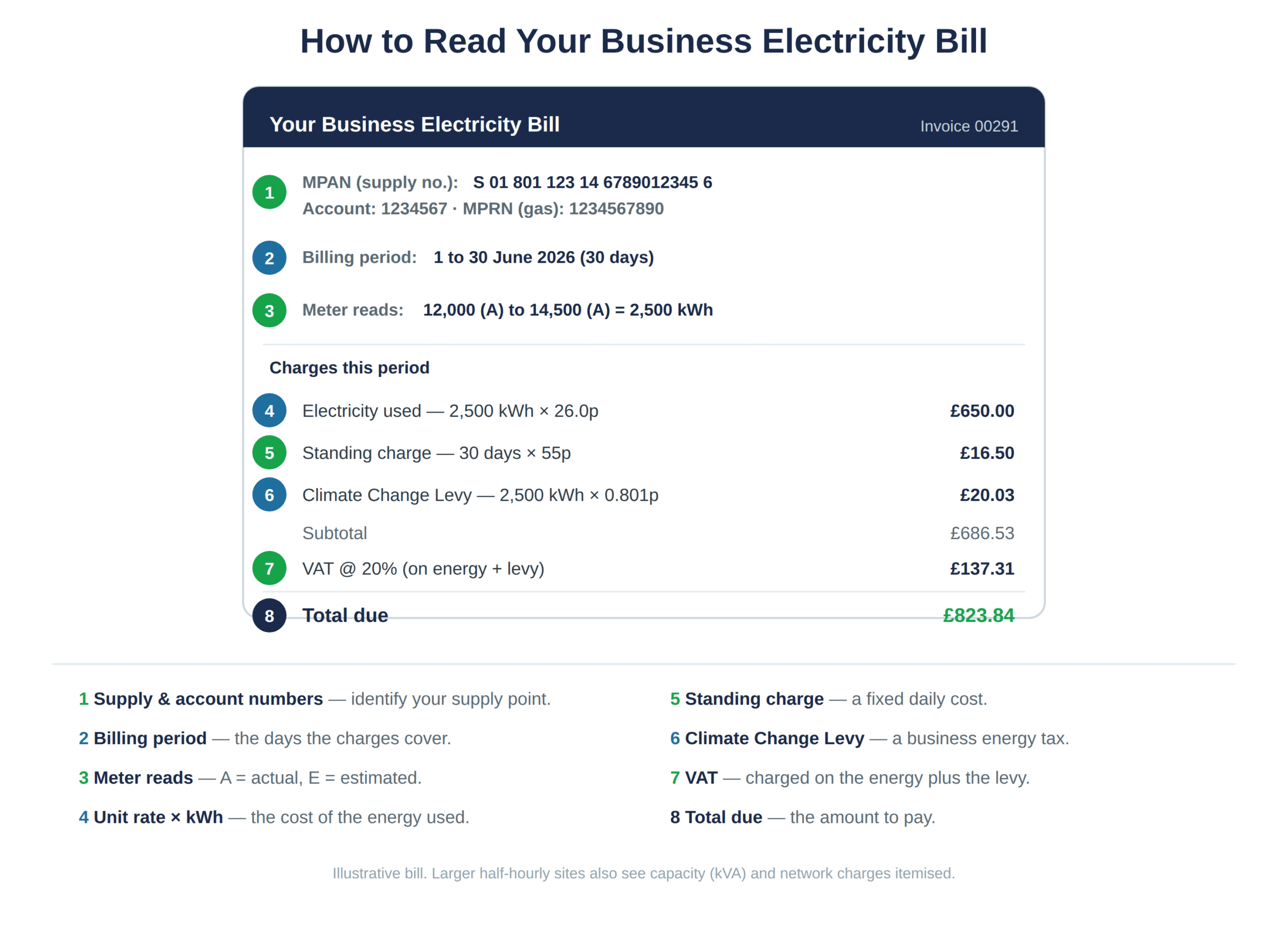
The main charges are the unit rate for the energy you use, a daily standing charge, the Climate Change Levy and VAT. The annotated example below shows how they fit together.
Unit rate and standing charge
The unit rate is the price for each kWh you use, and the standing charge is a fixed daily cost you pay even at zero usage. Business standing charges are not capped, so they vary by site and meter type.
Taxes and the levy
VAT is added at 20% for most businesses, or 5% for low-usage and qualifying sites. The Climate Change Levy is a separate business energy tax, shown on its own line.
| Line on your bill | What it is |
|---|---|
| Unit rate (p/kWh) | The price for each unit of energy you use |
| Standing charge (p/day) | A fixed daily cost for staying connected |
| Usage (kWh) | How much energy you used in the period |
| Climate Change Levy | A government tax on business energy |
| VAT | Charged on the energy plus the levy |
| MPAN / MPRN | Your electricity and gas supply numbers |
| Amount due | The total to pay for the period |
How do you check your meter readings?
Look for the read type next to each figure: A means an actual reading and E means an estimate. Bills built on estimates are the most common cause of surprise charges.
Actual versus estimated reads
An actual read comes from the meter, from you or from a smart meter, while an estimate is the supplier’s best guess from past usage. Suppliers use different letters, so check your bill’s own key.
Why estimates cause problems
An estimate that is too low builds up hidden debt that arrives as a large catch-up bill later. Sending a regular meter reading, or having a smart meter, keeps your bills accurate.
What are the supply numbers and account details?
Your bill shows your MPAN for electricity, your MPRN for gas, your account number and your contract end date. These identify your supply and tell you when to switch.
MPAN and MPRN
Your MPAN is the electricity supply number, starting with an S, and its first two digits are your profile class. The MPRN is the gas equivalent, and both stay the same if you switch supplier.
Account, meter serial and contract end date
The account number is your reference with the supplier, and the meter serial number is printed on the meter itself. The contract end date is the one to diarise, because it sets when you can switch your business energy supplier.
How is your bill total calculated?
Your total is the energy charges plus the standing charge and the Climate Change Levy, with VAT added last on the combined amount. The example below follows the numbers through.
A worked example
Take a shop using 2,500 kWh of electricity over 30 days. The CCL is charged at 0.801p per kWh for 2026 to 2027, and VAT is 20%.
| Charge | Calculation | Amount |
|---|---|---|
| Electricity used | 2,500 kWh × 26.0p | £650.00 |
| Standing charge | 30 days × 55p | £16.50 |
| Climate Change Levy | 2,500 kWh × 0.801p | £20.03 |
| Subtotal | £686.53 | |
| VAT at 20% | on £686.53 | £137.31 |
| Total due | £823.84 |
Notice that VAT is applied to the energy and the levy together, not the energy alone. For how VAT and standing charges work, Ofgem’s explainer is a useful reference.
What are the network and policy charges?
A large share of a business bill, often around half, is network and government policy charges rather than the raw energy. On a fixed contract they are built into your unit rate, and on a flexible contract they are itemised.
DUoS, TNUoS and BSUoS
DUoS pays for your local distribution network, and TNUoS pays for the national transmission grid, which costs more in the south than the north. BSUoS covers the cost of balancing the system minute by minute.
Capacity Market and policy costs
The Capacity Market charge helps keep enough generation available at peak times, and other lines fund low-carbon power. One myth to drop: under Ofgem’s Targeted Charging Review, the residual network charges moved to fixed capacity bands, so old advice about avoiding winter Triad peaks no longer applies to them.
What extra charges do larger sites see?
Larger, half-hourly sites see capacity and reactive power charges, plus time-banded unit rates. These do not appear on smaller business bills.
Capacity and availability (kVA)
You agree an available capacity with your network, measured in kVA, and pay for it whether you use it or not. Set it too high and you pay for headroom you never use, too low and you face excess charges.
Reactive power and time bands
Sites with motors or older equipment can draw reactive power, which attracts a charge if it is too high. Half-hourly rates are also time-banded, so shifting use out of peak periods cuts cost, which energy procurement support can help you manage.
| Charge (larger sites) | What it is |
|---|---|
| Capacity / availability (kVA) | A charge for your agreed supply capacity |
| Excess capacity | A penalty for exceeding your agreed kVA |
| Reactive power | A charge for poor power factor |
| Time-banded unit rates | Higher rates at peak times, lower off-peak |
What billing errors should you check for?
Check for estimated reads, the wrong VAT rate and rates that do not match your contract. If a bill is wrong, you can query it and escalate if needed.
Common errors
- An estimated read used when an actual reading exists.
- A unit rate or standing charge that does not match your signed contract.
- The wrong VAT rate, or the levy charged when you are exempt.
- Out-of-contract rates applied after a contract end date you were not warned about.
- An agreed capacity set too high, so you pay for unused headroom.
How to query and escalate
Raise a written complaint with your supplier, quoting your account number, supply number and the disputed lines. If it is unresolved after eight weeks, or you get a deadlock letter, you can take it to the Energy Ombudsman.
There is also back-billing protection: a microbusiness generally cannot be charged for energy used more than 12 months ago if the supplier failed to bill it correctly.
How is a business bill different from a domestic one?
Business bills have no price cap, add the Climate Change Levy and itemise network charges. VAT-registered businesses can also reclaim the VAT they pay.
The main differences
Because there is no cap, rates depend on your contract, so timing and comparison matter more. It pays to know your usage and check whether you could compare business energy suppliers for a better rate, whether you buy business electricity or business gas.