
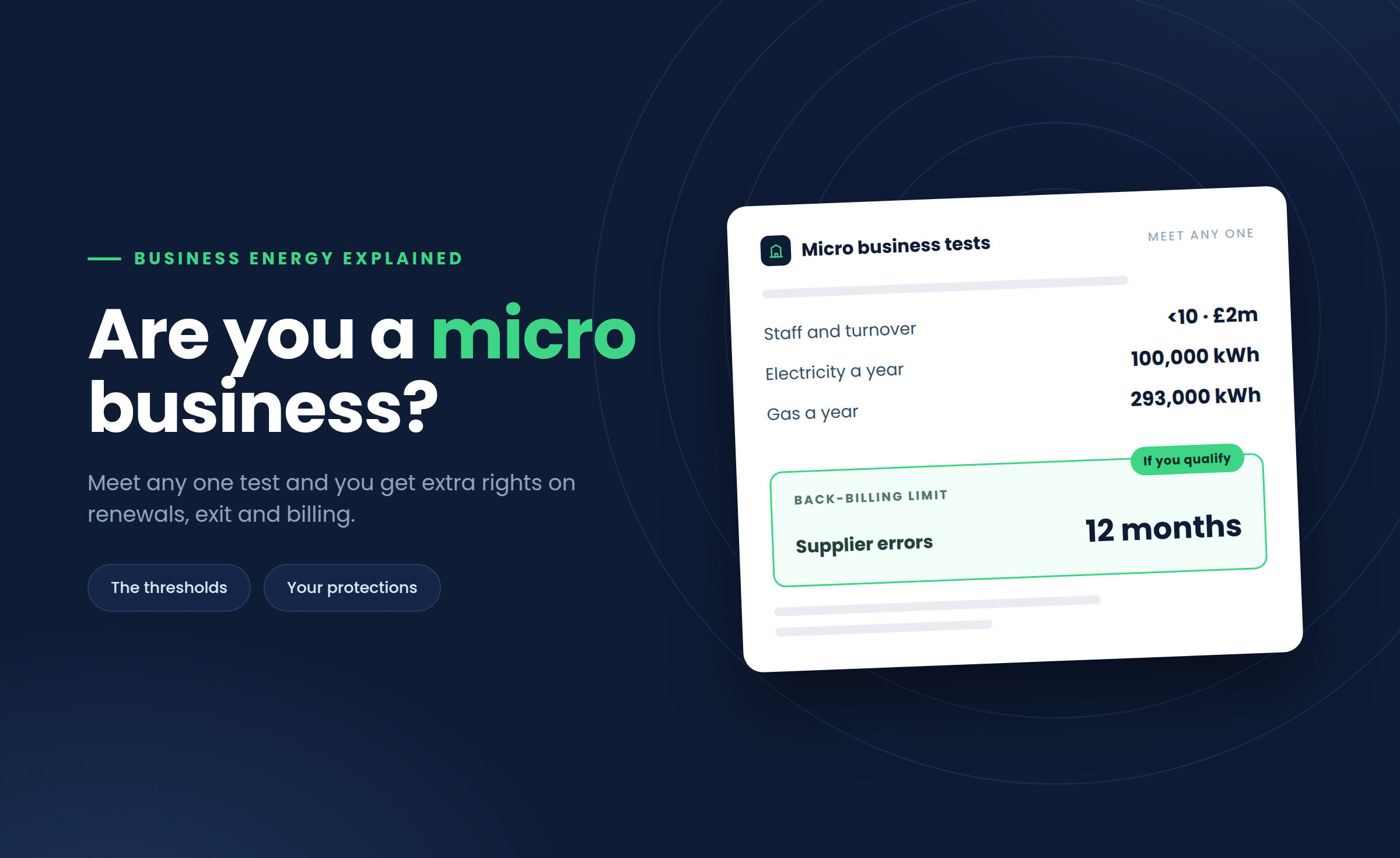
A micro business is the smallest category of energy customer, and it comes with extra protections from Ofgem. You qualify on size, or simply by using little energy, and the status makes contracts fairer and easier to leave.
Knowing you are a micro business is worth real money, because it changes your rights on renewals, exit, billing and disputes. This guide explains what counts, the protections Ofgem gives you, and where to turn for help.
Micro business status does not mean you are on the best rate, though. It is still worth running a business energy comparison and comparing business electricity rates and business gas rates to check your deal is competitive.
What counts as a micro business for energy?
You are a micro business if you meet any one of Ofgem’s criteria: fewer than 10 staff and £2 million or less in turnover, or you use 100,000 kWh of electricity or 293,000 kWh of gas a year or less.
The qualifying criteria
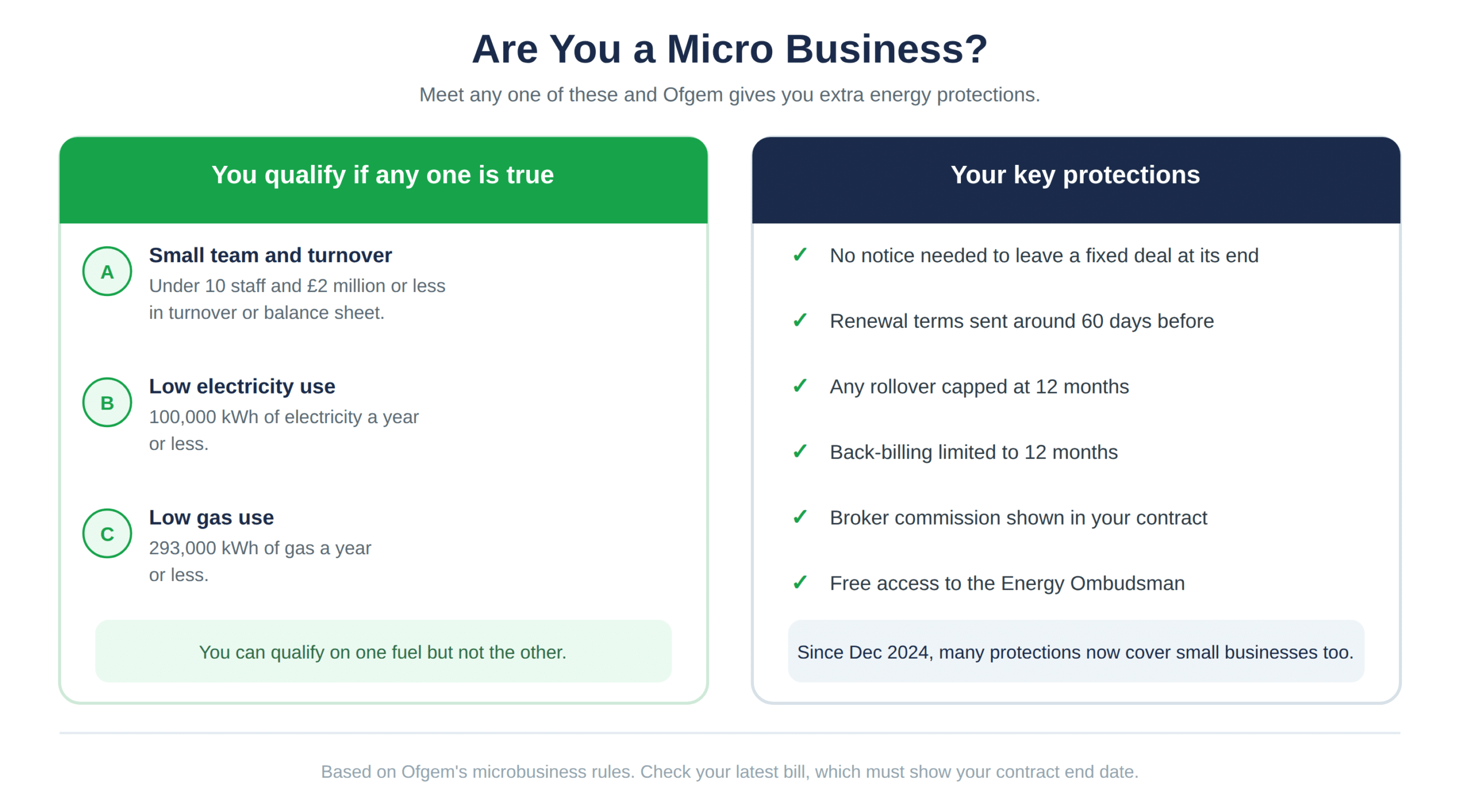
You only need to meet one of the tests below to qualify, and the usage figures are in kWh over a year. The graphic sums up who qualifies and what they get.
| Qualify as a micro business if you meet any one | Threshold |
|---|---|
| Staff and turnover | Fewer than 10 employees and £2 million or less in turnover or balance sheet |
| Electricity use | Uses 100,000 kWh of electricity a year or less |
| Gas use | Uses 293,000 kWh of gas a year or less |
You can qualify on one fuel only
The electricity and gas tests are separate, so a site can be a micro business for one fuel but not the other. Plenty of sole traders, small shops and independent restaurants qualify on usage alone.
Why does micro business status matter?
Micro business status gives you rights that larger firms do not get, covering how contracts are sold, renewed, ended and disputed. Together they make it harder to be locked into a poor deal.
The protections at a glance
Ofgem sets rules suppliers must follow for micro businesses. The table below summarises the main ones covered in this guide.
| Protection | What it means for you |
|---|---|
| Upfront contract terms | Key prices and terms shown before you sign |
| Renewal terms | A renewal notice around 60 days before the end date |
| Leaving a fixed deal | No termination notice needed to leave at the end |
| Back-billing | Charges limited to the last 12 months for supplier errors |
| Broker commission | Any commission disclosed in your contract |
| Disputes | Free access to the Energy Ombudsman |
Where to check your status
Your supplier must print your contract end date on your bill, which is the quickest place to look. If you are not sure whether you qualify, your annual usage in kWh from a recent bill will usually settle it.
What contract rights do micro businesses have?
Micro businesses get clear pre-sale information, a renewal notice before the end date, and the right to leave a fixed contract at its end without giving notice. Any rollover is also capped at 12 months.
Renewals and leaving
Your supplier must send renewal terms in the run-up to your end date, typically no earlier than 120 days and around 60 days before. Since October 2022 you no longer have to give termination notice to leave a fixed contract at its end, so you can switch supplier freely when it finishes.
Rollovers are capped
If you do nothing at the end, a rollover cannot last more than 12 months for a micro business. It is still an uncompetitive rate, so lining up a new deal early is far better than letting it roll.
How are micro businesses protected on bills?
Two rules protect micro businesses on billing: suppliers cannot back-bill for errors older than 12 months, and any broker commission must be shown in your contract. Your end date must also appear on your bill.
The 12-month back-billing limit
If a supplier failed to bill you correctly, Ofgem’s back-billing rule stops it charging for energy used more than 12 months ago. That protects you from a surprise catch-up bill caused by the supplier’s mistake.
Broker commission must be visible
If you used a broker, the commission built into your rates must be disclosed in your contract. This began for micro businesses in 2022 and, as Ofgem confirmed, now covers all non-domestic customers.
Do micro businesses pay less VAT and Climate Change Levy?
Low-usage sites qualify for the reduced 5% VAT rate and are exempt from the Climate Change Levy. The threshold is 33 kWh of electricity or 145 kWh of gas a day, not your micro business status itself.
The low-usage thresholds
If your average use is 33 kWh of electricity a day, about 1,000 kWh a month, or the gas equivalent, you get 5% VAT instead of 20% and no Climate Change Levy. Many small sites fall under this without realising.
How the lower rates apply
Suppliers usually apply the reduced rates automatically based on your consumption. Some ask you to complete a VAT declaration form, so it is worth checking your bill to confirm you are on the right rate.
How do you resolve a dispute as a micro business?
Raise the issue with your supplier or broker first. If it is not resolved within eight weeks, or you get a deadlock letter, a micro business can take it to the Energy Ombudsman free of charge.
The escalation route
Complain in writing and keep a record of every contact. If the eight weeks pass without a fix, the Energy Ombudsman offers free, independent dispute resolution, and its decision is binding on the supplier but not on you.
It covers brokers too
The scheme covers disputes with brokers as well as suppliers, since a supplier can only work with brokers signed up to a redress scheme. That gives you a route even when the problem sits with a third party.
Are the micro business protections changing?
Yes. From December 2024, Ofgem extended many of these protections beyond micro businesses to the larger small business category, so more firms now get Ombudsman access and similar rights.
The small business extension
The December 2024 changes widened protections such as Energy Ombudsman access to small businesses, not just micro businesses. If you are just over the micro thresholds, you may still be covered.
What counts as a small business
A small business is broadly one with fewer than 50 employees and turnover of £6.5 million or less, or a balance sheet of £5 million or less. Usage thresholds of 200,000 kWh of electricity or 500,000 kWh of gas a year also apply.
What if your micro business is struggling with bills?
If you are struggling to pay, contact your supplier early. Many offer payment plans or hardship support for micro businesses, and free independent advice is available if you need it.
Talk to your supplier first
Most suppliers have teams that help small and micro businesses in difficulty, and they can often arrange a payment plan or short-term relief. Get in touch as soon as you see a problem coming, rather than after a missed payment.
Where to get independent help
Citizens Advice and Business Debtline both offer free guidance on energy debt and your rights. Reviewing your energy procurement and moving to a cheaper deal can also ease the pressure over time.