
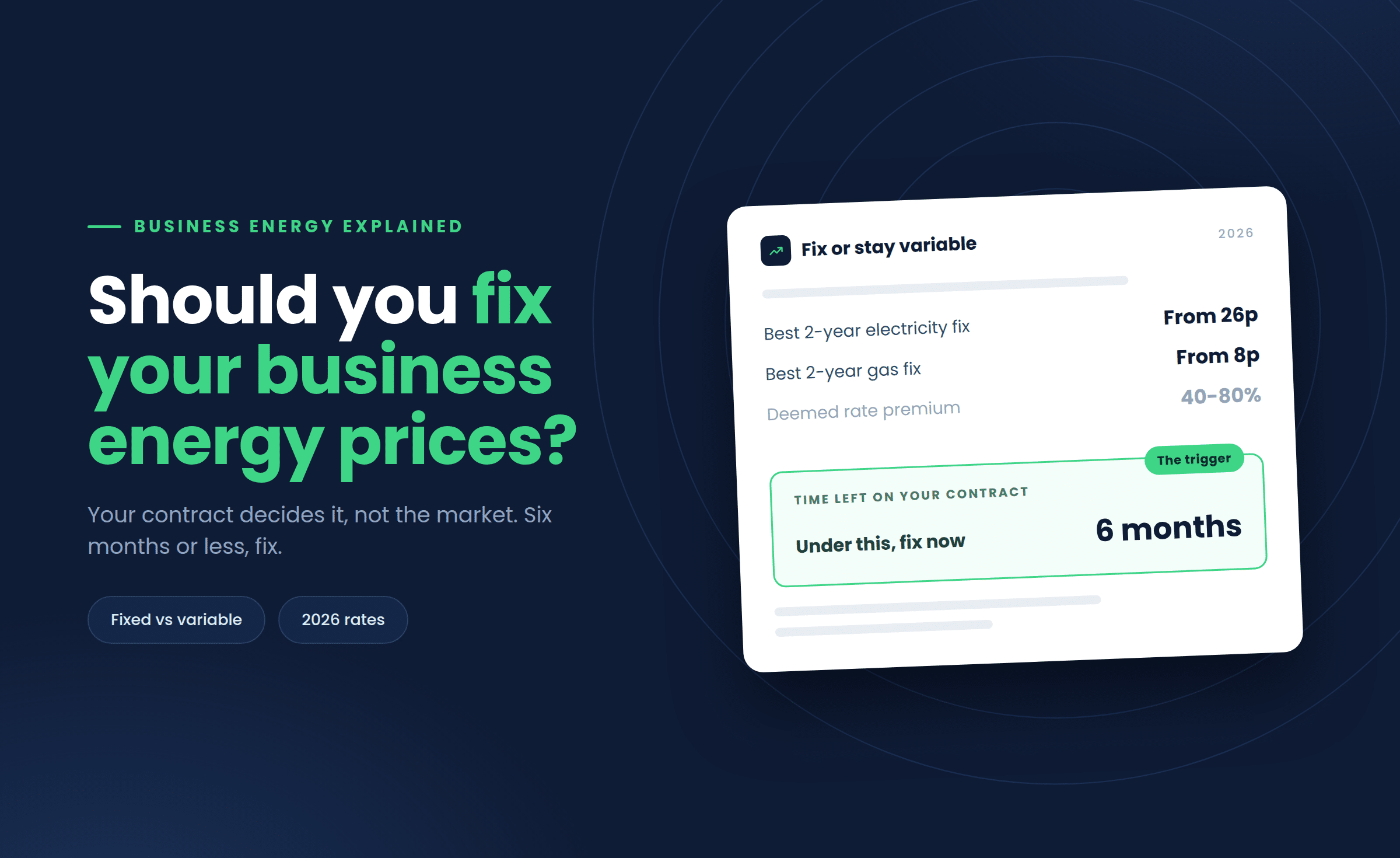
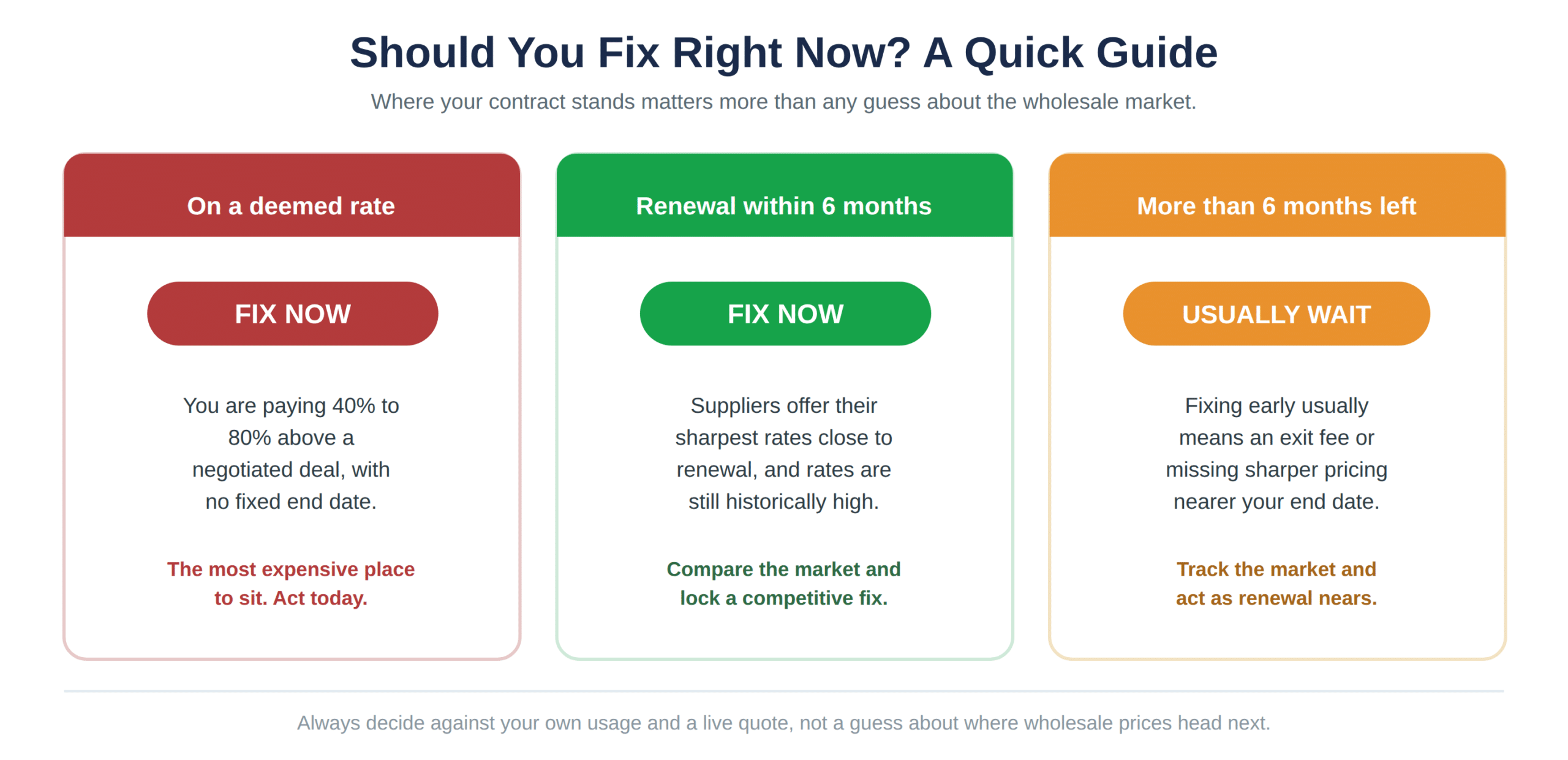
For most businesses, fixing your energy rate now makes sense if your deal ends within six months or you are already on a deemed rate, since a fixed contract protects against the 40% to 80% premium charged on out-of-contract supply.
Deciding whether to fix or stay variable feels harder than it needs to. There is real uncertainty in the wholesale market, and nobody can guarantee which way prices move over the next year.
What you can do is look at where rates sit today against recent history, weigh your appetite for risk, and decide on your actual exposure rather than guesswork. This guide walks through the fixed versus variable question and gives you a framework for deciding.
What does fixing your business energy price mean?
Fixing means agreeing a set pence per kWh rate with your supplier for a defined term, usually one to three years, protecting you from wholesale rises but also meaning you will not benefit if prices fall.
Fixed, variable and deemed
It is a trade of flexibility for certainty. Once fixed, your unit rate is locked regardless of the wholesale market, which makes budgeting far easier for finance teams.
The alternative, a variable or deemed rate, moves with the market or defaults to a supplier’s standard, usually inflated, pricing. Deemed rates apply when there is no active energy contract in place, often after a house move or a lapsed renewal.
| Fixed rate | Variable rate | |
|---|---|---|
| Unit rate | Locked for the term | Moves with the market |
| Budgeting | Predictable | Hard to plan |
| If prices rise | You are protected | You are exposed |
| If prices fall | No benefit | You benefit |
| Best for | Most SMEs wanting certainty | Risk-tolerant firms watching the market |
What are current rates telling us about timing?
The best 2026 fixed rates start from around 26p/kWh electricity and 8p/kWh gas on a two-year term, sitting close to the current all-business averages of 24.14p and 5.17p.
The table below shows the picture by fuel, from DESNZ price data. For the fuller breakdown, see our guides to current business electricity rates and business gas per kWh.
| Fuel | All-business average | Best fixed rate (2-year) |
|---|---|---|
| Electricity | 24.14p/kWh | From around 26p/kWh |
| Gas | 5.17p/kWh | From around 8p/kWh |
Why the best fix sits above the average
A good fix looking higher than the average catches people out. The averages are weighted by huge industrial users, so a typical small business paying a little above the all-business figure is normal, not a bad deal.
Electricity is broadly flat year on year but still around 60% above where it sat five years ago. Easing yet historically high is exactly the environment where businesses ask whether to fix now or wait.
What is the real risk of staying on a variable rate?
Staying variable means exposure to sudden wholesale spikes and, if your contract lapses entirely, deemed rates that run 40% to 80% above a negotiated deal.
Lessons from the 2021 energy crisis
The 2021 to 2023 crisis is the clearest example of variable exposure at its worst. Businesses without a fixed contract saw bills multiply within months, with little warning and no price cap to soften the blow, as the National Energy System Operator managed a badly stressed grid.
- No spike protection: nothing shields you from sudden wholesale rises.
- Automatic deemed rates: apply if a contract lapses, often 40% to 80% higher.
- Harder budgeting: no fixed monthly cost to plan around.
- No cooling-off: no statutory fallback if things move against you quickly.
If you are unsure whether you are even on a contract, our guide to deemed energy contracts explains how to check, and Ofgem’s business energy advice sets out your rights.
When does it make sense to hold off on fixing?
Holding off can make sense if your existing fixed contract still has six months or more to run, since locking a new rate too early usually means an exit fee or missing sharper pricing nearer your renewal.
There is rarely a good reason to fix speculatively while you are mid-contract on a competitive rate. Most suppliers will not offer their sharpest renewal pricing until you are within a few months of your end date anyway.
Fixing early on a poor deal also carries a real cost. Early-exit charges can wipe out any saving from a slightly better rate, so the maths rarely favours breaking a competitive contract before it ends.
Situations where waiting is reasonable
- Plenty of time left: you are more than six months from your contract end date.
- Highly seasonal usage: a longer fix might lock in an unfavourable average.
- A big change coming: new premises or equipment will alter your usage profile.
Waiting is not the same as doing nothing. Track the market and know your options through your business energy renewal timeline, so you are ready to act the moment it makes sense.
How do you decide for your own business?
Compare your current rate against the usage-band average, check how long is left on your contract, and get a live quote so you decide with real numbers instead of market sentiment.
A simple decision guide
-
Pull your bill
Note your MPAN, current rate and end date, then check it against a good rate for your band.
-
Benchmark it
Compare against the current price per kWh for your usage band.
-
Get real quotes
Price up one, two and three-year fixes against your actual usage.
-
Weigh it up
Balance certainty against the unpredictable chance rates fall further.
Utility Saving Expert compares a panel of 30+ business energy suppliers, so you can see fixed options side by side rather than relying on one renewal letter.