
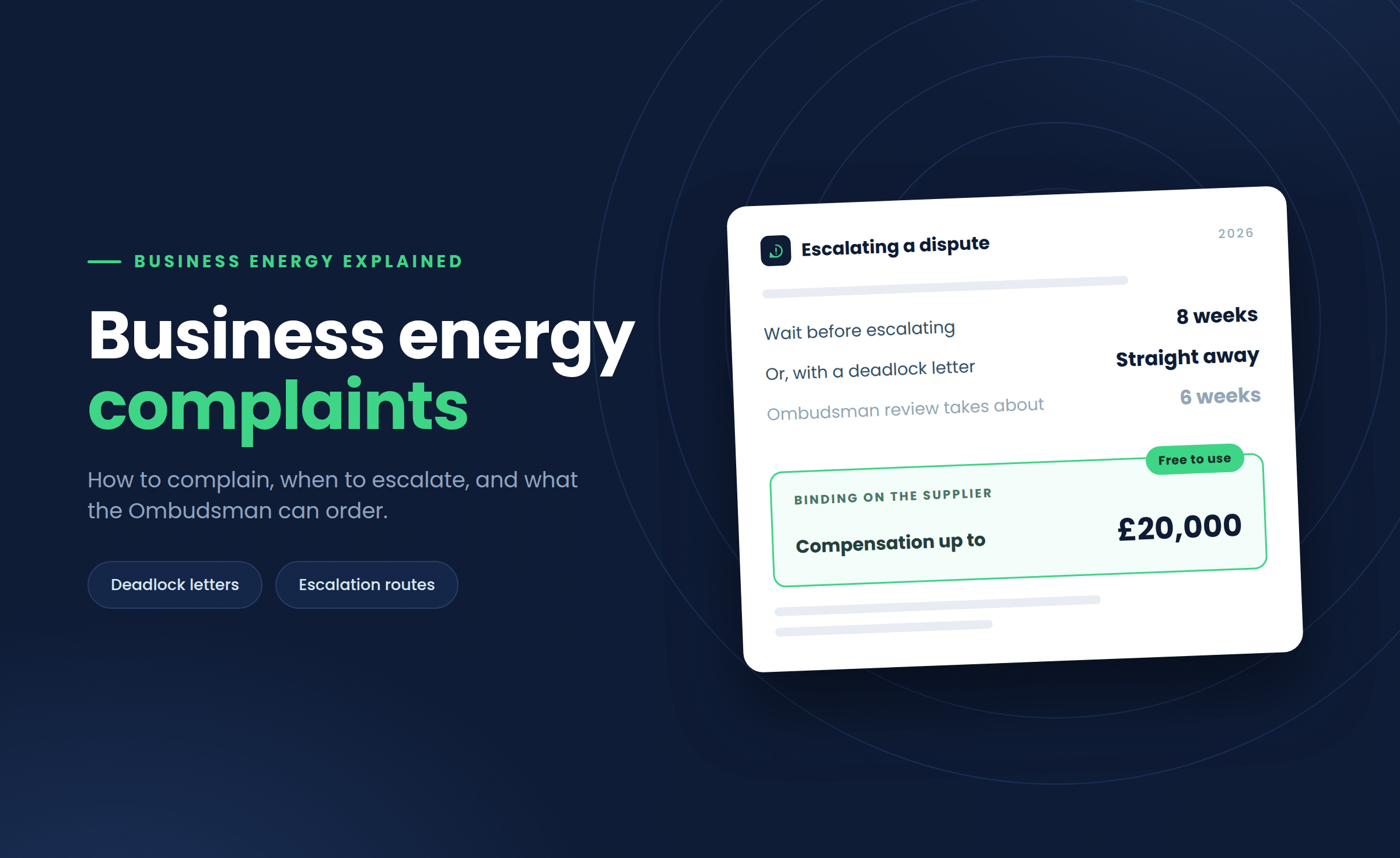
If you have a problem with your business energy supplier, you complain to them first, then escalate free to the Energy Ombudsman if it is not resolved. Billing disputes are by far the most common reason.
Business energy has fewer protections than home energy, so knowing the process matters. This guide covers how to complain, when you can escalate to the Energy Ombudsman, what it can order, and the routes beyond it.
Sometimes the cleanest fix is a fresh start. If poor service is the issue, it may be worth using a business energy comparison to move to a better-rated supplier.
What can you complain about?
You can complain about anything your supplier gets wrong, but billing issues dominate. Disputed usage, disputed account balances and late or inconsistent bills are the most common categories the Energy Ombudsman sees.
The most common complaints
Billing makes up more than half of the disputes the Energy Ombudsman handles. That covers wrong usage figures, disputed balances, back-billing and bills that arrive late or not at all.
Business-specific gripes
Beyond billing, common business complaints include high exit fees on rollover contracts and broker commission buried in the rates. Blocked switches, erroneous transfers and change-of-tenancy disputes also come up often.
How do you complain to your energy supplier?
Every complaint must go through your supplier’s own process first. Raise it formally, get a complaint reference number, and keep everything in writing so you have a clear record if you need to escalate.
Raise it formally
Start with the supplier’s complaints process, usually set out on a dedicated page. Suppliers must handle complaints promptly under Ofgem’s rules, so ask for a reference number and move the conversation to email early.
What to include
A clear, well-evidenced complaint is resolved faster and travels better if you escalate. Include the details below.
| Include | Why it helps |
|---|---|
| Business name, account number and a contact | Lets the supplier find and progress your case |
| Complaint reference and your MPAN or MPRN | Ties everything to the right supply and case |
| A concise summary of the issue | Makes the problem clear at a glance |
| Copies of supporting evidence | Backs up your version if it is disputed |
| The resolution you want | Tells the supplier exactly what would fix it |
What is a deadlock letter and when can you escalate?
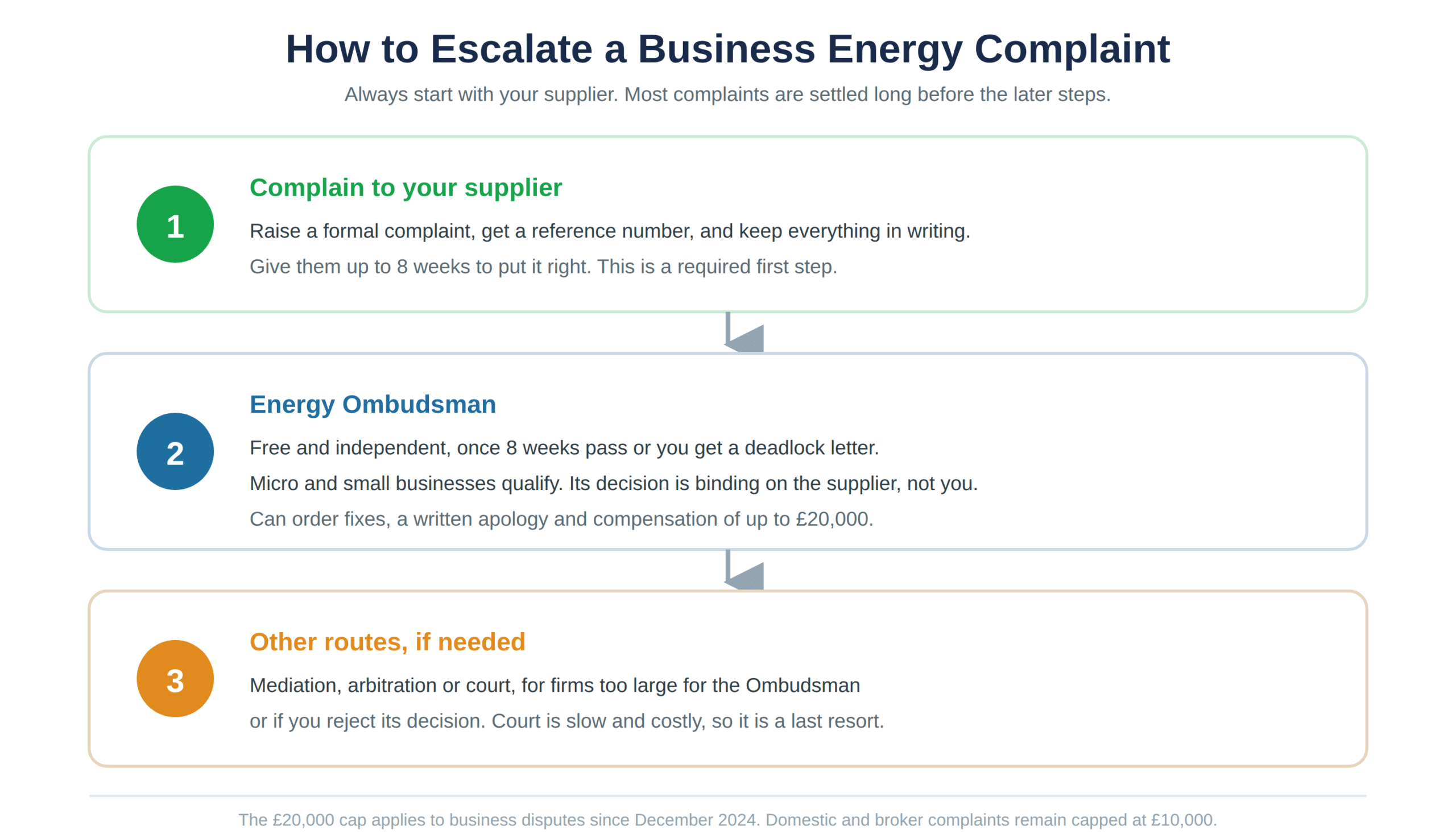
You can escalate to the Energy Ombudsman once eight weeks have passed without resolution, or as soon as your supplier issues a deadlock letter. A deadlock letter simply confirms the supplier cannot resolve the dispute.
The two triggers
Most escalation routes need you to have engaged with the supplier’s process for at least eight weeks. If the supplier accepts sooner that it cannot fix the issue, it issues a deadlock letter, which lets you escalate straight away.
Do not sit on a deadlock letter
Once you have a deadlock letter, you have 12 months to take the complaint to the Energy Ombudsman. Leave it longer and you can lose the right to escalate, so act while the case is fresh.
What is the Energy Ombudsman and are you eligible?
The Energy Ombudsman is a free, independent service that resolves disputes between businesses and their suppliers. Since December 2024 both micro businesses and small businesses can use it.
How to escalate
The graphic below shows the full escalation path, from your first complaint through to the routes beyond the Ombudsman.
Who qualifies
You are eligible if you meet the Ombudsman’s size criteria, which now include small businesses as well as micro businesses. The thresholds are below.
| Qualify if you meet either | Threshold |
|---|---|
| Size and finances | Under 50 staff and £6.5 million turnover or £5 million balance sheet or less |
| Electricity use | Uses 200,000 kWh of electricity a year or less |
| Gas use | Uses 500,000 kWh of gas a year or less |
What can the Energy Ombudsman do?
The Energy Ombudsman can order a supplier to fix the problem, pay compensation of up to £20,000, release you from a contract, or issue an apology. Its decision is binding on the supplier once you accept it.
Its powers
The Ombudsman has enforceable powers over suppliers. If you accept its final decision, the supplier must comply with the outcomes below.
| Power | What it can require |
|---|---|
| Corrective action | Fix bills, reverse charges or correct meter readings |
| Compensation | Up to £20,000 for a business dispute |
| Contract remedy | Release you from a contract without exit fees |
| Apology | A written apology and explanation of what went wrong |
Binding on the supplier, not you
You can accept or reject the Ombudsman’s decision. If you accept, the supplier is bound to carry it out, but if you reject it you keep the right to pursue other routes.
The £20,000 cap applies to business cases, while domestic and broker complaints stay at £10,000.
How does the Ombudsman process work?
You register the dispute online, submit evidence within 14 days, and the Ombudsman reviews the case in about six weeks before proposing a resolution. The service is free to use.
Registering and evidence
You raise the dispute through the Ombudsman’s online process and then have 14 days to send supporting evidence. That usually means your correspondence, the disputed bills and any relevant statements.
The review and outcome
The Ombudsman weighs the case against licence conditions, the contract terms and what is fair, rather than strict legal points. A review takes around six weeks, after which it proposes a resolution you can accept or reject.
What are the alternatives beyond the Ombudsman?
If your business is too large for the Ombudsman or you reject its decision, the alternatives are mediation, arbitration or court. Court is the slowest and most expensive, so it is a genuine last resort.
Mediation and arbitration
Mediation uses an impartial third party to help you and the supplier reach a settlement, which is only binding if both agree. Arbitration, where a contract requires it, ends in a binding private decision instead.
Court as a last resort
Court action gives the widest powers but is costly and slow, often taking 12 to 24 months. Courts usually expect you to have tried the supplier’s process and the Ombudsman or mediation first.
How do you avoid disputes in the first place?
Most disputes are avoidable. Reading contracts carefully, steering clear of verbal deals, submitting regular meter readings, and choosing a well-rated supplier prevent the majority of problems.
Prevention basics
Business contracts are binding with no cooling-off period, so read them before you sign and avoid agreeing anything by phone. Regular or smart meter readings stop the estimated bills that cause so many billing disputes.
Choose service, not just price
A cheap deal is a false economy if the service is poor. When you compare business electricity and business gas, weigh a supplier’s service record alongside the price, and review your energy procurement regularly.