
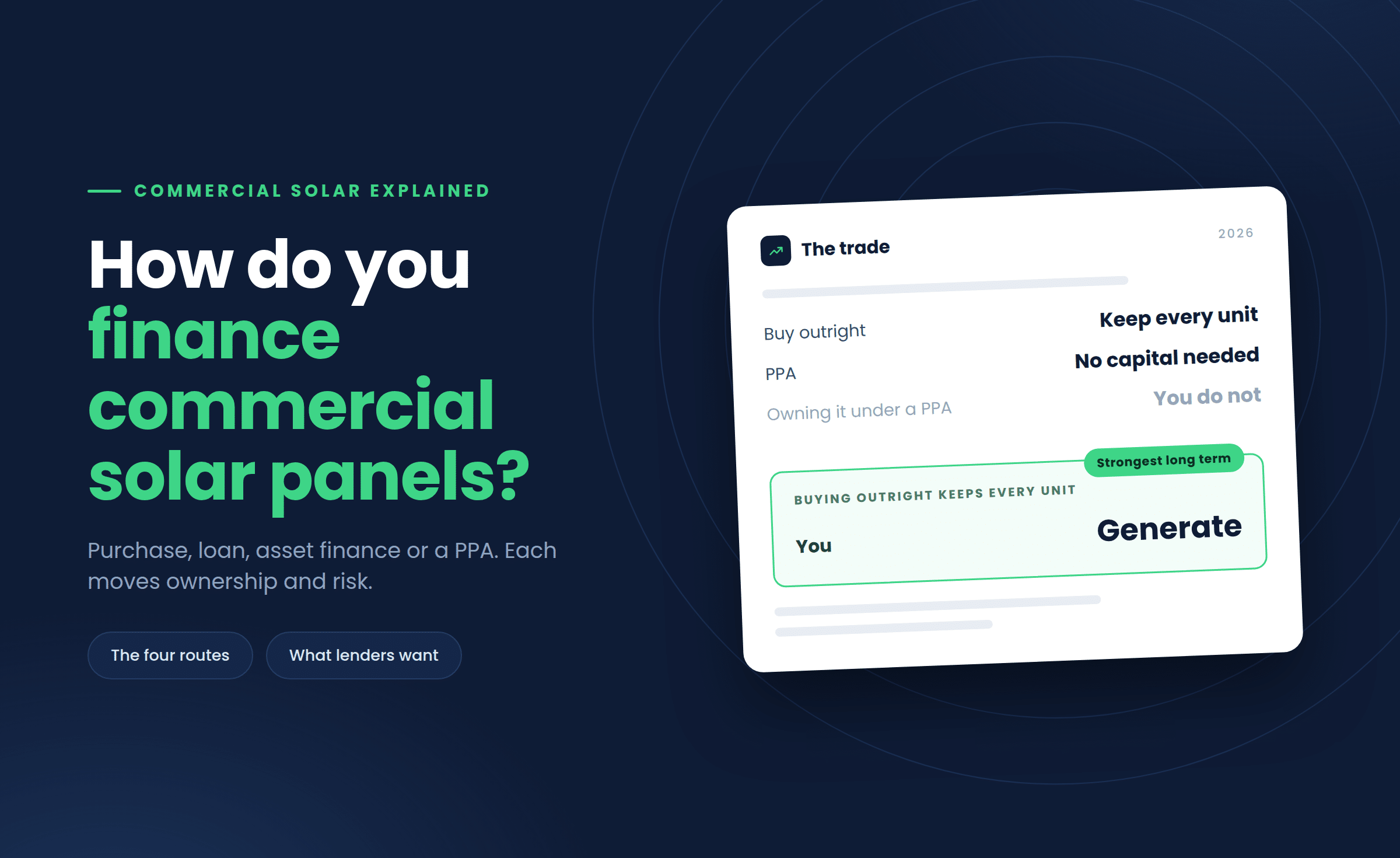
Most businesses finance commercial solar through outright purchase, a business loan, asset finance or leasing, or a power purchase agreement where a third party owns the system and sells you the electricity it generates at a discounted rate.
A commercial array large enough to move an energy bill rarely comes cheap. Even a modest rooftop install can run into five figures once you add inverters, scaffolding and the DNO connection.
That upfront number is the single biggest reason projects stall, even when the maths works. Our guide to commercial solar costs covers the spend, and this one covers how to fund it.
The good news is that finance has moved well past a simple choice between paying cash or walking away. Lenders, installers and investors now offer several routes that spread the cost or remove the outlay altogether.
Below are the main options, how a PPA actually works, and what a lender or installer looks for before they say yes.
What financing options are available for commercial solar?
Businesses can choose between outright purchase, a business loan, asset finance or leasing, and a power purchase agreement. Each option shifts ownership, risk and cash flow differently.
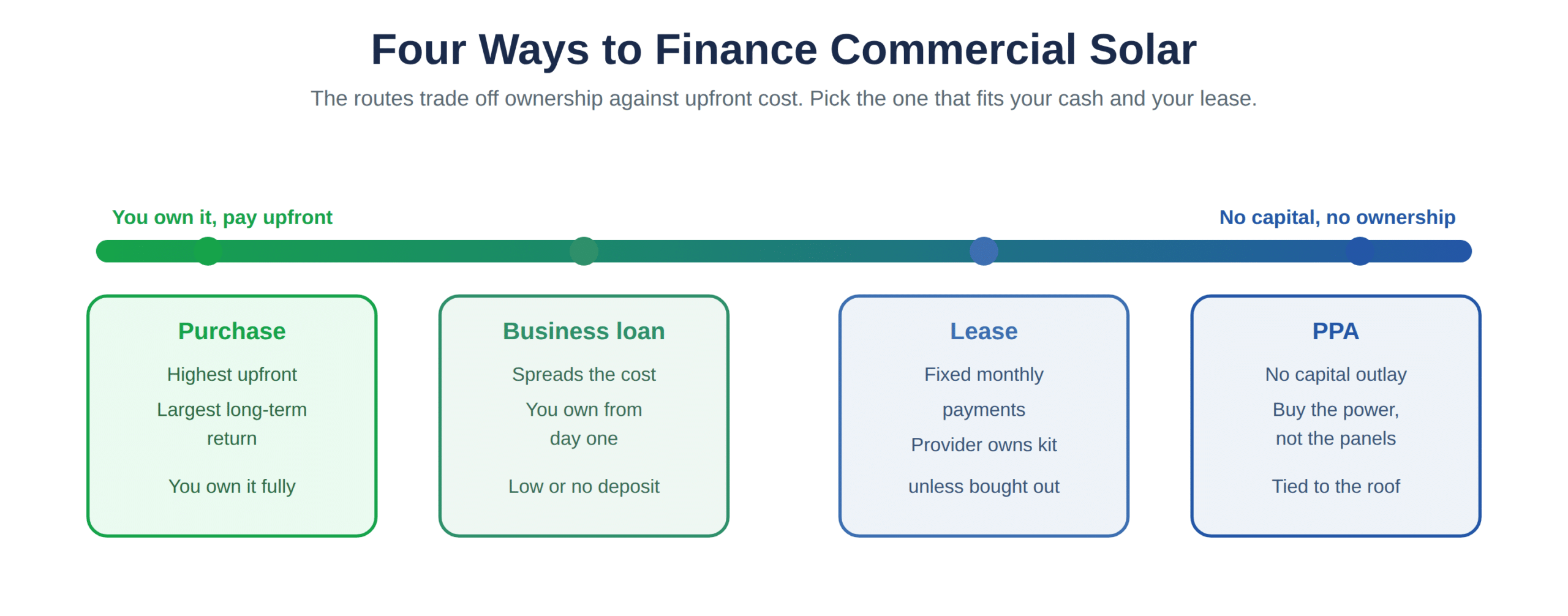
How the four routes compare
| Finance route | Who owns it | Upfront cost | Best suited to |
|---|---|---|---|
| Outright purchase | Your business | Highest | Capital available, long-term site |
| Business loan | Your business | None to low deposit | Ownership without draining cash |
| Asset finance / lease | Finance provider | None to low | Prioritising cash flow |
| Solar PPA / roof rental | Third-party investor | None | Savings with zero capital risk |
Buying outright means the highest day-one cost but the largest long-term return, since every unit generated and any export income is yours. A loan spreads that cost while you still own the asset, alongside your wider energy procurement planning.
Owning the asset also keeps depreciation and capital allowances on your own books rather than a funder’s. For a profitable business, that tax position can tip the decision toward a loan over a lease.
How does a solar power purchase agreement (PPA) work?
Under a commercial solar PPA, a third-party investor funds, installs and owns the panels on your roof, and your business agrees to buy the electricity generated at a rate that undercuts your grid price for a fixed term.
What happens to a PPA if you move premises?
Terms typically run between 10 and 25 years. The investor handles installation, maintenance, insurance and the DNO connection that any grid-connected system needs before it can export.
The catch most businesses miss is that a PPA is tied to the roof, not to your company. Moving out mid-term usually requires a novation to the new occupier or landlord.
If your lease has under ten years left to run, check the PPA’s transfer terms carefully before signing. An unresolved contract can complicate the sale or handover of a site.
A closely related model is roof rental, where a landlord is paid a fee for the roof space and the investor sells the power on or exports it. It suits a landlord who wants income without funding the system themselves.
Should you lease or buy commercial solar panels?
Buying delivers the strongest long-term saving because you keep every unit you generate, but leasing or a PPA suits businesses that would rather avoid upfront capital and ongoing maintenance.
Matching the route to your situation
Asset finance can sit on your balance sheet as debt depending on the structure, which matters near lending covenants. VAT treatment also differs, and our guide to VAT on solar for businesses covers the reliefs and exceptions.
- Own the building long term, capital available: purchase usually wins.
- Short lease or tight cash flow: a PPA or lease fits better.
- Somewhere in between: a business loan balances ownership against cash flow.
How long does it take commercial solar to pay for itself?
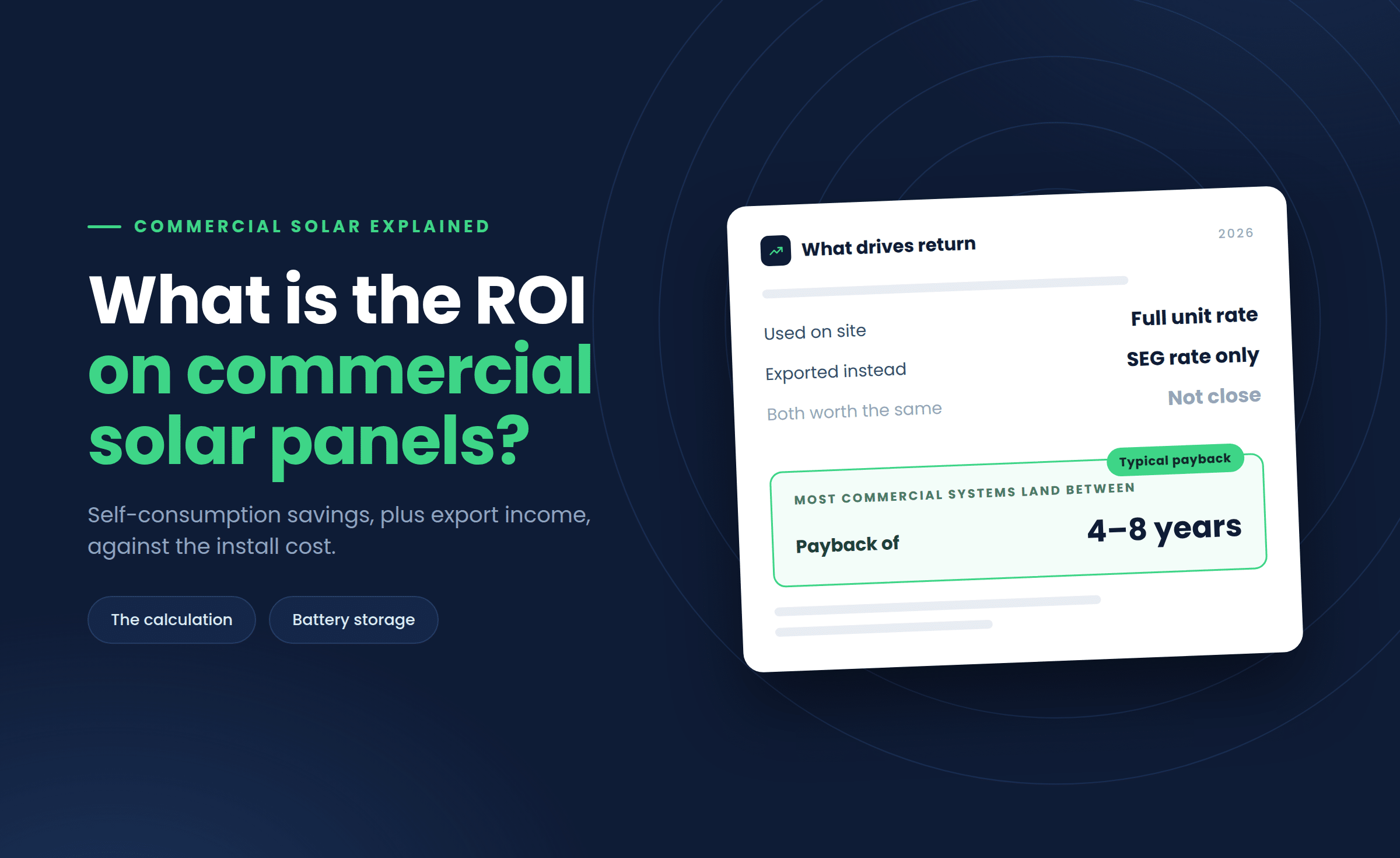
Payback for a purchased system typically falls between four and nine years, depending on system size, roof orientation, and how much generated power the business uses on-site rather than exporting.
Why self-consumption drives the number
Self-consumption is a bigger lever than export income, because using your own generation avoids the full delivered unit rate, around 24p per kWh for UK business electricity. Weigh it against your current business electricity rate, and see our solar ROI guide for the full calculation.
Treat any specific payback figure with caution. System cost, local irradiance, roof pitch and your own consumption pattern all move the number, sometimes by years in either direction.
What financial incentives reduce the cost of commercial solar?
The main incentives are the Smart Export Guarantee for surplus electricity, capital allowances on the equipment cost, and REGO certificates that support any renewable claims the business later wants to make.
The three incentives worth knowing
The Smart Export Guarantee pays for exported electricity at rates set by individual suppliers, while the Annual Investment Allowance can let you write off qualifying equipment against taxable profit.
- Smart Export Guarantee: income on the units you export.
- Capital allowances: including the Annual Investment Allowance on qualifying kit.
- REGO certificates: evidence of renewable generation for ESOS or SECR reporting.
What do lenders and installers look for before approving finance?
Lenders want a business with a stable trading history, an MCS-certified installer, a credible energy usage profile, and clear title or landlord consent to alter the roof.
Why installer accreditation matters for finance
An uncertified install can void warranties, complicate insurance and rule out export registration entirely. MCS accreditation for the installer, and RECC membership for the sales process, are close to non-negotiable for most funders.
Smaller or newer businesses may be asked for a director’s personal guarantee, particularly on unsecured lending or where the company has limited trading history to point to.
Lenders also like to see the DNO application sorted, or well underway, before releasing funds. A G98 or G99 already in progress signals a project that will actually connect and generate.
The single best move is to get quotes across more than one finance route before committing. The gap between the cheapest and most expensive way to fund the same system is often larger than businesses expect.