
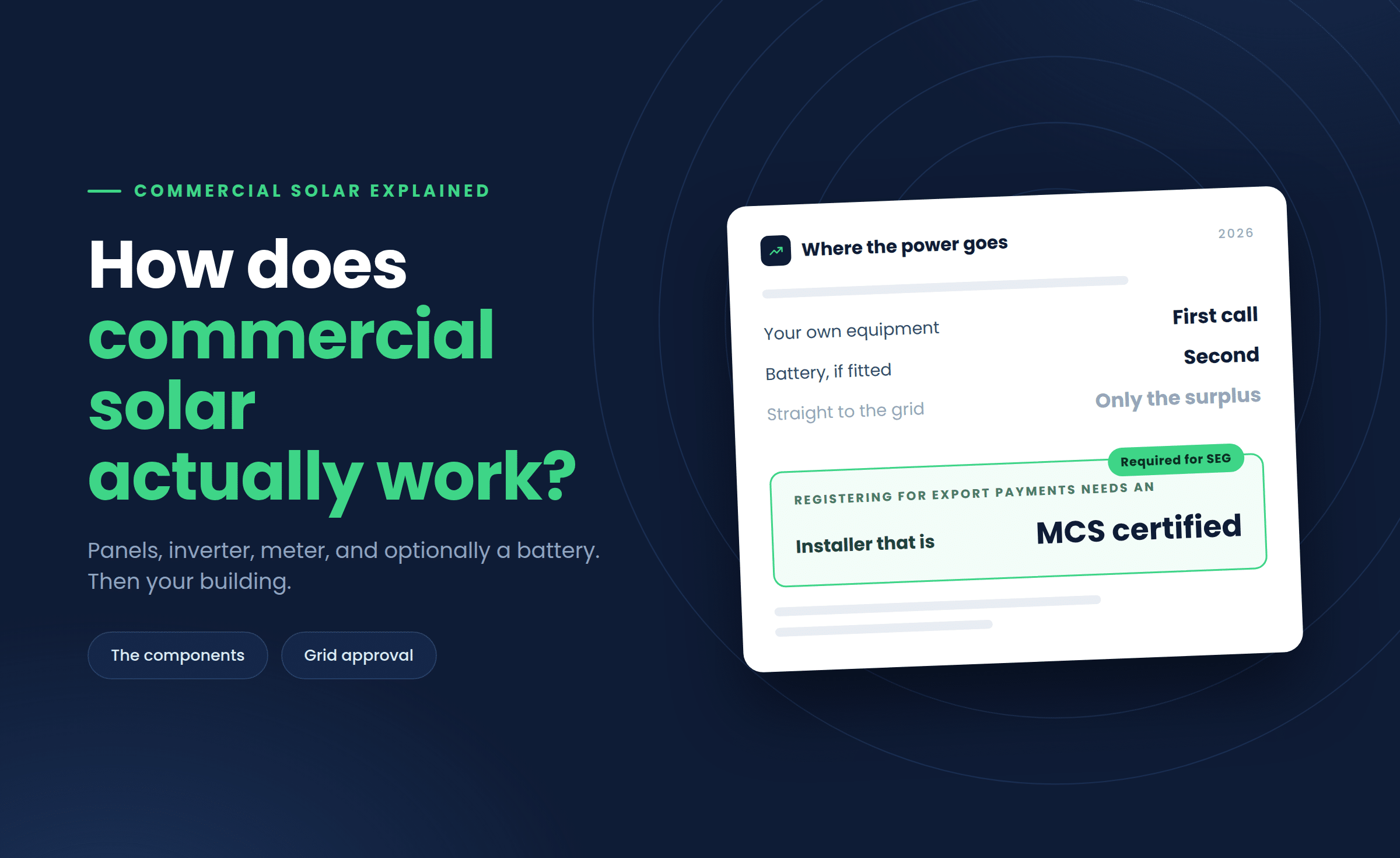
Commercial solar panels convert sunlight into DC electricity, an inverter turns that into usable AC power for the building, and any surplus your business does not use either exports to the grid or charges a battery, all tracked through metering.
You do not need an engineering degree to understand a business solar system, just five or six moving parts and how they connect.
Most of the confusion comes from jargon: kWp, inverters, G98 and G99, MCS certification, REGO certificates. None of it is complicated once you see how the pieces fit, and it helps when weighing whether solar is worth it.
Understanding the basics also helps when comparing quotes, since installers sometimes gloss over which components are included and which cost extra.
This guide walks through the components, how generation gets used, and who needs to sign off before you can connect.
What are the main components of a commercial solar PV system?
A typical business solar system has five parts: the panels, an inverter, the mounting and racking that fixes panels to the roof, a generation meter, and optionally a battery for storing surplus power.
What each part does
Each part has a specific job, and missing or undersized components are usually where installations underperform. The inverter in particular is the workhorse and the part most likely to need replacing during the system’s life.
Sizing is the other thing that makes or breaks a system. An array matched to your daytime demand pays back faster than one sized purely to fill the available roof.
| Component | What it does |
|---|---|
| Panels | Convert sunlight into DC electricity |
| Inverter | Convert DC into usable AC for the building |
| Mounting / racking | Fixes panels securely to the roof |
| Generation meter | Records how much the system produces |
| Battery (optional) | Stores surplus for use later in the day |
How does the electricity get generated and used?
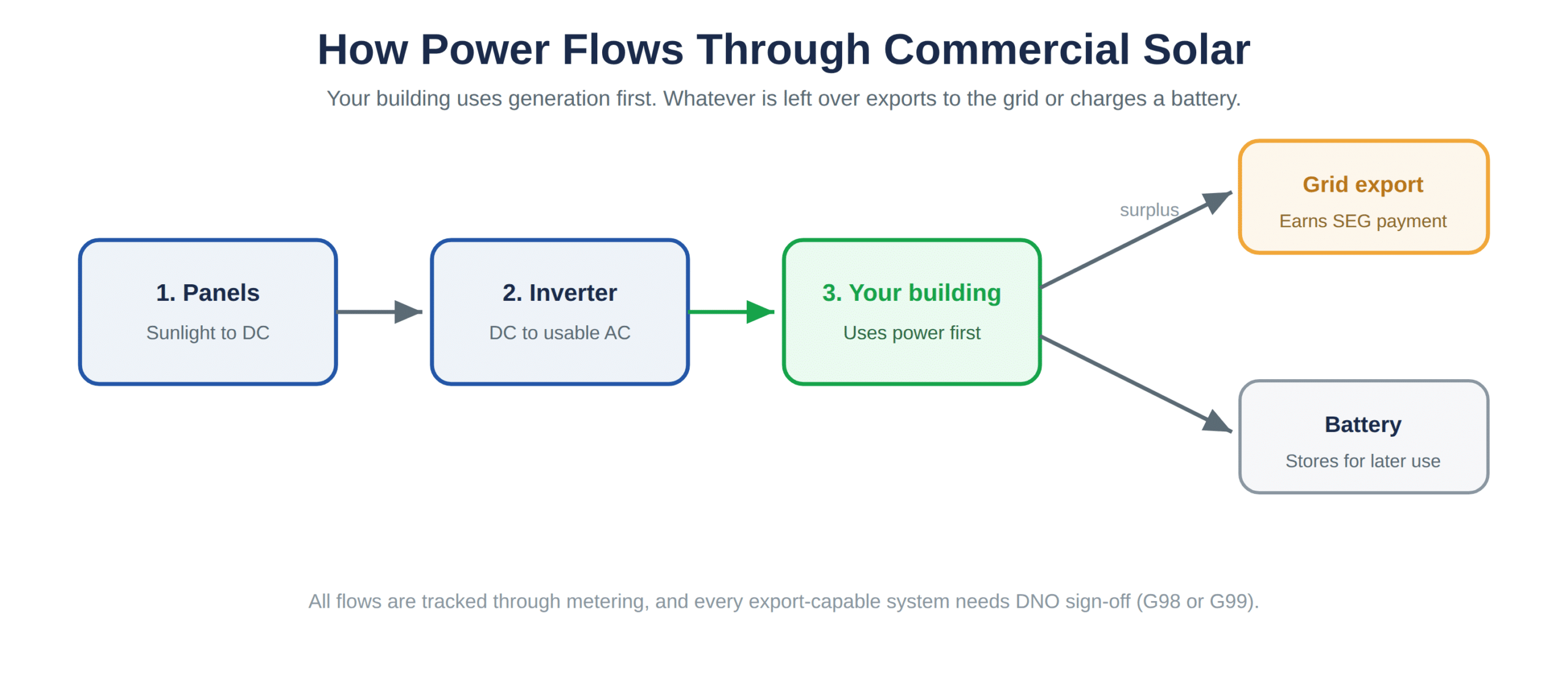
Sunlight hits the panels and generates DC current, the inverter converts it to AC synced with your supply, and your building’s own equipment draws that power first, before anything is imported from the grid.
Why timing matters more than total output
Output peaks around midday and tails off toward evening. Larger sites usually have half-hourly metering, which pairs import and generation data to show how much of your own power you actually use.
- Open 8am to 6pm: captures most of a typical UK solar generation curve.
- Open mainly evenings: misses the bulk of that generation window.
- Seasonal swing: UK generation is much higher in summer than winter.
Two businesses with identical roofs and identical annual generation can end up with very different savings. The one that uses power all day keeps more of it, while the one that closes early exports the rest at a lower rate.
What happens to surplus power your business doesn’t use?
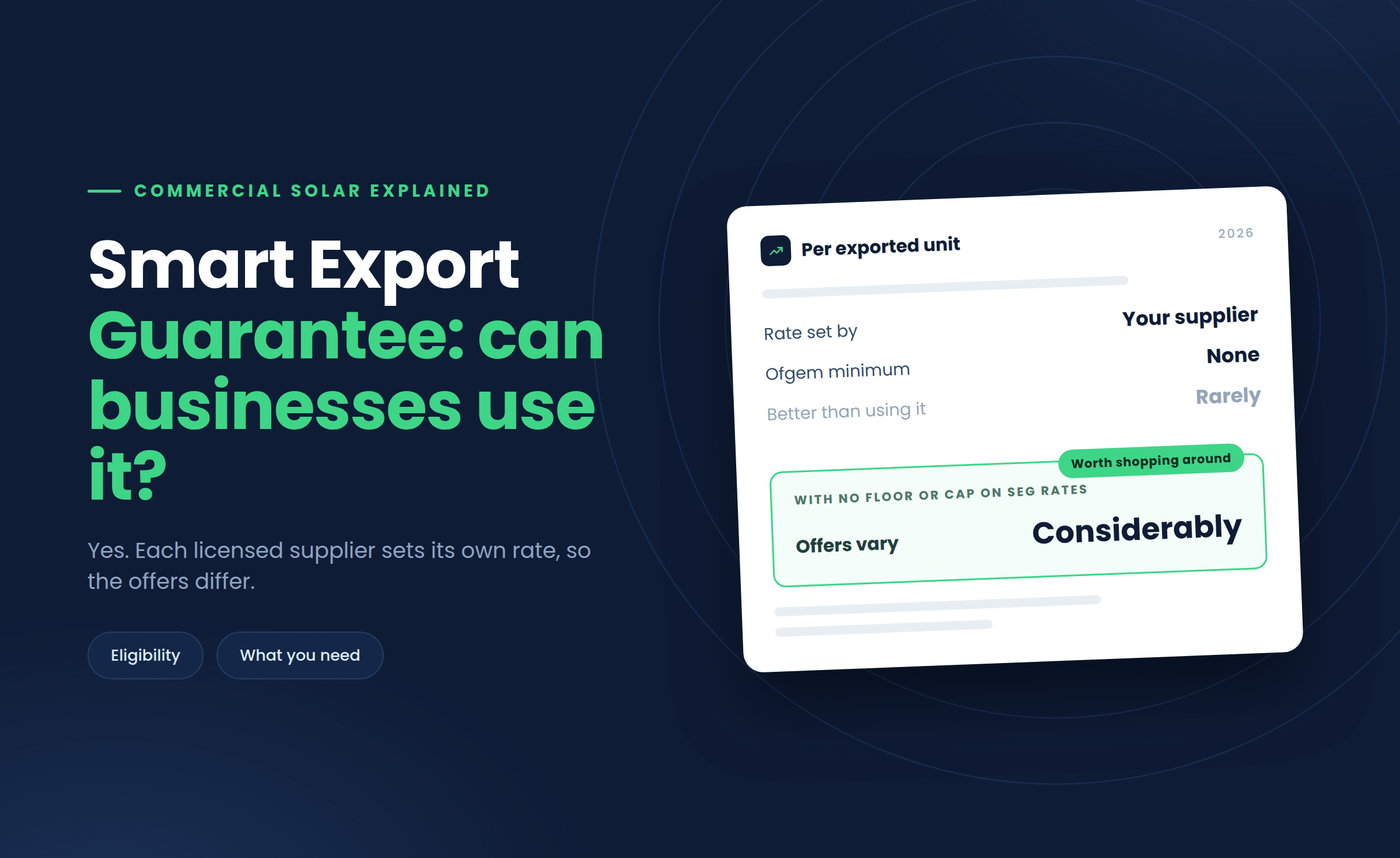
Surplus generation either exports to the local network, typically earning payment through a supplier’s Smart Export Guarantee arrangement, or charges a battery, if one is fitted, for use later in the day.
REGO certificates and carbon reporting
The Smart Export Guarantee replaced the older Feed-in Tariff for new installs, so any system commissioned today registers under SEG. Our SEG guide covers choosing an export tariff.
A REGO certificate can evidence the renewable origin of your generation, useful if you report under SECR or ESOS. It links the financial return to your carbon reporting.
Who installs and certifies a commercial solar system?
Use an MCS-certified installer. MCS certification confirms the installer and equipment meet recognised UK technical standards, and it is required to register the system for Smart Export Guarantee payments.
Checks worth making first
Check an installer’s MCS certification directly rather than taking it on trust, since only certified installations qualify for export payments and some finance or insurance arrangements.
- Confirm MCS status: current certification, before signing a contract.
- Check warranties: which components carry their own separate cover.
- Clarify the DNO application: check who handles it on your behalf.
Do you need approval from your network operator?
Yes, for any system capable of exporting power. Smaller installations typically need a G98 notification to your DNO, while larger arrays require a full G99 application and formal approval before connecting.
Planning and connection together
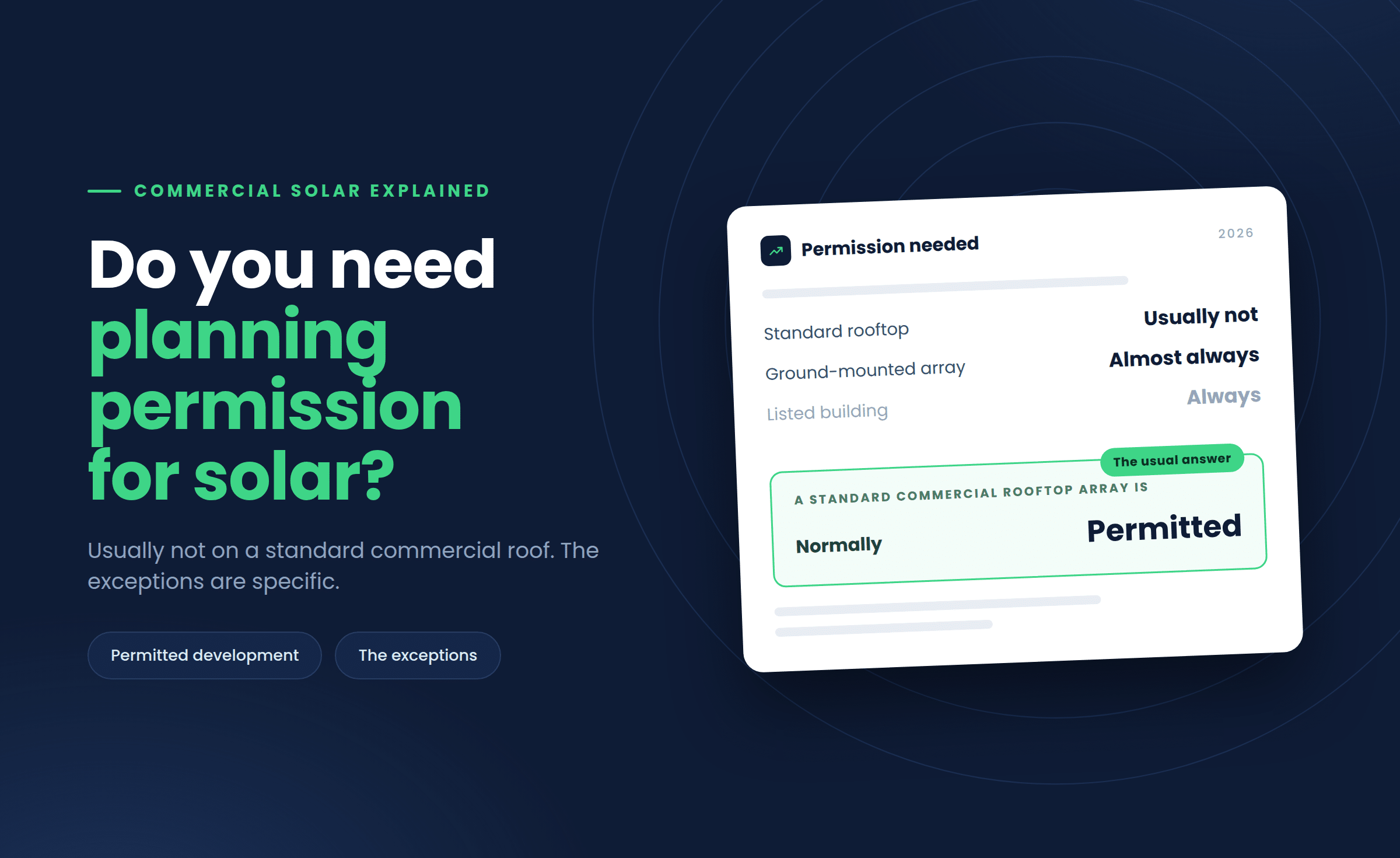
Most commercial rooftop solar counts as permitted development, but larger arrays, ground-mounted systems and listed sites usually need a full application. The DNO connection process runs alongside it.
Neither approval is a formality to skip. Connecting without the correct DNO sign-off can delay commissioning and, in some cases, require costly remedial work.
A good installer manages both the DNO application and the SEG registration for you. It is worth confirming that in writing, since gaps here are the most common cause of a delayed switch-on.