
Commercial solar cost varies hugely by system size and site, but as a rough UK guide a small rooftop system runs to the low tens of thousands of pounds installed, rising well beyond that for a large industrial array. A site-specific quote from an MCS-certified installer is the only accurate figure.
If you have asked two or three installers for a quote and got wildly different numbers back, you are not imagining it. The price depends on far more than panel count alone.
Roof type, access, scaffolding, inverter specification and whether you add battery storage all move the total. This guide sits alongside our look at whether commercial solar is worth it for your site.
Rising business electricity rates over the past five years have made the sums more attractive even where the upfront number still looks steep.
Below is a breakdown of what drives the cost, banded figures by system size, and the extras that often get missed in a first quote.
What determines the cost of a commercial solar installation?
System size in kWp is the biggest single factor, followed by roof type and access, whether you add battery storage, and any grid reinforcement needed for larger arrays.
The main cost drivers
A flat industrial roof with easy access and no scaffolding will always come in cheaper per kWp than a complex pitched roof needing heavy access equipment. Site conditions matter as much as size.
- System size: measured in kilowatt-peak (kWp), the biggest single factor.
- Roof and access: pitch, height and how much scaffolding is needed.
- Inverter and battery: specification and whether storage is included.
- Cable runs: distance between the panels and your consumer unit.
- DNO connection: costs that scale with export capacity on larger systems.
How much does a small commercial solar system cost?
A small system of roughly 10 to 50kWp suits a shop, small office or single-unit warehouse and tends to fall in the lower tens of thousands of pounds installed. Treat this as an indicative UK band, not a quote.
Indicative cost bands by size
| System size | Typical UK cost band | Suited to |
|---|---|---|
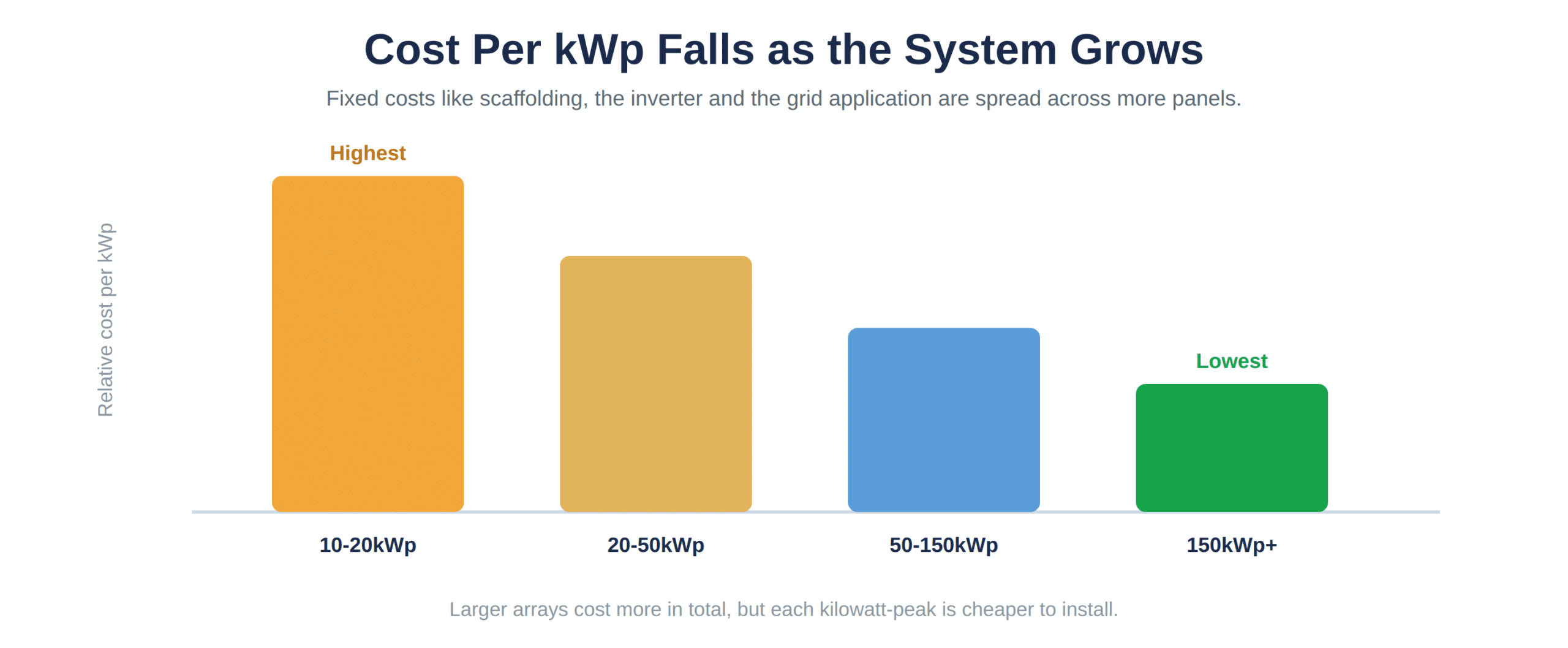
| 10 to 20kWp | Low tens of thousands | Small office, shop or unit |
| 20 to 50kWp | Mid tens of thousands | Larger retail or small industrial |
| 50 to 150kWp | High tens of thousands | Mid-sized industrial site |
| 150kWp+ | Six figures upwards | Large warehouse or estate |
Smaller systems generally cost more per kWp than larger ones. Fixed costs like scaffolding, the inverter and the grid application do not shrink much just because the array does.
How much does a large commercial solar system cost?
Large arrays from 150kWp upwards benefit from economies of scale that bring the cost per kWp down, but grid reinforcement and a full G99 DNO application can add cost and lead time that smaller systems avoid.
Grid reinforcement to expect
A large distribution warehouse with a big flat roof is often the best value per kWp, because the roof space is abundant and the install is simple. Where a DNO identifies network constraints, grid connection reinforcement can add a meaningful sum.
Factor reinforcement into any large-scale budget from the outset. It is the cost most likely to surprise a business scaling up from a small rooftop system.
Lead times grow with size too. A G99 application and any reinforcement can take months, so a large project needs planning well ahead of the point you want it generating.
What extra costs should you budget for beyond the panels?
Beyond the panels and inverter, budget for scaffolding or access, DNO application fees under G98 or G99, potential grid reinforcement, ongoing maintenance, and insurance for the new asset.
The extras a first quote often misses
Inverters typically need replacing once in a system’s life, usually around year 10 to 15. Build that into a longer-term budget rather than treating the initial quote as the full lifetime spend.
- Scaffolding or access: mobile equipment for the install itself.
- DNO fees: G98 for smaller systems, G99 for larger ones.
- Grid reinforcement: where the local network needs it.
- Maintenance and inverter swap: cleaning plus an eventual replacement.
- Insurance: covering the new asset on your roof.
How do commercial solar costs compare with the savings?
Weigh the upfront number against avoided grid purchases at your current electricity rate, plus any export income for surplus generation, rather than looking at cost in isolation.
Reading cost against return
The higher your current business electricity rate, the more each self-consumed unit is worth, and the faster a given system pays for itself. A high rate can make a pricier install the better decision.
Always base a budget on quotes from MCS-certified installers. MCS registration is also required to claim the Smart Export Guarantee, so it protects both the install quality and your export income.
Our guide to solar ROI walks through that calculation properly, including how self-consumption changes the maths compared with exporting. It is the number that matters more than the sticker price.
VAT treatment for commercial installs differs from the reduced rate on some residential systems, as our guide to VAT on solar for businesses explains, so confirm it before finalising a budget. Financing can also spread the cost, covered in our solar finance guide.