
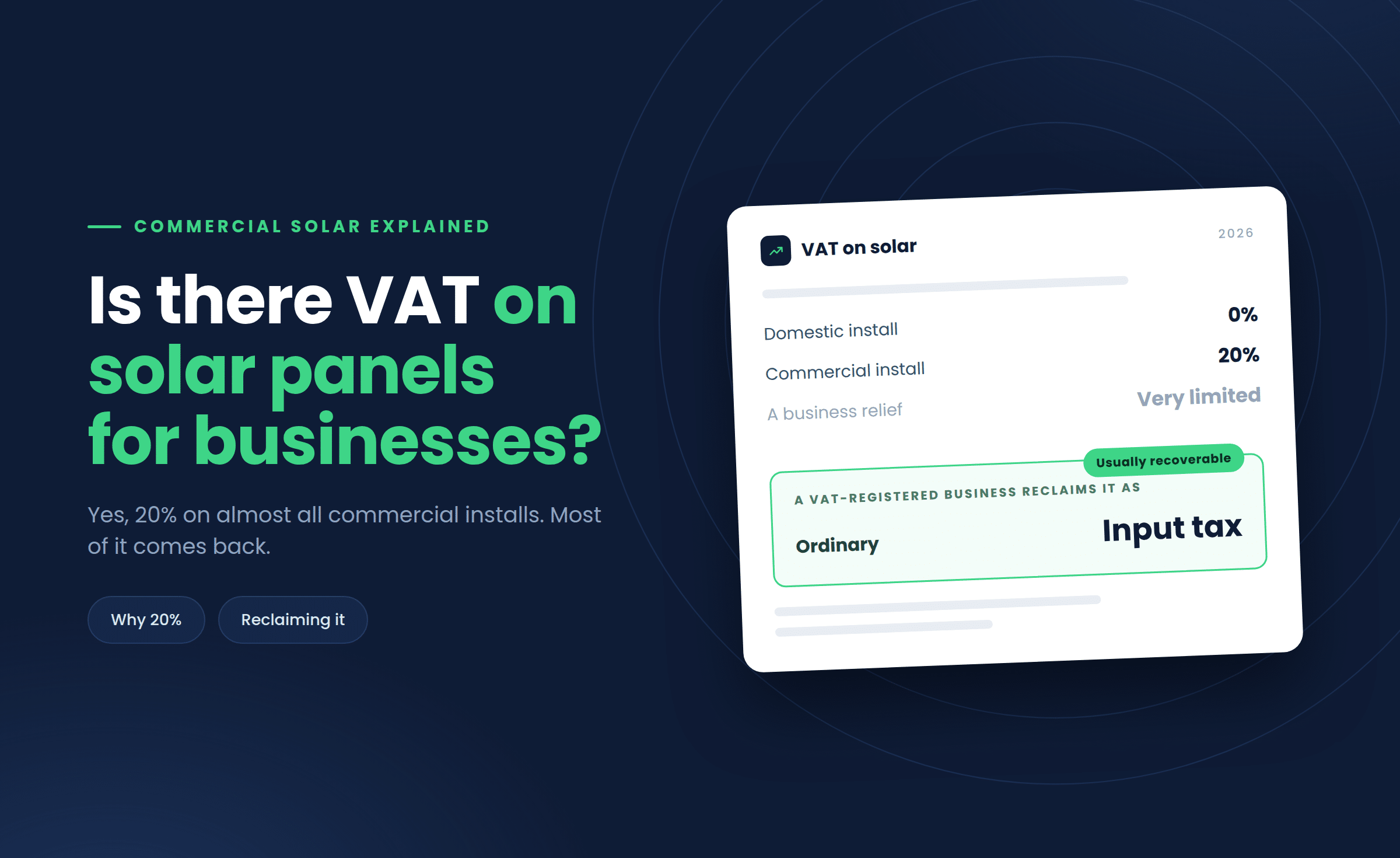
Yes. Commercial solar installations are normally charged the standard 20% VAT rate, unlike qualifying domestic installs which can benefit from a 0% rate on energy-saving materials, though a VAT-registered business can usually reclaim what it pays as an input cost.
Ask most people about solar and VAT and they will mention the 0% rate, because that is what makes the news when the domestic market is discussed. Business premises are a different story.
The reduced and zero rates for energy-saving materials were built around homes, care homes and a few charitable uses, not commercial trading premises. It is a key line in any solar cost comparison.
That does not make VAT a dealbreaker. If your business is VAT-registered, the standard rate on the installation is generally recoverable like VAT on any other qualifying business purchase.
This guide covers exactly what rate applies, why the domestic zero rating does not extend to most businesses, and how reclaiming works in practice.
What VAT rate applies to commercial solar installations?
The standard 20% VAT rate applies to solar panels, inverters, batteries and installation labour on the great majority of commercial premises, covering offices, shops, warehouses, factories and most other trading buildings.
How HMRC treats the purchase
This contrasts with residential energy-saving materials, where a 0% rate has applied since 2022 for qualifying installs, as set out in HMRC Notice 708/6. Commercial solar simply does not fall within that legislation.
HMRC treats the solar system as a capital purchase for the business, and VAT is charged in the usual way on both the equipment and the fitting work, whether invoiced together or separately.
Why do domestic installs get 0% VAT but businesses don’t?
The 0% relief on energy-saving materials was designed as a cost-of-living and decarbonisation measure targeted at households, so it was drafted around residential and specific charitable use rather than commercial trading.
Different support for business
Commercial energy support runs through separate routes: capital allowances, the Smart Export Guarantee and sector grants. Some businesses can also check their climate change levy position alongside VAT.
There is a logic to the split. A VAT-registered business, unlike most homeowners, can usually recover the VAT it is charged, so the practical cost difference is smaller than the headline rate suggests.
That recovery is why the standard rate rarely changes whether commercial solar is worth it. For most trading businesses the VAT washes through, and the payback maths turns on generation and self-consumption instead.
Can a VAT-registered business reclaim VAT on solar panels?
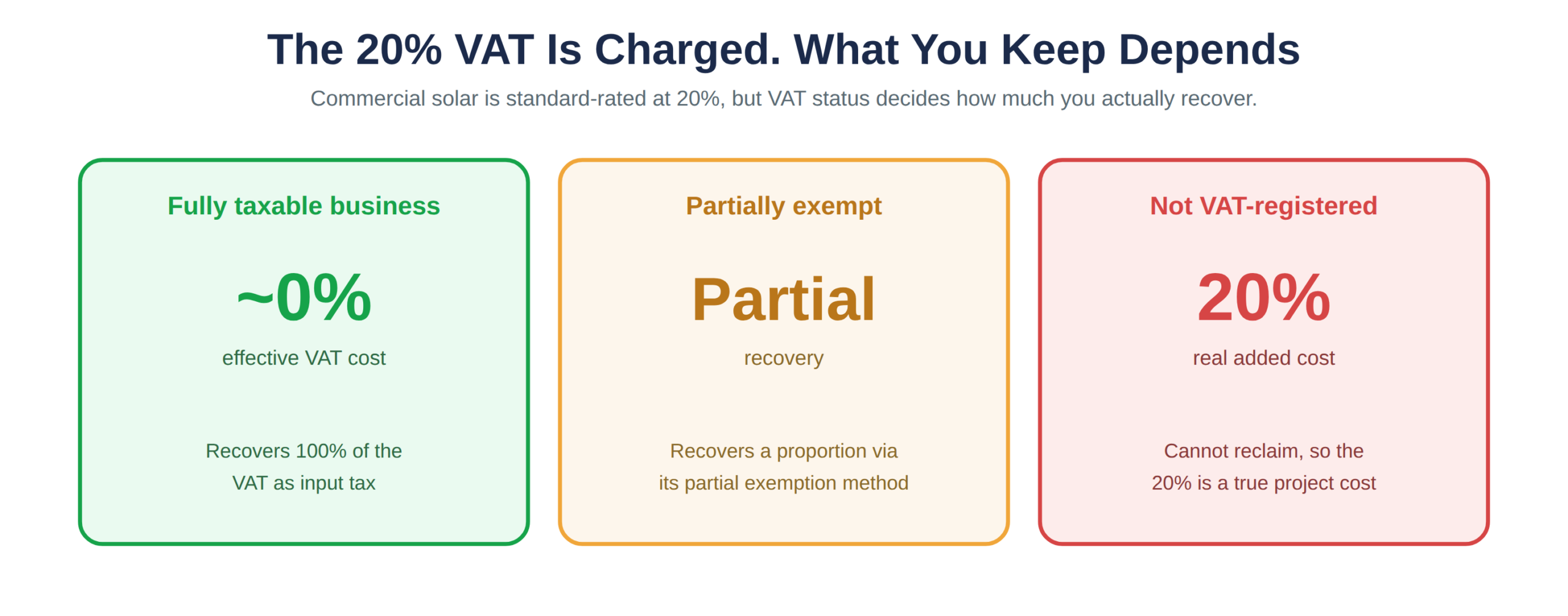
Yes. A VAT-registered business making taxable supplies can generally reclaim the VAT charged on a commercial solar installation as input tax, the same way it would on any other capital equipment purchase.
How recovery differs by VAT status
A partially exempt business, with a mix of taxable and exempt income, may only recover a proportion, calculated using its partial exemption method. A business below the registration threshold absorbs the 20% as a real cost.
| Business VAT status | VAT recovery on solar |
|---|---|
| Fully taxable, VAT-registered | Usually recovers 100% |
| Partially exempt | Recovers a calculated proportion |
| Not VAT-registered | Cannot reclaim, pays it as cost |
Are there any VAT reliefs at all for commercial solar?
Direct VAT relief is limited, but a handful of charities and specific building types can qualify for a reduced or zero rate, and the wider tax picture includes capital allowances that offset the cost differently.
Charities, mixed-use and capital allowances
Charities using a building for a relevant charitable purpose can sometimes access a reduced or zero rate, though the rules are specific. Outside VAT, the Annual Investment Allowance can cut the taxable profit impact, often a more valuable lever.
Mixed-use buildings, community buildings and some healthcare premises sit in genuinely grey areas. Get written confirmation from your accountant or installer before assuming either rate applies.
The distinction matters because getting the rate wrong on a large capital purchase is expensive to unwind later. A quick written check before the invoice is issued avoids a correction with HMRC down the line.
How does VAT work on solar leases and pPAs?
Under a lease or PPA, VAT is typically charged on the ongoing rental or electricity payments rather than a single upfront cost, since the finance provider or investor retains ownership of the equipment.
VAT follows the supply
Our guide to financing commercial solar covers the funding structures, but the VAT principle stays consistent: VAT follows the supply being charged for, whether that is equipment, a lease rental, or electricity under a PPA.
A VAT-registered business can generally still reclaim VAT on these ongoing payments as it goes, spreading the recovery across the contract term rather than as one lump sum at purchase.
What records do you need to reclaim solar VAT correctly?
Keep the full VAT invoice showing the installer’s VAT number, the amount charged, and a clear breakdown of equipment against labour, then include it in your normal VAT return for the period the invoice falls.
The paperwork to keep
Businesses on flat rate VAT accounting should check the treatment for capital purchases, since large one-off items like solar are often handled differently than day-to-day expenses under that scheme.
- Full VAT invoice: with the installer’s VAT registration number.
- Cost breakdown: equipment cost versus installation labour.
- Evidence of business use: for partial exemption calculations if relevant.
- Accounting scheme: confirm standard, cash or flat rate.