
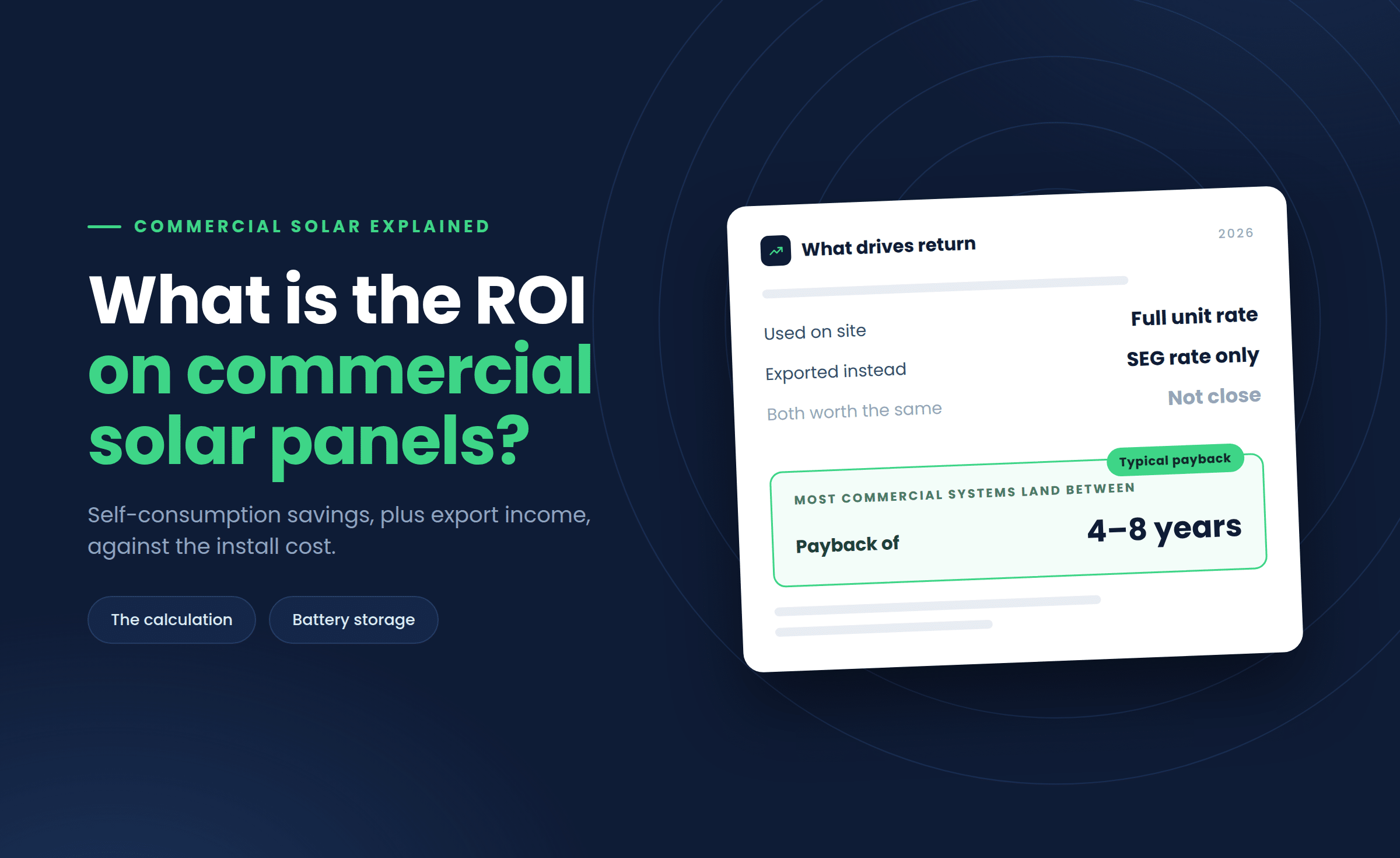
Most UK commercial solar installations recover their upfront cost within roughly 4 to 8 years through avoided electricity purchases and export income, then keep generating low-cost power for the remaining 15 to 20-plus years of a system’s life.
A finance director does not want to hear that solar feels like a good idea. They want a payback period, a lifetime return figure, and the assumptions behind both spelled out clearly.
The calculation pulls together system cost, expected generation, how much of that generation you use on-site, and your existing electricity rate. It sits alongside our guide to whether commercial solar is worth it.
Get those inputs roughly right and the maths is easy to follow, even if the exact output varies from site to site.
This guide walks through how to build the calculation, what pushes it up or down, and where the Smart Export Guarantee and battery storage fit in.
How do you calculate solar ROI for a business?
Add up annual savings from self-consumed generation plus any export income, subtract running costs, then divide the installed system cost by that annual figure to get a payback period in years.
The five inputs you need
Get these five numbers from your own site rather than a generic estimate. Together they decide both the payback period and the lifetime return.
- Installed system cost: including the inverter and any battery.
- Expected annual generation: from system size, orientation and shading.
- Self-consumption share: how much you use on-site versus export.
- Your electricity rate: the value of each self-consumed unit.
- Your export rate: what your supplier pays for exported units.
What is a realistic payback period for commercial solar?
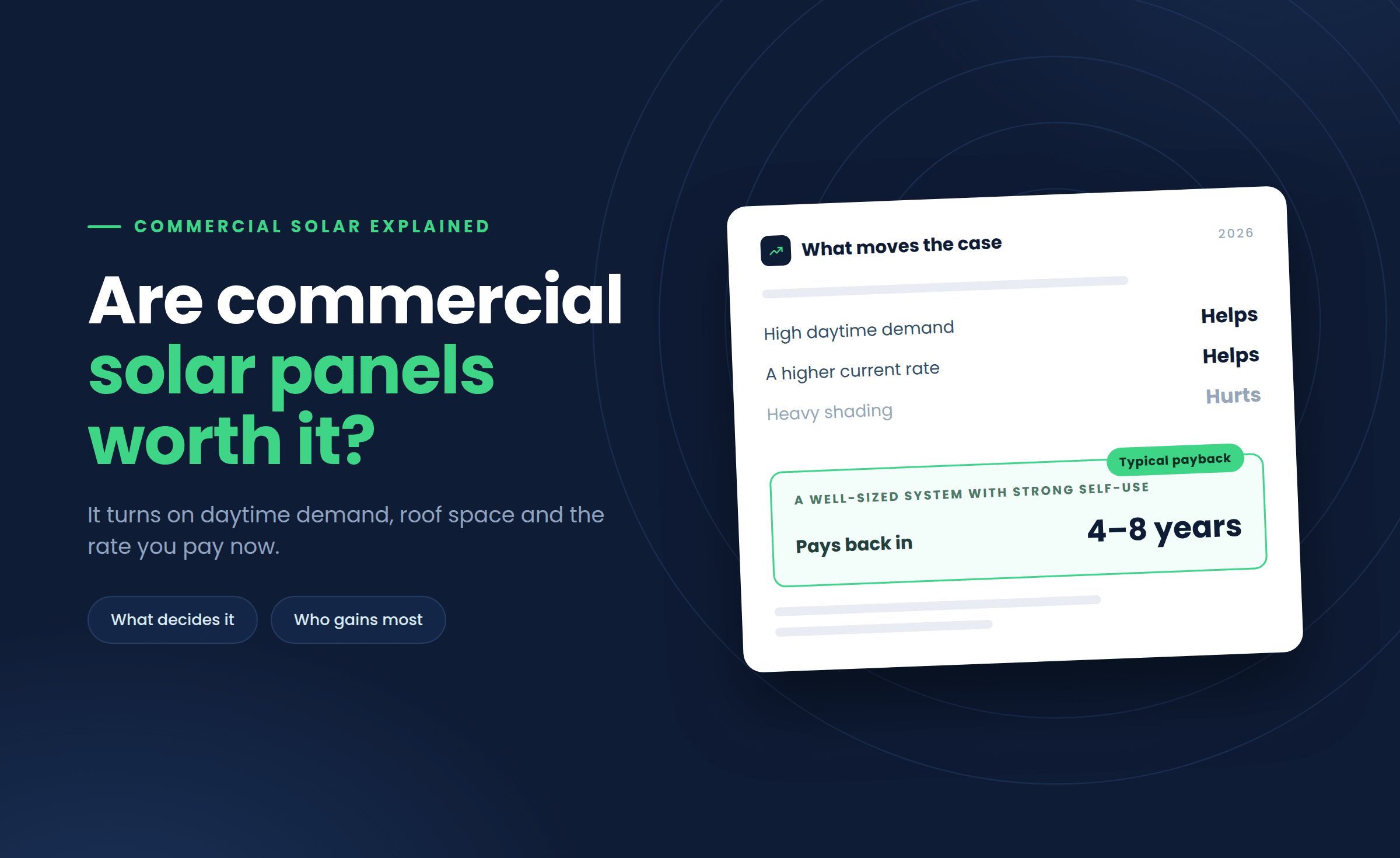
A commercial solar payback period typically runs 4 to 8 years, with the shorter end for sites with high daytime self-consumption and the longer end for systems that export a larger share of their generation.
What happens after payback
Once payback is reached, the system keeps generating for the rest of its life, commonly 25 years or more, at a fraction of the cost of buying every unit from the grid. Our solar cost guide covers the upfront side of that equation.
That long tail is the real prize. A shorter payback is welcome, but the decades of low-cost generation afterwards are where most of the lifetime value sits.
Financing changes how the return reads on paper. Spreading the cost with a loan or lease, covered in our solar finance guide, can make the system cash-flow positive from year one even if the headline payback is unchanged.
What increases or reduces the ROI on a solar installation?
High daytime self-consumption, a higher existing electricity rate, and a well-oriented, unshaded roof all push ROI up. Heavy shading, low daytime usage and costly grid reinforcement all pull it down.
Why rising electricity rates matter
UK business electricity rates have risen sharply over five years, which means the same generation offsets a bigger saving today than it once did. Your current business electricity rate is the value of every self-consumed unit.
| Pushes ROI up | Pulls ROI down |
|---|---|
| High daytime self-consumption | Low daytime usage, evening-heavy demand |
| South-facing, unshaded roof | Heavy shading or north-facing pitch |
| A high current electricity rate | Extensive grid reinforcement needed |
| Well-matched system size | Oversized array exporting cheaply |
How does the smart export guarantee affect the numbers?
The Smart Export Guarantee pays for surplus generation you export rather than use on-site, but each licensed supplier sets its own rate and terms, so the export value varies considerably between offers.
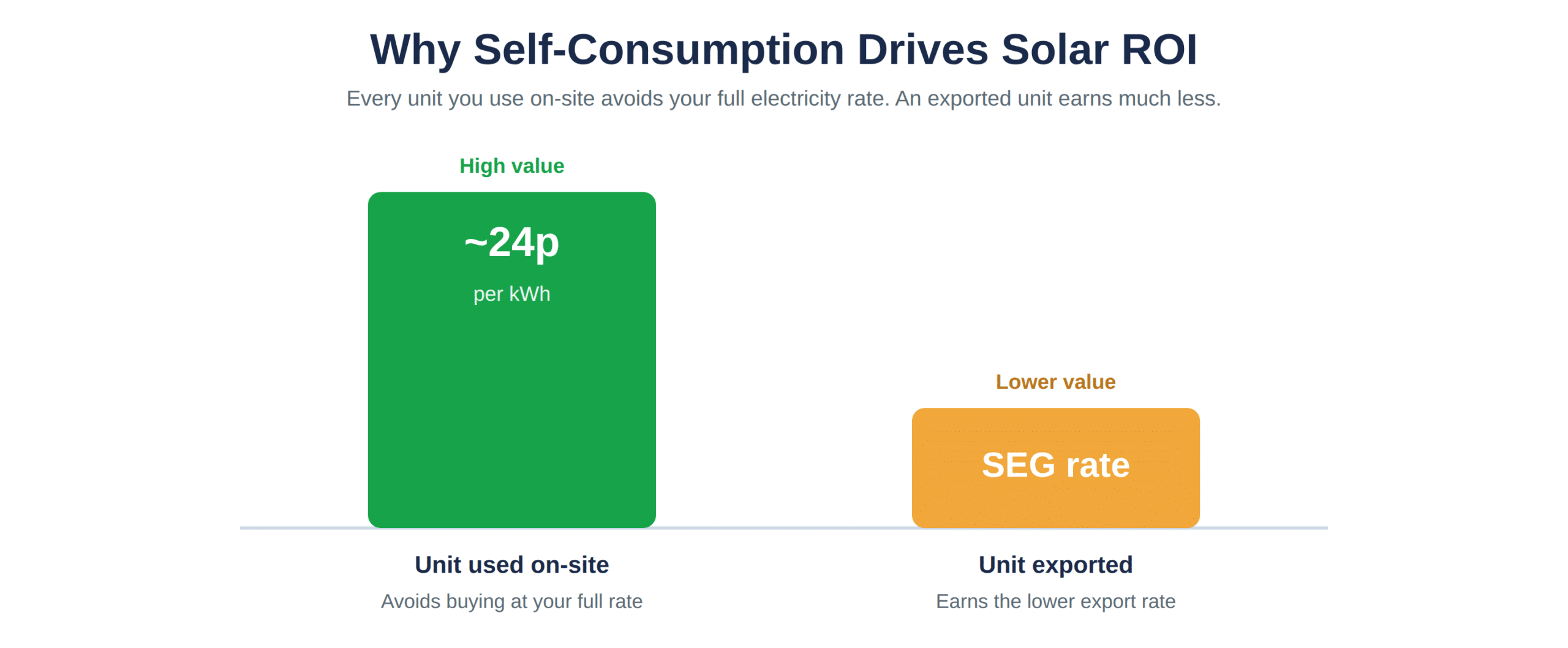
Self-consumption versus exporting
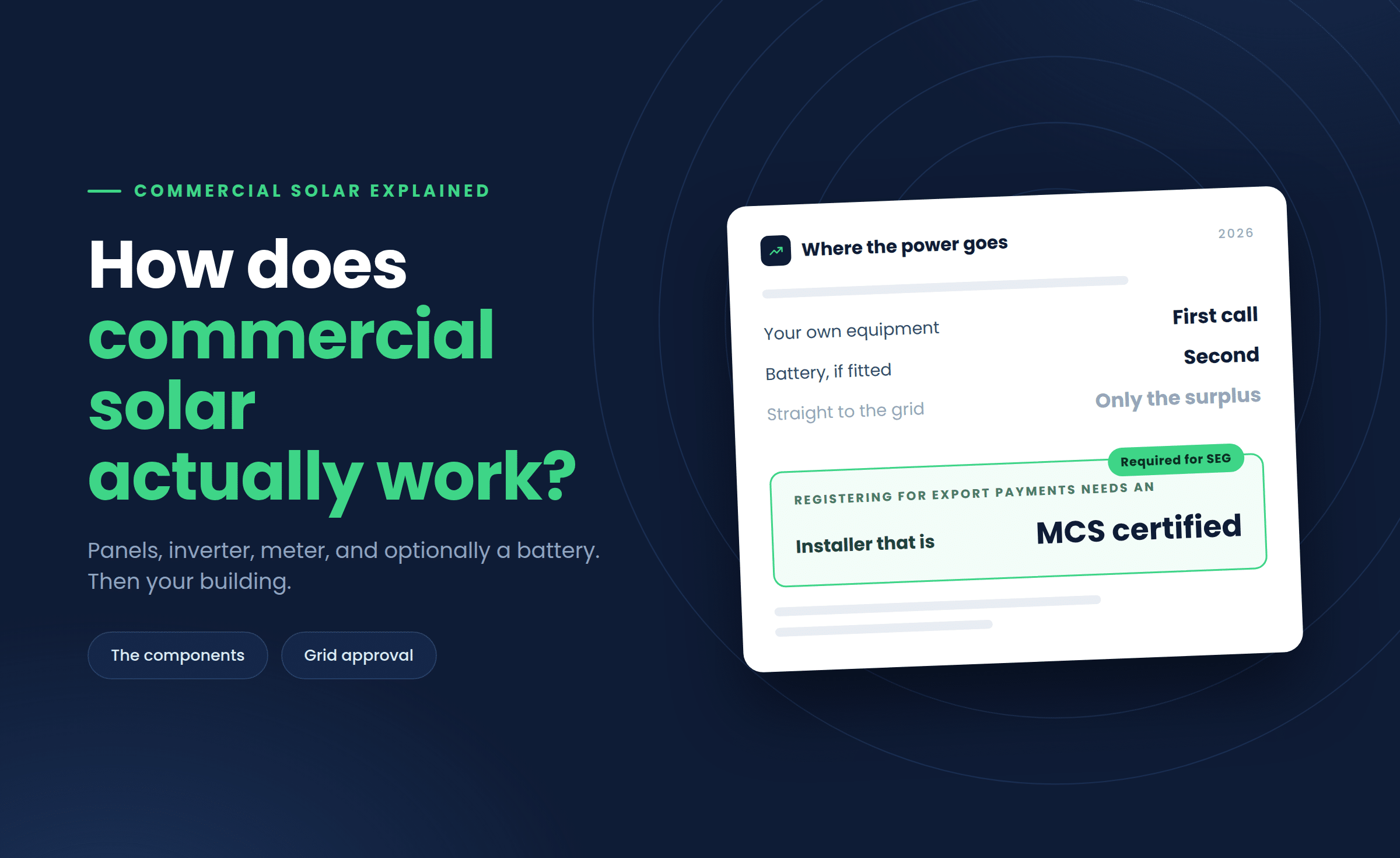
The Smart Export Guarantee replaced the old Feed-in Tariff for new installs, and registering requires an MCS-certified installation plus DNO export approval. Our SEG guide covers how to choose an export tariff.
Because export rates sit below the rate you pay to buy a unit, self-consumption nearly always beats exporting for ROI. A REGO certificate can also evidence the renewable origin for green tariff and sustainability reporting.
Does battery storage improve commercial solar ROI?
It can, by shifting surplus daytime generation into the evening instead of exporting it at a lower rate. The battery’s cost extends the initial payback, so it only helps where usage patterns do not already match generation hours.
When a battery earns its place
A business open mostly during daylight, with demand tracking generation closely, often gets a better return from a larger array than from adding storage. Storage pays off where evening or out-of-hours demand is real.
Battery prices continue to fall, which is slowly improving the case. Even so, the honest test is whether you have enough out-of-hours demand to use the stored power rather than simply holding it.
- Helps ROI: businesses with real evening or out-of-hours demand.
- Adds less value: businesses already using most generation during the day.