
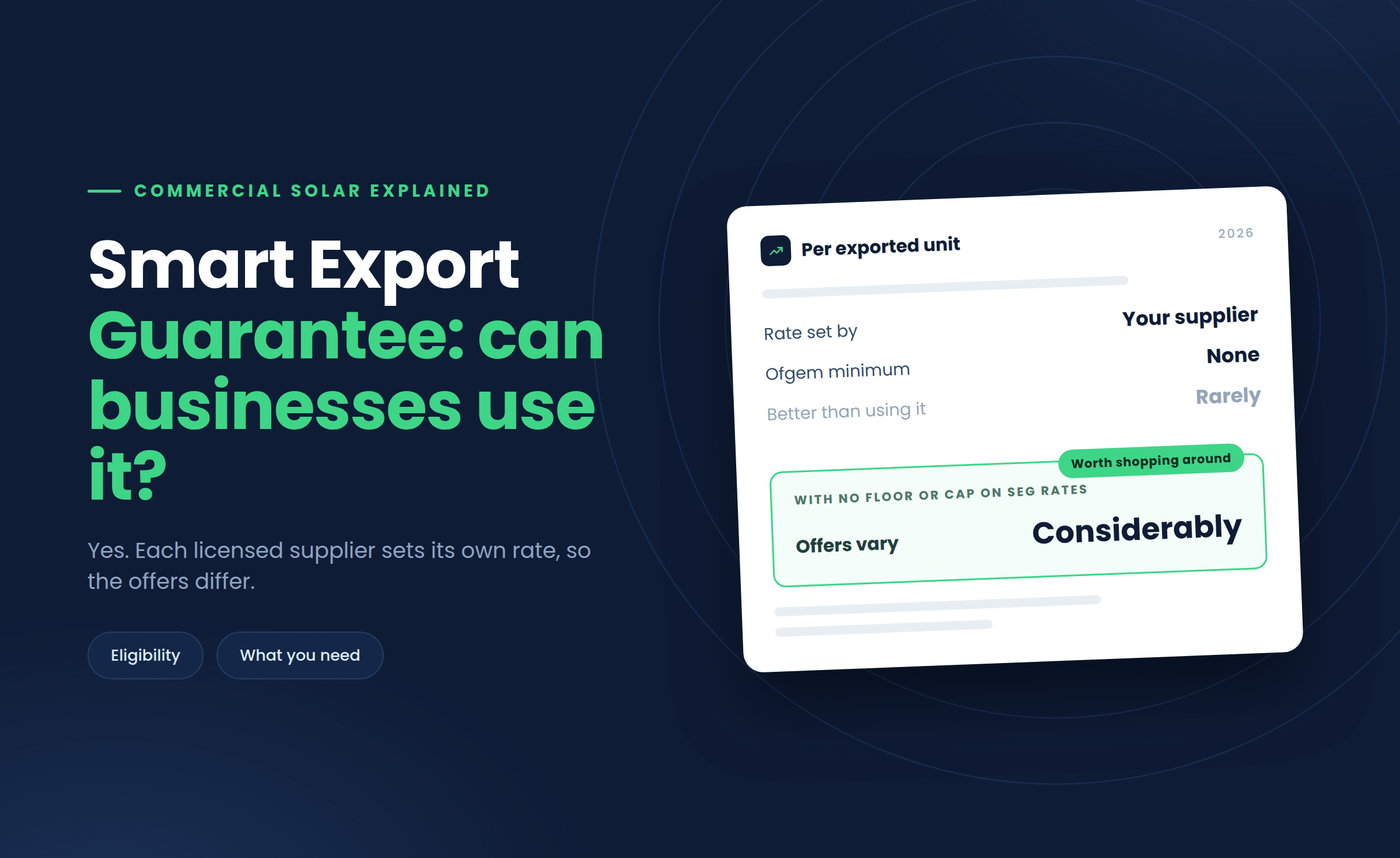
The Smart Export Guarantee is the scheme that pays small-scale generators, including businesses, for electricity they export to the grid. Rates are set independently by each licensed supplier rather than by Government, and yes, businesses with an eligible export meter can use it.
Anyone who has looked into commercial solar has come across the SEG somewhere in the small print, usually alongside a rate that varies widely depending on which supplier you ask.
That variation is not a mistake. It is the entire structure of the scheme, designed to work through commercial rates rather than a fixed Government tariff, and it changes the solar ROI calculation once self-consumption is factored in.
For a business weighing up solar, understanding SEG rates properly shifts the payback maths, usually for the better.
This guide covers how the scheme works, who is eligible, what it pays, and how it compares to simply using the power yourself.
How does the smart export guarantee work for businesses?
A business with an eligible small-scale renewable system, most commonly solar, signs up with an SEG licensee, which then pays for every kilowatt-hour exported to the grid, usually measured through a smart or export meter.
You choose your SEG provider
You do not have to take SEG payments from the company that supplies your electricity. Businesses shop around and register with whichever licensee offers the best export tariff, as the Ofgem Smart Export Guarantee framework allows.
- Eligible technologies: solar, wind, hydro, anaerobic digestion and micro-CHP up to 5MW.
- Paid on real export: based on actual metered data, not an estimate.
- Independent choice: your SEG provider need not be your electricity supplier.
Which businesses are eligible for SEG payments?
Any business with an eligible small-scale generation installation, an export meter capable of recording it accurately, and an MCS certificate or equivalent for larger systems can generally apply for SEG.
Certification and connection first
MCS certification covers systems up to 50kW, while larger commercial installs meet an equivalent recognised standard. Before exporting, the system needs DNO approval, and our commercial solar planning guide covers the wider sign-off.
That approval is a G98 notification for smaller systems, or the more detailed G99 application for larger commercial arrays. Exporting before it is in place is not permitted.
Using an MCS-certified installer is the practical route to eligibility, since the certificate is what most licensees require before they will register your export account.
How much can a business earn from SEG rates?
SEG rates vary considerably by supplier and tariff type, and unlike the domestic price cap, there is no minimum or maximum set by Ofgem, so shopping around genuinely changes the outcome.
Fixed versus variable tariffs
Fixed tariffs offer a set rate per kWh for the term, which is easier to forecast. Variable tariffs track wholesale prices and can pay more during high demand but carry more uncertainty.
Because rates change frequently and depend on export volume, meter type and contract length, treat any specific pence-per-kWh figure as a snapshot rather than a guarantee, and compare live offers before signing.
Payments are typically made monthly or quarterly based on your metered export. It is worth revisiting the market at each renewal, since suppliers reprice their export tariffs regularly and last year’s best rate is rarely still leading.
What do you need before you can register for SEG?
You need MCS certification for the installation or the equivalent for larger systems, a smart or half-hourly export meter, confirmation of your DNO connection approval, and details of your generation capacity.
Documents worth having ready
Most installers handle SEG registration as part of the project, since the paperwork overlaps with the DNO connection. A REGO certificate is separate but related, evidencing renewable origin for reporting, as our how commercial solar works guide explains.
- MCS certificate: or equivalent technical compliance evidence.
- DNO approval: confirmation of your G98 or G99 connection.
- Export MPAN: the Meter Point Administration Number for the export meter.
- Capacity figures: system size and expected annual generation.
Is SEG better than using your own solar power on site?
For most businesses, using generated electricity on-site is worth more than exporting it, because self-consumption avoids the full delivered unit rate while SEG rates are usually a fraction of that per exported unit.
Where SEG still adds value
A retail unit, warehouse or manufacturing site running equipment through the day consumes most of its generation before anything is exported. Weigh export income against your business electricity rate, since SEG is only a top-up for genuine surplus at weekends or quiet periods.
It should never be the headline reason a business installs solar. Whether solar is worth it turns on cutting what you buy, with export income as a bonus, and half-hourly metering shows the split clearly.
How does SEG differ from the old feed-in tariff?
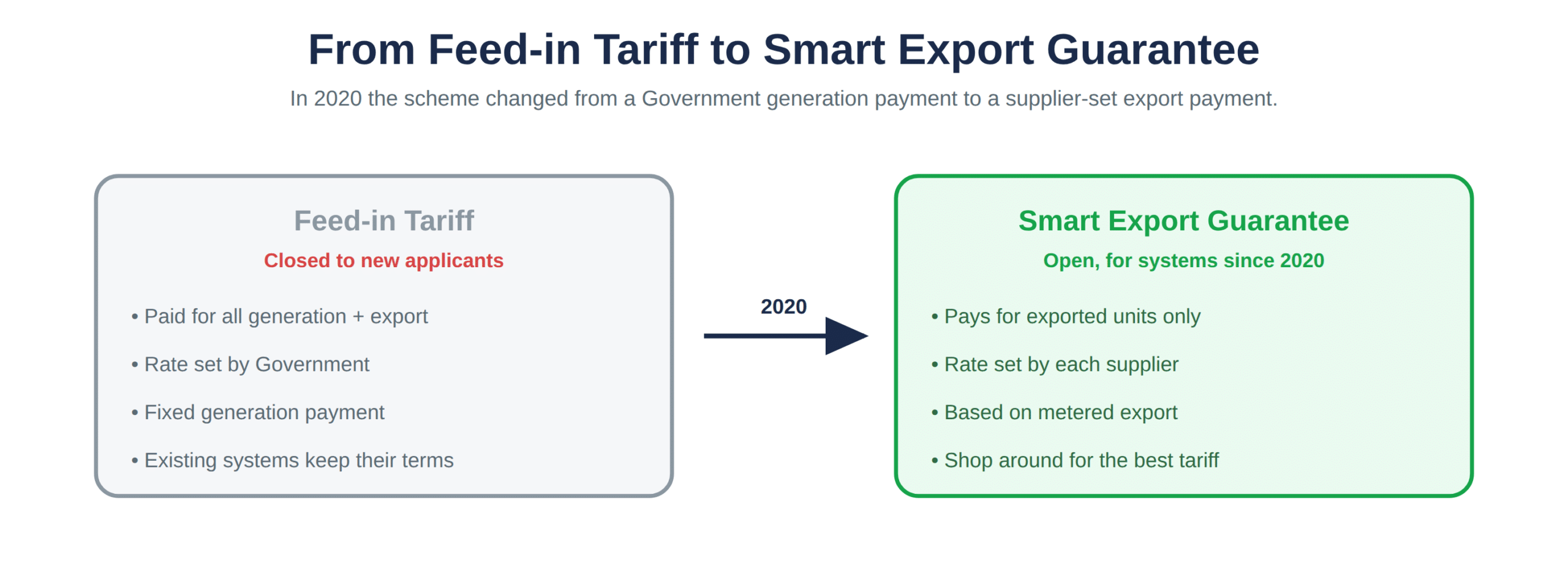
The Smart Export Guarantee replaced the Feed-in Tariff for new installations from 2020, moving payment from a Government-set generation tariff to a supplier-set export-only tariff based purely on metered export.
What changed and who is affected
| Feature | Feed-in Tariff (closed) | Smart Export Guarantee |
|---|---|---|
| Pays for | All generation plus export | Exported units only |
| Rate set by | Government | Each licensed supplier |
| Status | Closed to new applicants | Open, for systems since 2020 |
Businesses still receiving Feed-in Tariff payments from an older system stay on those terms. SEG applies only to systems commissioned after the Feed-in Tariff closed to new applicants.