
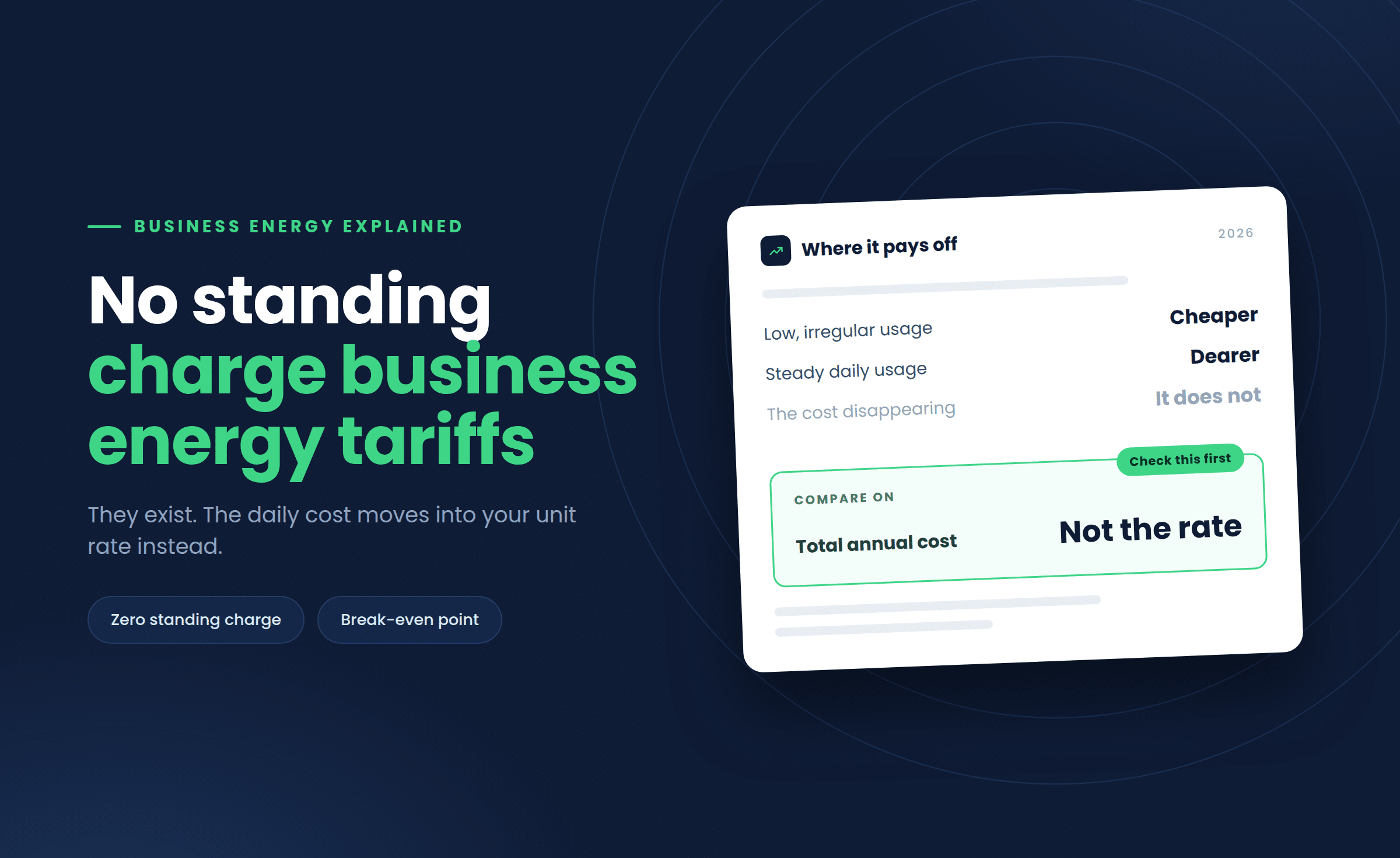
A genuine zero standing charge tariff does exist for some business electricity contracts, but the daily cost does not disappear: suppliers who remove it fold the equivalent cost into a higher unit rate instead.
Energy without a standing charge sounds like an obvious win, especially for a business that barely uses any power across the week. The idea of one less fixed cost is naturally appealing.
But no supplier gives away network costs, metering and its own margin for free. A zero standing charge tariff is a different shape of bill, not automatically a smaller one.
If a zero standing charge tariff is on the table for your business, the maths matters more than the headline. Some businesses genuinely come out ahead, and plenty do not.
Why does almost every business tariff include a standing charge?
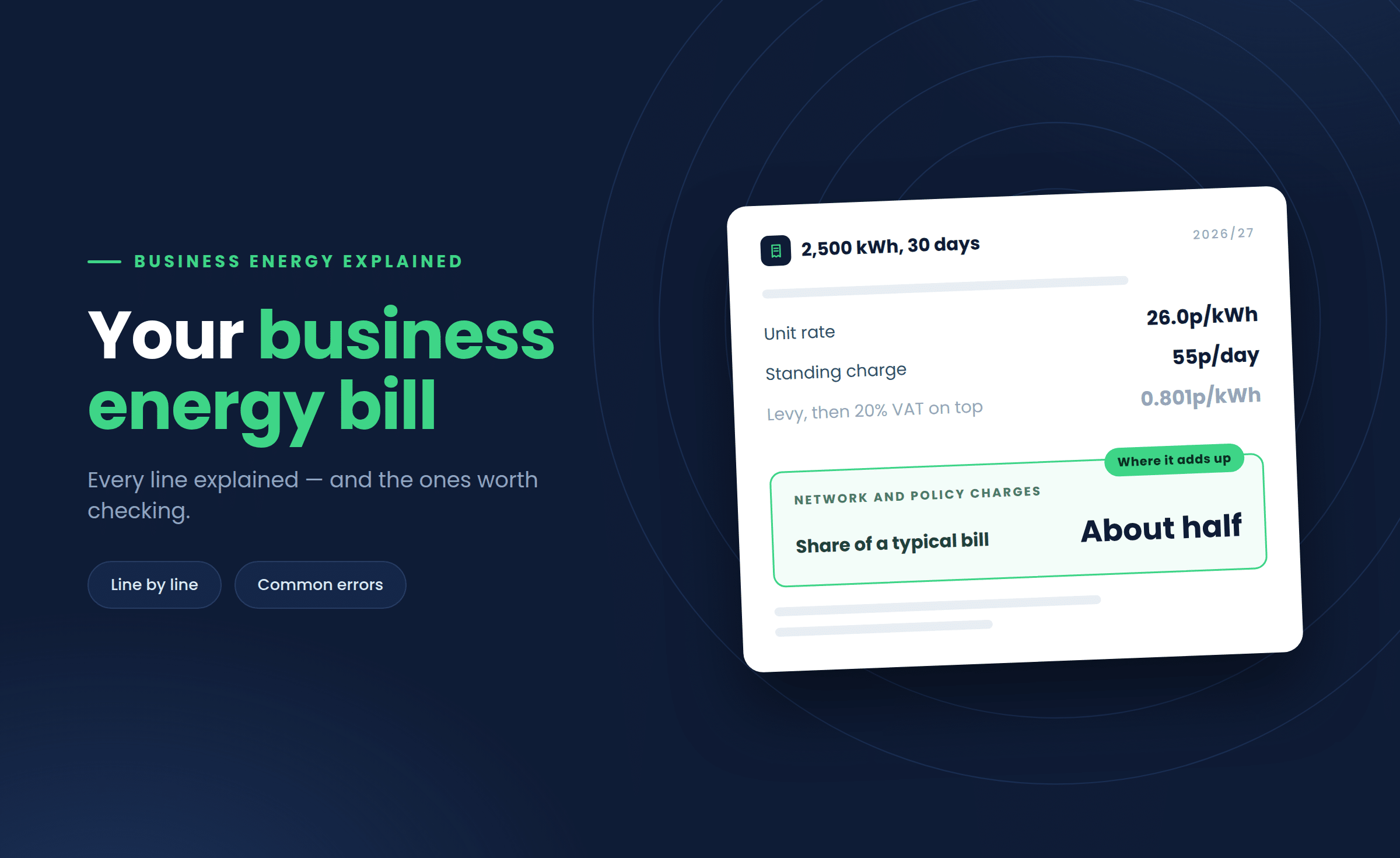
Almost every tariff includes a standing charge because network connection costs, distribution charges and metering costs exist whether or not any energy flows, and suppliers need to recover them somehow.
Removing it does not remove the cost
A network operator still maintains the wires to your premises, Elexon and NESO still balance the system, and a supplier still needs to bill and service the account.
Folding those costs into the unit rate is the only alternative way to collect them, which is exactly what a zero standing charge tariff does behind the scenes.
Do zero standing charge tariffs for businesses actually exist?
Yes, a small number of suppliers offer energy without a standing charge on certain tariffs, usually aimed at very low usage or seasonal sites. Availability shifts regularly as suppliers adjust their product range.
A niche product, not an entitlement
These tariffs turn up most often for very low consumption premises, including some seasonal outlets and places of worship that use very little electricity across large stretches of the year.
This is a commercial product some suppliers choose to offer, not a regulated entitlement, so it comes and goes. It is worth checking during a comparison rather than assuming it is available.
What’s the trade-off if a supplier removes the standing charge?
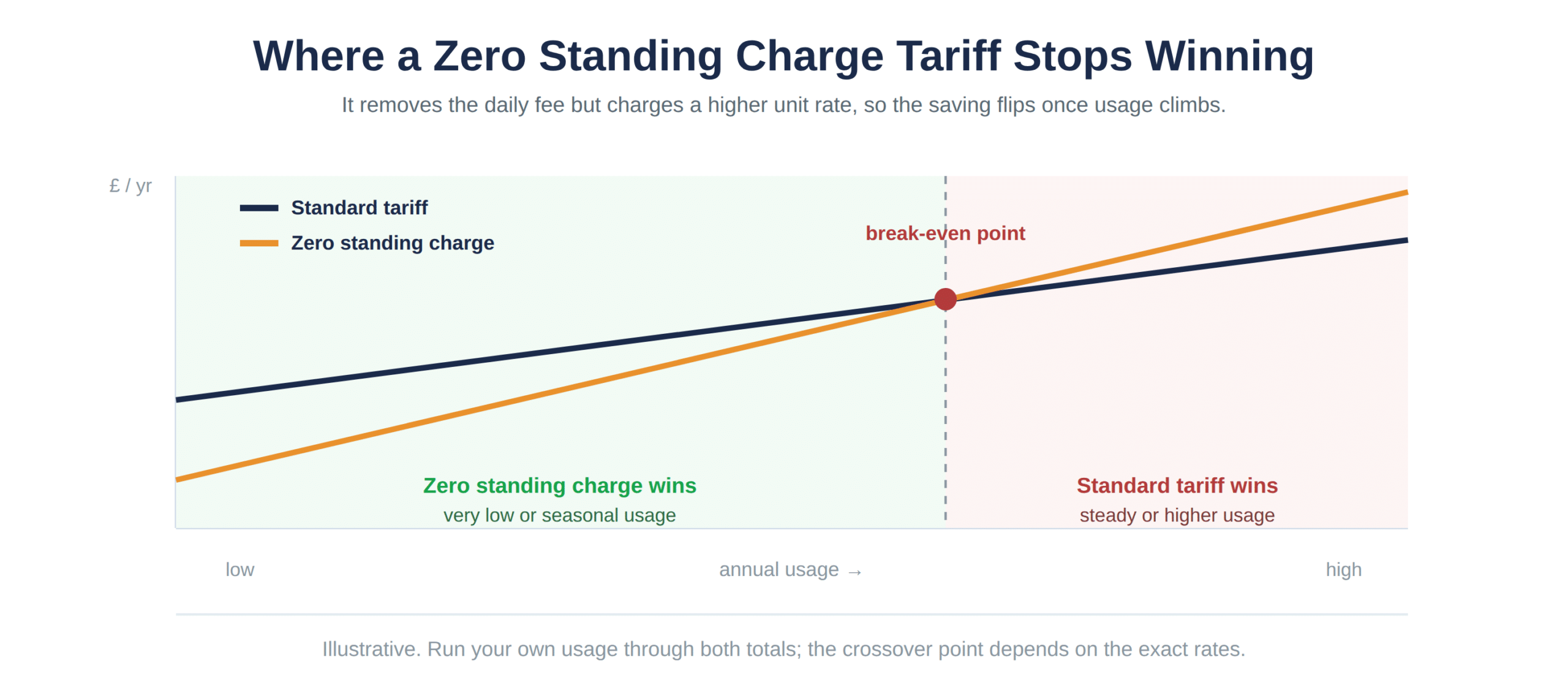
The unit rate rises to cover it, so a zero standing charge tariff almost always carries a higher p/kWh rate than an equivalent standard tariff from the same supplier.
A worked example in numbers
| Annual electricity usage | Unit rate uplift to recover a £100/yr standing charge saving |
|---|---|
| 5,000 kWh | 2.0p/kWh |
| 15,000 kWh | 0.67p/kWh |
| 25,000 kWh | 0.40p/kWh |
| 50,000 kWh | 0.20p/kWh |
| 100,000 kWh | 0.10p/kWh |
At 5,000 kWh, a 2p/kWh uplift is a serious jump against a 2026 average of 35.02p/kWh for very small users, from DESNZ data. At 100,000 kWh, a 0.1p/kWh increase barely registers.
Which businesses benefit most from a zero standing charge tariff?
Very low, irregular or seasonal users benefit most: small storage sites, seasonal outlets and premises used only a few days a week, where a fixed daily fee would otherwise eat up a disproportionate share of the bill.
Could this suit a seasonal or part-year business?
A high usage site sees the opposite effect, since piling the standing charge into the unit rate multiplies against every extra kWh, so it rarely suits medium or large businesses, as our guide to micro business energy costs explains.
A premises that closes for several months a year still pays a fixed daily charge during the closed period on a standard tariff. A zero standing charge deal removes that ongoing cost entirely and shifts everything to actual usage, which is worth running the numbers on before assuming either wins.
How do you check if a no standing charge deal is genuinely cheaper?
Run the full comparison: multiply the zero standing charge tariff’s unit rate by your expected annual usage, then compare that total against a standard tariff’s unit rate plus 365 days of standing charge. Our guide on which suppliers offer the cheapest standing charge shows how far that daily figure moves between suppliers.
The three-step check
- Get your usage: your EAC from a recent bill or your supplier.
- Total both ways: the full annual cost under each tariff type, not the headline rate.
- Re-run on change: the winner can flip as your usage rises or falls.
Cross-check against our guide to unit rate versus standing charge if you are unsure which figure to prioritise. Suppliers structure this trade-off differently, which is why a side-by-side comparison beats one supplier’s marketing.
A panel comparison of business electricity prices shows the real total, not just the presence or absence of a standing charge line. Ofgem’s business energy advice sets out your rights through any switch.