
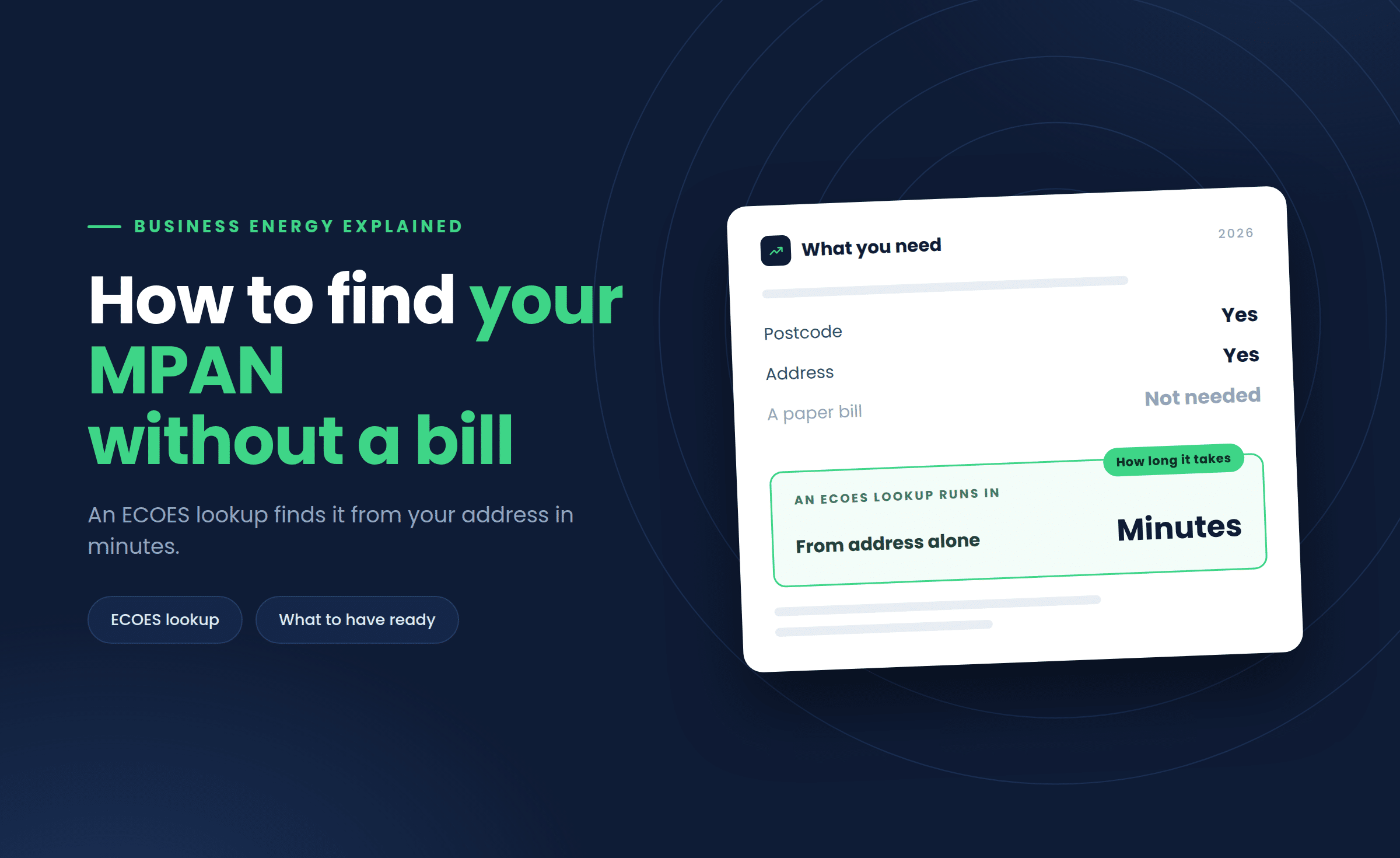
The quickest route is an ECOES-based MPAN lookup using your postcode and address, which your supplier or a broker can run in minutes. You do not need a paper bill to hand for this to work.
Bills go missing. They land in a spam folder, get filed under the wrong site, or belong to a previous tenant who took the paperwork with them when they left.
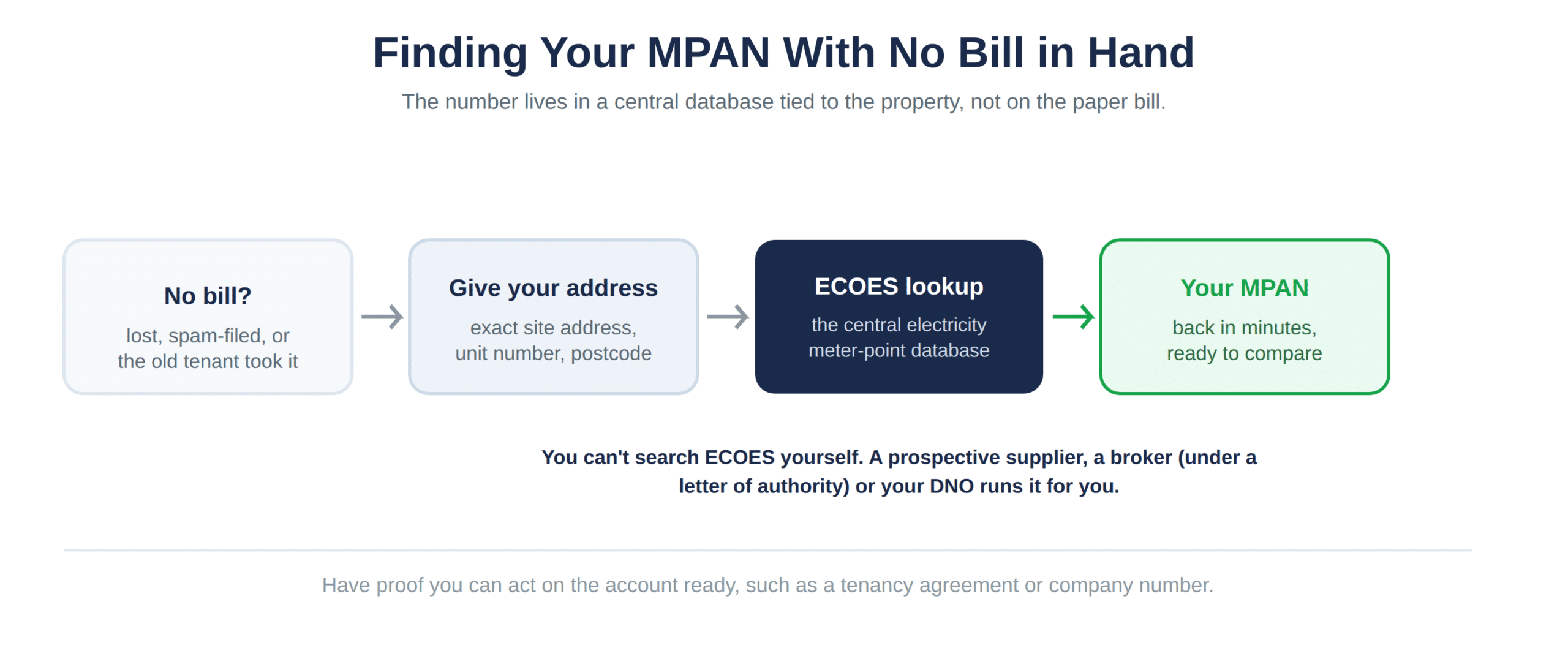
None of that stops you finding your MPAN, because the number itself does not live on the bill. It lives in a central industry database tied to the physical property.
A fair number of businesses only need this because they are switching supplier, disputing a charge, or setting up a new connection and the previous account holder is not answering calls.
Why would you need your MPAN without a bill?
The most common reasons are a lost or missing bill, a new tenancy where paperwork has not transferred yet, or a broker running a comparison before you have formally taken over the account.
New tenancies are the usual trigger
New occupiers of a unit often inherit a live electricity connection with no documentation at all. In that situation you cannot wait for a bill to arrive before you compare business electricity prices or set up a supply agreement in your own name.
A dispute over consumption or a suspected billing error is another common trigger. If you are querying a charge, you will usually be asked to confirm the exact MPAN before anyone will investigate, and it is not always easy to lay hands on a bill from months ago.
How does an ECOES lookup work?
ECOES, the Electricity Central Online Enquiry Service, holds MPAN records for every electricity meter point in Great Britain, searchable by full address and postcode. Suppliers, meter operators and registered brokers use it to run a lookup on your behalf.
Who can run the search
You generally cannot search ECOES yourself as a member of the public; access is restricted to registered industry parties for data protection reasons. The practical route is asking a prospective supplier or comparison service to run it.
- Full site address: including building or unit number.
- The exact postcode: not a nearby one.
- A letter of authority: so a broker can run the lookup under a letter of authority and quote the same day.
Where else can you find your MPAN besides a bill?
Beyond an ECOES-based lookup, you can ask your DNO, check old paperwork from a previous occupier, or request it directly from a supplier over the phone using your address alone.
A quick checklist
Your local distributor keeps records of every connection on its network and can often confirm the MPAN once they have verified you are linked to the property. A broker who previously arranged your business energy contract may still hold the number on file.
- Ask your DNO: directly, using the site address.
- Ask a previous occupier: landlord or managing agent.
- Ask a prior broker: who handled the account before.
The industry Find My Supplier service can also identify who supplies a site if you are not sure where to start.
What information should you have ready first?
Have the exact site address, an estimate of your annual usage in kWh, and proof you are authorised to act on the account, such as a tenancy agreement or company registration.
Expect to prove your interest
| What you provide | Why it’s needed |
|---|---|
| Full site address and postcode | Pinpoints the exact MPAN among several on one site |
| Business name or company number | Confirms you have a legitimate interest in the property |
| Approximate annual usage (kWh) | Helps size an accurate quote alongside the MPAN |
| Move-in date or tenancy start | Establishes when you became responsible for the connection |
Suppliers will not hand over meter details to just anyone, particularly for a commercial property with a change of occupier. Expect to confirm your role at the business before they release the number.
What if the lookup doesn’t return your details?
A blank result usually means the property has never had a live electricity connection, or the address is recorded slightly differently in the industry database. Try the postcode with and without the unit number.
Common address mismatches to watch for
- A different spelling: the building name recorded differently than on your lease.
- A wrong floor or block: a unit number recorded against the wrong one.
- A shared postcode: covering several units with no clear sub-address.
None of these are unusual, and a supplier used to running lookups will know how to work around them. If gas is also missing, our guide to business gas and the meter itself, where the MPAN sits on the meter, both help.