
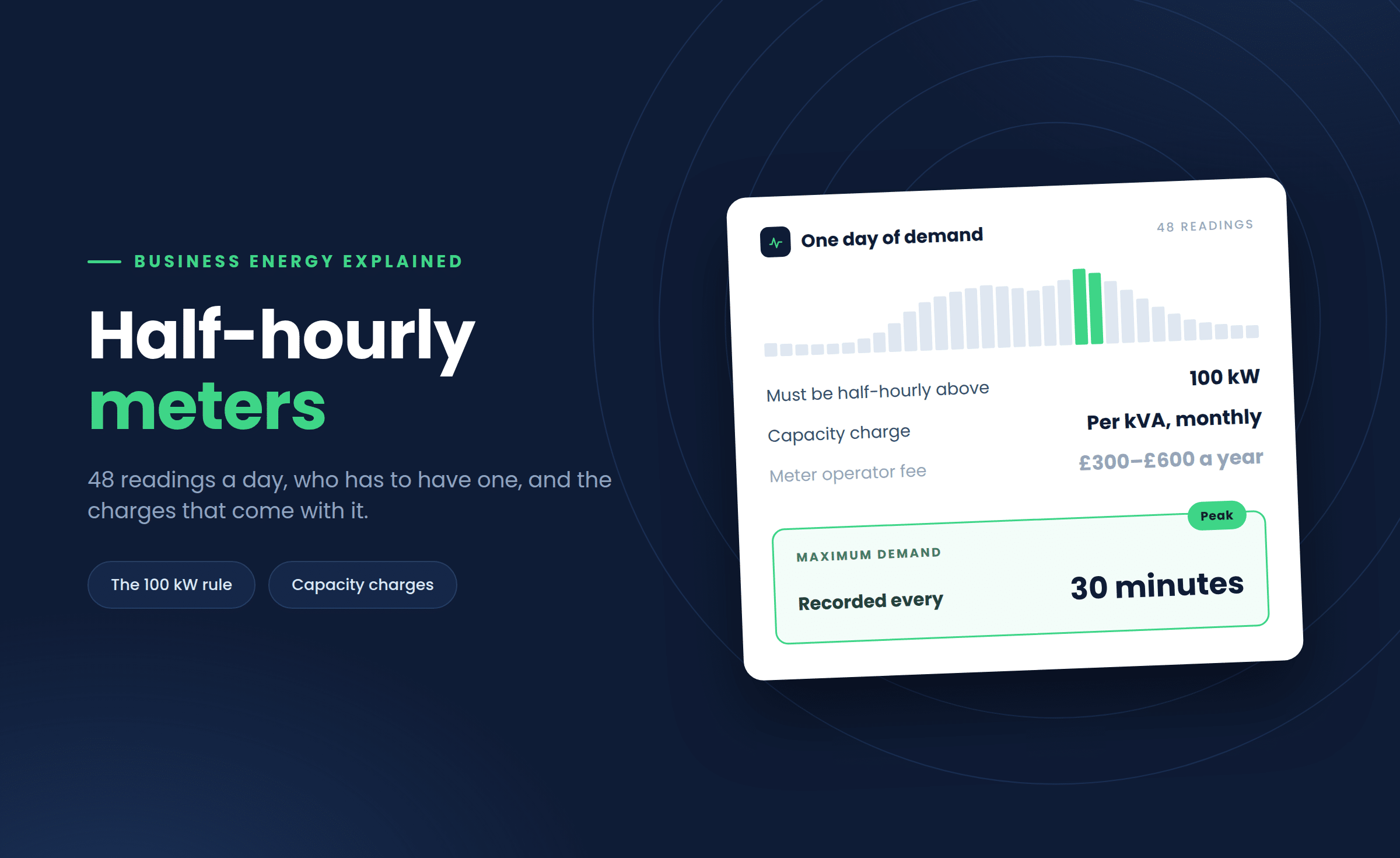
A half-hourly meter records your electricity use every 30 minutes and sends the data to your supplier automatically. It is required for larger sites and comes with extra charges a standard meter does not have.
If your business has a high power demand, you almost certainly already have one. This guide explains how they work, the rules on who needs one, the charges they carry, and whether to keep or remove one.
Because half-hourly bills have more moving parts, comparing them is worth doing carefully. Running a business energy comparison helps you check your rates and capacity charges are competitive, and you can compare business energy suppliers directly with our team.
What is a half-hourly electricity meter?
A half-hourly meter is a digital electricity meter that logs consumption every 30 minutes and transmits it remotely. It gives your supplier accurate, near real-time readings without any manual input.
How it differs from a standard meter
A standard meter gives a single cumulative reading that you or the supplier read periodically. A half-hourly meter captures 48 separate readings a day and sends them automatically.
What it measures
As well as active energy in kWh, a half-hourly meter records reactive power and logs your peak half-hourly demand in kW. That extra detail is what drives the charges later in this guide.
How does a half-hourly meter work?
A half-hourly meter measures your consumption, transmits 48 time-stamped readings a day over a mobile or network connection, and passes them to data services that prepare them for your supplier and for settlement.
Measure and transmit
The meter sits where the supply enters your property and timestamps a reading every 30 minutes. A built-in communication module then sends the day’s 48 readings over a mobile, broadband or landline connection.
Collect and settle
The readings pass to a data collector and aggregator, then to your supplier for billing. They also feed national settlement run by Elexon, which reconciles electricity generated against electricity used.
Who needs a half-hourly meter?
A business must have a half-hourly meter if its maximum demand exceeds 100 kW. You can check whether you already have one from the profile class at the start of your MPAN.
The 100 kW rule
Sites with a peak demand above roughly 100 kW must be settled half-hourly, which is around the demand of 25 to 30 homes at once. The figure is a power demand in kW, not the same as your kVA capacity, though the two are often confused.
How to tell from your MPAN
The first two digits of your MPAN are the profile class, which tells you how your supply is settled. The table below shows the classes that matter for half-hourly metering.
| Profile class | What it means | Half-hourly? |
|---|---|---|
| 00 | Dedicated half-hourly settled supply | Yes |
| 05 to 08 | Non-domestic maximum-demand sites | Yes, since P272 in April 2017 |
| 03 to 04 | Standard non-domestic supplies | No, non half-hourly |
Our guide to profile classes explains what every code from 00 to 08 means.
Are half-hourly meters more expensive?
Half-hourly sites usually pay more overall, mostly through higher standing and capacity charges rather than the unit rate. The unit rate itself can even be a little lower than a small business pays.
The extra charges to expect
The added cost comes from several line items a small meter never sees. The table below sets out the main ones.
| Charge | What it is | Typical level |
|---|---|---|
| Standing charge (DUoS) | Distribution cost, scaled to your capacity | Much higher than a small site |
| Capacity charge (kVA) | Monthly fee per kVA of agreed import capacity | Fixed monthly cost per kVA |
| Excess capacity | Penalty for exceeding your agreed capacity | Applied only when you go over |
| Reactive power | Charge when your power factor drops too low | Only on poor power factor |
| Meter operator (MOP) | Fee to install and maintain the meter | Around £300 to £600 a year |
Unit rates can be lower
A half-hourly meter does not usually raise your unit rate. Because these sites use a lot of energy, the rate per kWh can be slightly cheaper than a microbusiness pays.
What are capacity and reactive power charges?
Capacity charges pay for the maximum import capacity reserved on your connection, billed per kVA each month. Reactive power charges apply when your site’s power factor falls too low, not at a fixed percentage of usage.
Capacity and excess capacity
Your connection has an agreed maximum import capacity, measured in kVA, and you pay a monthly charge for it whether you use it or not. Exceed that agreed level and a separate excess capacity penalty applies.
Reactive power, explained
Equipment like lifts, motors and air conditioning draws reactive power, which does no useful work but loads the network. A charge typically applies when your power factor drops below around 0.95, so it reflects efficiency rather than a flat 5% of consumption.
Who is responsible for a half-hourly meter?
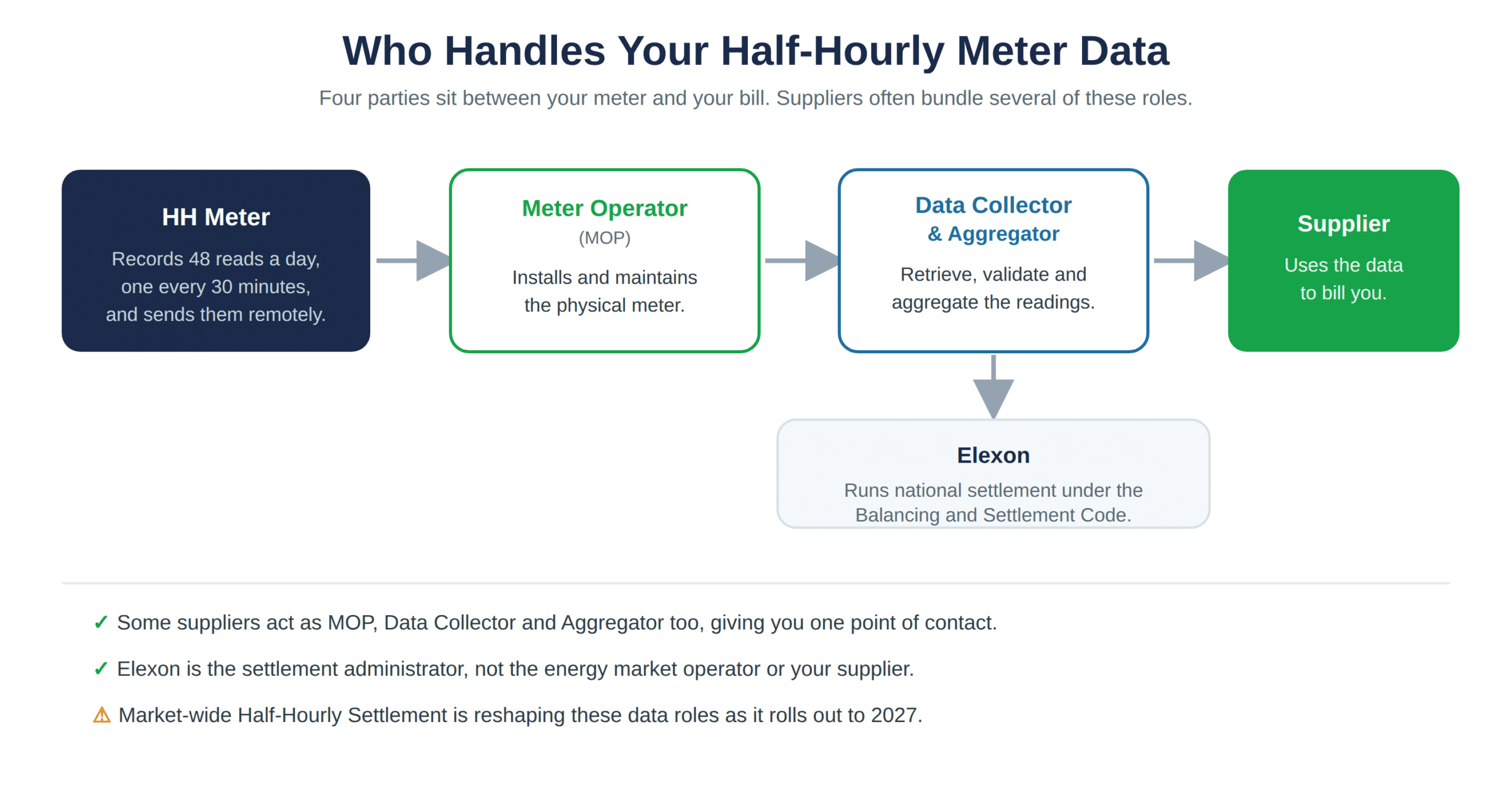
Several parties sit behind a half-hourly meter. A meter operator installs and maintains it, data services collect and aggregate the readings, and your supplier turns them into bills, with Elexon running national settlement.
The roles at a glance
The chart below shows how your data moves from the meter to your bill. Many suppliers take on several of these roles themselves.
What each party does
The meter operator, or MOP, fits and services the meter. A data collector retrieves and validates the readings, a data aggregator groups them, and your supplier uses them to bill you.
Elexon is the settlement administrator under the Balancing and Settlement Code, not your supplier or an energy trader. Its role is being reshaped as the Market-wide Half-Hourly Settlement reforms roll out.
What are the benefits of a half-hourly meter?
A half-hourly meter brings accurate automatic billing, access to time-of-use tariffs, detailed consumption data, and the option to earn money through demand flexibility schemes.
Accurate billing and better tariffs
Automatic readings mean your bills are based on real usage, not estimates, so there are no catch-up surprises. The half-hourly data also unlocks multi-rate tariffs that reward shifting use to cheaper off-peak periods.
Data and demand flexibility
The granular data helps you spot waste and forecast costs. A half-hourly meter also lets you join the Demand Flexibility Service, which pays businesses to cut usage at peak times.
Should you upgrade to or remove a half-hourly meter?
You should not upgrade to a half-hourly meter unless you are required to have one. If you have inherited one but use little power, removing it can cut costs, though the work itself is not cheap.
When to leave it alone
If your demand is under the threshold, a modern smart meter can still give half-hourly readings with lower standing charges. There is rarely a case for taking on a half-hourly meter voluntarily.
Removing an inherited meter
Moved into a property with a half-hourly meter but only light demand? Reducing the capacity or swapping the meter needs your network operator or an independent connection provider, so weigh the cost against the saving before switching or renegotiating your contract. Reviewing your energy procurement first often finds the quicker win.