
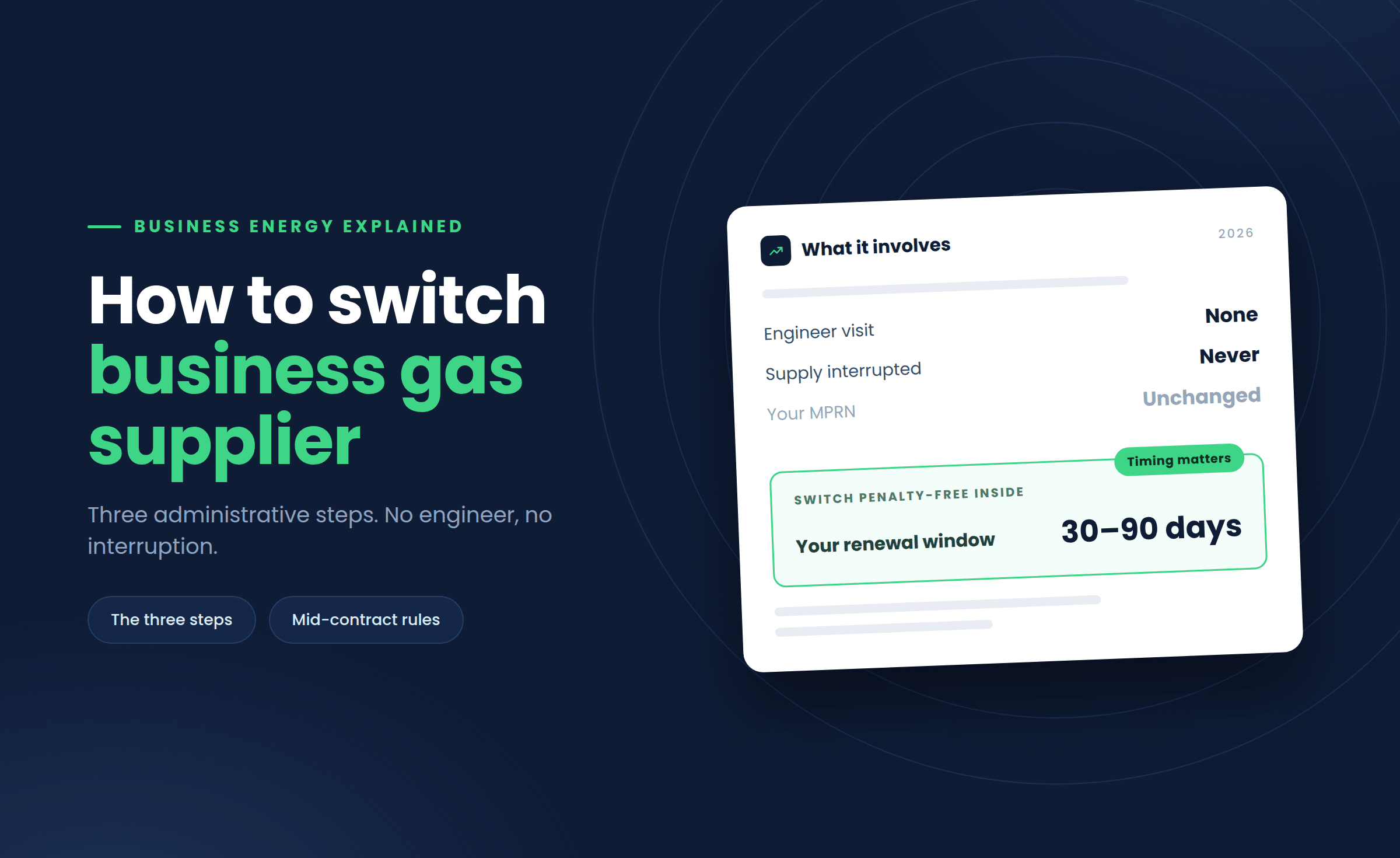
You switch business gas supplier by comparing current market rates against your existing deal, then letting the new supplier handle the transfer using your MPRN. Nothing physical changes, only the company billing you: the same pipes, the same gas, the same meter.
A surprising number of businesses stay on an old gas deal simply because switching sounds like a hassle. Nobody wants an engineer turning up, or the heating cutting out mid-way through a busy shift.
That fear is largely unfounded. Gas transporters like National Gas Transmission move the gas itself, and switching supplier is purely an administrative change managed through your MPRN and the industry’s central systems.
Businesses that leave it too long often end up on an out-of-contract rate, which typically runs 40% to 80% higher than a negotiated deal. Utility Saving Expert customers who switch save an average of £1,952 a year, a meaningful incentive to change rather than drift.
What do you need before you can switch commercial gas suppliers?
Before you switch, you need your MPRN, a recent bill, and your annual consumption in kWh. Suppliers cannot quote accurately without them, and guessing usage tends to produce a quote that does not match your actual bill later.
The four things to have ready
Your MPRN is a unique reference number for your specific gas supply point, and our guide to how to read a business energy bill shows exactly where to find it, usually near the top of your bill.
- Your MPRN: found on any recent gas bill.
- 12 months of usage: in kWh, or an estimated annual quantity if you are new to the premises.
- Your end date: and the notice period on your current contract.
- Company details: name, address, and who is authorised to sign.
How do you compare business gas rates properly?
Compare rates against your current unit rate and standing charge using real consumption figures, not a generic quote. The UK average business gas rate in 2026 sits at 5.17p/kWh, but the figure that matters is the one that applies to your usage band.
Rates fall as usage rises
| Business size | Annual usage | Average rate (p/kWh) |
|---|---|---|
| Very small | 0 to 278 MWh | 7.48p |
| Small | 278 to 2,777 MWh | 4.77p |
| Medium | 2,778 to 27,777 MWh | 4.55p |
| Large | 27,778 to 277,777 MWh | 4.46p |
| UK average | All businesses | 5.17p |
These are 2026 averages from DESNZ data, including CCL and excluding VAT. The best available rates currently start from around 8p/kWh on a two-year fixed deal for smaller users, so a like-for-like comparison of business gas prices matters more than a headline number.
What actually happens during the switch?
Once you sign a new contract, the new supplier registers the change against your MPRN through the industry’s central data systems and notifies your old supplier automatically. You do not need to contact your existing supplier yourself in most cases.
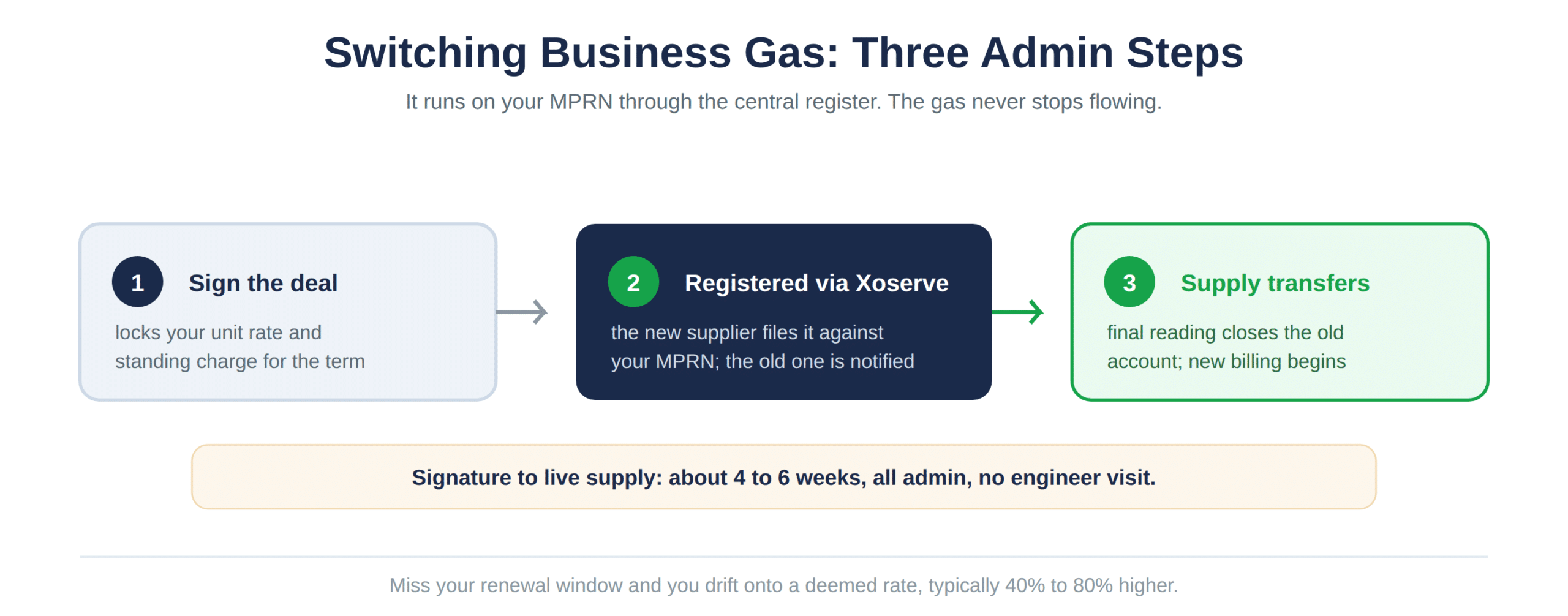
Three steps, no engineer
Signing locks your unit rate and standing charge for the term. The new supplier then submits the change against your MPRN through Xoserve, the body that maintains the central database of UK gas meter points, and your old supplier has a short window to object if something does not match.
Your final meter reading with the old supplier becomes the opening reading with the new one, and the gas itself never stops flowing. From signature to live supply, most switches take four to six weeks, largely down to notice periods and admin checks rather than anything at the meter.
Can you switch business gas supplier mid-contract?
Generally no, not without paying an early termination charge. Unlike household energy, business gas contracts have no statutory cooling-off period once signed, so you are committed for the agreed term.
Watch your renewal window
Most contracts open a renewal window, typically 30 to 90 days before the end date, where you can shop around and switch without penalty, as our guide to business energy contracts explains.
Missing that window is what pushes most businesses onto a deemed or out-of-contract rate, which is exactly the expensive default this guide is trying to help you avoid.
What tends to go wrong, and how do you avoid it?
Most failed or delayed switches come down to an incorrect MPRN, a missed notice deadline, or an objection from the current supplier over an unpaid balance. All three are avoidable with accurate paperwork and a bit of planning.
Three checks that prevent most problems
- Double-check your MPRN: against a recent bill, not an old one from a previous tenant.
- Clear any balance: or agree a payment plan, since debt is the most common blocker.
- Sign a valid LOA: if a broker is switching for you, a proper letter of authority is required.