
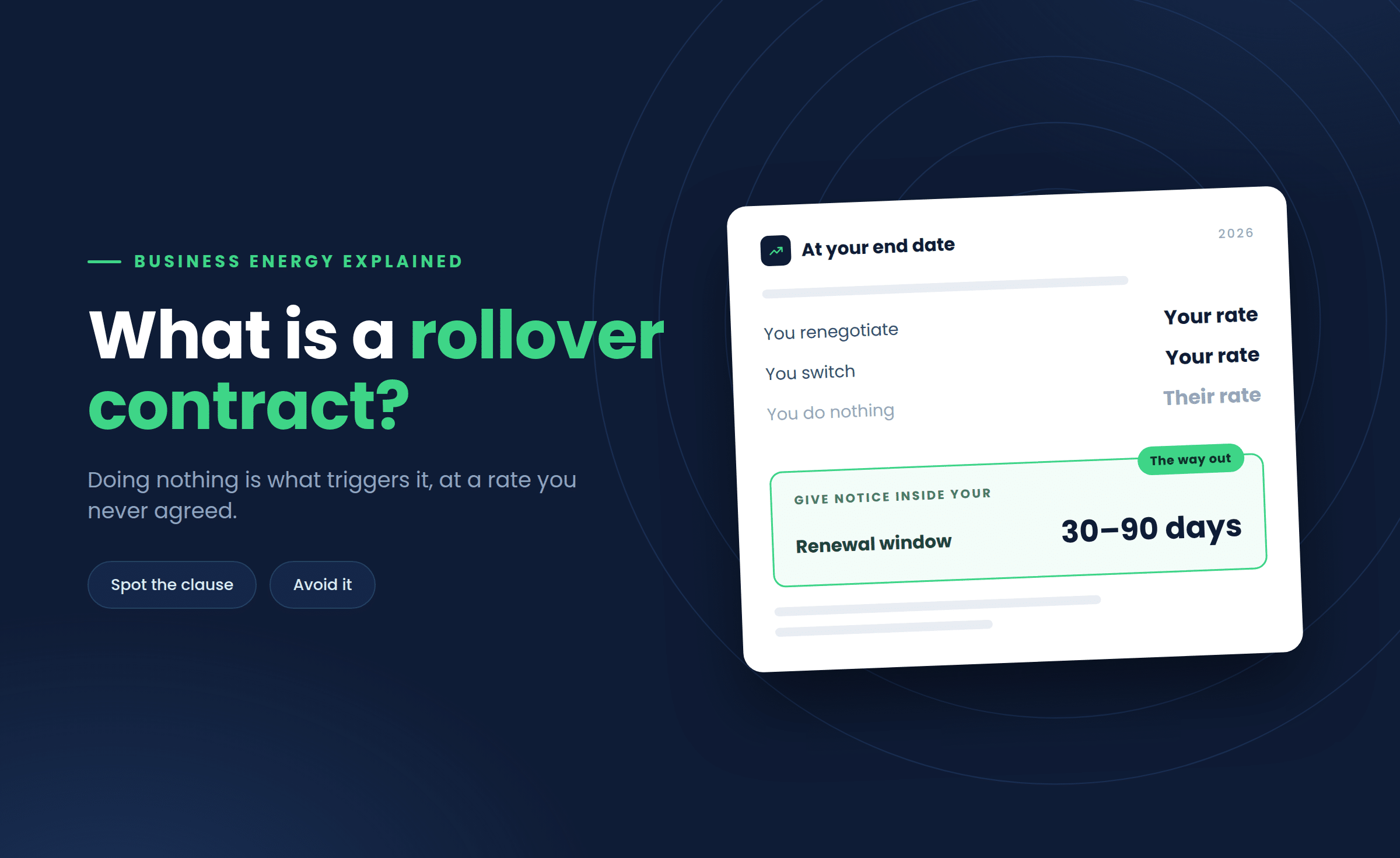
A rollover contract is what happens when your business energy deal ends and you have not switched or renegotiated, so the supplier moves you automatically onto a fresh term at a rate it sets, not one you have agreed. It is legal, common, and catches out thousands of UK businesses every year.
Nobody signs up for a rollover on purpose. It happens by default, triggered by a clause most people never read past the first time they signed.
The mechanism is not the scary part. The price is, because rollover rates sit well above anything you would get by comparing the market before your term ends.
Suppliers are not doing anything underhand here. Business customers do not get the same automatic protections as households, so acting before the deadline sits with you, as our guide to business energy contracts explains.
How does an automatic rollover energy contract work?
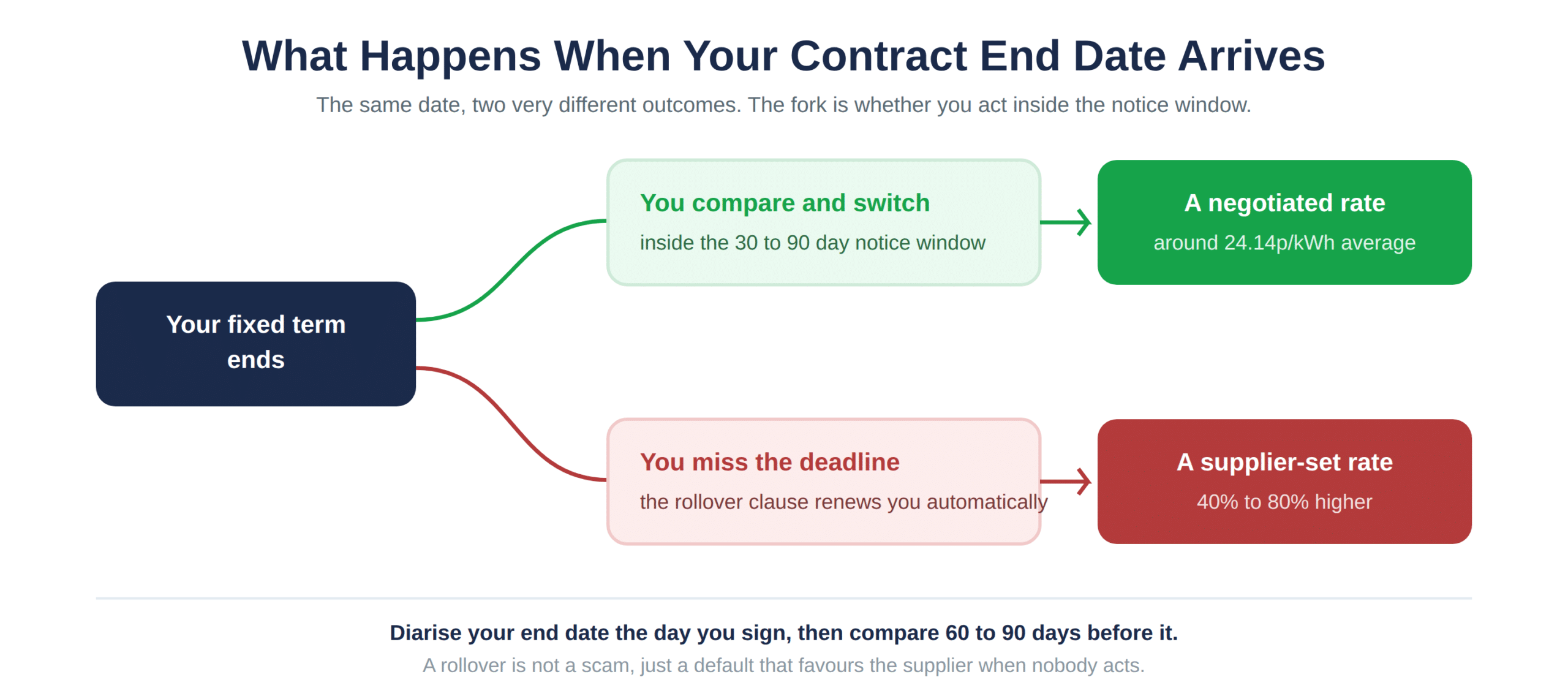
When your fixed term ends without a new agreement in place, most suppliers roll you straight onto a new contract, often for another 12 months, priced at whatever the supplier decides rather than a rate you have negotiated.
The notice rules suppliers must follow
Ofgem’s standard licence conditions and the Retail Energy Code require suppliers to notify you that a renewal is coming. In practice that notice often arrives as one line in a routine letter, easy to miss if you are not looking for it.
- The new term: usually mirrors your old one in length, commonly 12 months.
- The rate: is set by the supplier, not benchmarked against the wider market.
- Your options: you can usually still switch, though a deemed contract differs, applying when there is no agreement at all.
Why do rollover rates cost so much more than a negotiated deal?
They are priced on the assumption that you will not shop around, so suppliers build in a margin well above their live market offers. A rollover or out-of-contract rate typically runs 40% to 80% more than a properly negotiated deal.
How the rates compare
| Rate type | Typical positioning | Difference vs negotiated deal |
|---|---|---|
| Negotiated fixed rate | 24.14p/kWh electricity, 5.17p/kWh gas (UK average) | Baseline |
| Best available 2026 rate | From around 26p/kWh electricity, 8p/kWh gas | Varies by usage band |
| Rollover or out-of-contract | Set by supplier, no negotiation | 40% to 80% higher |
UK average business electricity sits at 24.14p/kWh and gas at 5.17p/kWh in 2026, from Government data. A rollover rate can run comfortably above that, sometimes close to double for very small users, with no cap to stop it, so an out-of-contract rate is rarely where you want to stay.
How do you spot a rollover clause before it catches you out?
Check your contract’s renewal or evergreen clause. It states the notice period required to stop automatic renewal, commonly 30 to 90 days before your end date.
Does a broker or TPI manage rollover notices?
Read the section headed termination, renewal or evergreen terms, not just the price page. It is worth checking yourself rather than assuming a third party has it covered.
Some third-party intermediaries do monitor renewals, some do not. If one holds a letter of authority for your account, ask directly whether renewal monitoring is part of their service or something you still need to handle.
What steps help you avoid rollover contract renewal?
Diarise your contract end date the moment you sign, then start comparing 60 to 90 days beforehand, comfortably inside any notice window your supplier sets.
The four-step habit
- Set a reminder: 90 days ahead of your end date, not the week before.
- Compare against current averages: 24.14p/kWh electricity, 5.17p/kWh gas.
- Check a panel: across suppliers rather than accepting one renewal offer, as our guide on how to switch business energy supplier sets out.
- Confirm in writing: before your old contract’s notice window closes.
Utility Saving Expert compares a panel of trusted UK suppliers, and switching businesses save an average of £1,952 a year against staying on an uncompared rate. A completed switch typically takes 4 to 6 weeks, so comparing business electricity rates early matters as much as doing it at all.
What happens if you’re already stuck on a rollover rate?
You can usually still switch away, though it is worth checking whether an early exit fee applies before you move mid-term.
What to do this week
Rollover terms do not normally trap you forever. They just remove the negotiating position you would have had if you had compared before the deadline passed.
Pull your latest bill, find your MPAN or MPRN reference, and get a comparison done now rather than waiting for the next cycle. Comparing business gas quotes alongside electricity aligns both contracts, and Ofgem’s business energy advice sets out your rights while you move.