
Apply to the Gas Transporter or Independent Gas Transporter covering your site for a formal quotation, agree the pipe route and cost, then have a Gas Safe registered engineer connect and commission the supply. A simple connection close to an existing main can be done in weeks; a new pipe run to remote premises takes considerably longer.
Fitting out a new restaurant, converting a warehouse, or building on a site with no existing pipework all raise the same question: how does gas actually get there in the first place? It is not a case of simply calling a supplier.
A new gas supply runs through the local Gas Transporter’s network, or occasionally an Independent Gas Transporter on newer developments, rather than through the energy supplier you will eventually pay.
Costs and timescales depend heavily on how close you are to an existing main and how much pipe needs laying. Hospitality and catering sites in particular cannot always trade without a working gas supply, so timing matters.
Who do you apply to for a new commercial gas connection?
You apply to the Gas Transporter responsible for your area, or an Independent Gas Transporter if your development uses privately owned pipework, rather than to an energy supplier.
Is your site on an IGT network?
National Gas Transmission operates the high-pressure national pipeline, with regional networks carrying supply the rest of the way. On newer developments an IGT sometimes owns the final section of pipe, as National Gas and the regional networks set out.
A site’s sales pack or the developer will usually confirm whether an IGT was involved in building the estate’s pipework. If in doubt, a Gas Safe engineer or the regional transporter’s own team can check before you apply.
What does the process for a new gas supply look like?
You submit an application specifying your expected gas demand, the transporter surveys the route and issues a formal quotation, and once accepted, they lay any required pipework before a Gas Safe engineer connects and commissions the meter.
The steps in order
- Apply: with your expected demand and site details.
- Survey and quote: the transporter prices the route from the nearest main.
- Accept and pay: approve the quotation and any required deposit.
- Lay, connect, commission: pipe laid and pressure-tested, then a Gas Safe engineer commissions the supply against a new MPRN.
Our guide to who installs a business gas meter covers that final metering step in more detail, including who is responsible for the actual fitting.
What affects the cost of a commercial gas connection?
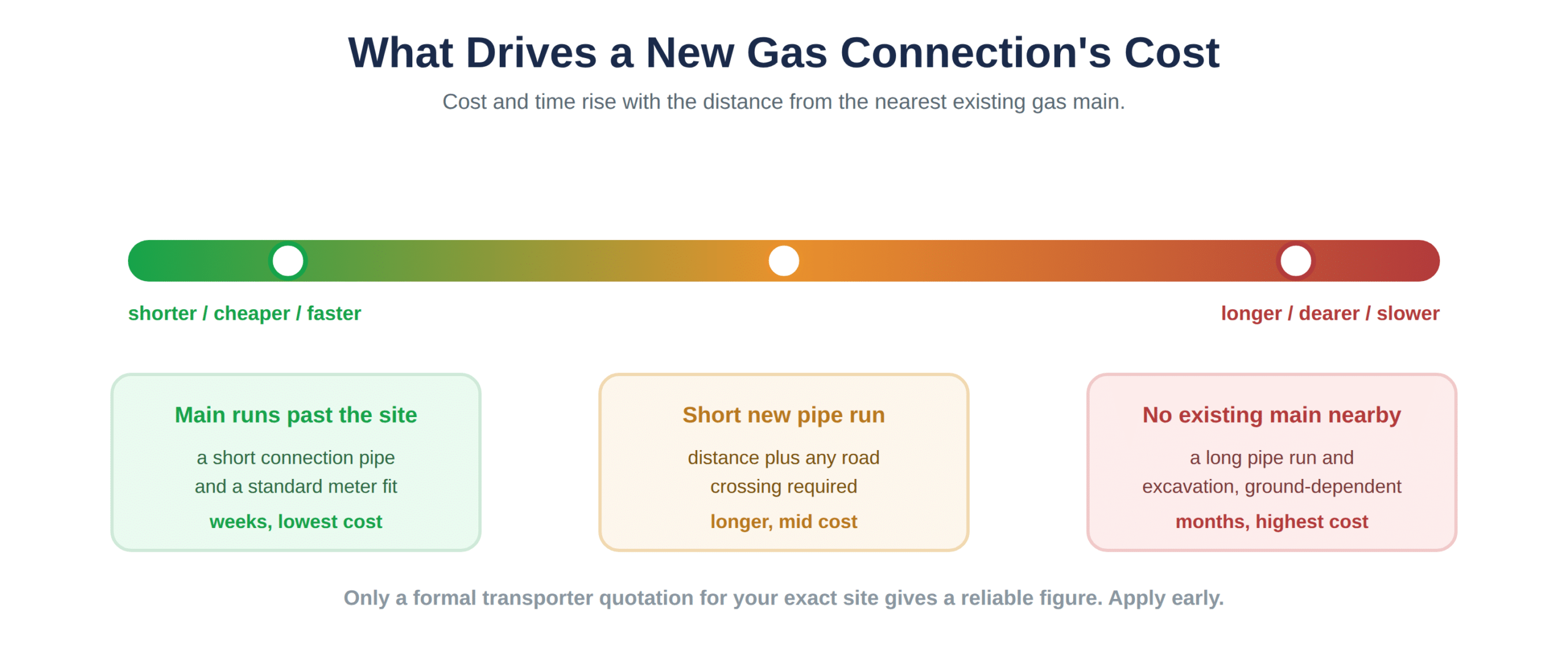
Commercial gas connection cost depends mainly on how far your premises sit from an existing main, the pipe diameter needed for your expected demand, and any road works or excavation involved.
What drives the quote
| Connection type | Typical complexity | What drives the cost |
|---|---|---|
| Existing main runs past the site | Low | Short connection pipe and standard meter fit |
| Main nearby, short new pipe run | Medium | Distance and any road crossing required |
| No existing main, longer pipe run | High | Length of pipe laid and ground conditions |
| Site on an IGT network | Varies | The IGT’s own charges and programme of works |
A restaurant on a high street with gas already running past the building costs far less than an industrial unit set back on an undeveloped site. Only a formal quotation from the transporter for your exact site gives a reliable figure.
How long does a new business gas connection take?
A connection close to an existing main can often be completed within a few weeks, while a longer new pipe run or a complex site can take a couple of months or more from application to a live supply.
Apply early in the fit-out
Transporters work to published timescales for standard jobs, but anything needing major excavation, a road closure permit, or third-party wayleave agreements extends the programme. Applying as early as possible in a fit-out schedule gives the most flexibility.
What happens once the gas connection is live?
Once the transporter has connected and commissioned your supply, you appoint an energy supplier, who arranges for a Meter Asset Manager to confirm the meter and register your MPRN fully.
Line up a supplier and check your CCL
Lining up a supplier before commissioning finishes means gas can flow from day one, rather than sitting connected but unbilled. Our guide to a new business electricity connection runs through the equivalent process, which often needs arranging in parallel.
It is also worth checking your Climate Change Levy position at this stage, since new commercial gas accounts are set up with the correct rate and any exemptions from the outset. Commissioning must be done by a Gas Safe registered engineer.