


Your gas supplier arranges a Meter Asset Manager (MAM) to carry out the meter installation, working alongside the Gas Transporter that owns the pipework serving your premises. A Gas Safe registered engineer always carries out the physical fitting, whichever company they work for.
Gas connections involve one extra layer that electricity does not: safety regulation. Nobody without a Gas Safe registration is legally allowed near a live gas meter, which shapes who is involved at every stage.
Commercial gas meter fitting also splits ownership between the pipe network, the meter hardware and the safety inspection. Knowing which company does which job means you know exactly who to chase if something stalls.
Independent Gas Transporters add another wrinkle on newer developments, since not every pipe network belongs to National Gas Transmission or a regional transporter.
What is a meter asset manager (MAM) and how do they fit into gas metering?
A Meter Asset Manager owns and maintains the physical gas meter on your premises, in the same way a MOP does for electricity, and is appointed by your supplier under the gas equivalent of a MOP contract.
When you deal with the MAM
Some suppliers use their own in-house metering arm, while others contract the job to a specialist MAM that handles metering for several suppliers at once.
You will rarely deal with the MAM directly except when the meter is faulted, out of date for recertification, or when you are moving to a smart gas meter.
How does business gas meter installation work in practice?
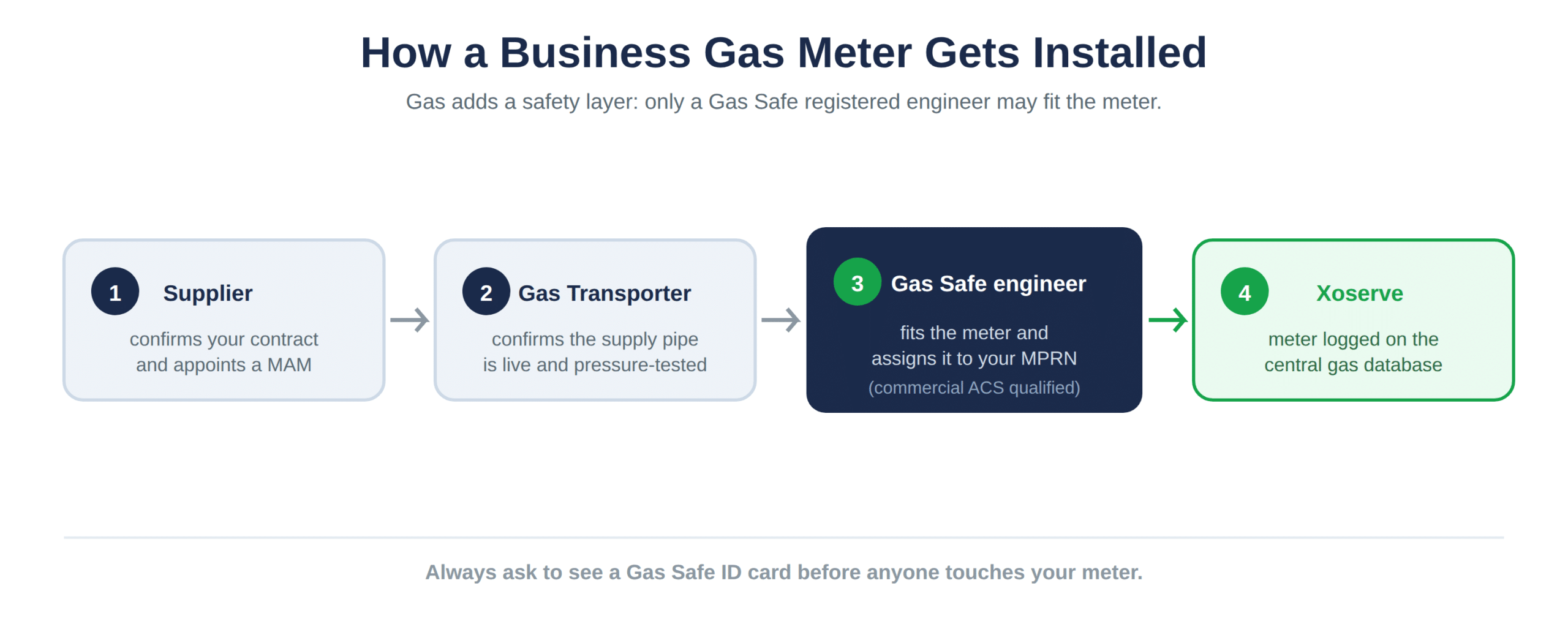
A Gas Safe registered engineer, instructed through the MAM your supplier has appointed, fits the meter once the Gas Transporter has confirmed the supply pipe is live and safe to connect.
Commercial engineers need extra qualifications
- Supplier appoints a MAM: once your contract is confirmed.
- Transporter checks the pipe: installed and pressure-tested.
- Engineer fits the meter: and assigns it to your MPRN.
Engineers working on non-domestic gas need a commercial-specific Gas Safe qualification on top of the standard registration. Always ask to see a Gas Safe ID card before anyone touches your meter, and for a site with no existing pipework our guide to a new business gas connection covers the extra steps.
What’s the role of the gas transporter and iGTs?
The Gas Transporter owns and maintains the gas pipes bringing supply to your area, while an Independent Gas Transporter owns and maintains newer, privately built pipe networks on some developments and industrial estates.
Where an IGT changes things
| Party | Role in commercial gas meter fitting |
|---|---|
| Supplier | Arranges your contract and appoints a MAM |
| MAM (Meter Asset Manager) | Owns, installs and maintains the meter |
| Gas Transporter / IGT | Owns the pipe network delivering gas |
| Gas Safe engineer | Physically fits and certifies the meter |
| Xoserve | Records meter and supply-point details industry-wide |
National Gas Transmission runs the high-pressure national system, with regional networks carrying gas the rest of the way. On newer sites an IGT sometimes owns the final stretch of pipe instead, which can slightly change who gets involved in a new meter installation.
Either way, the transporter’s job stops at the pipe. The meter itself remains the MAM’s responsibility, and your energy contract and billing sit with your chosen supplier.
Who pays for a new business gas meter?
Fitting or replacing a meter at an existing gas connection is usually included in your supply contract, while connecting a genuinely new gas supply involves a separate charge from the Gas Transporter or IGT.
Getting a quotation for new premises
If your premises already has a live gas pipe and a working meter, moving supplier rarely triggers any extra installation cost. A completely new connection is priced individually based on distance from the main, pipe diameter needed and site access.
How long does commercial gas meter fitting usually take?
Replacing or fitting a meter at an existing connection typically happens within a couple of weeks of your contract starting, subject to engineer availability and site access.
Why a new connection takes longer
A brand new gas connection takes considerably longer, since it depends on the transporter’s own programme of works and any pipe-laying required. Complex commercial sites with higher gas demand can also need extra design and safety checks before an engineer turns up.
Booking your appointment window well ahead of any planned opening date avoids a last-minute scramble, particularly for hospitality and catering sites where a working gas supply is business-critical. Comparing business electricity at the same time keeps both contracts aligned.