
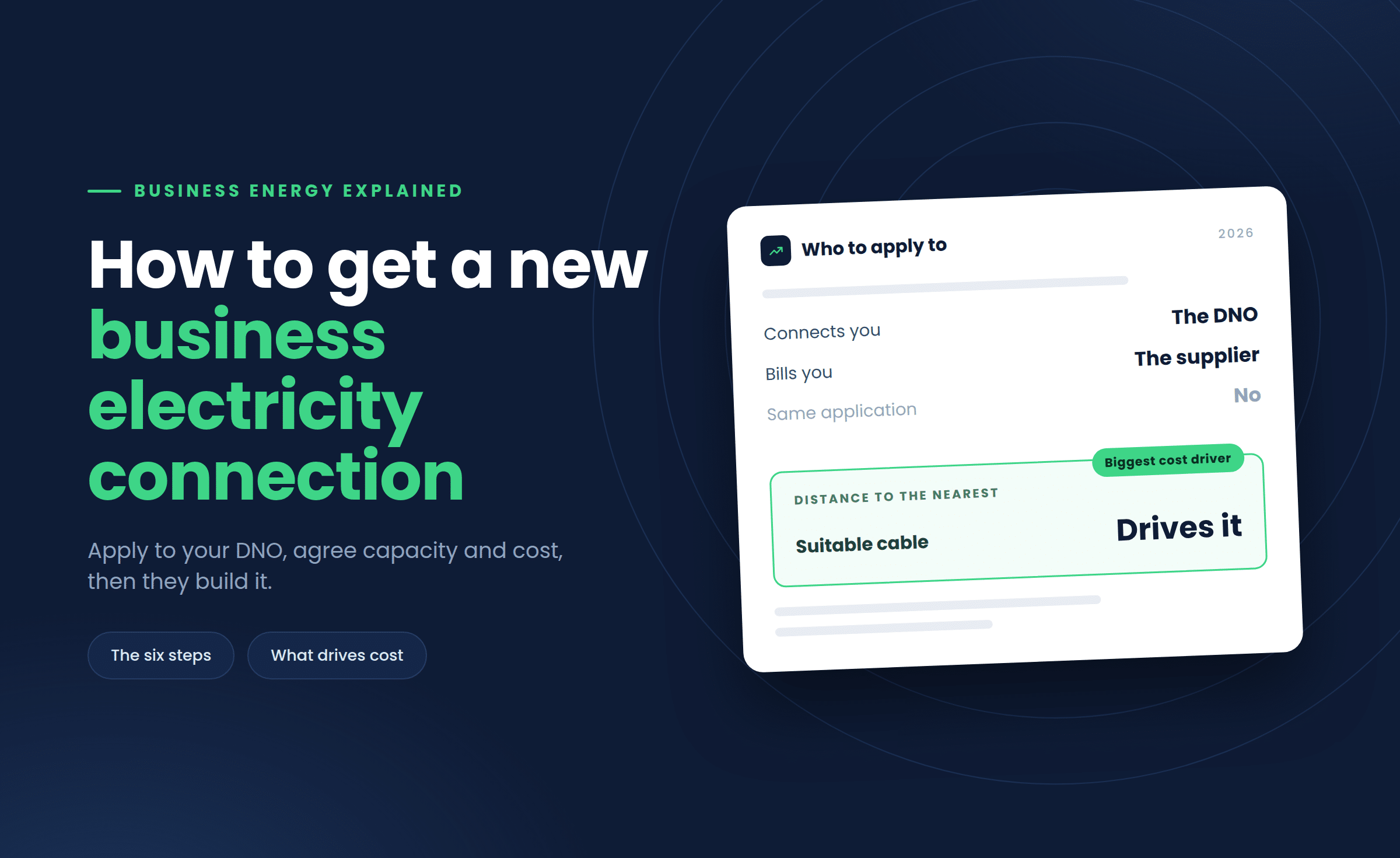
Apply to your local Distribution Network Operator (DNO) for a quotation, agree the capacity and cost, then let them carry out the physical connection before you appoint an energy supplier. The process runs from a few weeks for a simple connection to several months for a high-capacity industrial site.
New premises, an extension, or a change of use can all mean starting an electricity connection from scratch rather than switching an existing one. It is a different process entirely from switching supplier at a site that already has power.
The DNO for your area, not your chosen energy supplier, owns the physical process of connecting a brand new supply. That catches a lot of people out, since it is easy to assume your supplier handles everything.
Costs and timescales vary hugely depending on how far you are from the existing network and how much capacity you need. A single-phase shop unit and a three-phase industrial unit are almost different projects.
Who do you actually apply to for a new electricity connection?
You apply directly to the Distribution Network Operator covering your postcode, not to an energy supplier, since the DNO owns the cables and substations that need connecting.
Finding the DNO for your site
Six operator groups run 14 electricity distribution licence areas across Great Britain, and whichever covers your site’s location is the only DNO you can apply to, as our guide to who your DNO is explains.
Each DNO publishes a postcode checker, and the Energy Networks Association hosts one too. Our guide to what an MPAN number is explains how the first two digits of your future meter reference will identify your DNO once live.
What does the new business electricity connection process look like?
You submit a connection application with your required capacity, the DNO surveys the site and issues a formal quotation, and once you accept it, they schedule and carry out the physical works.
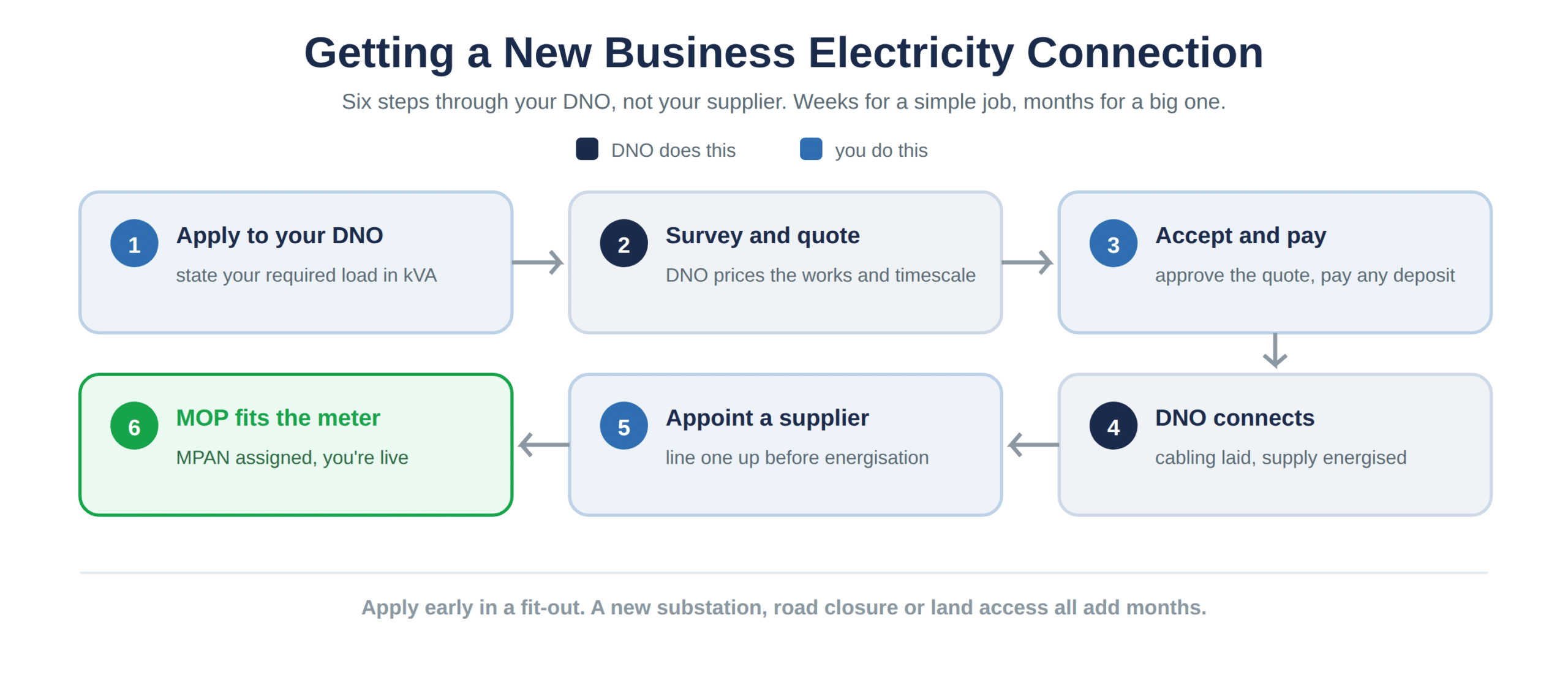
The six steps in order
- Apply: state your required load, usually measured in kVA.
- Survey and quote: the DNO reviews capacity and issues a formal quotation.
- Accept and pay: approve the quote and pay any required deposit.
- Connect and energise: the DNO carries out the works, per the Energy Networks Association’s connection guidance.
For smaller loads on an established street with existing capacity, several of these steps happen quickly. Larger sites needing new cabling or a substation take longer, since civil works and permissions get involved.
What affects the cost to connect electricity to new premises?
New electricity connection cost depends mainly on the capacity you need in kVA, how far your site sits from existing infrastructure, and whether new cabling or a substation upgrade is required.
What drives the quote
| Connection type | Typical complexity | What drives the cost |
|---|---|---|
| Small single-phase (shop, office) | Low | Distance from the nearest existing cable |
| Standard three-phase (restaurant, small industrial) | Medium | Cable capacity and any road works |
| High-capacity industrial or multi-unit | High | New substation, reinforcement, distance |
| Temporary supply (construction, events) | Low to medium | Duration and equipment hired |
A small retail unit on a standard single-phase supply close to an existing cable costs far less than an industrial site needing a dedicated three-phase supply from some distance away. The only reliable figure is a formal DNO quotation for your specific site.
How long does a new business electricity connection take?
A simple connection close to existing capacity can be completed in a matter of weeks, while a high-capacity connection needing new infrastructure can take several months from application to energisation.
Apply early in the fit-out
DNOs work to published standard timescales for simple jobs, but anything requiring a new substation, a road closure, or third-party land access naturally extends the schedule. Apply as early as possible in a fit-out programme, not once building work is already underway.
What happens once your connection is live?
Once the DNO has energised your supply, you appoint an energy supplier, who arranges a MOP to fit the meter and assigns your premises a unique MPAN.
Line up a supplier before energisation
Until a supplier is chosen, you are effectively unbilled but also unable to draw power for anything beyond the connection itself. Our guide to who installs a business electricity meter covers exactly what happens at this final stage.
Getting a supplier lined up before energisation keeps the project moving without a gap, and comparing business gas at the same time aligns both contracts from day one.