
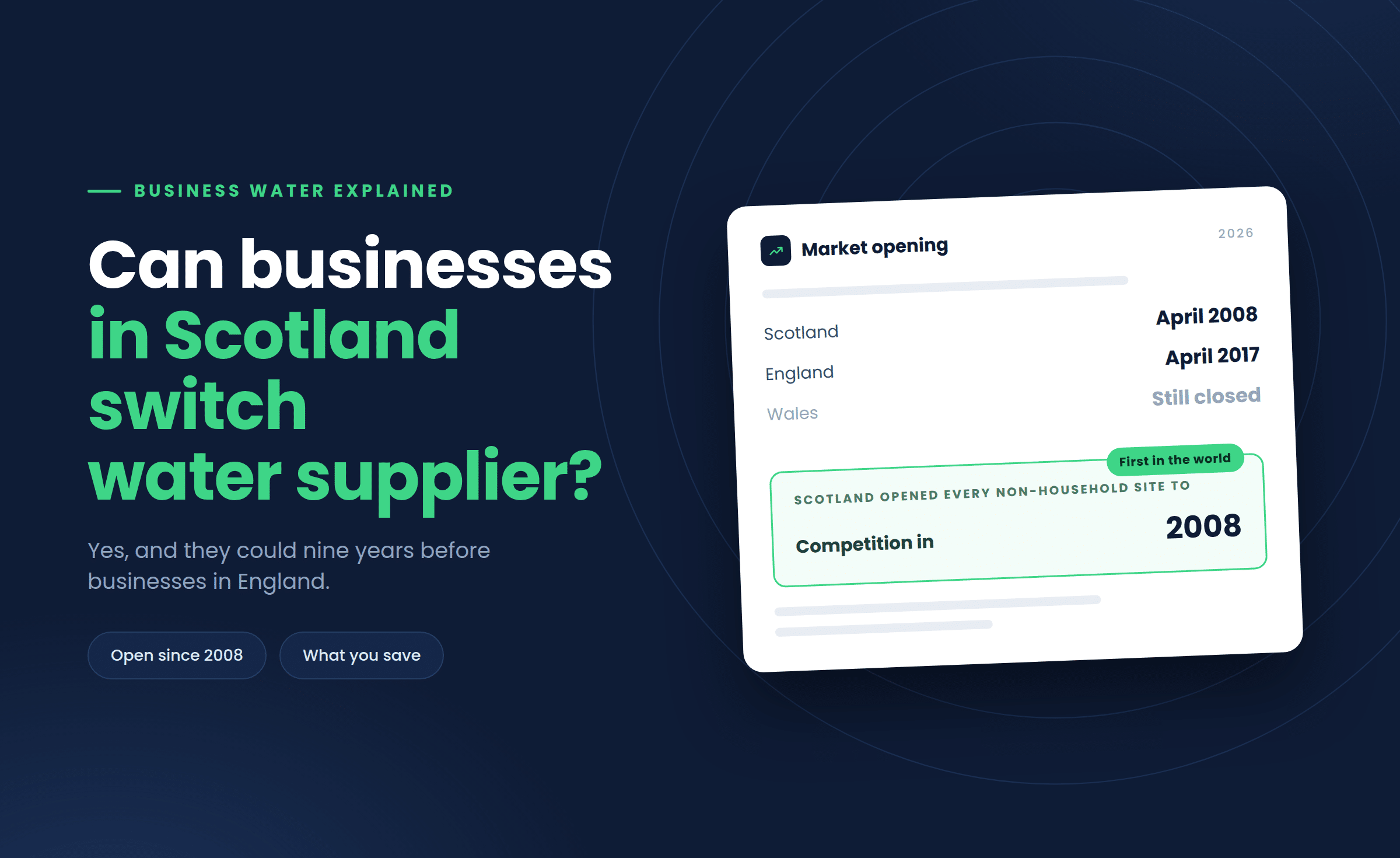
Yes. Scotland opened its non-household water market to competition in April 2008, almost a decade before England, so any business, charity or public sector site north of the border can choose its own retailer.
Scottish businesses have had this choice for far longer than their counterparts south of the border, yet plenty still do not realise it exists. Water bills tend to sit at the bottom of the pile, renewed on autopilot year after year.
Switching business water in Scotland works much like switching energy: you keep the same pipes and the same water, you just change who bills you. It is one of the simpler entries on any lower a business water bill checklist.
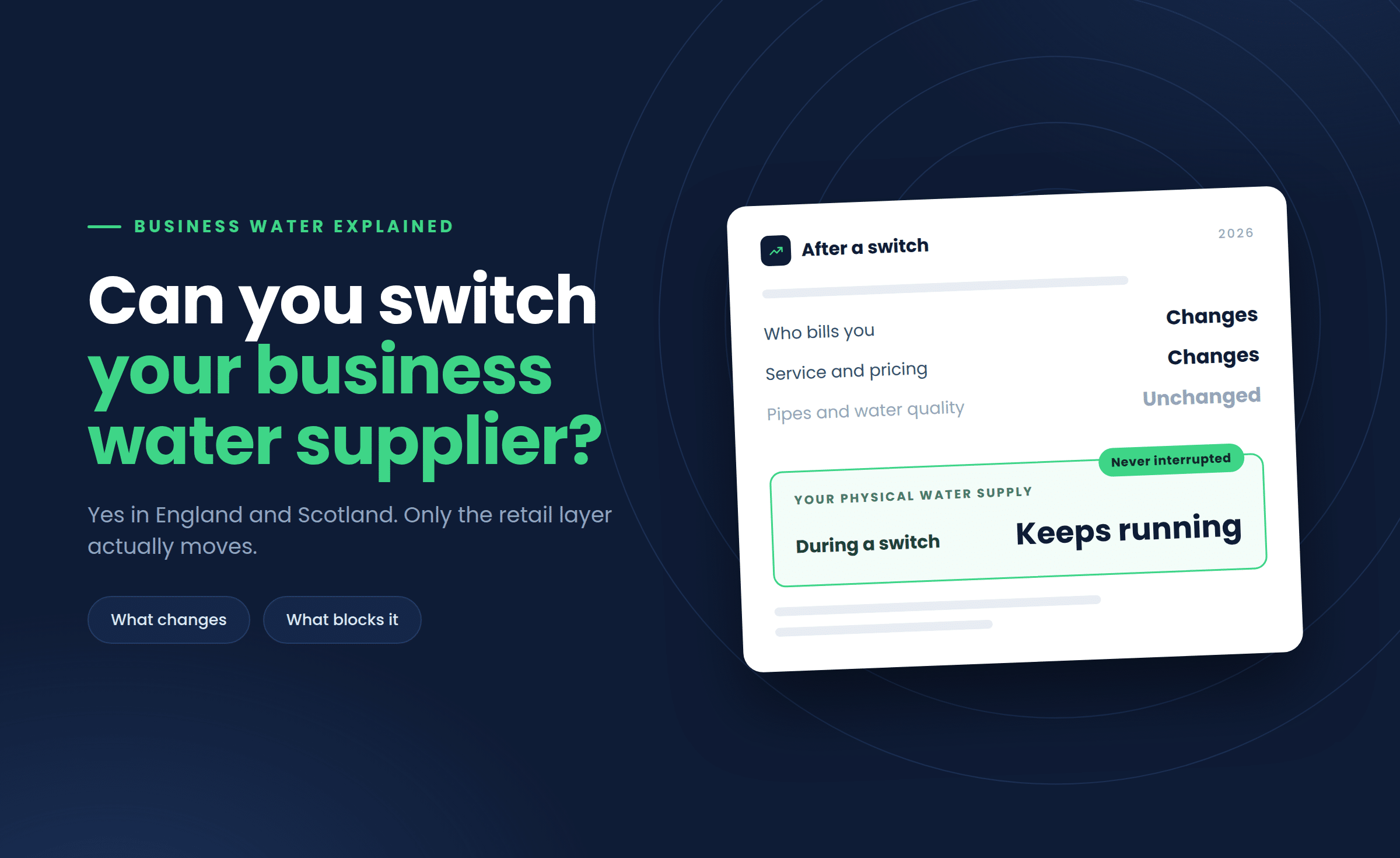
Scottish Water still owns the network, treats the water and fixes the pipes regardless of which retailer sends your invoice. The competition sits entirely on the retail side.
This guide covers how the Scottish market works, how it differs from England and Wales, and what a switch involves in practice.
How long has the scottish water market been open?
Since April 2008. Scotland was the first country in the world to fully open its water and wastewater retail market to competition for every non-household customer, regardless of size.
How the market is set up
The Water Industry Commission for Scotland regulates the market, setting the rules retailers and the wholesaler must follow. Its early start means competition has had close to two decades to mature.
- Opened to competition: April 2008, the first market of its kind in the world.
- Regulator: the Water Industry Commission for Scotland (WICS).
- Sole wholesaler: Scottish Water, throughout the whole country.
- Retailers: Business Stream, Castle Water and others compete for custom.
Who supplies the water if you switch?
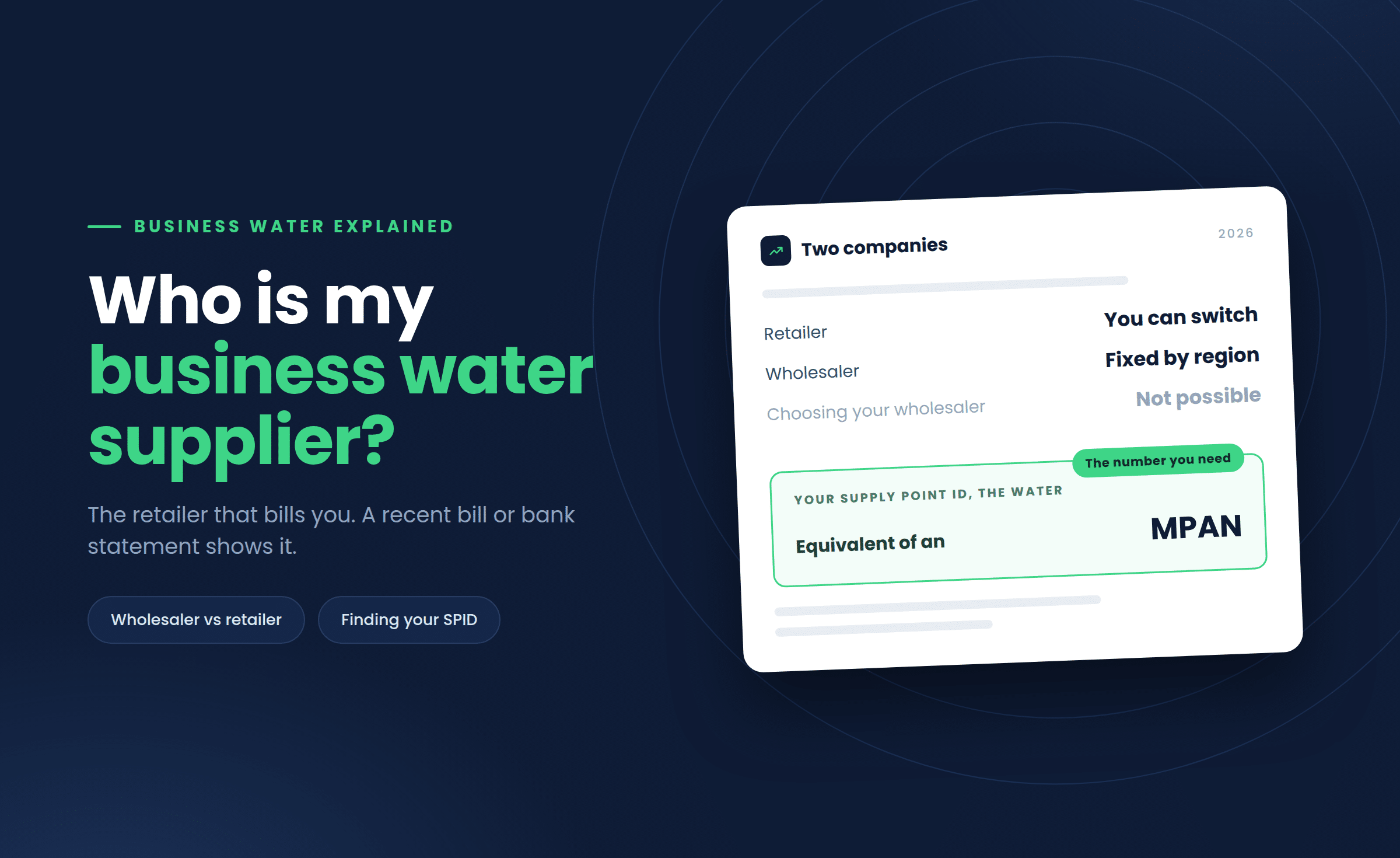
Your retailer handles billing, meter readings, customer service and your contract. Scottish Water remains the sole wholesaler across the country, owning the network and treating the water no matter who you switch to.
Why the retail and wholesale split matters
This split confuses many owners the first time they hear it. Switching retailer changes who you deal with day to day, not the physical infrastructure, exactly as our guide to switching business water supplier explains for the rest of the UK.
Every supply point also carries a unique SPID, or Supply Point ID, the water market’s version of an MPAN or MPRN. That number stays the same no matter how many times you switch retailer.
Because the wholesaler never changes, the quality of the water and the response to a burst main are identical across retailers. What you are really choosing is the account team, the billing platform and the contract terms.
How is scotland different from england and wales?
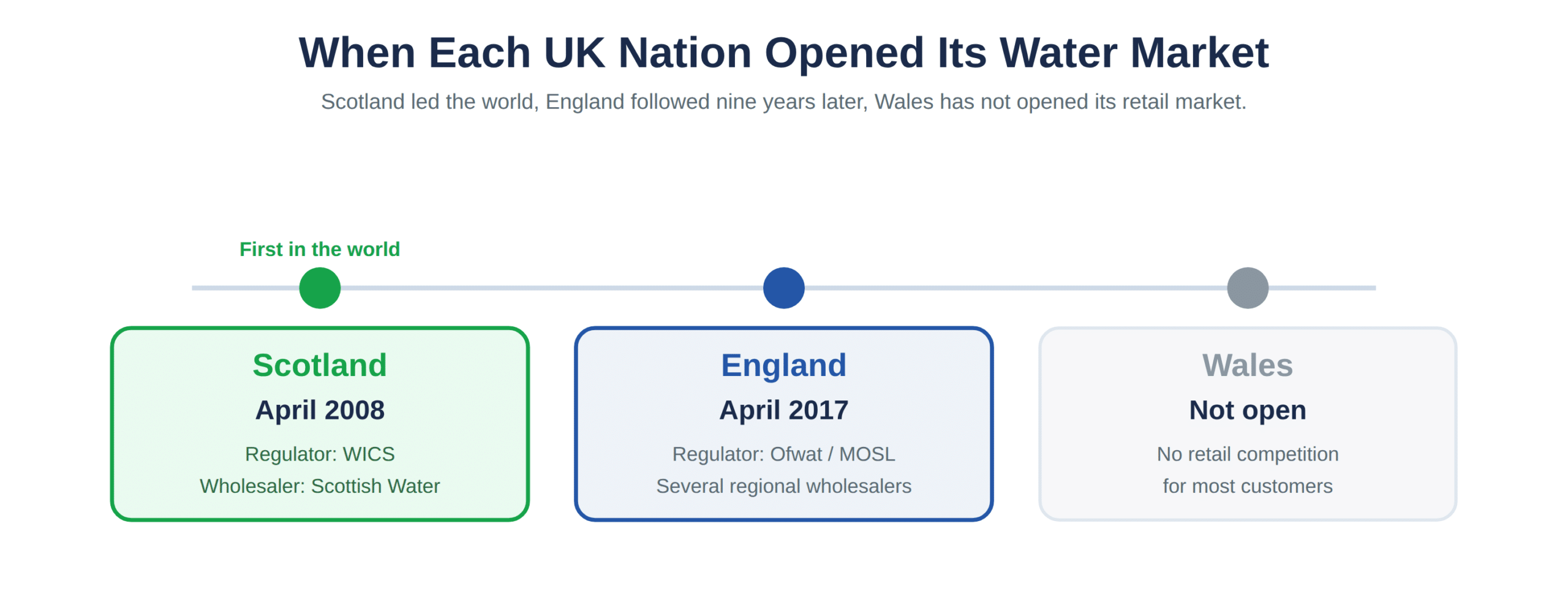
Scotland deregulated first in 2008 under WICS, while England followed in April 2017 under Ofwat and MOSL. Wales has not opened its retail market, so most Welsh non-household customers still cannot switch.
Three nations, three positions
| Nation | Market opened | Regulator | Wholesale layer |
|---|---|---|---|
| Scotland | April 2008 | WICS | Scottish Water only |
| England | April 2017 | Ofwat / MOSL | Several regional wholesalers |
| Wales | Not open | Ofwat / NRW | No retail competition |
A business with sites in both Scotland and England can genuinely shop around in both, though it may deal with different retailers, or the same retailer under different rules. The Ofwat market covers the English side.
What can you save by switching in scotland?
Savings mostly come from a lower retail margin, consolidated billing across multiple sites and fewer billing errors, rather than a discount on the water. Wholesale charges for water in, wastewater and drainage stay the same whichever retailer you pick.
Who tends to save the most
Comparisons tend to show the biggest gaps in service quality and how quickly a retailer sorts out a billing dispute, not in the underlying charges for usage. Multi-site businesses gain the most from a single consolidated bill.
A retailer can also bundle water, wastewater and surface water drainage into one clearer statement. For a business juggling several Scottish sites on separate accounts, that alone can be worth switching for.
It is worth reviewing your water at the same time as your energy contracts. The savings are usually smaller and more service-driven, but the effort is minimal once you already have a recent bill to hand.
If your site discharges trade effluent, that is billed separately from standard wastewater, so check a prospective retailer handles those accounts well. A business energy broker can run a water comparison alongside your energy renewal.
How do you switch business water supplier in scotland?
Gather a recent water bill for your SPID, compare retailer offers, then sign a new contract. Your new retailer handles the transfer, and the physical water supply is never interrupted during the switch.
What to have ready before you switch
- A recent bill: showing your SPID and current usage.
- Site details: your address and any multi-site account numbers.
- A letter of authority: if a broker is managing the switch for you.
- Trade effluent consent: details where relevant.
The process runs in the background between retailers and Scottish Water, much like switching business energy supplier works on the energy side, and Scottish Water keeps the supply running throughout.