
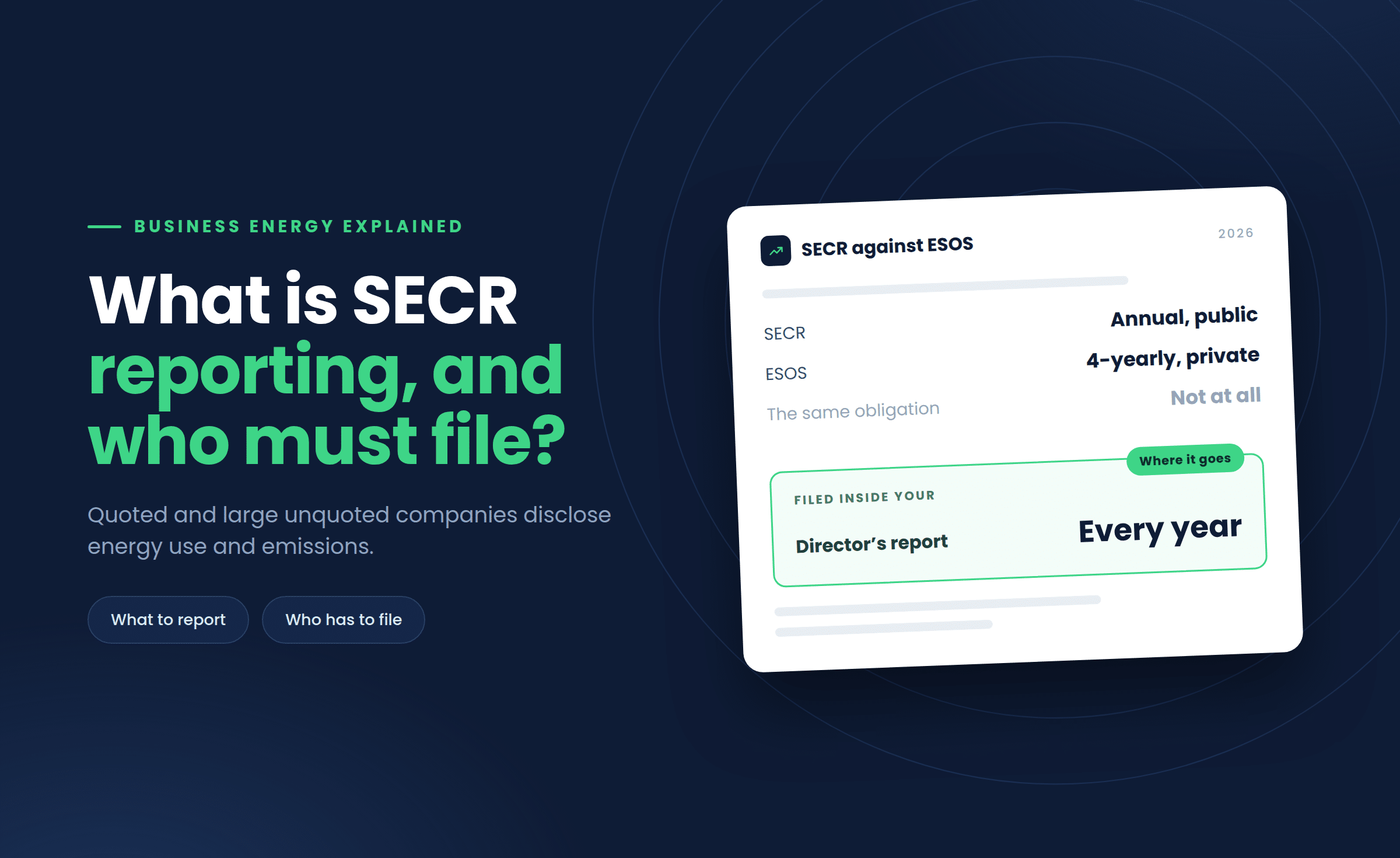
SECR, Streamlined Energy and Carbon Reporting, requires quoted companies and large unquoted companies and LLPs meeting Companies Act size thresholds to disclose their UK energy use, associated greenhouse gas emissions, and at least one intensity ratio, within their annual director’s report.
SECR sits in an odd spot for a lot of finance teams. It is not run by an energy regulator; it is a Companies Act requirement, so it lands on whoever prepares the annual accounts rather than a sustainability specialist.
That distinction matters more than it sounds. SECR gets filed alongside the director’s report every year, on the same timetable as the rest of the statutory accounts, not as a separate standalone submission.
For businesses used to voluntary sustainability reporting, the mandatory, structured nature of SECR can be an adjustment, since specific figures and a set methodology are required. It is often confused with ESOS, which is a different scheme entirely.
What information must a SECR report include?
A SECR report must disclose UK energy use, associated greenhouse gas emissions, at least one intensity ratio expressing emissions relative to a business metric, details of energy efficiency action taken, and the methodology used to calculate the figures.
The five required elements
| SECR requirement | What it means in practice |
|---|---|
| UK energy use | Total energy consumed within the UK, by source |
| Associated GHG emissions | Emissions calculated from that energy use |
| Intensity ratio | Emissions expressed relative to a business metric |
| Energy efficiency action | Narrative describing measures taken or planned |
| Methodology | Description of how the figures were calculated |
The intensity ratio makes the figures comparable year on year, expressing emissions relative to something like turnover, floor area or output. Efficiency action need not be extensive for a first report: a short narrative of measures underway satisfies the requirement.
The level of detail expected does grow with company size. A large quoted group is held to a fuller standard than a business that has only just crossed the threshold, so scale your disclosure to what your peers report.
Does your business have to comply with SECR?
SECR applies to all UK quoted companies of any size, plus large unquoted companies and LLPs that meet at least two of the Companies Act thresholds: turnover above £36 million, a balance sheet above £18 million, or 250 or more employees.
The low energy user exemption
Low energy users, businesses using 40,000 kWh or less across the reporting period, can make a simplified disclosure, so it is worth checking that exemption first. Always confirm current figures against the government’s environmental reporting guidance.
One point to watch: the Companies Act size thresholds were uplifted from April 2025, but SECR is being decoupled from that change so the uplift does not automatically pull firms out of scope. Check the company size guidance for the position that applies to your accounting period.
Quoted companies are in scope regardless of size, purely by being listed. A company that did not meet the thresholds last year can still be in scope the next after growth or an acquisition.
How does SECR differ from ESOS?
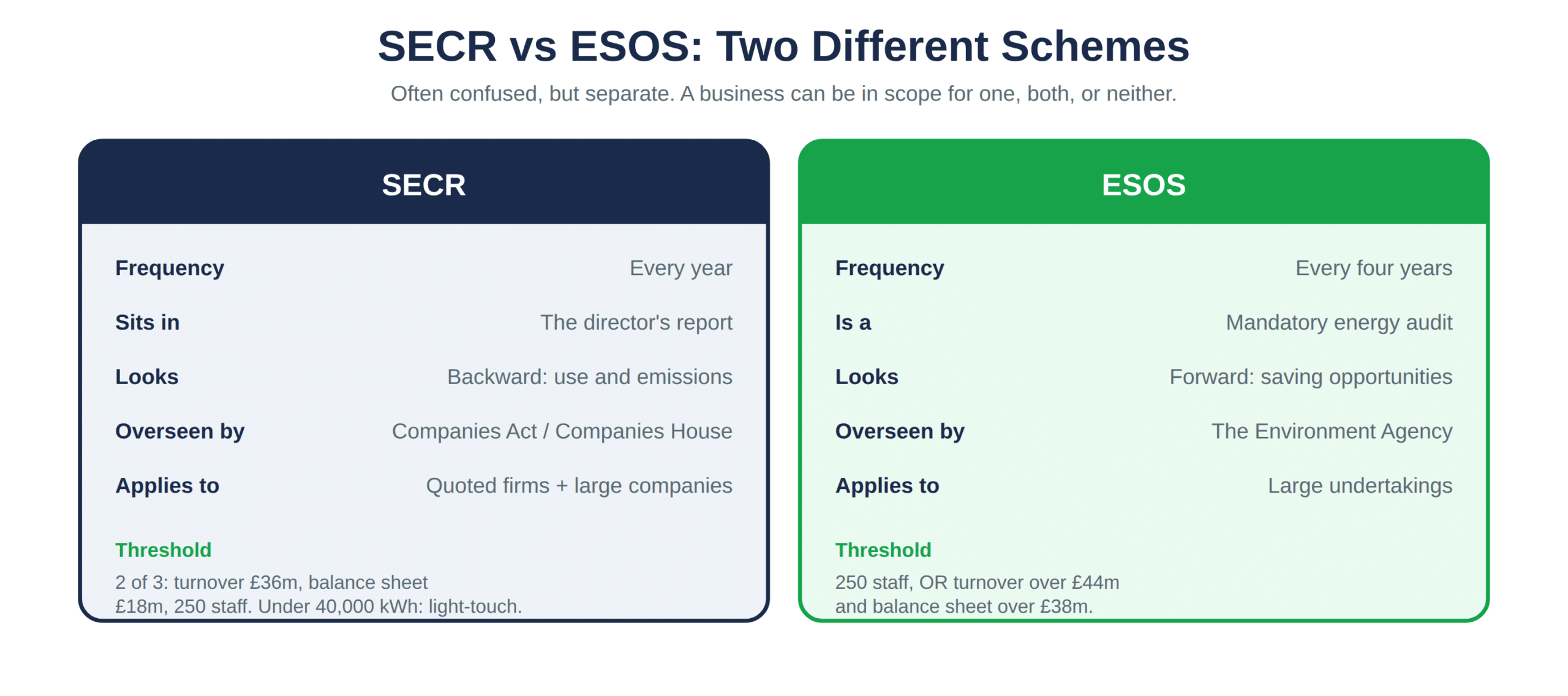
SECR is an annual disclosure within the Companies Act framework, while ESOS is a four-yearly mandatory energy audit administered by the Environment Agency. A business can be in scope for one, both, or neither, depending on which thresholds it meets.
Backward-looking versus forward-looking
SECR reports what has already happened: energy use and emissions for the year just ended. ESOS looks forward, identifying opportunities to reduce future consumption through a structured audit.
- SECR: annual, sits in the director’s report, backward-looking disclosure.
- ESOS: four-yearly, a mandatory audit, forward-looking recommendations.
- Different thresholds: so checking both separately matters.
Plenty of larger businesses handle both at once, and there is real efficiency in doing so. Data gathered for one can feed directly into the other, saving duplicated effort across finance and facilities teams.
How does a business put a SECR report together?
Most businesses gather energy data from supplier bills and meter records, apply standard emissions conversion factors, calculate an intensity ratio, and draft a short efficiency narrative before the figures go into the annual director’s report.
Common gaps first time round
Government-published emissions conversion factors, updated annually, turn raw consumption into a greenhouse gas figure, so confirm you are on the correct year’s conversion factors. Our guide to what a kWh is helps anyone unsure about converting meter readings.
- Missing site data: from a site added or acquired partway through the year.
- Wrong-year factors: using last year’s emissions conversion factors by mistake.
- Poor intensity ratio: choosing one that does not reflect actual business activity.
What happens if a business gets SECR reporting wrong?
Inaccurate or missing SECR disclosure is treated as a Companies Act reporting failure, which can affect the accuracy of the wider annual accounts and draw scrutiny from Companies House or auditors, separate from any SECR-only penalty.
It affects the whole director’s report
Because SECR sits inside the statutory accounts rather than as a standalone filing, errors here can complicate sign-off of the whole director’s report. A business energy audit carried out for ESOS can supply much of the underlying data and reduce that risk.
Genuine methodology changes year to year, such as switching intensity ratios or correcting a data gap, are generally fine as long as they are disclosed clearly rather than left unexplained.
The practical fix is consistency. Collecting the same data the same way every year means next year’s report does not start from scratch, and it makes any genuine change easy to explain.