
A business energy audit is a structured review of how, when and where a site uses energy, drawing on bills, meter data and a physical inspection to find where money is being wasted. Most businesses can run a basic version themselves, while larger organisations may be required to carry one out formally under ESOS.
Ask most business owners how their bill breaks down by system or time of day, and they will struggle to answer beyond the total on the invoice. An audit exists to close that gap.
It is not an academic exercise. A proper commercial energy assessment turns a vague sense that a building costs too much to run into a ranked list of specific, costed actions.
For a subset of larger businesses, running one is not optional. The Energy Savings Opportunity Scheme, or ESOS, overseen by the Environment Agency, requires qualifying organisations to audit their energy use on a set cycle.
What does a business energy audit involve?
A business energy audit is a structured review of how much energy a site uses, when it uses it, and where it is being wasted, drawing on bills, meter data and a physical walk-round of the building.
What a thorough audit covers
At its core, a commercial energy assessment compares expected against actual consumption for a building of that size and use, then explains the gap. It looks at heating, lighting, ventilation and any process plant, drawing on business electricity and gas data alike.
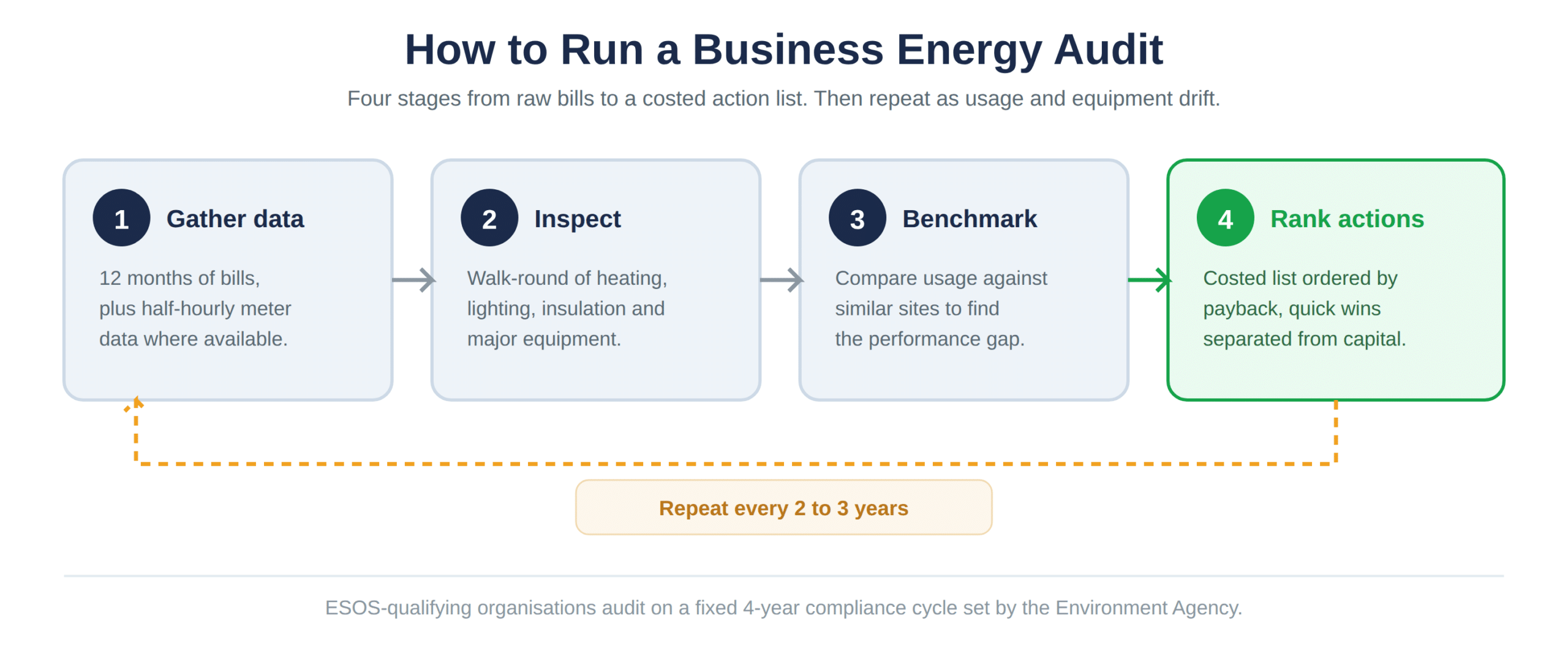
- Bill review: at least 12 months of bills and, where available, half-hourly data.
- Physical inspection: heating, lighting, insulation and major equipment.
- Benchmarking: against typical consumption for similar buildings and sectors.
- Ranked actions: a list of recommendations with estimated cost and payback.
Do you need a professional or can you audit your own site?
A basic self-audit using bills and a walk-round checklist is a good starting point for most small and medium businesses, but a professional assessment finds issues that are not visible without specialist equipment.
What a self-audit can cover
Gathering 12 months of bills, checking timer settings against opening hours, and doing an evening walk-round are all things any business can do without help. Knowing your profile class also tells you how your meter is treated for settlement.
What a professional adds
A qualified assessor brings thermal imaging, power quality monitoring and benchmarking data that shows exactly where a building underperforms. Half-hourly consumption from a half-hourly meter makes that analysis far sharper for larger sites.
Is your business required to carry out an audit under ESOS?
Large undertakings must take part in ESOS, a mandatory audit scheme run by the Environment Agency. A business qualifies if it has 250 or more employees, or turnover above £44 million and a balance sheet above £38 million.
The compliance cycle and dates
ESOS runs in four-year phases covering buildings, transport and industrial processes. For Phase 4, organisations qualify based on their position on 31 December 2026 and must report compliance by 5 December 2027, as gov.uk’s ESOS guidance confirms.
How SECR overlaps with ESOS
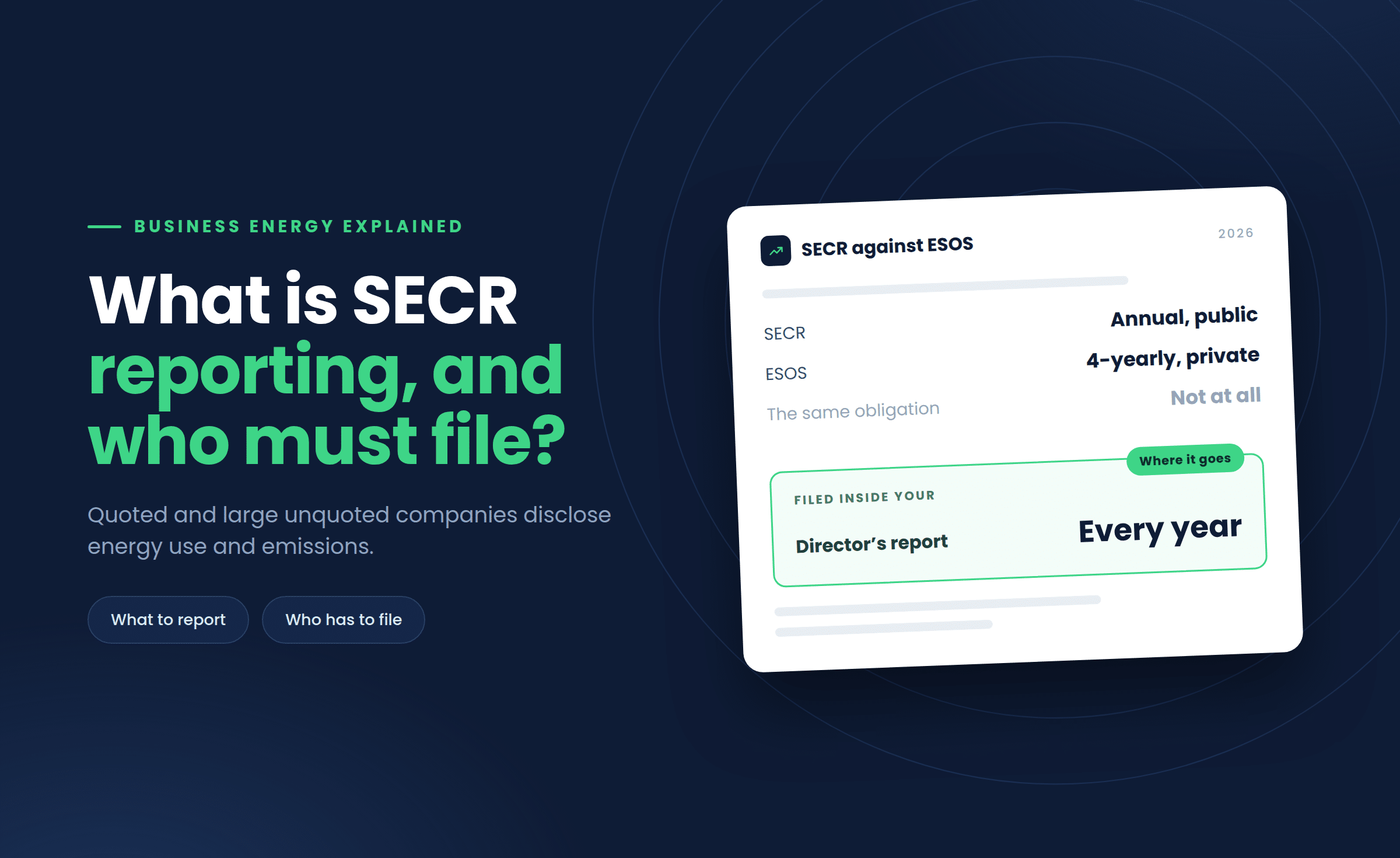
Separately, larger companies may fall under SECR, a Companies Act reporting requirement covering energy and carbon in the annual report. The two overlap in purpose but sit under different legislation, as the government’s environmental reporting guidance sets out.
What should a business energy audit report tell you?
A good audit report ranks recommended actions by cost and payback period, not just by potential saving, so you can prioritise what is realistic to act on first.
What a good report contains
| Report element | What it should show |
|---|---|
| Baseline consumption | Current usage by fuel, benchmarked against similar sites |
| Identified waste | Specific areas where energy is used unnecessarily |
| Recommended actions | Ranked list with estimated cost and payback period |
| Quick wins | Zero and low-cost changes separated from capital projects |
| Compliance notes | Any ESOS or SECR obligations relevant to the business |
If a report just lists generic advice without numbers attached to your specific site, it has not done the job. The value of an audit is in the specificity.
How do you turn audit findings into actual savings?
Start with the recommendations that need no capital spend, then build a simple business case for the upgrades with the shortest payback, rather than trying to act on everything at once.
Action three, not twenty
A report with twenty recommendations is only useful if three or four actually get actioned. Pick the ones with the best mix of impact and ease, and our guide to how to reduce energy consumption in a business covers the measures worth prioritising after an audit.
Treat the rest as a longer-term plan rather than an immediate to-do list. A staged approach keeps the project moving without needing a single large budget sign-off.
How often should a business repeat an energy audit?
Most businesses benefit from a fresh audit every two to three years, or sooner after any major change to the building, equipment or occupied hours.
A routine check, not a one-off
ESOS-qualifying organisations have set compliance periods to work to regardless of internal preference, so check the current cycle if your business falls under the scheme.
Outside a mandatory scheme, treat an audit like a supplier renewal: a routine check rather than a one-off event, since usage patterns and equipment both drift over time.