
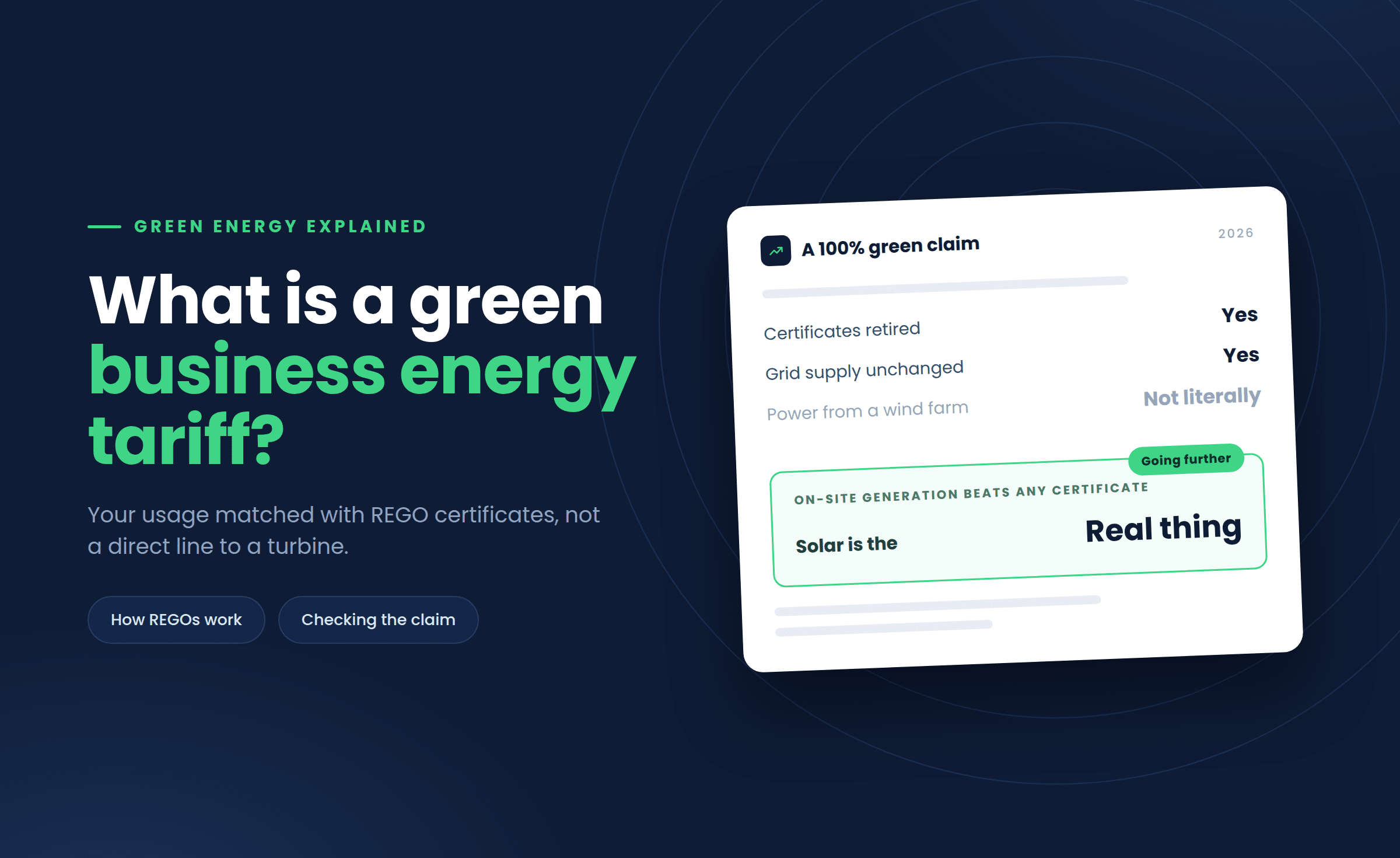
A green business energy tariff is a supply contract backed by REGO certificates confirming an equivalent amount of electricity was generated from renewable sources. The electricity physically reaching your premises is the same mix as everyone else’s on the shared grid.
That is not a trick or a loophole. It is simply how the grid works: every generator feeds into the same network, and there is no way to route a specific renewable electron to a specific building.
What a green tariff actually buys is a certified claim, backed by paperwork that traces to real renewable generation somewhere on the system, in a volume matching your consumption.
Some tariffs go further, funding new renewable capacity or disclosing where their certificates come from. That is where the real differences between business energy suppliers start to show.
This guide covers how green tariffs work, what REGO certificates mean in practice, and how to check whether a 100% green claim is genuinely credible.
How do green business energy tariffs work?
A supplier matches your annual electricity consumption against REGO certificates purchased from renewable generators, then markets the contract as a green tariff based on that certificate coverage.
Why there is no separate green cable
Physically, your premises draws power from the National Grid the same way it always has, alongside every other connected building nearby. There is no separate green cable.
The certificates are the mechanism that lets a supplier credibly say the equivalent volume of renewable generation was produced and retired against your usage, rather than claiming it with no backing at all.
Retiring a certificate is the important step. Once it is retired against your account, it cannot be counted again by another supplier, which is what stops the same renewable unit being sold twice.
What is a REGO certificate and why does it matter?
A Renewable Energy Guarantees of Origin certificate is issued for every megawatt-hour a renewable generator produces, and suppliers buy and retire these against customer volumes to substantiate a green tariff claim.
The evidence chain behind the claim
The Ofgem REGO scheme records the generation technology, location and accreditation period, giving a traceable evidence chain behind any renewable claim a supplier makes.
Without REGO backing, a green label is effectively just marketing. With it, there is at least an auditable link back to real generation, even if the physical electron routing cannot be pinned down.
Is 100% green business electricity from renewable sources?
A 100% green claim means the supplier has matched your entire consumption with REGO certificates, not that the power arriving at your meter came directly from a wind farm or solar site.
Questions worth asking before you switch
This distinction matters for accurate SECR or ESOS reporting, where the source and quality of a renewable claim is scrutinised more closely than a marketing page suggests.
- Coverage: are REGOs matched to 100% of my consumption, or a partial share?
- Origin: which generators or technologies do the certificates come from?
- Additionality: does the tariff fund new capacity, or buy existing certificates only?
Do green tariffs cost more than standard business tariffs?
Not always. Green tariffs sit anywhere from broadly comparable to a small premium above standard rates, depending on the supplier, contract length and how the certificates are sourced.
Why timing the comparison matters
A green tariff can land close to a standard rate or slightly above, so a straight comparison at renewal is always worth doing. Our guide to business energy renewals explains why timing the comparison protects you from overpaying.
Businesses assuming renewable energy automatically costs much more are often surprised when they compare live quotes. Check your business electricity options side by side before deciding.
How can a business go further than a standard green tariff?
Businesses wanting genuine on-site renewable generation rather than certificate-backed grid electricity typically install commercial solar, sometimes paired with battery storage or a solar PPA.
Combining on-site generation with a green tariff
Installing commercial solar reduces reliance on the grid mix entirely for the hours the system generates, a step beyond even a fully certificated green tariff, as our guide to whether solar is worth it explains.
Combining on-site generation with a green tariff for the remaining grid-supplied electricity is increasingly common among businesses that take their sustainability reporting seriously.
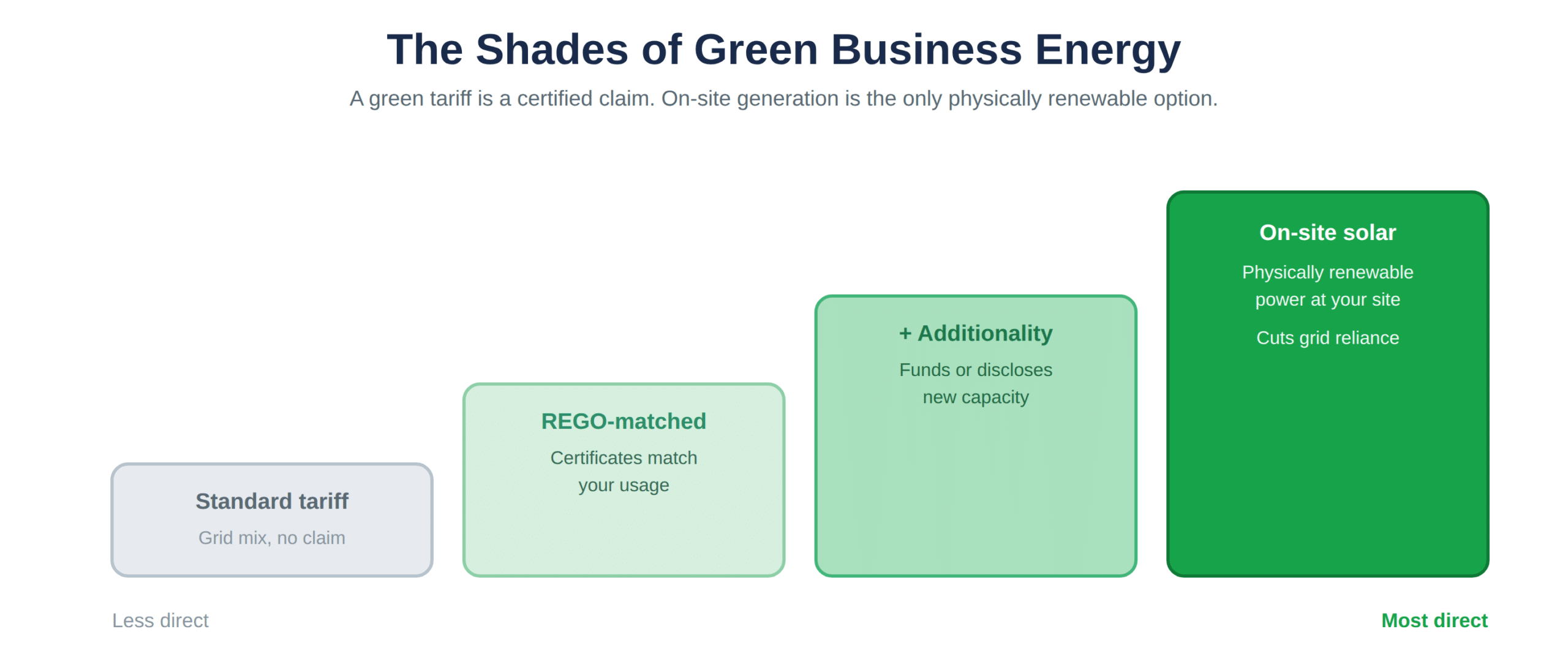
| Option | What it guarantees |
|---|---|
| Standard tariff | Grid mix, no renewable claim |
| REGO-matched green tariff | Certificates match your usage |
| Green tariff plus additionality | Funds or discloses new renewable capacity |
| On-site solar generation | Physical renewable power at your premises |
How do you check if a green tariff is genuinely credible?
Ask the supplier for their REGO coverage percentage, request evidence of the generators behind the certificates, and check whether any greenwashing concerns have been flagged about the tariff.
Spotting a credible claim
Ofgem and consumer bodies periodically review green claims, and the Green Claims Code sets the standard for environmental marketing, so a quick search for a supplier’s name alongside ‘green tariff’ before committing is worthwhile.
A supplier confident in its green credentials should be able to explain its REGO sourcing clearly and quickly, without vague language standing in for actual evidence.
This matters most when the green claim is part of your own marketing to customers. A tariff you cannot substantiate becomes a reputational risk rather than a selling point if it is ever questioned.