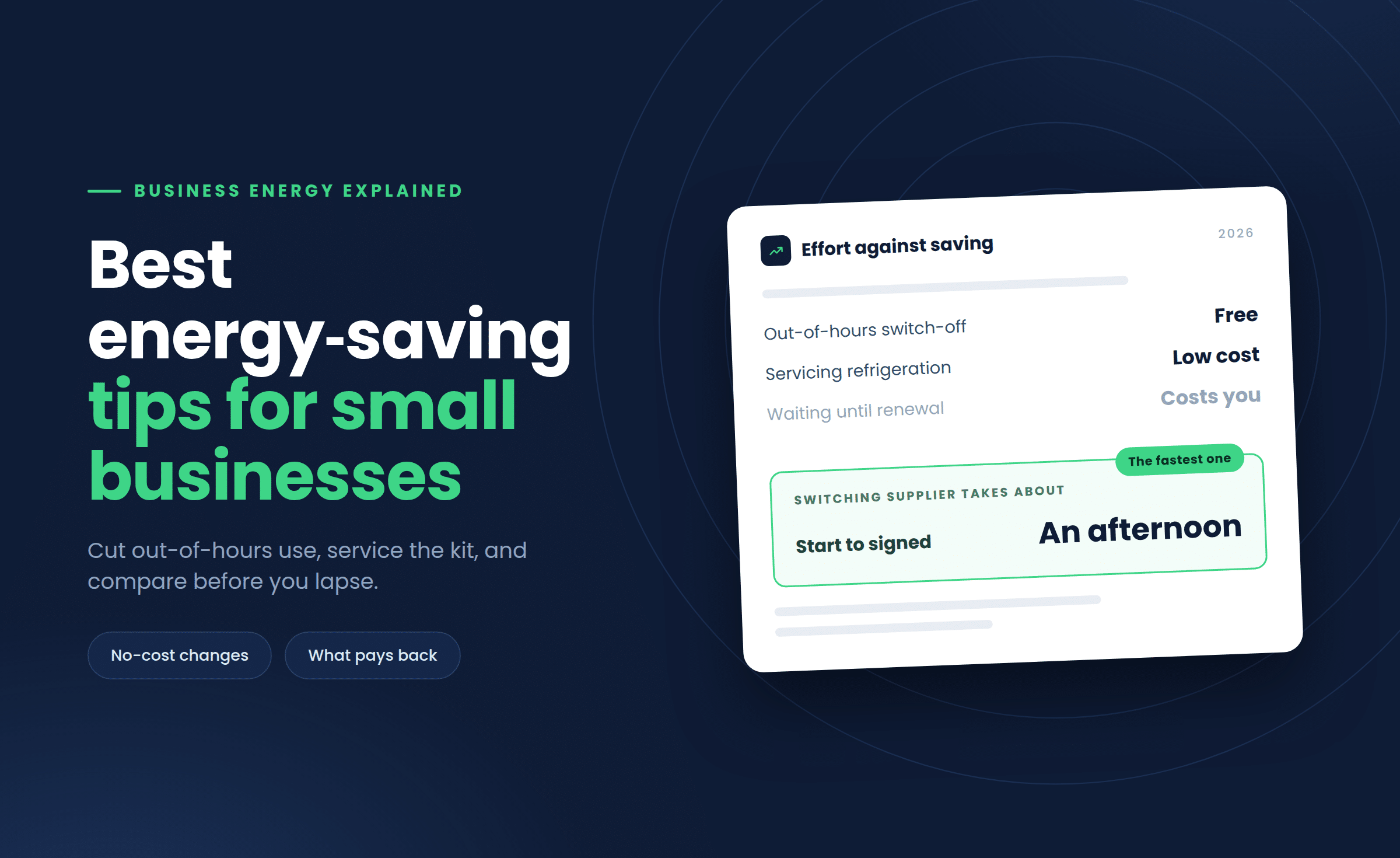

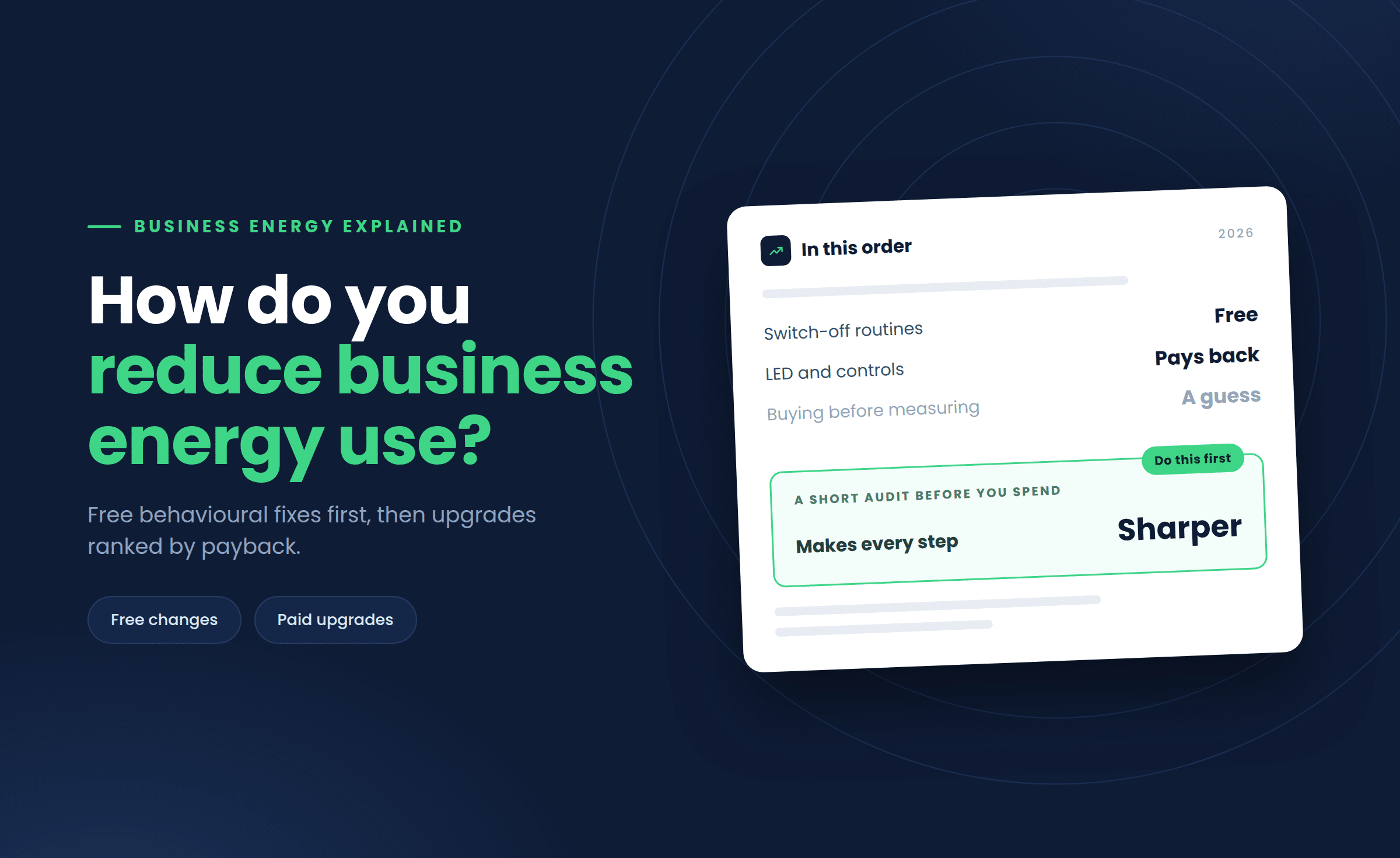
Start with free behavioural changes such as switch-off routines and tighter timer settings, then move to equipment upgrades like LED lighting and smart heating controls once you know where usage is actually going. A short energy audit beforehand makes every step after it more effective.
Every business wants a lower bill, but consumption and cost are two different problems solved in different ways. This guide focuses on the consumption side: how to use less, not just pay less for what you use.
The biggest wins often cost nothing. Heating running two hours longer than it needs to, lights left on in empty rooms, and kit on standby overnight are common across almost every sector, which is why a short business energy audit is the right first step.
Beyond the free wins sits a second tier of upgrades, lighting, heating controls and insulation, that pay for themselves within a few years and then keep delivering savings indefinitely.
Where does most business energy get wasted?
Heating, cooling and lighting running outside occupied hours account for the bulk of avoidable business energy waste, alongside equipment left on standby overnight and at weekends.
The usual culprits
Most businesses do not have a clear picture of where their consumption goes, because a single monthly bill does not break usage down by time of day or by system. That is where half-hourly data becomes genuinely useful.
- Out-of-hours HVAC: heating or cooling left running outside opening hours.
- Generous lighting timers: set too long, or with no timer at all.
- Standby load: IT equipment, monitors and kitchen appliances left on overnight.
- Tired plant: old or poorly maintained equipment working harder than it needs to.
A site running heating or air conditioning two hours either side of occupied hours, every working day, pays for a real chunk of energy nobody uses. Multiply that across a year and it is rarely a trivial figure.
What quick changes cut business energy usage without spending money?
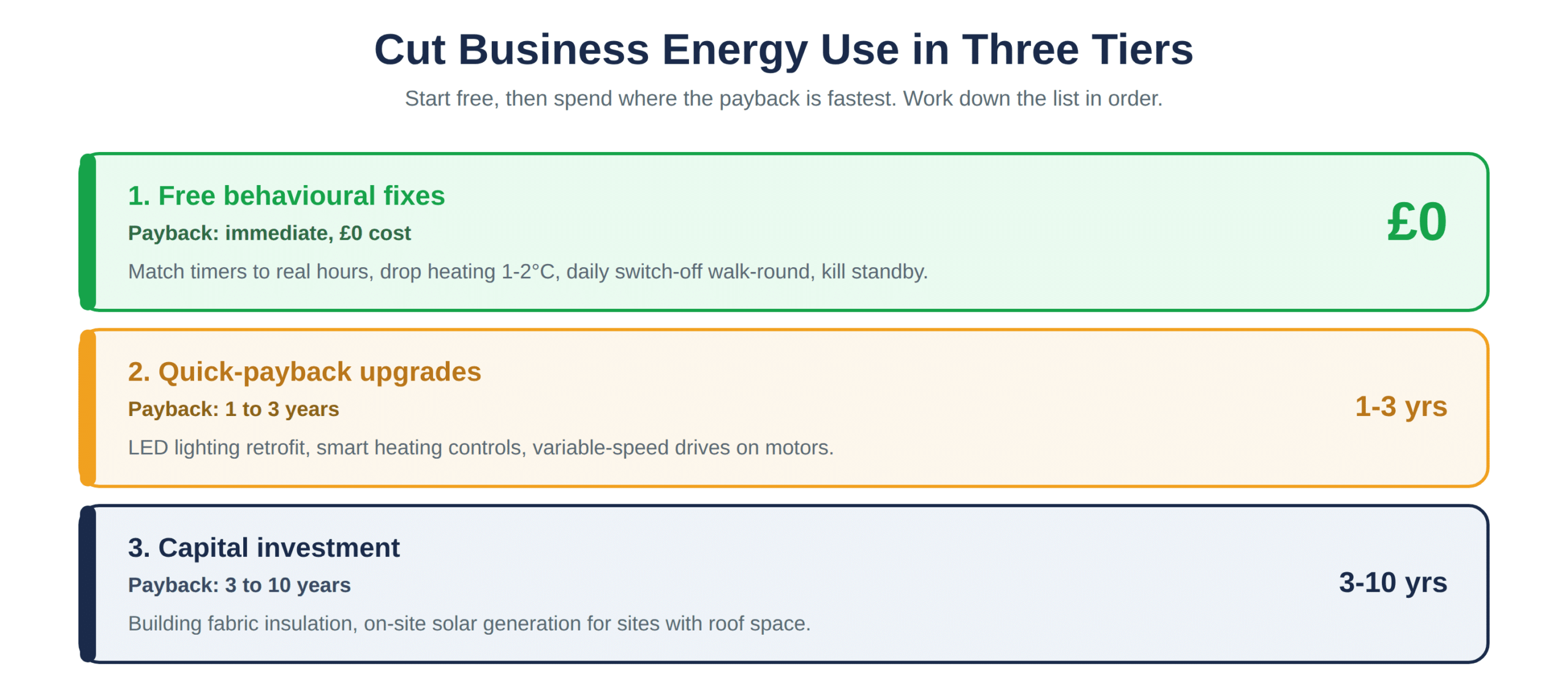
Adjusting thermostat settings, tightening timer schedules and building a simple switch-off routine can lower consumption within weeks, at no capital cost at all.
A basic switch-off checklist
- Kill standby: monitors and desktop PCs switched off, not left on standby.
- Unplug the kitchen: kettles and coffee machines off at the wall overnight.
- Cover the gaps: lights in unoccupied areas switched off where timers do not reach.
- Recheck timers: heating and cooling schedules matched to current opening hours.
Dropping a heating set point by one or two degrees, paired with better timer control, is repeated advice in energy efficiency for a reason. For more no-cost ideas, see our energy-saving tips for small businesses.
Which equipment upgrades pay back fastest for lowering consumption?
LED lighting and better heating controls tend to pay back fastest, often within one to three years, because they cut consumption continuously with minimal ongoing input.
Payback by upgrade type
| Upgrade | Typical payback | Best suited to |
|---|---|---|
| LED lighting retrofit | 1 to 3 years | Retail, warehouse, office space |
| Smart heating controls | 1 to 2 years | Any site with fixed heating hours |
| Variable speed drives on motors | 2 to 4 years | Warehouse, manufacturing, catering |
| Building fabric insulation | 3 to 7 years | Older stock, industrial units |
| On-site solar generation | 5 to 10 years | Sites with roof space and daytime use |
The government’s Energy Technology List helps identify efficient equipment, and commercial solar can cut exposure to volatile wholesale rates over time, though its payback runs longer than the changes above.
Prioritise by payback, not by headline saving. A cheap control upgrade that pays back in a year usually beats a larger project that takes a decade, especially where cash for capital works is tight.
How much difference can staff behaviour make to energy usage?
Behavioural change alone can meaningfully lower consumption, but only when it is backed by simple systems, not a one-off email asking people to switch things off.
Systems beat posters
A poster by the light switch works for about a week. A named person doing a daily walk-round with a short checklist keeps working for months, an approach the Carbon Trust recommends for lasting results.
Involving staff in the reasoning, not just the instruction, helps too. People who understand that overnight heating has a real cost attached are more likely to notice and flag it themselves.
Does comparing suppliers help cut consumption, not just cost?
Switching supplier will not directly reduce how much energy you use, but a cheaper contract and a genuine efficiency drive work well together, and half-hourly data from a new deal often reveals patterns worth acting on.
Getting the double benefit
Rate is what you pay per unit; consumption is how many units you use. A business paying the UK average of 24.14p/kWh for electricity and using less thanks to efficiency benefits twice, and our guide to how to read a business energy bill helps make sense of the usage figures first.
It is worth separating the two conversations even though they get bundled together, and comparing business electricity rates on a lower volume is where the combined saving really shows.
How do you know if your changes are working?
Track consumption against a like-for-like comparison period, ideally using half-hourly meter data, rather than relying on the total on your monthly invoice alone.
Measure against last year, not last month
Comparing this month against the same month last year strips out seasonal swings that would otherwise mask real progress. A half-hourly meter makes that comparison far more precise than a single monthly figure.
A simple spreadsheet tracking monthly kWh against the previous year, with notes on what changed, turns anecdotal impressions into something you can defend to a finance director.