
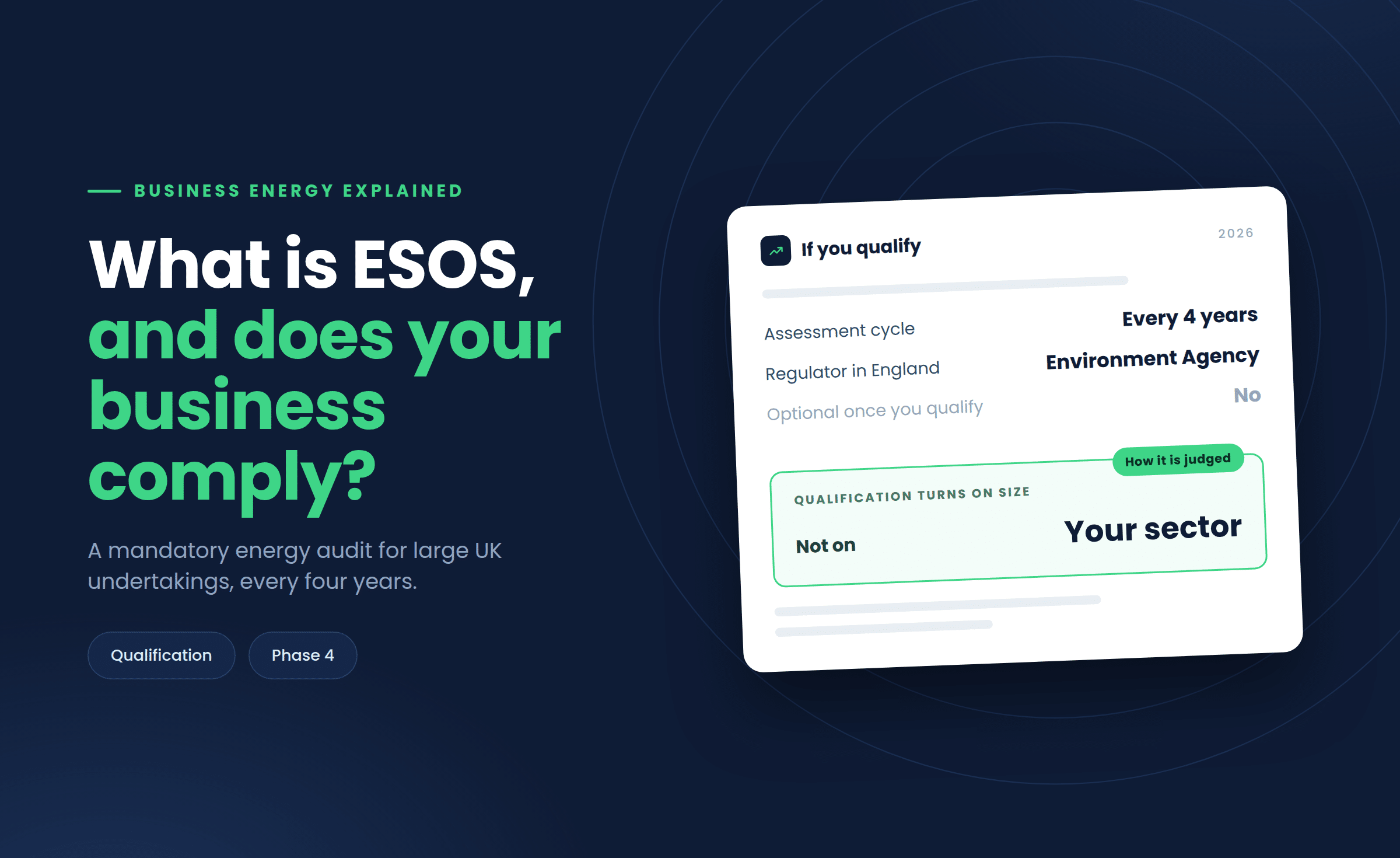
ESOS, the Energy Savings Opportunity Scheme, is a mandatory energy audit scheme for large UK undertakings, administered by the Environment Agency in England. If your business meets the qualifying size thresholds, you are legally required to assess your energy use every four years and report compliance.
ESOS turns up in a lot of finance and facilities inboxes with little warning, usually a few months before a compliance deadline that someone forgot was approaching.
That is not because the scheme is new. It has run in phases since 2015, but it only applies to a specific band of business, so plenty of companies genuinely never need to think about it.
The trouble starts when a business grows, restructures or changes ownership and crosses the threshold without anyone flagging it. Compliance is not optional once you qualify, and the gov.uk ESOS guidance is clear the Environment Agency does check.
What does ESOS require businesses to do?
ESOS requires qualifying businesses to audit at least 90% of their total energy consumption, identify cost-effective energy-saving opportunities, and notify compliance to the Environment Agency, all within a four-yearly cycle.
The core obligations
The audit must be carried out or reviewed by an approved lead assessor, someone registered with an approved professional body who takes responsibility for its technical accuracy. It sits alongside a standard business energy audit but is a formal, legal version of it.
- Audit 90% of energy: across buildings, transport and industrial processes.
- Use a lead assessor: or have the assessment reviewed by one.
- Identify measures: cost-effective energy-saving recommendations.
- Notify compliance: to the Environment Agency by the relevant deadline.
Buildings, transport and industrial processes are all in scope. A business with a vehicle fleet alongside its premises has to account for both, not just the energy used on site.
Does your business qualify for ESOS?
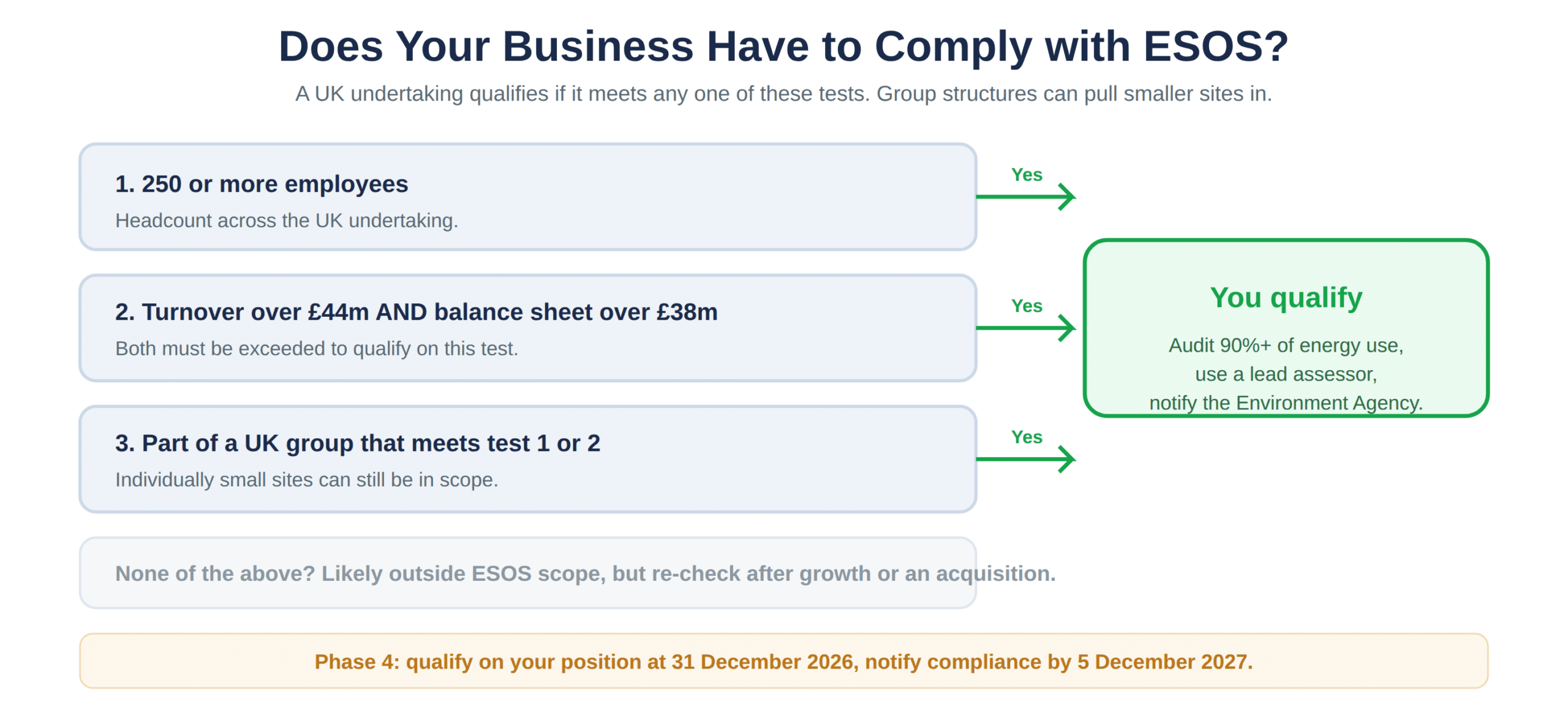
A UK undertaking qualifies for ESOS if it employs 250 or more people, or has an annual turnover above £44 million and a balance sheet above £38 million, or is part of a corporate group where the group as a whole meets one of those tests.
When the thresholds catch you out
Because group structures and franchise arrangements complicate the picture, check your status directly against the gov.uk ESOS guidance rather than assuming last time’s answer still applies. The definition is set out in the ESOS Regulations 2014.
A business that did not qualify at the last deadline can still be in scope for the next one, particularly after growth, an acquisition or a change in corporate structure.
What happens during an ESOS assessment?
An ESOS assessment involves gathering energy consumption data across the business, commissioning or reviewing site audits, identifying energy-saving measures, and compiling everything into a report signed off by a board-level director before notification.
Who does what
| Assessment stage | Usually responsible | What it involves |
|---|---|---|
| Data gathering | Facilities or finance team | Collecting consistent energy data across sites, meters and fleets |
| Site audits | Approved ESOS lead assessor | Auditing buildings, transport and industrial processes |
| Report sign-off | Board-level director | Approving the assessment before it is notified |
| Notification | Director or compliance lead | Submitting confirmation of compliance by the deadline |
Data gathering is usually the slowest part, and pulling consistent figures across multiple sites and fleets takes longer than most businesses budget for. Data from half-hourly meters makes this stage considerably easier for larger sites.
A director or equivalent senior individual has to sign off the assessment before it is notified. That means ESOS genuinely needs board-level attention, not a facilities team ticking a box quietly in the background.
What is new under ESOS phase 4?
ESOS Phase 4 is the current cycle. Businesses qualify based on their position on 31 December 2026 and must notify compliance by 5 December 2027, building on the enhanced reporting introduced in the previous phase.
More accountability after the audit
Earlier phases focused heavily on completing the audit itself. Recent phases push further into what businesses actually do with the recommendations, including setting out an action plan and reporting progress against it.
This matters for businesses already thinking about wider sustainability reporting, since ESOS findings increasingly overlap with what is expected under SECR reporting. Bigger recommended projects may also qualify for business energy efficiency grants, worth checking before ruling one out on cost.
What happens if a business does not comply?
Non-compliance with ESOS is a civil matter enforced by the Environment Agency, which can issue compliance notices, financial penalties and publish details of non-compliant businesses. Check the current figures on gov.uk, since enforcement guidance is updated periodically.
Publication is often the bigger worry
Publication of non-compliance is often the part that concerns businesses most, since it is visible to customers, competitors and investors in a way a private fine is not, as the Environment Agency’s ESOS pages set out.
Genuine oversights do happen, particularly around group structures or newly qualifying businesses. The Environment Agency does engage with businesses working towards compliance rather than treating every case identically.
Even so, leaving it late is expensive. A rushed assessment near the deadline costs more and delivers weaker recommendations than one planned across the four-year cycle.