
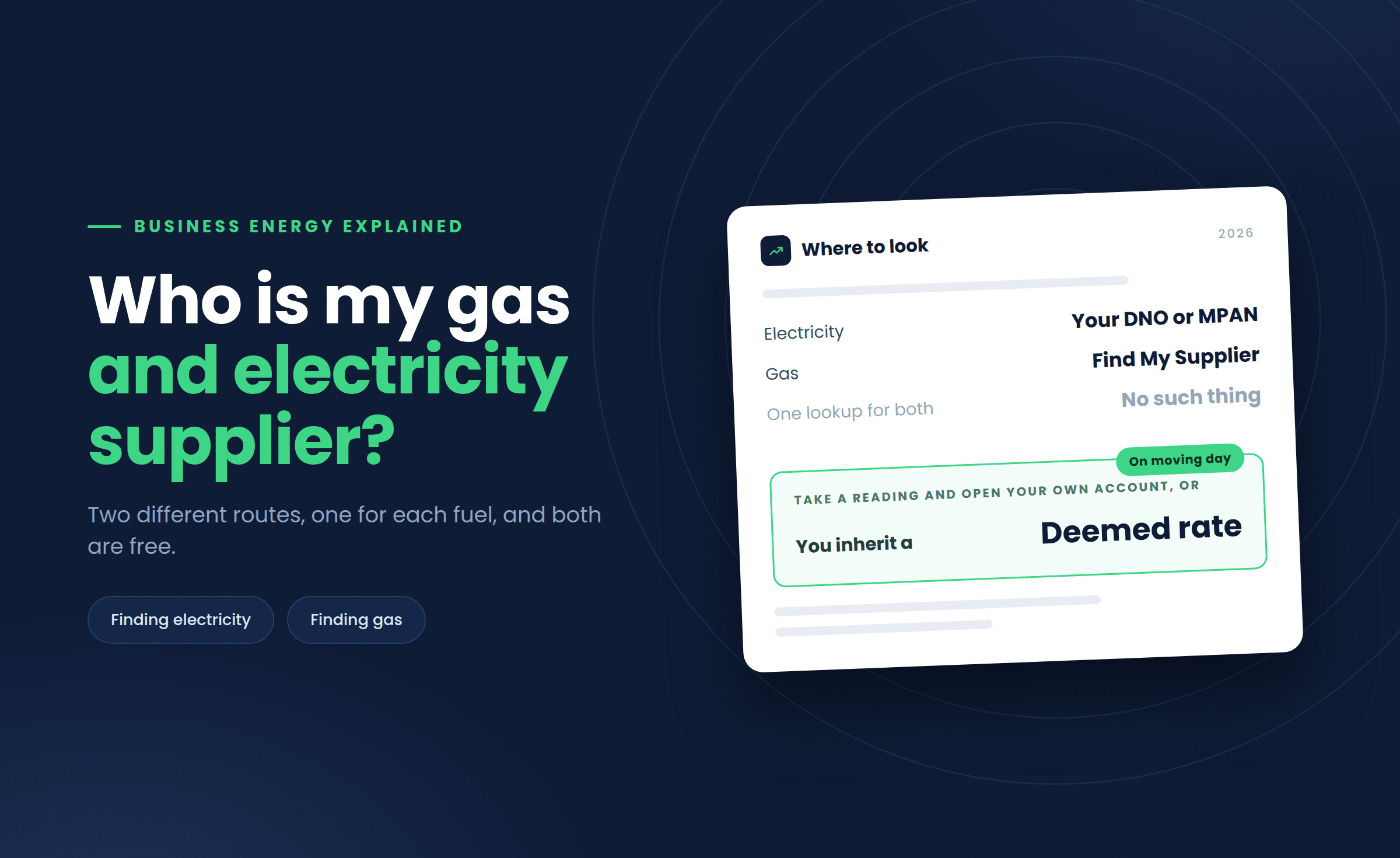
To find your electricity supplier, contact the Distribution Network Operator for your region or use your MPAN; to find your gas supplier, use the free Find My Supplier service or the Meter Number Helpline. Both routes identify who currently bills the premises so you can compare and switch.
It is a common question when you take on new premises, since energy does not move with the occupier. The supply keeps running, but the account and the supplier attached to that meter may be a mystery until you check.
Getting the answer matters, because a new occupier is usually placed on an expensive default rate until a proper contract is agreed, as our guide to deemed contracts explains.
This guide covers how to identify your electricity and gas supplier, what to do the day you move in, and how to move off that default rate quickly.
How do you find your electricity supplier?
Contact the Distribution Network Operator that runs the wires in your region, or quote your MPAN, the supply number printed on any electricity bill. The DNO can tell you which supplier is registered to the meter.

Find your regional network operator
There is no single national lookup for electricity, but the Energy Networks Association has a postcode tool that names your DNO, and your MPAN number identifies the exact supply point.
The DNO owns and maintains the network, not your contract, so it will not sell you energy. It simply confirms which supplier is currently registered to the meter.
Your MPAN appears on any electricity bill as a grid of numbers, usually labelled the supply number. Having it to hand makes every later step, from tracing the supplier to switching, considerably quicker.
Which network operator covers my region?
Great Britain is split between six Distribution Network Operators, each covering set regions. Identifying yours is the quickest way to trace an unknown electricity supplier.
The six GB distribution network operators
| Network operator | Regions covered |
|---|---|
| UK Power Networks | London, South East, East of England |
| National Grid Electricity Distribution | Midlands, South West, South Wales |
| Northern Powergrid | North East England and Yorkshire |
| Electricity North West | North West England |
| SP Energy Networks | Merseyside, North Wales, South Scotland |
| Scottish and Southern Electricity Networks | North Scotland and southern England |
These operators replaced the older regional electricity boards, so any list naming EDF, Western Power or Central Networks as your distributor is out of date. The regions themselves are unchanged.
How do you find your gas supplier?
Use the free Find My Supplier service online, which identifies your gas supplier and MPRN from your postcode, or call the Meter Number Helpline on 0870 608 1524 if you would rather speak to someone.
Your MPRN is the key
The Find My Supplier service returns your Meter Point Reference Number, the unique ID for the gas meter, along with the registered supplier. That number stays with the meter no matter who occupies the property.
Unlike electricity, gas has a single national lookup, which makes it the faster of the two to trace. Keep the MPRN once you have it, since you will need it to switch.
What should you do the day you move in?
Take a meter reading, find out who supplies the premises, and contact that supplier to open an account in your name, so you are billed correctly from day one rather than inheriting someone else’s account.
Getting the account into your name
The quickest source is often the landlord, letting agent or previous occupier, who can name the supplier directly. Our guide to change of tenancy covers who needs telling and when.
You may also get a letter addressed to the occupier naming the supplier. Whatever the route, a photographed opening meter reading protects you from being charged for the previous occupier’s usage.
Do not simply ignore the first bill because it is not in your name. The account stays live under whoever last held it until you actively take it over, and unpaid usage can become a dispute later.
How do you move off the default rate and save?
Once you know who supplies the premises, compare the market and agree a proper contract, because the deemed rate you are placed on when you move in is almost always more expensive than a negotiated deal.
From default rate to a real contract
A default or deemed rate is the supplier’s fallback, not a competitive tariff. Comparing business energy suppliers against a recent bill is the fastest way off it, and our guide to switching business energy walks through the process.
If you are still setting up at a new site, our guide to energy when moving business premises covers the wider timeline, and Ofgem sets out your rights on a deemed contract in the meantime.