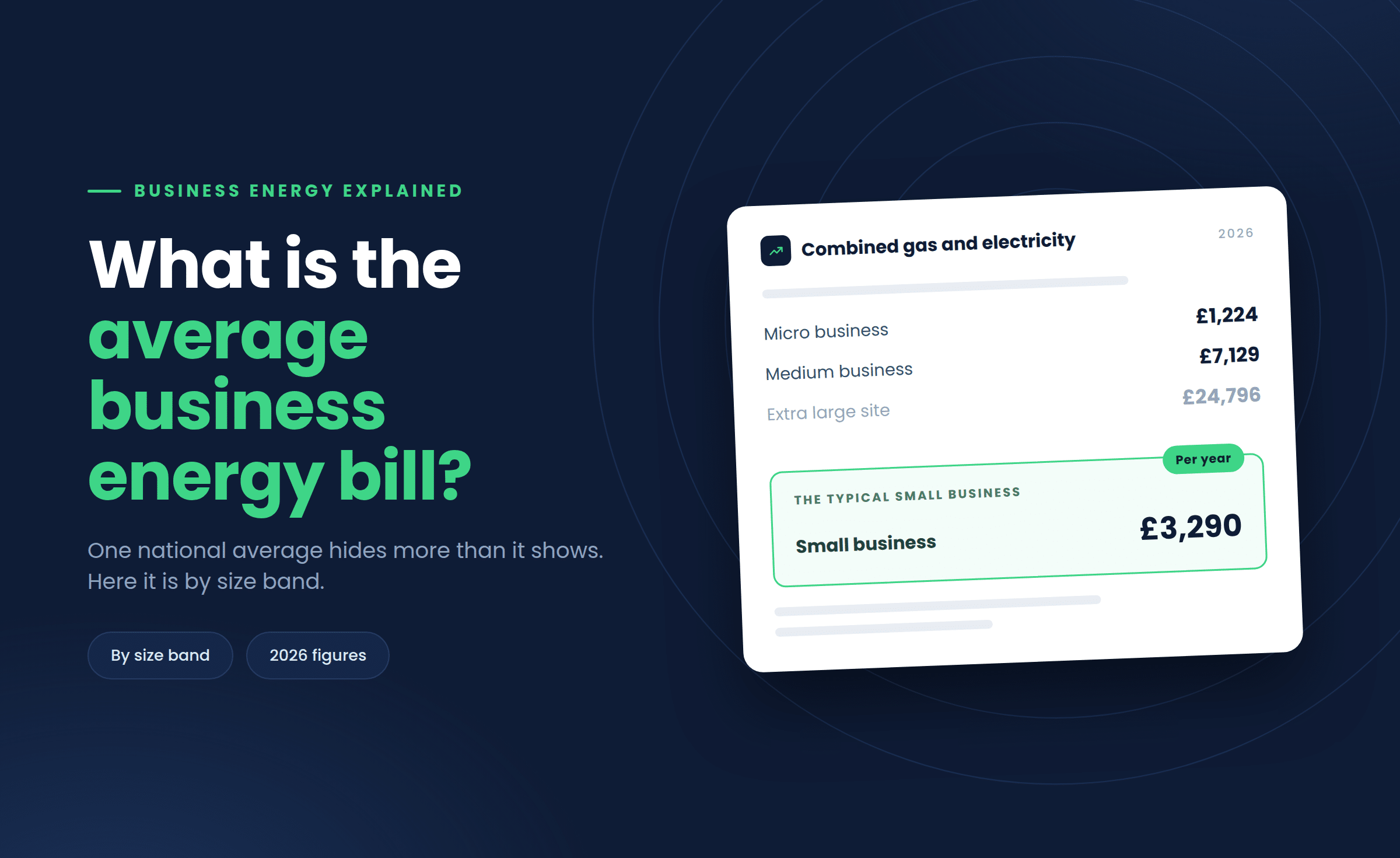

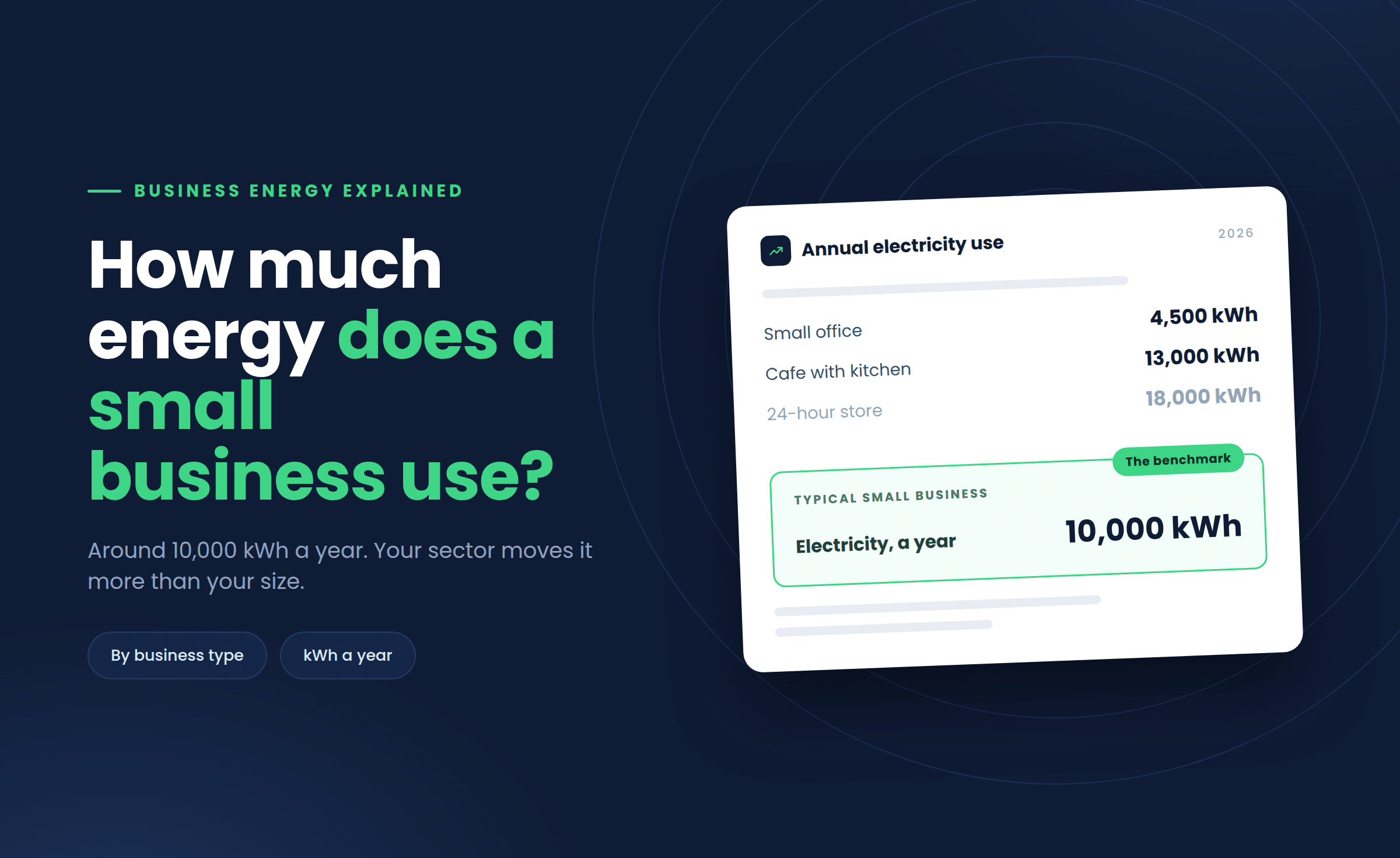
A typical small business uses around 10,000 kWh of electricity and 2,500 kWh of gas a year, roughly £3,290 combined at current average rates, though that figure moves a lot with sector, opening hours and premises size.
Ask five small business owners how much energy they use in a year and you will get five different answers. A hairdresser running two dryers and a boiler all day looks nothing like a solicitor’s office with a kettle, a printer and a few laptops.
Even so, a benchmark is useful: it tells you whether your bill sits roughly where it should, or whether a poor tariff or a fault is pushing your costs higher. Government consumption data, broken down by size, gives a reasonably reliable national picture to check yourself against.
What counts as a small business for energy usage purposes?
Energy suppliers generally class a small business as one using between 20 and 499 MWh of electricity a year, a far wider band than most owners assume, and most independent shops, cafes and offices sit well below the top of it.
That banding matters because it drives your unit rate. Your usage band is set against your MPAN number for electricity or MPRN for gas, the unique references tied to your meter point.
Why smaller sites often pay a higher unit rate
Counterintuitively, very small users tend to pay the highest rate per kWh, not the lowest. Suppliers spread fixed costs to serve, like metering and billing, across fewer units, and there is less room to negotiate on a small annual spend.
How much electricity does a small business use per year?
A small business with modest equipment and standard hours typically uses between 5,000 and 15,000 kWh of electricity a year, working out at around £2,884 for a business using up to 15,000 kWh.
The table below sets out usage and cost by size. It matches the figures in our average business energy bill guide, and our price per kWh breakdown explains the rates behind them.
| Business size | Annual electricity usage | Average electricity cost/yr |
|---|---|---|
| Micro | Up to 5,000 kWh | £888 |
| Small | Up to 15,000 kWh | £2,884 |
| Medium | Up to 25,000 kWh | £5,563 |
| Large | Up to 50,000 kWh | £10,606 |
| Extra large | Up to 100,000 kWh | £19,356 |
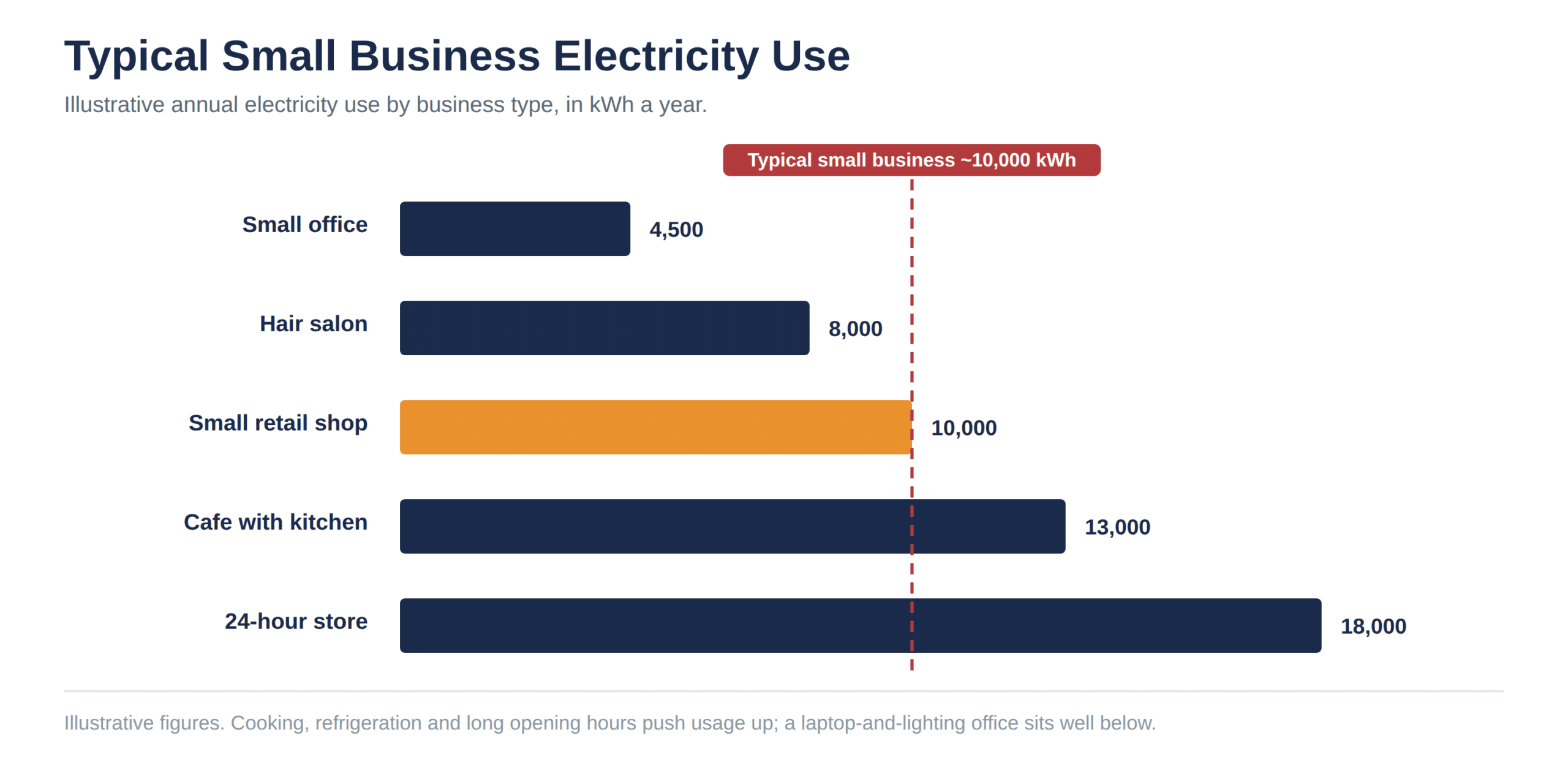
Usage varies by business type
Retail units with refrigeration or catering with cooking equipment sit toward the top of that range. A small office running laptops, lighting and a bit of air conditioning tends to sit toward the bottom.
These are averages, not quotes. Your own figure depends on region, meter type, consumption pattern and supplier, so treat the table as a sense check rather than a bill.
How much gas does a small business use per year?
Gas usage for a small business typically sits around 2,500 kWh a year where gas is mainly for heating, rising sharply for anywhere with commercial cooking, and costing roughly £876 a year at current averages.
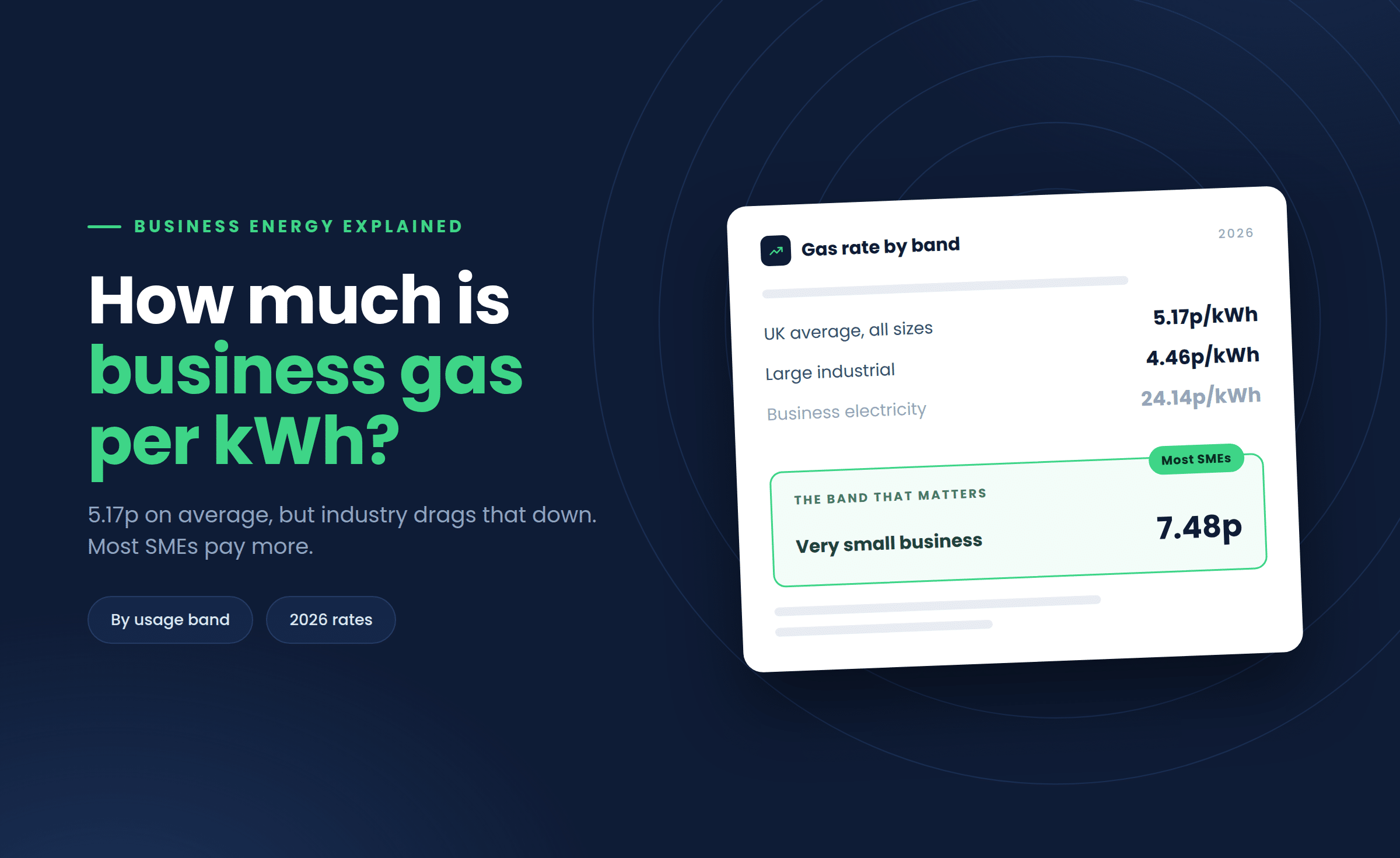
Many offices and salons have no gas supply at all and run entirely on electricity. Where gas is used, the very small band averages 7.48p/kWh, well above the 5.17p all-business average, as our business gas per kWh guide explains.
What drives gas use
- Cooking: a small cafe with a gas oven and hob uses far more than a gas-free office.
- Seasonality: swings matter more for gas than electricity, since heating drives most demand.
- Boiler condition: a poorly maintained boiler can lift gas use noticeably year on year.
What pushes small business energy usage up or down?
Sector, opening hours, equipment and building fabric are the four biggest drivers of small business energy use, and getting any one wrong moves your figure well away from the national average.
The four biggest drivers
- Sector: catering, retail refrigeration and manufacturing use far more than professional services.
- Opening hours: extended trading or shift patterns raise both electricity and gas demand.
- Equipment: older heating, lighting and refrigeration use considerably more than efficient kit.
- Building fabric: poor insulation pushes heating costs up regardless of tariff, and Carbon Trust guidance covers where to start.
How does small business usage compare with medium and large sites?
Usage and unit rate move in opposite directions as businesses grow: larger sites use far more energy overall but secure a lower rate per kWh, because they are a bigger, lower-risk contract for suppliers.
Why comparison matters more for small sites
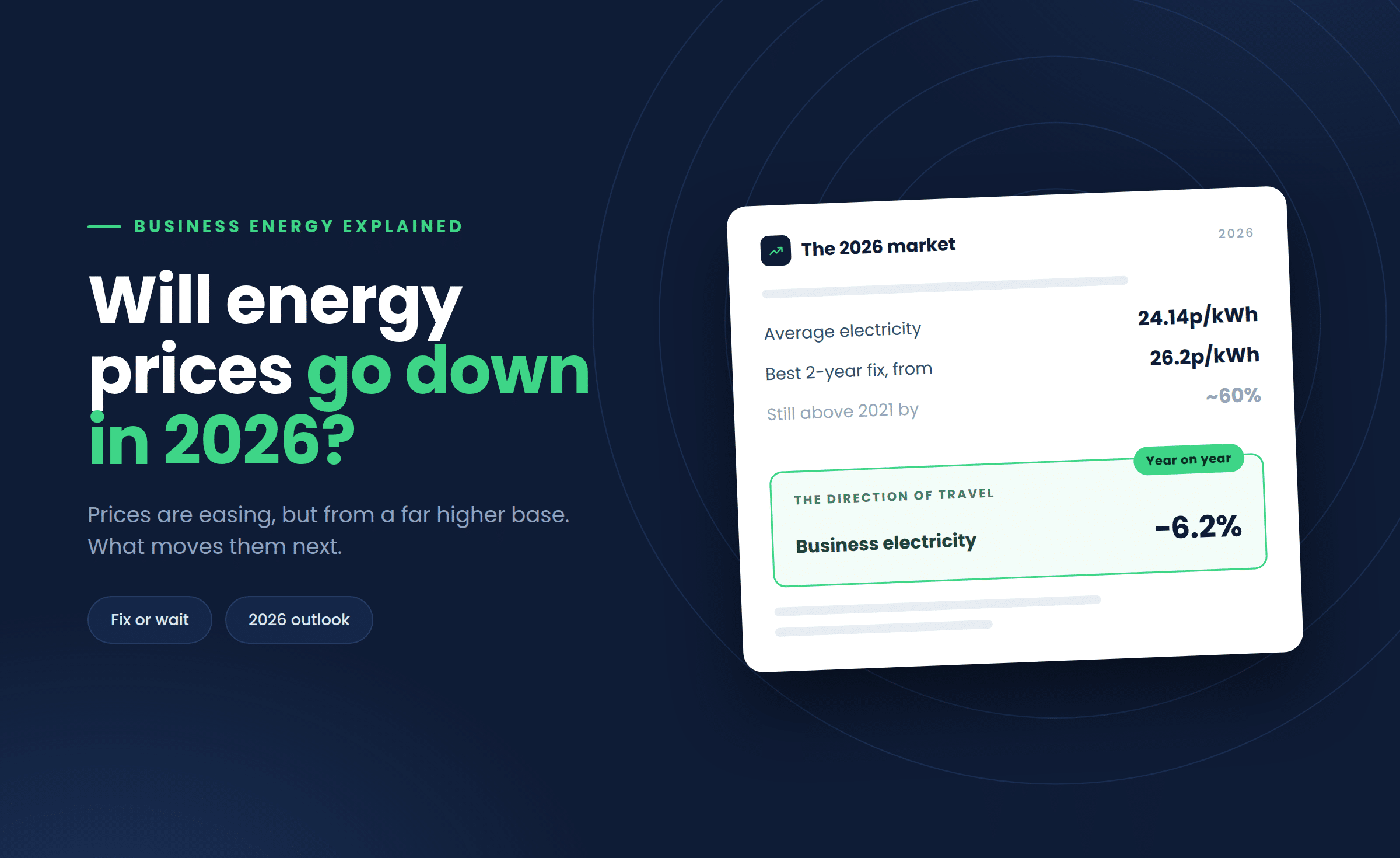
The rate gap, around 11p/kWh between the very small and large bands, is exactly why comparison matters more for smaller businesses. There is more slack in the rate to negotiate down, even if your total usage is modest.
| Business size | Annual electricity usage | Electricity rate 2026 |
|---|---|---|
| Very small | 0 to 20 MWh | 35.02p/kWh |
| Small | 20 to 499 MWh | 28.76p/kWh |
| Small / medium | 500 to 1,999 MWh | 28.08p/kWh |
| Medium | 2,000 to 19,999 MWh | 25.00p/kWh |
| Large | 20,000 to 69,999 MWh | 23.93p/kWh |
How can you find out your business’s exact usage?
Your annual usage sits on your bill as your Estimated Annual Consumption for electricity or Annual Quantity for gas, both in kWh, and a smart or half-hourly meter gives a more precise breakdown by time of day.
Where to find your EAC or AQ
Our guide on how to read a business energy bill walks through exactly where to find this figure and what the other numbers mean.
Businesses above around 100,000 kWh of electricity a year are usually settled half-hourly. Our half-hourly meters guide covers when that applies, and timing a switch well, as our best time to switch guide sets out, can then save more.
Once you know your usage, a comparison across a panel of business energy suppliers shows whether your rate is competitive, and Ofgem’s business energy advice sets out your rights.