
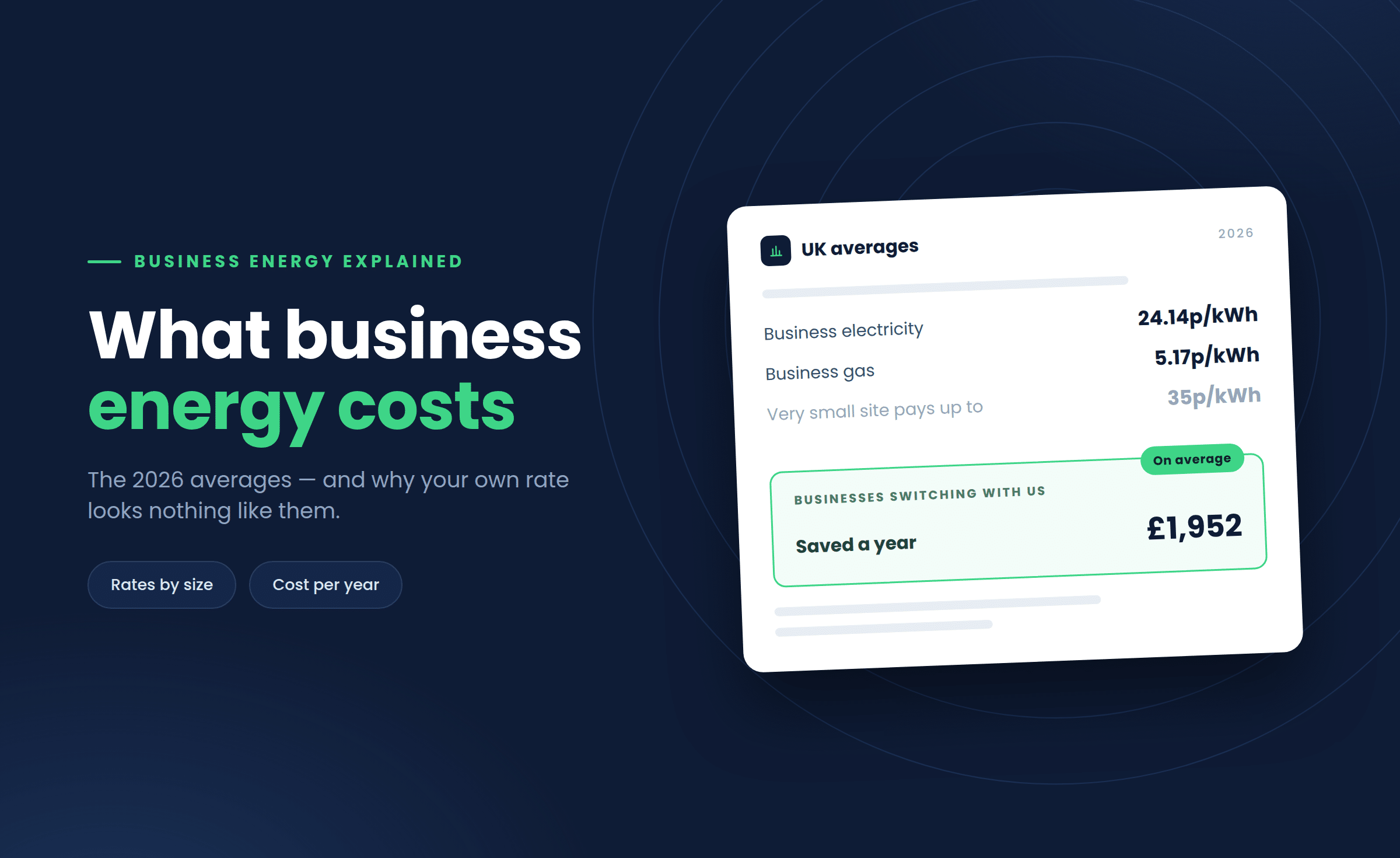
The average UK business pays around 24.14p per kWh for electricity and 5.17p per kWh for gas in 2026. What you actually pay depends on your size, your meter and your contract far more than on any national average.
Ask five business owners what they pay and you will get five different figures. Unlike household bills, there is no single headline rate and no price cap that applies to everyone.
A corner shop on a standard meter and a warehouse on a half-hourly meter can pay very different unit rates for the same electricity, even on the same street. This guide breaks down the average business energy cost by size, what makes up your bill, and how to tell if yours is reasonable.
What is the average business energy cost in the UK?
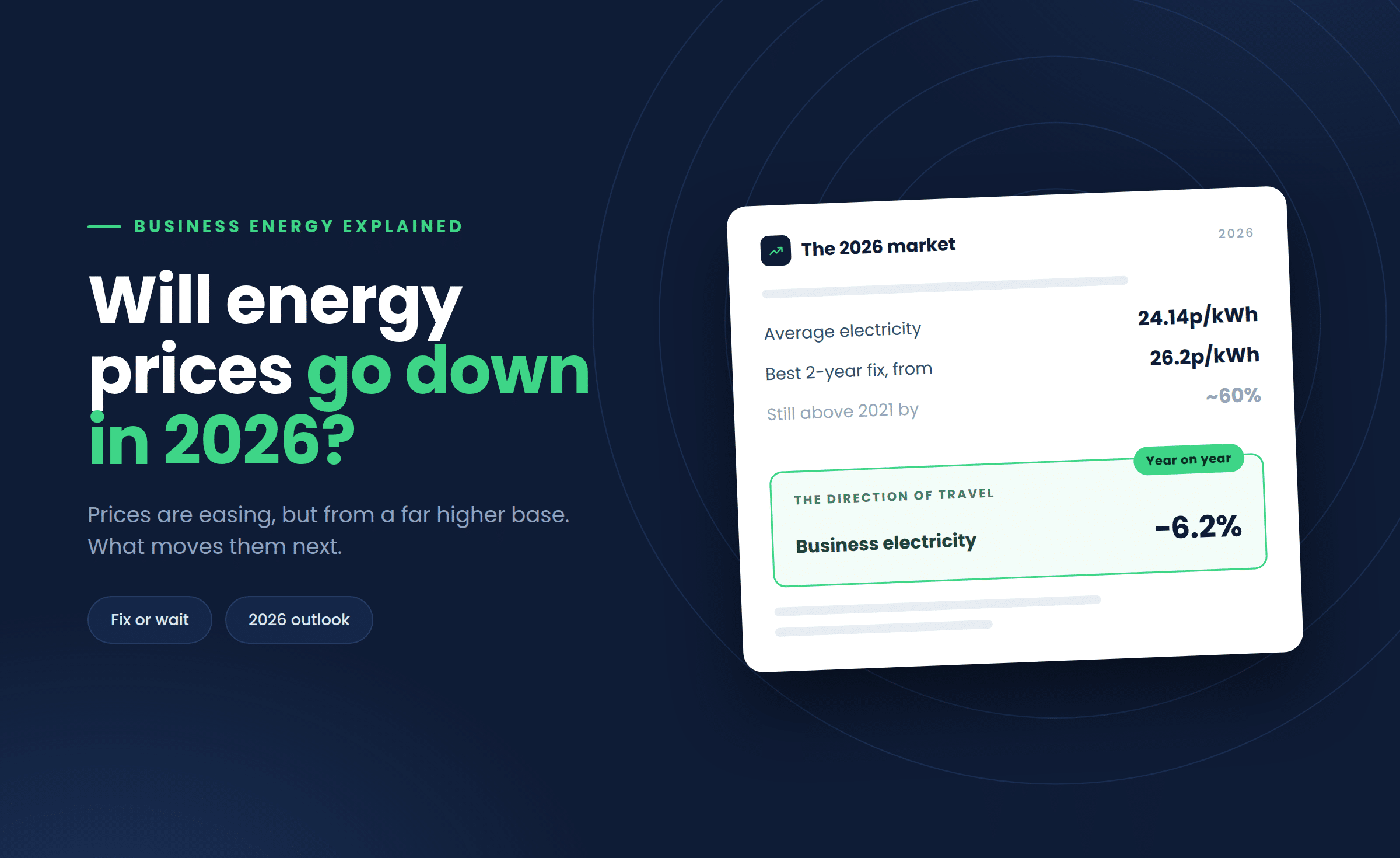
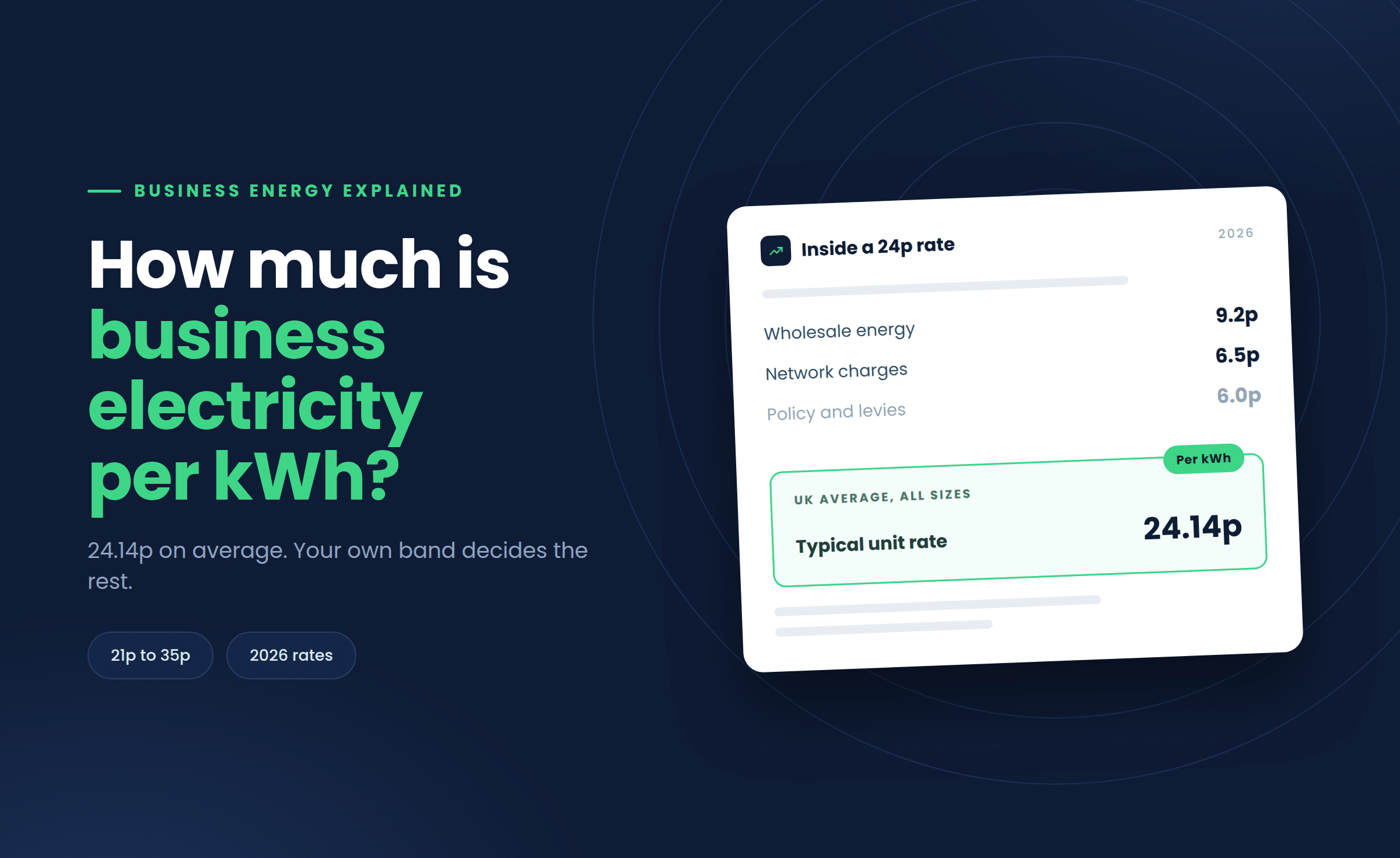
The UK average is 24.14p per kWh for business electricity and 5.17p per kWh for business gas in 2026, including the Climate Change Levy but excluding VAT. Both averages fell by around 6% on the year.
How rates fall as you use more
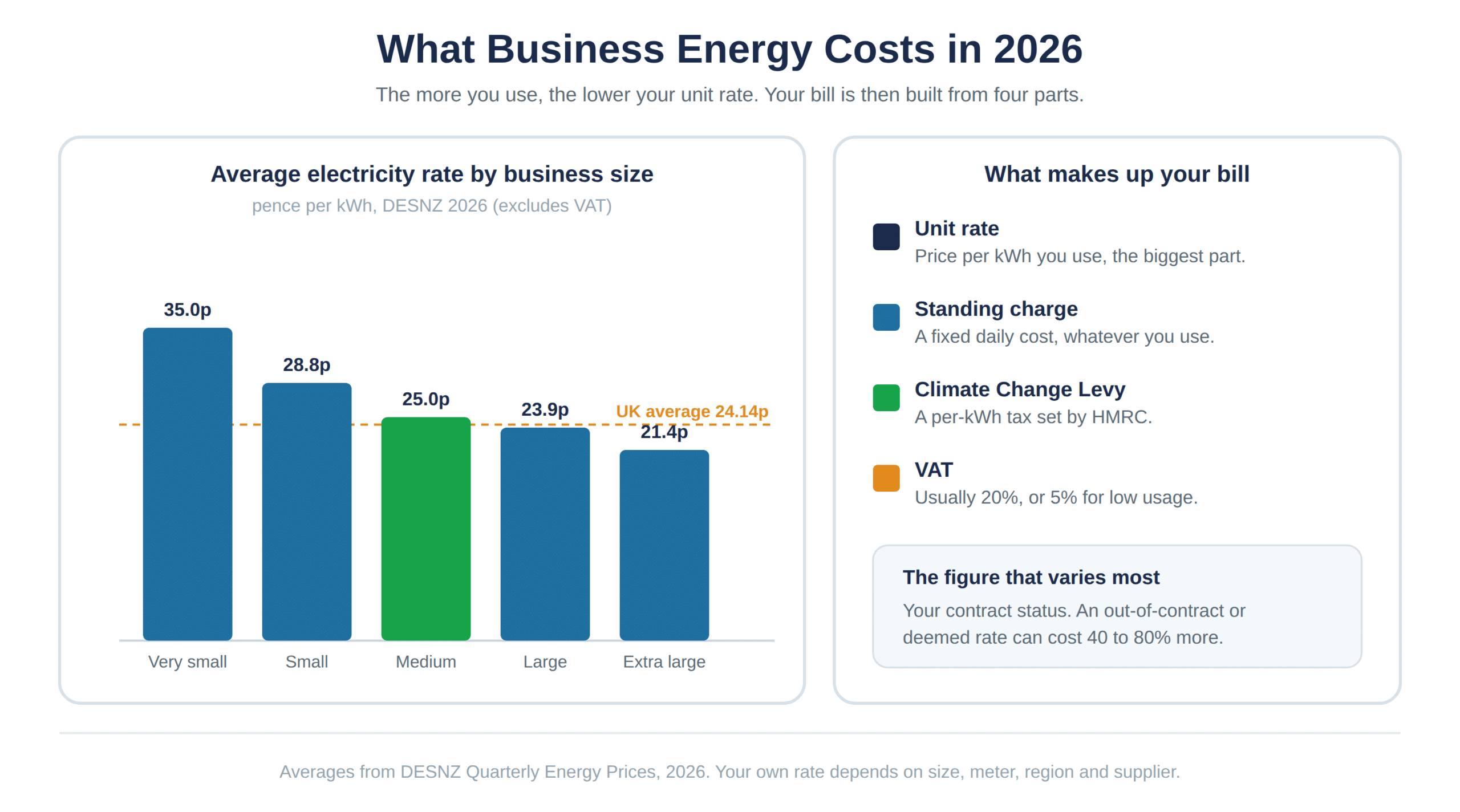
These are volume-weighted averages from government energy price data, so bigger users pull the average down. A very small site can pay about 35p per kWh, while an extra large one pays closer to 21p.
| Business size | Annual electricity use | Average rate (p/kWh) |
|---|---|---|
| Very small | 0 to 20 MWh | 35.0p |
| Small | 20 to 500 MWh | 28.8p |
| Medium | 2,000 to 20,000 MWh | 25.0p |
| Large | 20,000 to 70,000 MWh | 23.9p |
| Extra large | Over 150,000 MWh | 21.4p |
| UK average | All businesses | 24.14p |
How business gas compares
Gas follows the same pattern, and the national average of 5.17p sits below what most small firms are quoted. A small business is typically offered 7 to 9p per kWh, so it is worth checking live business gas rates against your own bill.
| Business size | Typical gas rate (p/kWh) |
|---|---|
| Very small | 8.0p |
| Small | 7.0p |
| Medium | 6.0p |
| Large | 4.6p |
| UK average | 5.17p |
How much does a business pay for energy per year?
A small business using 10,000 kWh of electricity pays around £3,200 a year before VAT, while a large site using 100,000 kWh pays well over £24,000. Gas adds to that on top.
Annual electricity cost by size
The figures below combine a typical unit rate per kWh for each size band with a representative daily standing charge. They are electricity only, before VAT.
| Business size | Electricity used | Rate | Standing charge | Approx cost a year |
|---|---|---|---|---|
| Micro | 10,000 kWh | 30.0p | 55p/day | £3,200 |
| Small | 25,000 kWh | 28.0p | 65p/day | £7,240 |
| Medium | 50,000 kWh | 25.0p | 100p/day | £12,865 |
| Large | 100,000 kWh | 23.9p | 148p/day | £24,440 |
What a typical combined bill looks like
Add gas and the totals rise. A micro office using 10,000 kWh of electricity and 12,000 kWh of gas pays roughly £3,200 for electricity and about £1,100 for gas, a little over £4,300 combined before VAT.
For a fuller breakdown, see our guide to the average business energy bill.
If your bill sits well above the band that matches your usage, that usually points to an out-of-contract or deemed rate rather than a negotiated one.
What makes up a business energy bill?
Your bill is built from a unit rate per kWh, a daily standing charge, the Climate Change Levy, and VAT. The unit rate is the biggest part and the one you have most control over.
The four components
The unit rate and standing charge are set in your contract and reflect wholesale costs, network charges and the supplier’s margin. The levy and VAT are added on top whichever supplier you use.
- Unit rate (p/kWh): the price for each unit of energy you use.
- Standing charge: a fixed daily cost, whatever your usage.
- Climate Change Levy: a per-kWh tax set by HMRC, unless you hold a Climate Change Agreement.
- VAT: usually 20%, sometimes 5% for qualifying low-usage sites.
How VAT applies to your bill
Business energy usually carries 20% VAT, but a reduced 5% rate applies if you use very little energy or qualify for charitable relief. Our guide to VAT on business energy explains the low-usage thresholds, and the current Climate Change Levy rates are published by the government.
What pushes one business’s energy costs higher than another’s?
Contract status is the single biggest factor. A business left on an out-of-contract or deemed rate typically pays 40% to 80% more than one on a negotiated deal, for exactly the same energy.
Contract status comes first
The gap between a negotiated rate and a default one is bigger than any other single factor, which is part of why business energy prices feel so high. Letting a contract lapse is the most expensive mistake a business can make on energy.
Meter, region and supplier
Beyond contract status, your region and network area change the charges baked into your rate, and a half-hourly meter settles differently from a standard one. Which of the 30-plus suppliers on the market you are with matters too, as some load their margin onto renewal quotes.
How can a business reduce its energy cost per year?
The most reliable saving is to compare the market and switch before your contract ends. Businesses that compare with Utility Saving Expert save an average of £1,952 a year.
Compare and switch at the right time
Start comparing three to six months before your renewal date, then agree a deal to start when your current one ends. The transfer itself completes in about five working days under Ofgem’s faster switching rules, so switching supplier is far quicker than most owners expect.
You can run a business energy comparison across our panel of more than 30 suppliers in 60 seconds, or talk it through with our UK team on 01242 32 31 31. Reviewing your energy procurement this way is where most of the saving comes from.
Check your meter details and usage
A look at your MPAN or MPRN, your annual quantity and your actual consumption can flag billing errors that quietly inflate your cost. A free bill health check will spot them for you.
Is business energy cheaper than domestic energy?
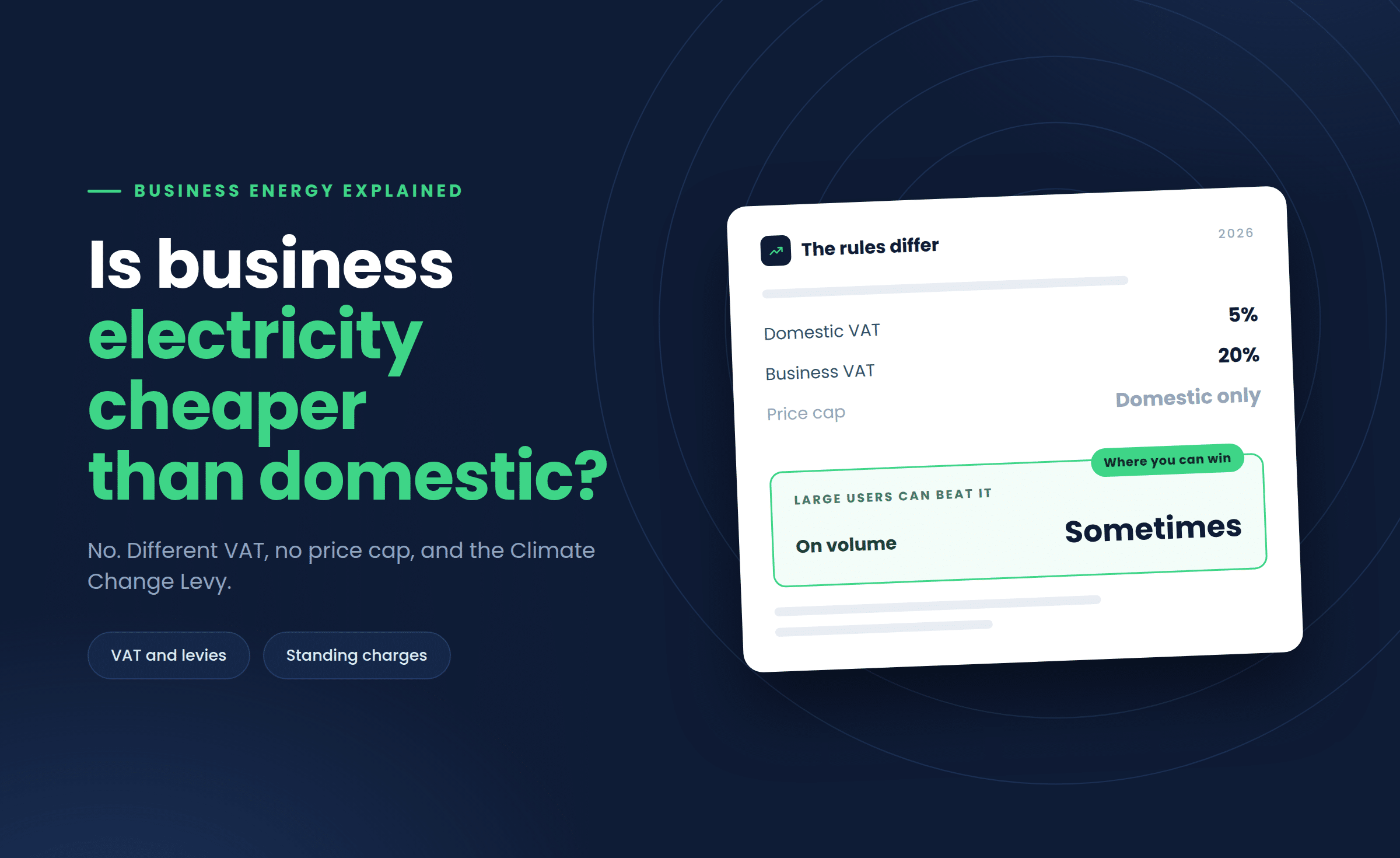
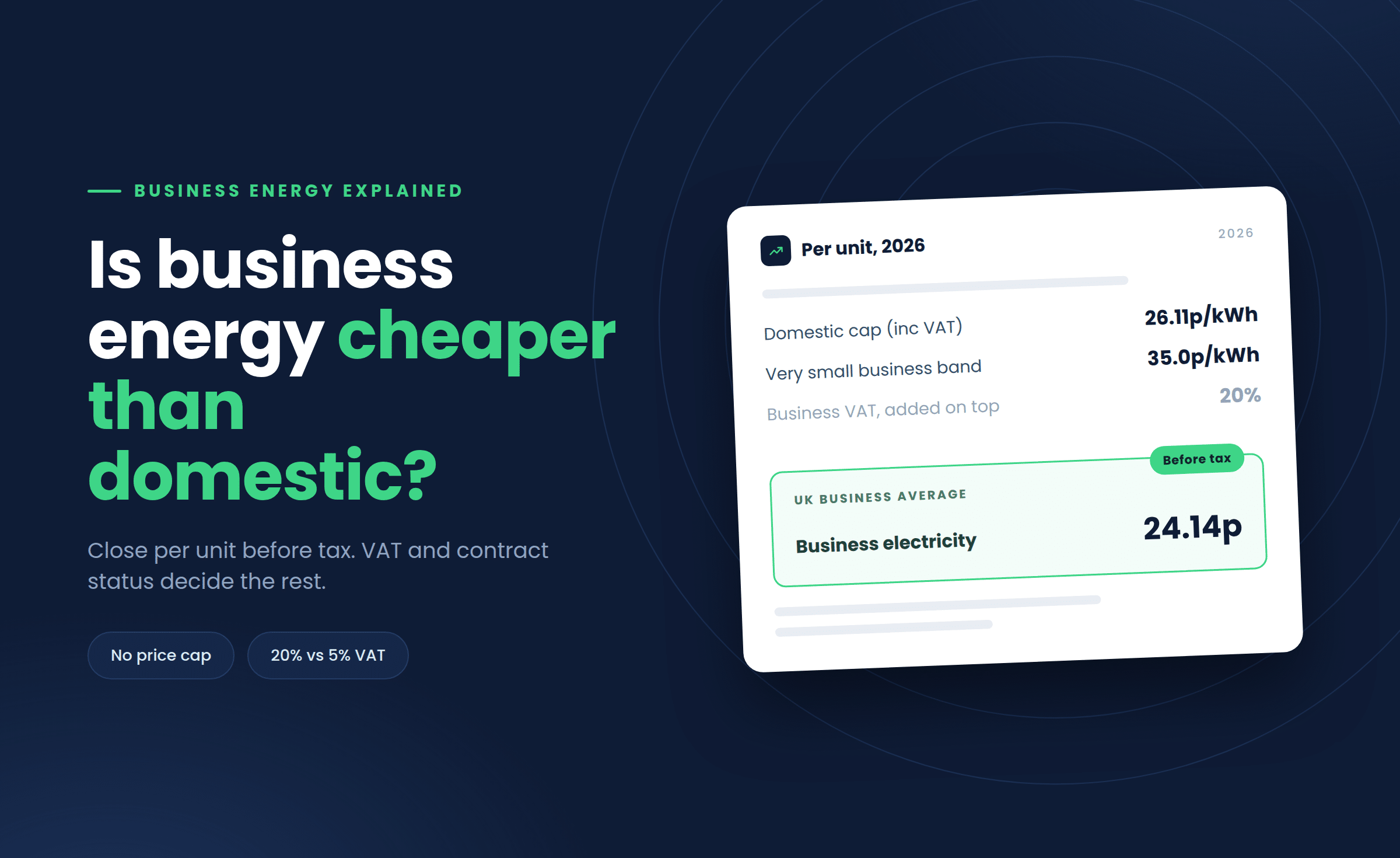
There is no simple yes or no. Business and household energy are priced differently, and there is no price cap on business rates, so a good business deal can beat a home tariff while a bad one costs far more.
There is no business price cap
Ofgem’s price cap covers domestic customers only, not businesses, as its guidance for businesses sets out. Business rates move with the wholesale market and your contract instead of a capped ceiling.
What that means for you
Because there is no cap, comparing the market is the only real protection, and the difference between a fair deal and a default one is large. Our guide on business versus domestic energy covers how the two compare in more depth, and you can check current business electricity and business gas rates for your own site.