
There is not a single best business energy contract length. A 1-year deal gets you back to the market sooner if rates fall, a 3-year deal buys longer price certainty, and the right answer depends on how much risk your business can absorb.
It is a genuinely close call for a lot of businesses, which is why this comes up at almost every renewal. Suppliers price 1, 2 and 3-year business energy contracts slightly differently, and the gap is not always obvious from a single quote.
Your industry matters here too. A seasonal hospitality business thinks about this differently to a warehouse running the same load year-round.
Here is what each term actually offers, how they compare on price and risk, and how to work out which one fits your business rather than someone else’s.
What does a 1-year business energy contract offer?
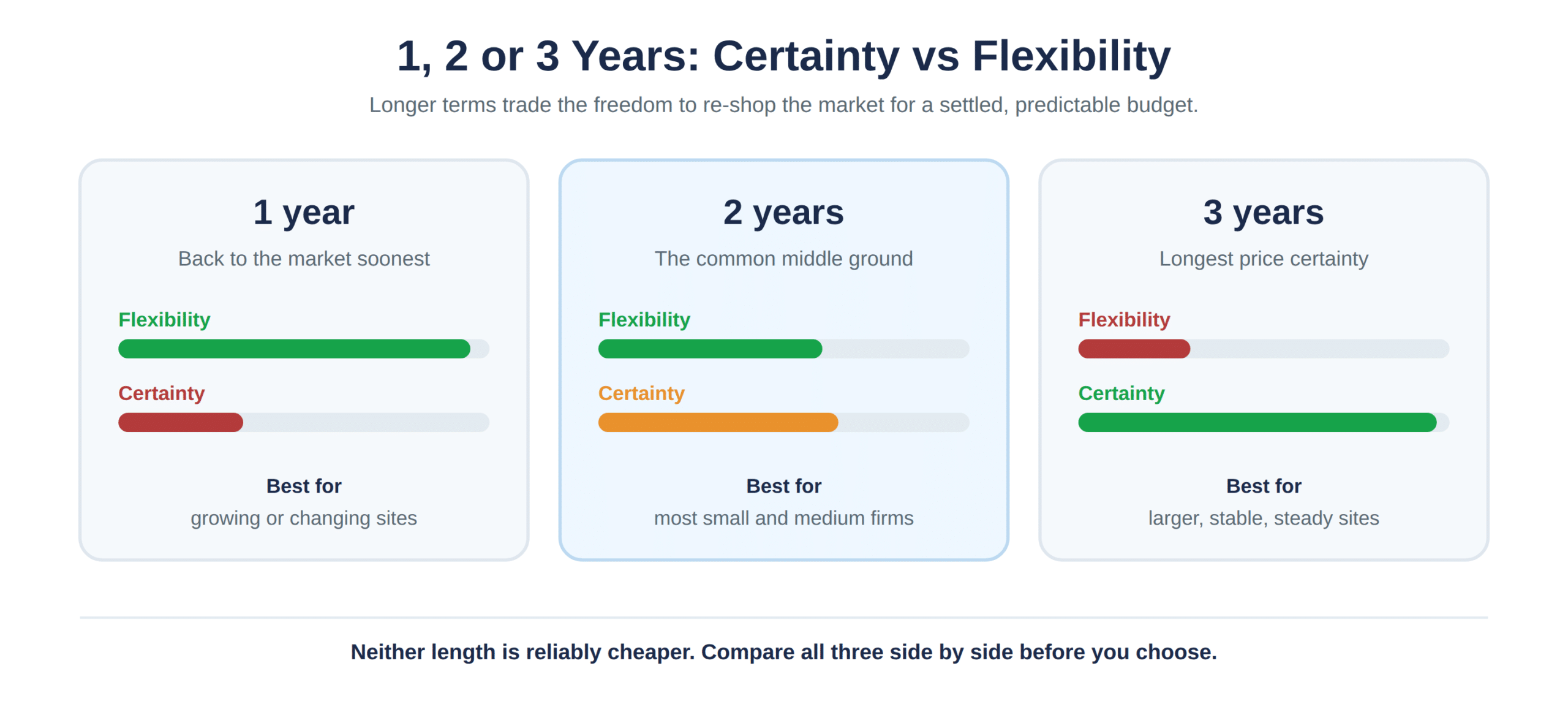
A 1-year contract gives you the most flexibility, letting you return to the market annually to take advantage of falling rates, at the cost of renewing and re-comparing every single year.
Who a 1-year term suits
It suits businesses expecting to grow, move premises, or change usage within the next 12 months. If you are moving site entirely, our guide to change of tenancy explains how that interacts with your existing contract length.
- Best for change: growth, relocation, or a usage shift within a year.
- Most admin: it requires the most frequent renewal.
- Sooner exposure: you meet market movement earlier, for better or worse.
What does a 2-year business energy contract offer?
A 2-year contract is the middle ground: enough certainty to plan a full financial year plus a bit, without locking in for as long as a 3-year deal.
A manageable planning window
UK average business electricity is 24.14p/kWh and gas 5.17p/kWh across all sizes, from DESNZ data, though your exact quote depends on usage band, meter type and region.
A medium business using around 25,000 kWh of electricity a year is looking at roughly £6,000 annually at average unit rates. That makes a 2-year fix a manageable chunk of budgeting to plan around rather than an open-ended commitment.
What does a 3-year business energy contract offer?
A 3-year contract offers the longest price certainty on the market, useful for businesses that want energy costs off the table entirely for the medium term.
Who a 3-year term suits
It suits larger or half-hourly metered sites where budgeting stability matters more than chasing a marginally better rate next year. Our guide to half-hourly meters explains how metering type can influence which term length suppliers offer.
Care homes, warehouses and manufacturing sites often lean this way. The trade-off is obvious: if wholesale prices drop sharply during your term, you will not benefit until it ends.
How do long vs short energy contract options compare on price and risk?
Longer contracts do not always cost more or less than shorter ones. The relationship depends on where wholesale prices sit when you sign, and how suppliers are pricing risk at that moment.
| Contract length | Price certainty | Renewal frequency | Best suited to |
|---|---|---|---|
| 1 year | Lowest | Annual | Growing or changing businesses |
| 2 years | Moderate | Every 2 years | Most small and medium businesses |
| 3 years | Highest | Every 3 years | Larger, stable or half-hourly sites |
Does a longer contract always mean a lower rate?
Not necessarily. Suppliers sometimes price longer terms slightly higher to compensate for the risk of fixing further into the future, so it is worth checking actual quotes rather than assuming.
Average business electricity is broadly flat year-on-year but still around 60% higher than in 2021, which shows how much this market moves over a 3-year window. Comparing business gas quotes alongside electricity gives you the full picture before you commit.
Which contract length actually suits your business?
In short: 2 years suits most small and medium businesses, 1 year suits anyone expecting change, and 3 years suits larger, stable, or heavily energy-dependent sites.
Match the term to your situation
- Expecting change within a year: consider a 1-year term.
- Want a simple balance: consider 2 years for certainty with flexibility.
- Run a large, stable site: consider 3 years, and check the early exit terms before signing a longer fix.
If you are unsure, comparing business electricity rates across all three lengths at once usually makes the right choice obvious. Ofgem’s business energy advice sets out your rights whichever term you pick.