
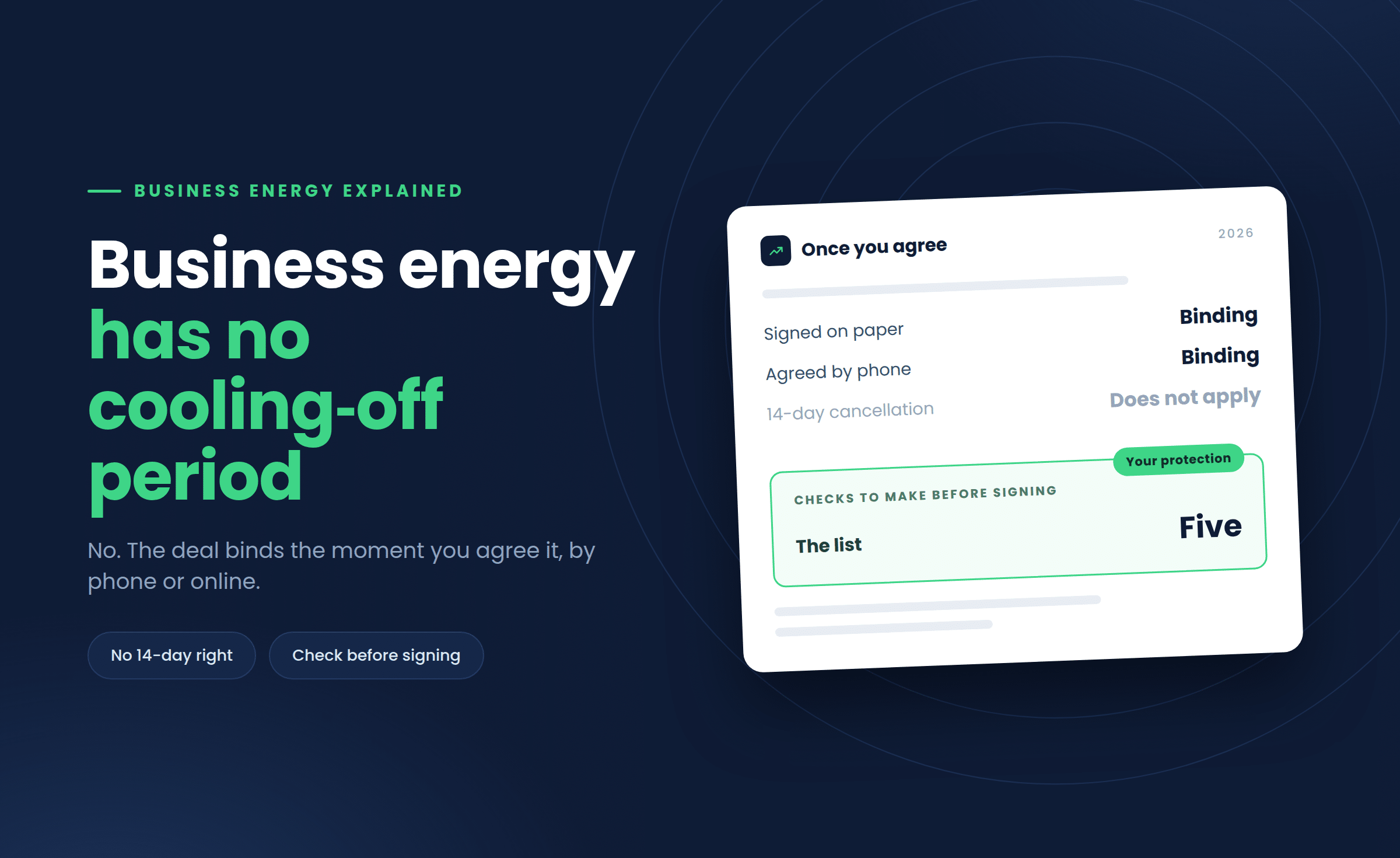
No, there is no statutory 14-day cooling-off period on a business energy contract once you have agreed it, whether by phone, online or on paper. The deal binds straight away, so the checking has to happen before you sign, not after.
Owners often assume the same rules apply as everywhere else in commercial life. Buy something as a consumer online and you typically get 14 days to change your mind, but energy does not work like that once you are signing for a company.
The confusion is understandable. Household energy customers get some protection when they switch, and most regulated consumer contracts carry a cancellation window, but business energy sits outside that framework entirely.
What happens the moment you sign a business energy contract?
Your contract becomes legally binding as soon as you accept it, and that includes a verbal agreement given over the phone to a supplier or broker, with no automatic cooling-off window afterwards.
Energy sales calls are recorded for exactly this reason. Once you confirm the rate, term and start date, the supplier treats it as done, and if you used a broker, your letter of authority usually lets them commit you to a deal on your behalf.
Why verbal agreements count as binding
- A recorded call: confirming rate, term and start date is treated as acceptance.
- A broker’s authority: under a signed letter of authority can bind you without a second signature.
- A missed email: not reading a follow-up confirmation does not cancel a verbal agreement.
Why doesn’t the 14-day cooling-off right apply to business energy?
The Consumer Contracts Regulations 2013 give a 14-day cancellation right, but only to a consumer acting outside their trade or business, and a company or sole trader signing for its own premises does not meet that definition.
The consumer versus business line
Ofgem’s household protections exist for a similar reason: domestic customers are assumed to have less negotiating power than a business. The Consumer Contracts Regulations simply do not extend to a business signing for its own supply, since the market expects you to compare before signing, not after.
| Scenario | Cooling-off right? | Why |
|---|---|---|
| Buying goods online as a consumer | Yes, 14 days | Consumer Contracts Regulations 2013 |
| Switching domestic household energy | Some protection | Household consumer safeguards |
| Signing a business energy contract | No | Business treated as a commercial customer |
| Signed away from your premises | Sometimes | Separate off-premises cancellation rules |
Are there any exceptions that let you cancel a business energy deal?
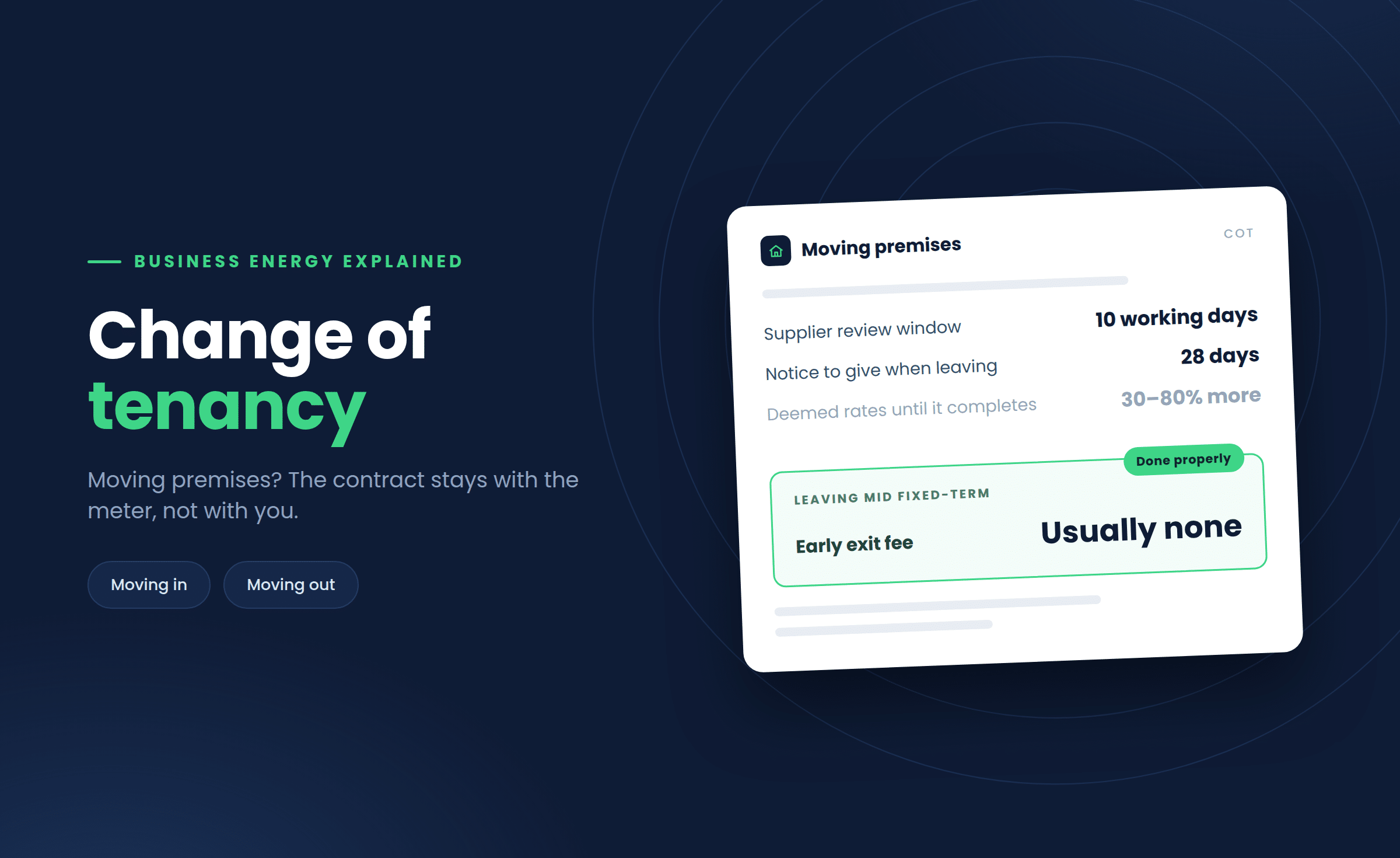
A small number of situations do allow cancellation: contracts signed away from your business premises, proven mis-selling by a broker, or a supplier’s own goodwill policy, though none are guaranteed.
Off-premises and doorstep sales
If a sales agent signs you up somewhere other than your business address, such as at a trade show or your home, separate off-premises cancellation regulations can sometimes apply. It is worth checking exactly how and where you were signed up.
Broker mis-selling and the retail energy code
If a broker misrepresented the rate, the term or their own commission, that is potential mis-selling rather than a right to cool off. The Retail Energy Code sets standards brokers must meet, and since December 2022 suppliers may only use brokers signed up to a redress scheme, so breaches can be raised as business energy complaints with the supplier or the Energy Ombudsman.
Comparing across a panel of business energy suppliers before you commit is the surest way to avoid needing any of these routes.
What should you check before signing to avoid regretting a contract?
Because there is no way to unwind a bad deal afterwards, the pre-sign checklist matters more here than almost anywhere else in running a business, so read the whole contract, not just the headline rate.
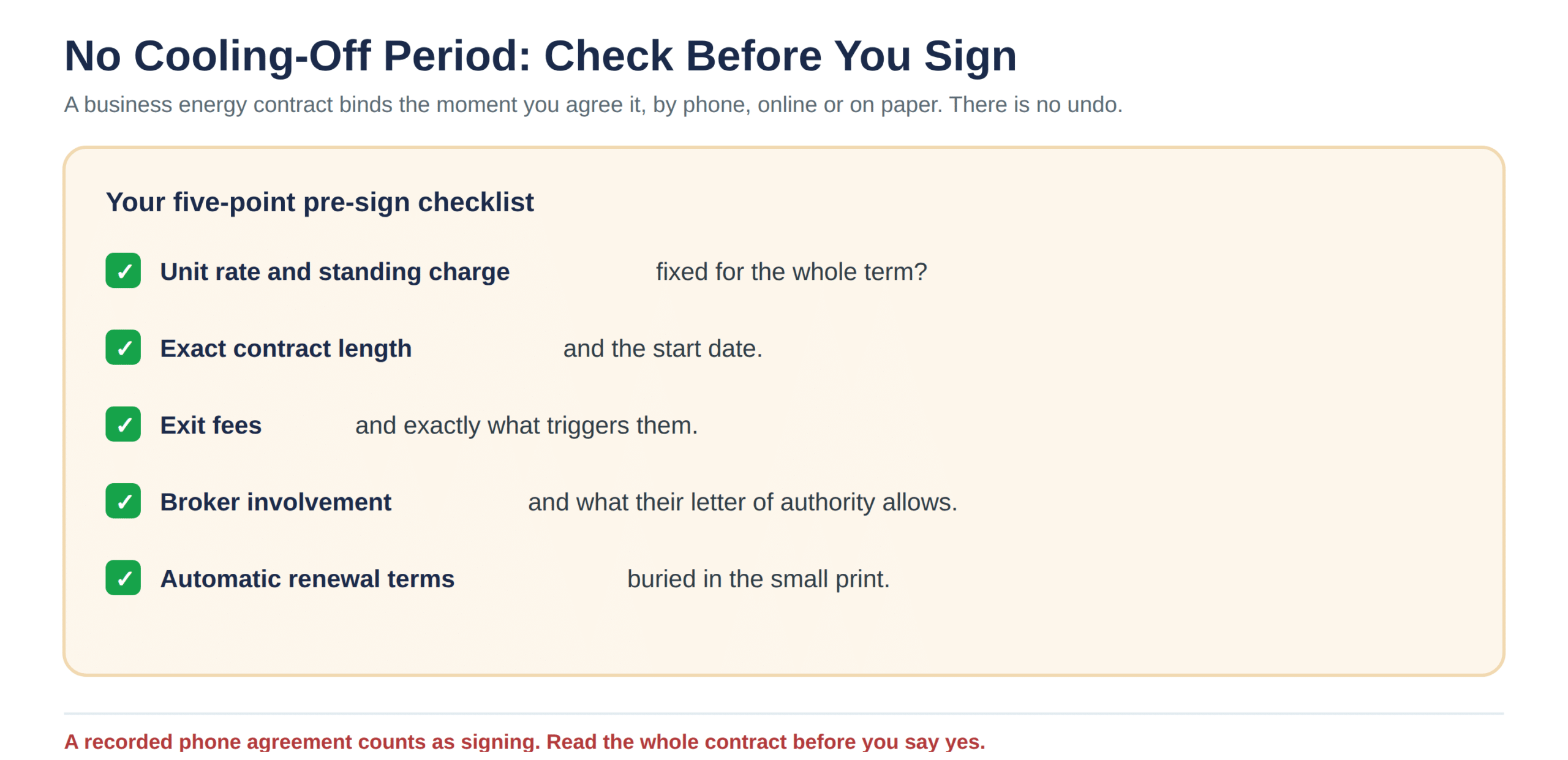
Your pre-sign checklist
- Rates: the unit rate and standing charge, and whether they are fixed for the term.
- Term: the exact contract length and start date.
- Exit fees: and what triggers them.
- Broker role: whether one is involved and what their authority allows, and your wider contract rights.
- Renewal terms: any automatic renewal buried in the small print.
What can you do if you’ve already signed a deal you regret?
Once signed, your main options are negotiating directly with the supplier, checking for genuine mis-selling grounds, or riding it out until renewal and comparing properly next time.
Your options after signing
| Option | What it involves | How likely to help |
|---|---|---|
| Negotiate with the supplier | Ask for a shorter term or a compromise | Sometimes, on goodwill |
| Raise a mis-selling complaint | If you were misled on rate or commission | Only where genuine grounds exist |
| Ride it out to renewal | Compare properly at your next window | Always available |
Contact your supplier’s business team directly. They will not release you from a fair contract just because you changed your mind, but a shorter compromise is sometimes possible, and our guide on exiting a fixed-term contract covers where a genuine exit exists.
If you believe you were misled about the rate or a broker’s fees, raise it with the supplier in writing first, then the Energy Ombudsman if it is not resolved within eight weeks. Ofgem’s business energy advice sets out your rights either way.