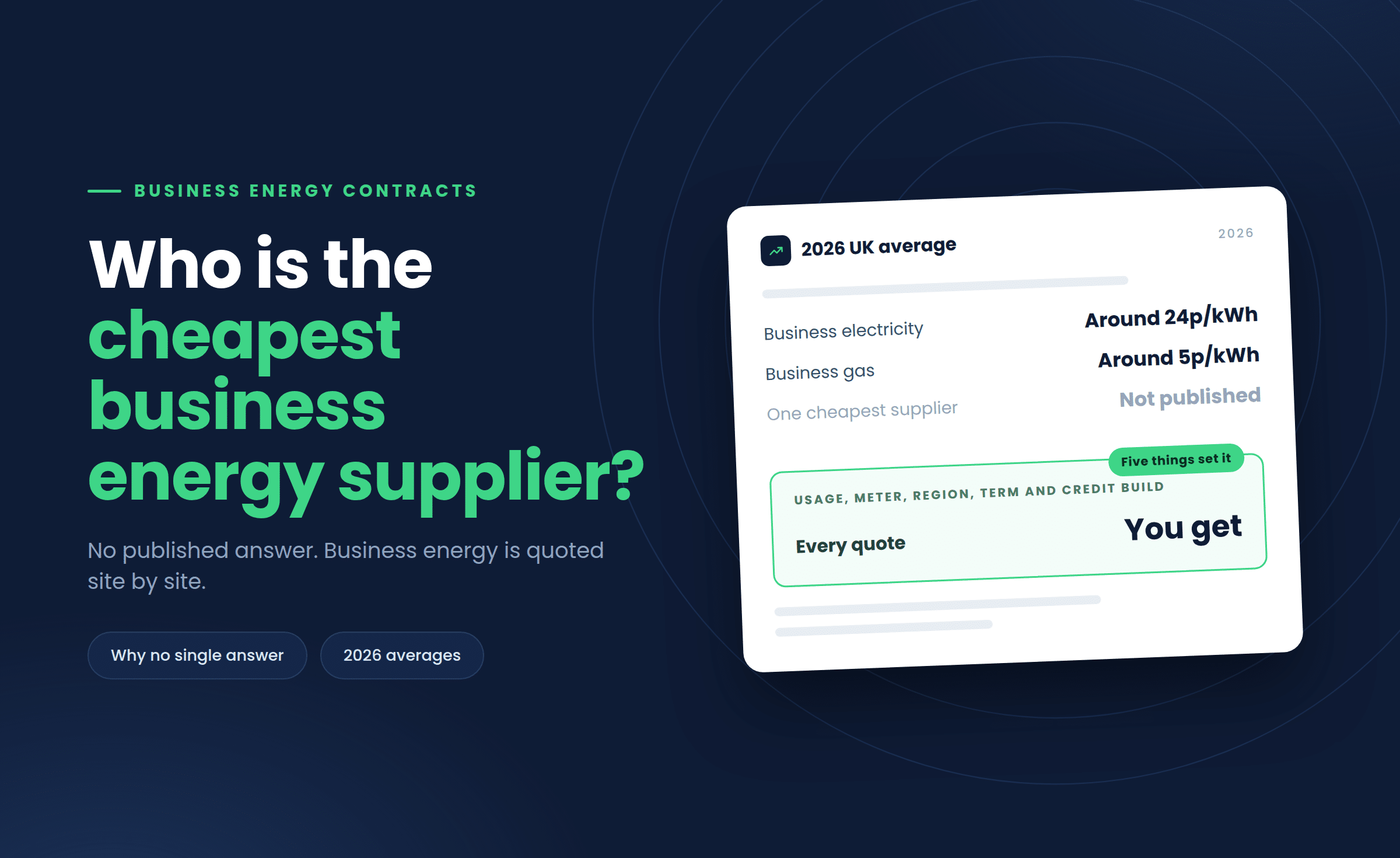

There is not one fixed answer. The cheapest business electricity supplier changes week to week depending on your usage, region, meter type and contract length, which is exactly why comparison at the point of switching matters more than any single supplier’s reputation.
It is a fair question to ask, though. With rates moving and a panel of suppliers competing for business customers, it feels like there should be one name that consistently comes out on top.
In practice, wholesale energy costs shift daily, and each supplier prices differently depending on how much risk it is carrying and which customer profiles it wants that month. A supplier cheapest for a 5,000 kWh office might not even quote competitively for a 200,000 kWh warehouse.
That does not mean you are stuck guessing. It means the useful question is not who is cheapest overall, but who is cheapest for a business like yours, right now.
Why isn’t there one fixed cheapest business electricity supplier?
Business electricity is priced individually, not from a published tariff list, so the cheapest supplier depends on your specific usage, region and contract term rather than a single market-wide winner.
No cap, no single rate card
Unlike a household default tariff, there is no capped price and no single rate card. Every quote is built from wholesale costs at the time, your consumption band, network charges in your region and how much risk the supplier takes on a fixed term.
That is why one supplier can be sharply priced for a small retail unit in the North West and considerably less competitive for a medium manufacturer in the South East during the same week.
Which suppliers regularly offer competitive business rates?
Several suppliers consistently compete hard for business customers, including British Gas Business, EDF Business, E.ON Next Business, Scottish Power Business, SSE Business and Octopus Business, though none holds the cheapest position permanently.
Why a panel beats picking one name
- Large national suppliers: cover every business size from micro to industrial.
- Digital-first challengers: often price keenly for specific smaller usage bands.
- Specialist suppliers: can be competitive for niche or higher-usage profiles.
Working with a panel of business energy suppliers means your business gets quoted against whoever is pricing keenly for your usage band that week, rather than relying on brand reputation alone.
What actually determines the price a supplier quotes you?
Your annual usage, meter type, region, contract length and credit profile all feed into the rate a supplier offers, and changing any one of them can shift your quote noticeably.
The five main levers
Wholesale prices set the baseline, but suppliers layer on network charges specific to your DNO area, plus a margin reflecting the risk of fixing your rate for one, two or three years.
- Annual consumption band: larger users generally unlock lower unit rates.
- Meter type: half-hourly settled sites are priced differently to non-half-hourly ones.
- Region: DUoS charges vary by DNO area and affect the delivered rate.
- Credit and payment: how a bad credit score affects your prices plays into the quote.
How do rates compare across different business sizes right now?
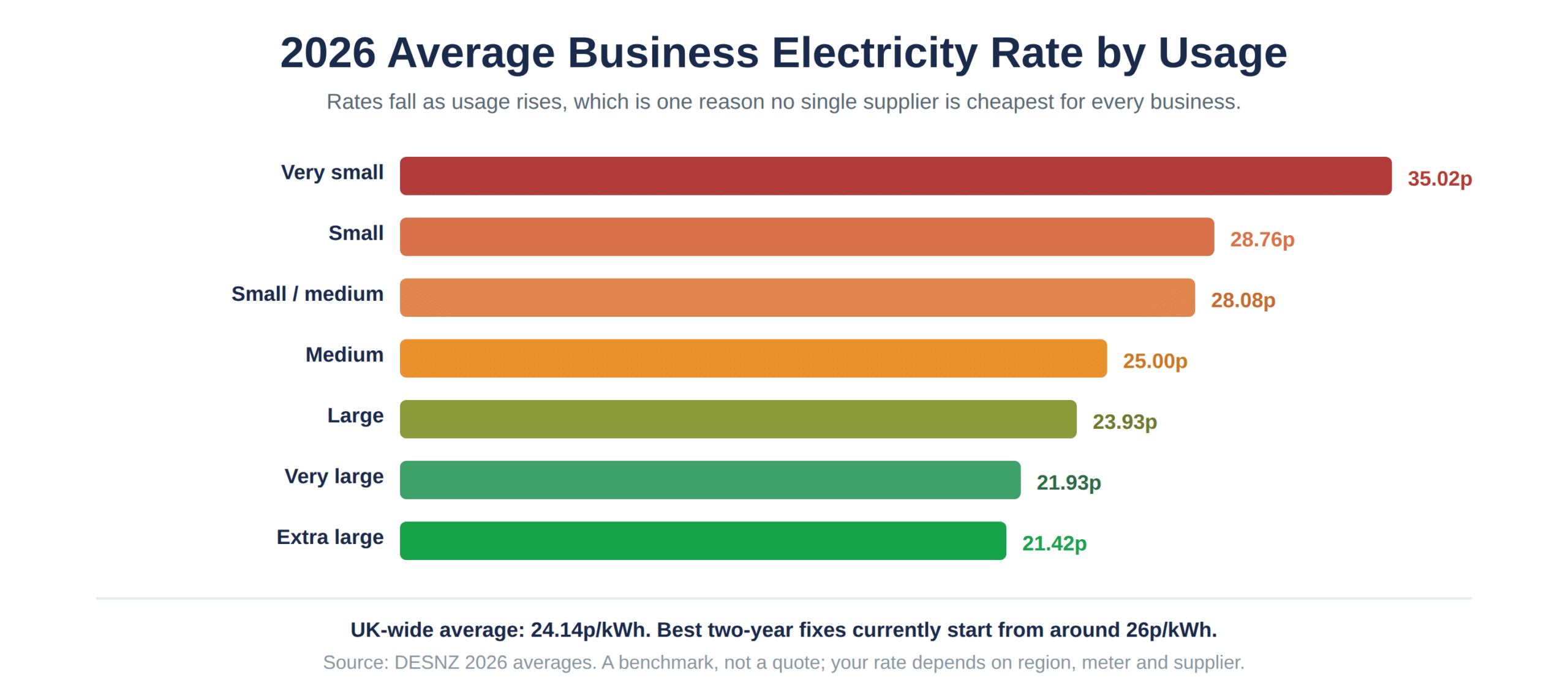
UK average business electricity rates in 2026 range from 35.02p/kWh for very small users to 21.42p/kWh for extra large consumers, and the best available fixed rates currently start from around 26p/kWh on a two-year deal.
Why the average falls by usage
| Business size | Annual usage | 2026 average rate |
|---|---|---|
| Very small | 0 to 20 MWh | 35.02p/kWh |
| Small | 20 to 499 MWh | 28.76p/kWh |
| Small / medium | 500 to 1,999 MWh | 28.08p/kWh |
| Medium | 2,000 to 19,999 MWh | 25.00p/kWh |
| Large | 20,000 to 69,999 MWh | 23.93p/kWh |
| Very large | 70,000 to 150,000 MWh | 21.93p/kWh |
| Extra large | Over 150,000 MWh | 21.42p/kWh |
A supplier pricing keenly for very small users will not necessarily be sharpest once you climb into the medium or large bands. These DESNZ figures are a benchmark, not a quote.
How do you actually find the best business electricity supplier for you?
Run a live comparison with a recent bill to hand, since the cheapest business electricity supplier for your business only becomes clear once real quotes are pulled against your actual usage.
What to have ready
- Your MPAN and usage: plus your current contract end date.
- Compare early: 2 to 3 months before renewal, never after the contract has lapsed.
- Check the whole quote: standing charge and term, not just the headline rate; a letter of authority lets a broker act for you.
Businesses that compare through Utility Saving Expert save an average of £1,952 when they switch, and a completed switch typically takes 4 to 6 weeks. Switching off an out-of-contract rate, which can run 40% to 80% higher than a negotiated deal, is where the biggest saving usually sits.