
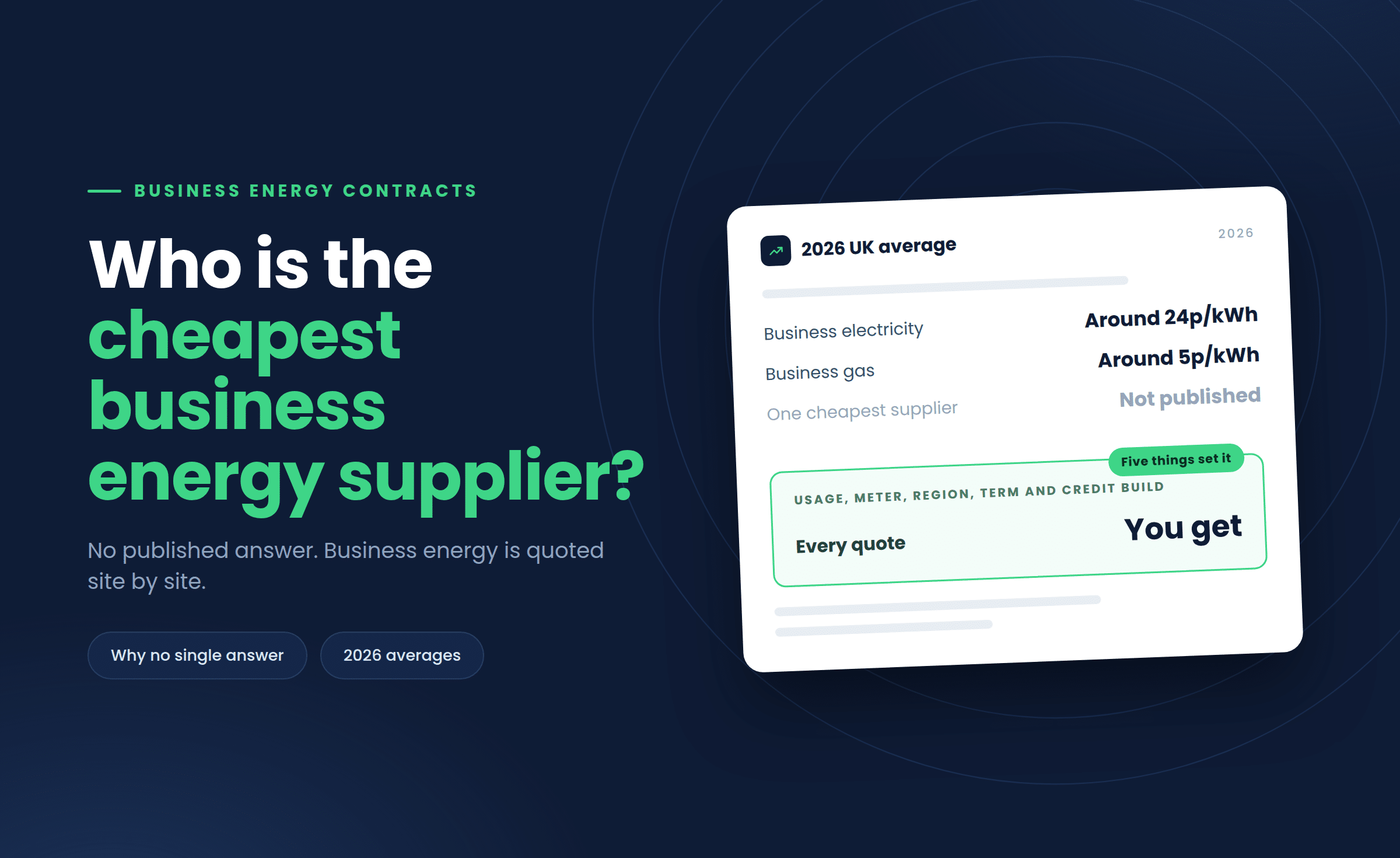
There is no single cheapest business energy supplier, because business energy is not priced off a public tariff list. Every quote is built from your usage, location, credit position and contract length, so the cheapest supplier for a warehouse in Leeds on a 3-year deal will not be the cheapest for a cafe in Bristol on a 12-month term.
It is a fair question, and a fair thing to feel frustrated about. Domestic energy has a headline price cap and well-known comparison tables, so it is natural to expect business energy to work the same way.
It does not. Business electricity and gas are quoted individually, site by site, using your annual consumption, your meter type and how far ahead you fix.
That is not a dodge, it is how a competitive wholesale market prices risk. This guide covers what actually drives your quote and how to compare fairly across business energy suppliers instead of chasing a headline that does not exist.
Why is there no single cheapest business energy supplier?
Business energy is quoted per site, not published as a fixed tariff, so the same supplier can be the cheapest option for one business and the most expensive for another on the same day.
How each quote gets priced
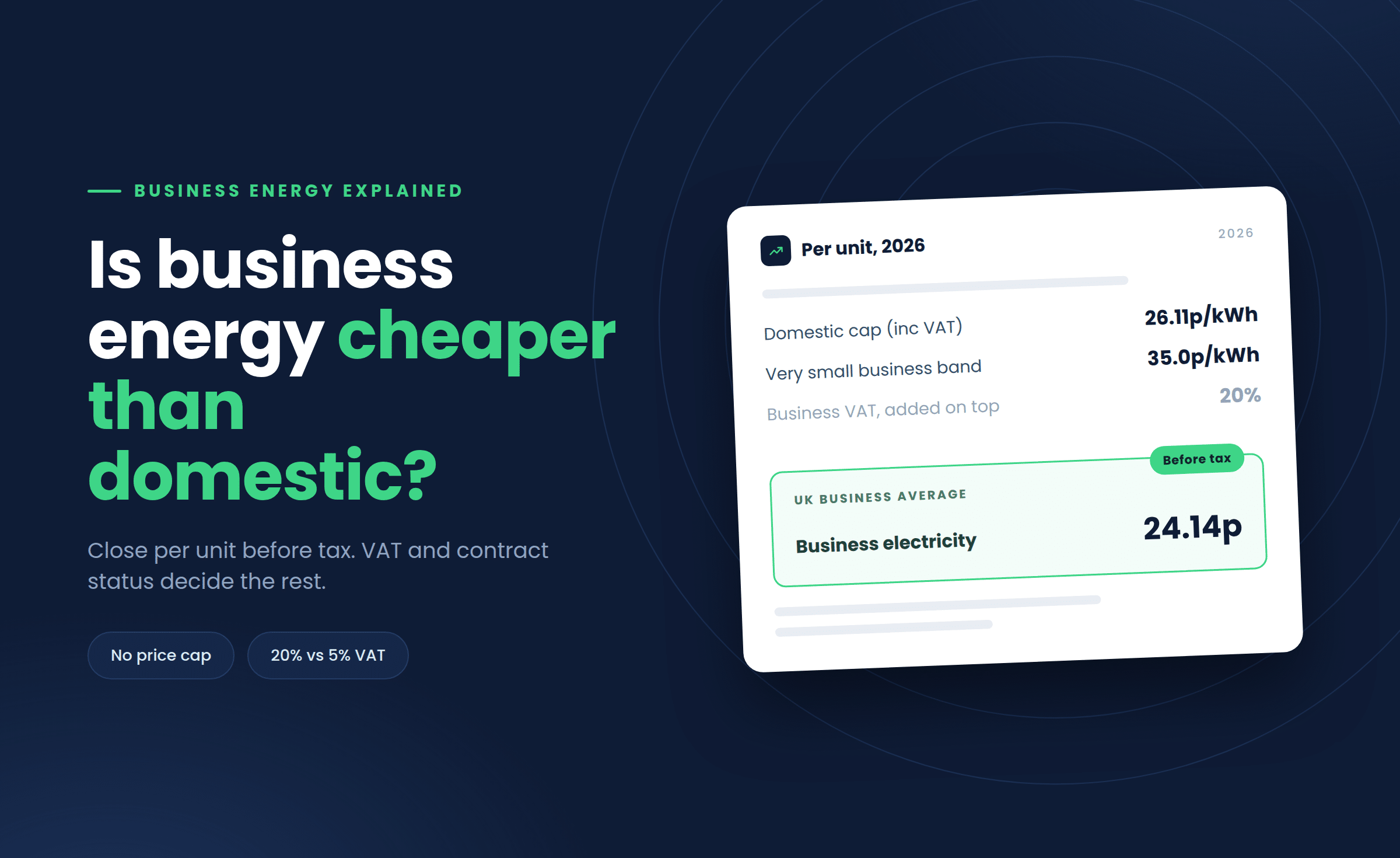
Domestic tariffs are published and capped by the Ofgem price cap. Business energy sits entirely outside that cap, priced on wholesale conditions at the moment you ask, your consumption, your postcode and your credit score.
Ask again in three weeks and the numbers move, sometimes meaningfully. Any article or broker claiming to name the single cheapest supplier is oversimplifying a market that does not work that way.
Established UK business energy suppliers
These are established suppliers to UK commercial customers. Listing them is informational, not a ranking, and none should be read as a live quote.
- Large legacy suppliers: British Gas Business, EDF, E.ON Next, Scottish Power, SSE.
- Challenger and specialist: Octopus, TotalEnergies, Crown Gas & Power, Corona Energy, Yu Energy.
Some focus on smaller sites, others on larger half-hourly meters or specific sectors like hospitality or manufacturing. Each tends to be strongest at a particular kind of customer rather than universally cheapest.
Two businesses on the same industrial estate, using roughly the same power, can get quotes differing by several pence per kWh depending on when they asked and how their credit checks out. That spread is the whole reason a single ranking cannot exist.
What determines your business energy price?
Your quote is built from five things: annual usage, meter type, region, contract length and credit score, and changing any one can move the price by several pence per kWh.
The five levers on your rate
Larger consumers get lower unit rates, since fixed contract costs spread more thinly at higher volumes. Your region sets the distribution charges baked into the bill, and our guide to reading a business energy bill shows where each appears.
- Contract length: a 1-year deal usually carries a small premium versus a 2 or 3-year fix.
- Credit score: a weak rating pushes suppliers to quote higher or ask for a deposit.
- Meter type: half-hourly settlement is priced differently to non-half-hourly.
- Timing: wholesale prices move daily, so the date you ask genuinely matters.
How do average business energy rates compare in 2026?
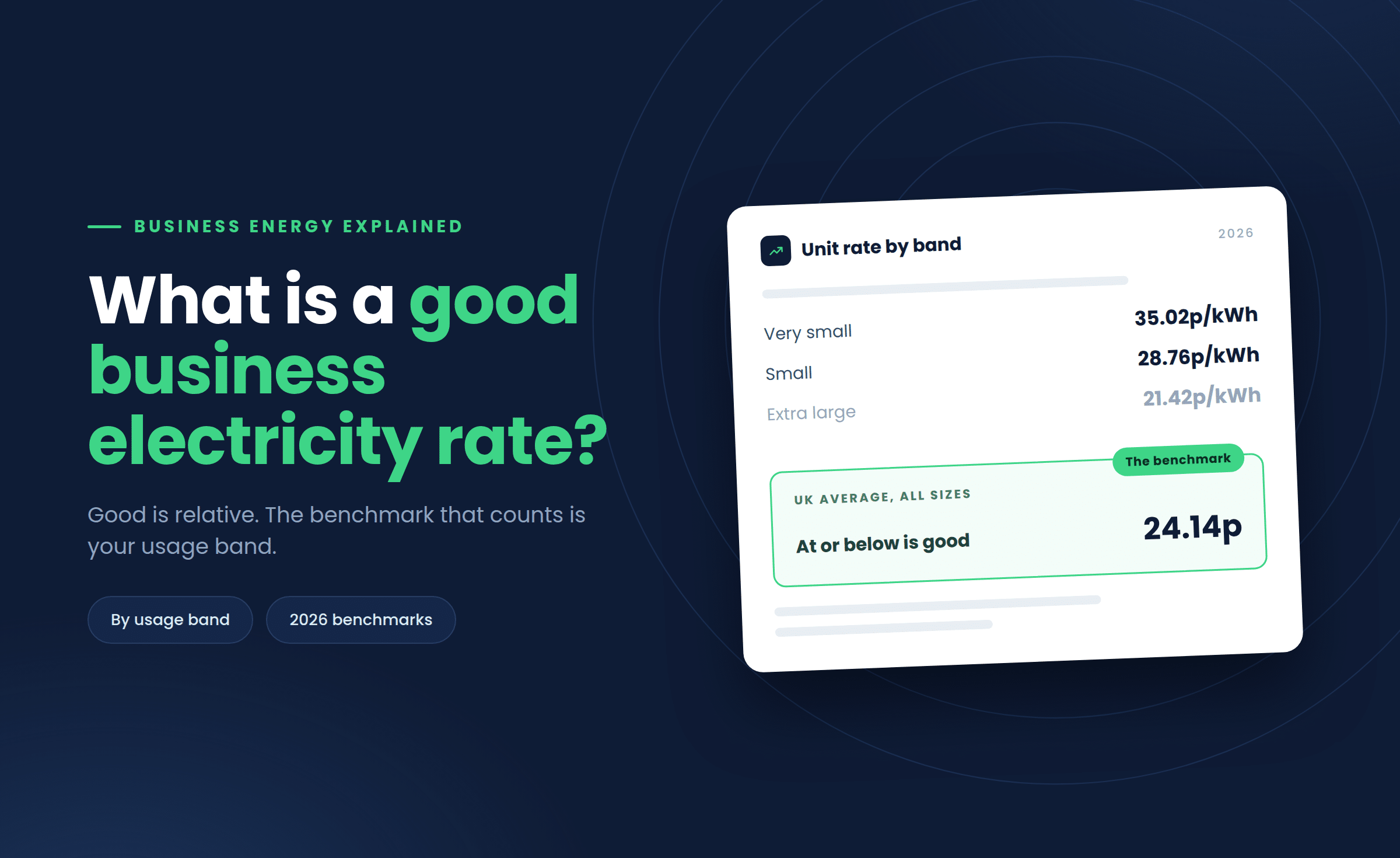
UK average business electricity in 2026 sits around 24p per kWh and gas around 5p, but the rate for your business depends heavily on how much you use each year.
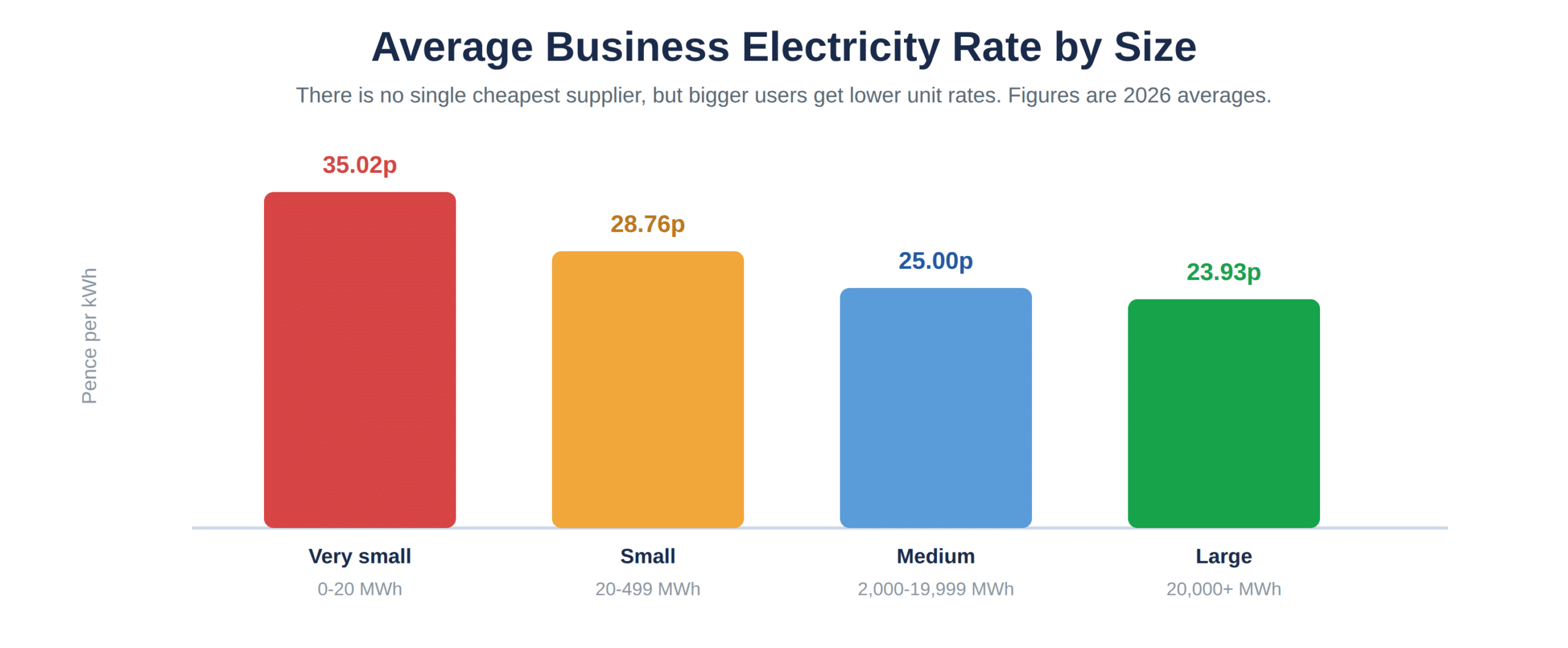
Averages by business size
| Business size | Annual usage | Avg electricity rate |
|---|---|---|
| Very small | 0 to 20 MWh | 35.02p/kWh |
| Small | 20 to 499 MWh | 28.76p/kWh |
| Medium | 2,000 to 19,999 MWh | 25.00p/kWh |
| Large | 20,000 to 69,999 MWh | 23.93p/kWh |
These averages are a sanity check, not a way to judge a single quote. Compare live business electricity and business gas rates against a recent bill for the only figure that matters for your site.
Rates have eased from their recent peak but remain well above where they sat five years ago, so cheap is relative to a market still elevated by historic standards. A good deal today beats your out-of-contract fallback, rather than matching an old rate.
How do you find the lowest business energy rates?
Get a fresh quote from a recent bill, compare across a wide panel of suppliers, and time it around your renewal window rather than waiting until your existing deal has already rolled over.
Questions worth asking before you commit
- Levy included? does the quoted rate include or exclude the Climate Change Levy?
- Standing charge: how does it trade off against the unit rate?
- Billing record: the supplier’s track record for your meter type.
- Exit fees: any charges if you need to leave before the contract ends.
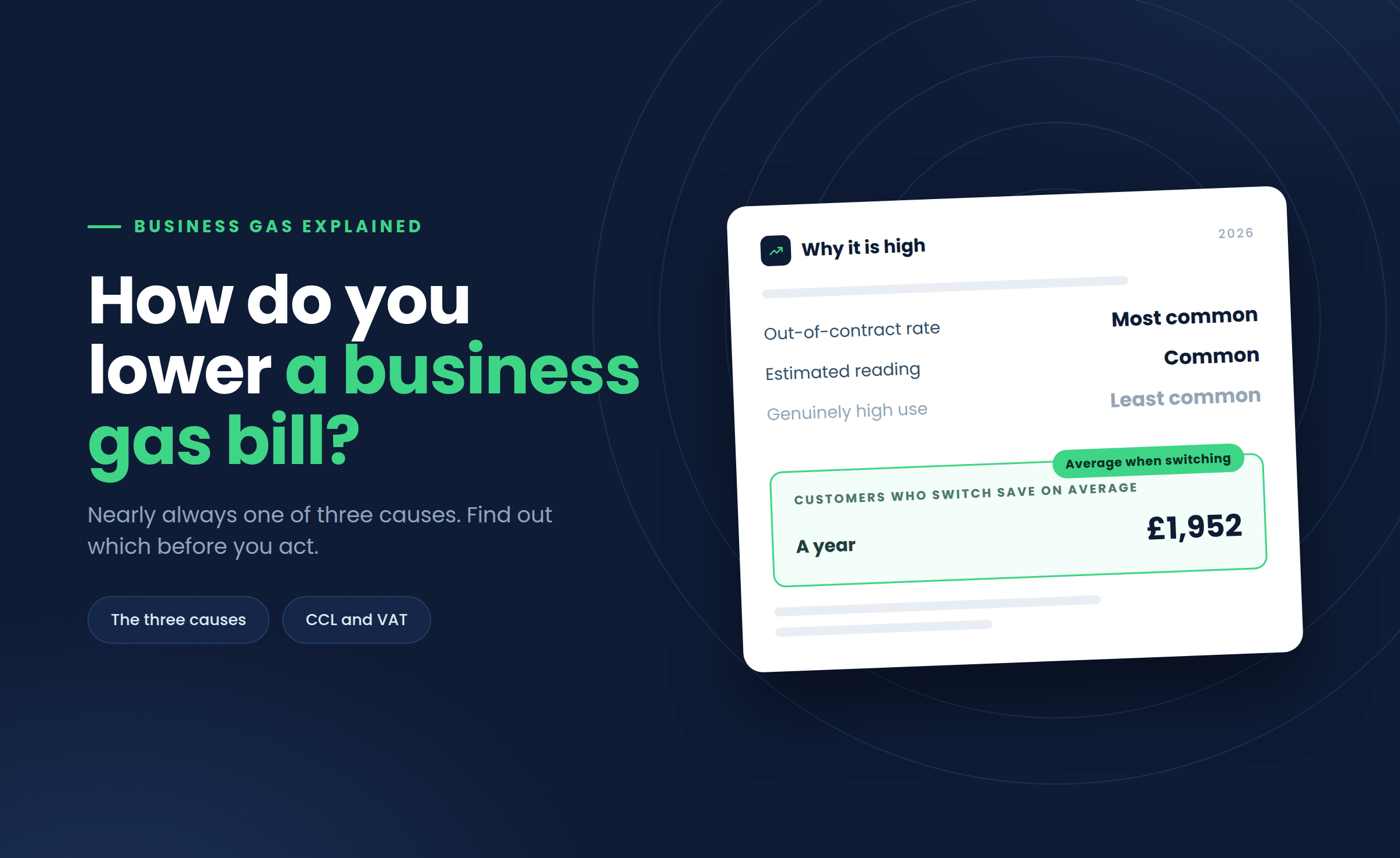
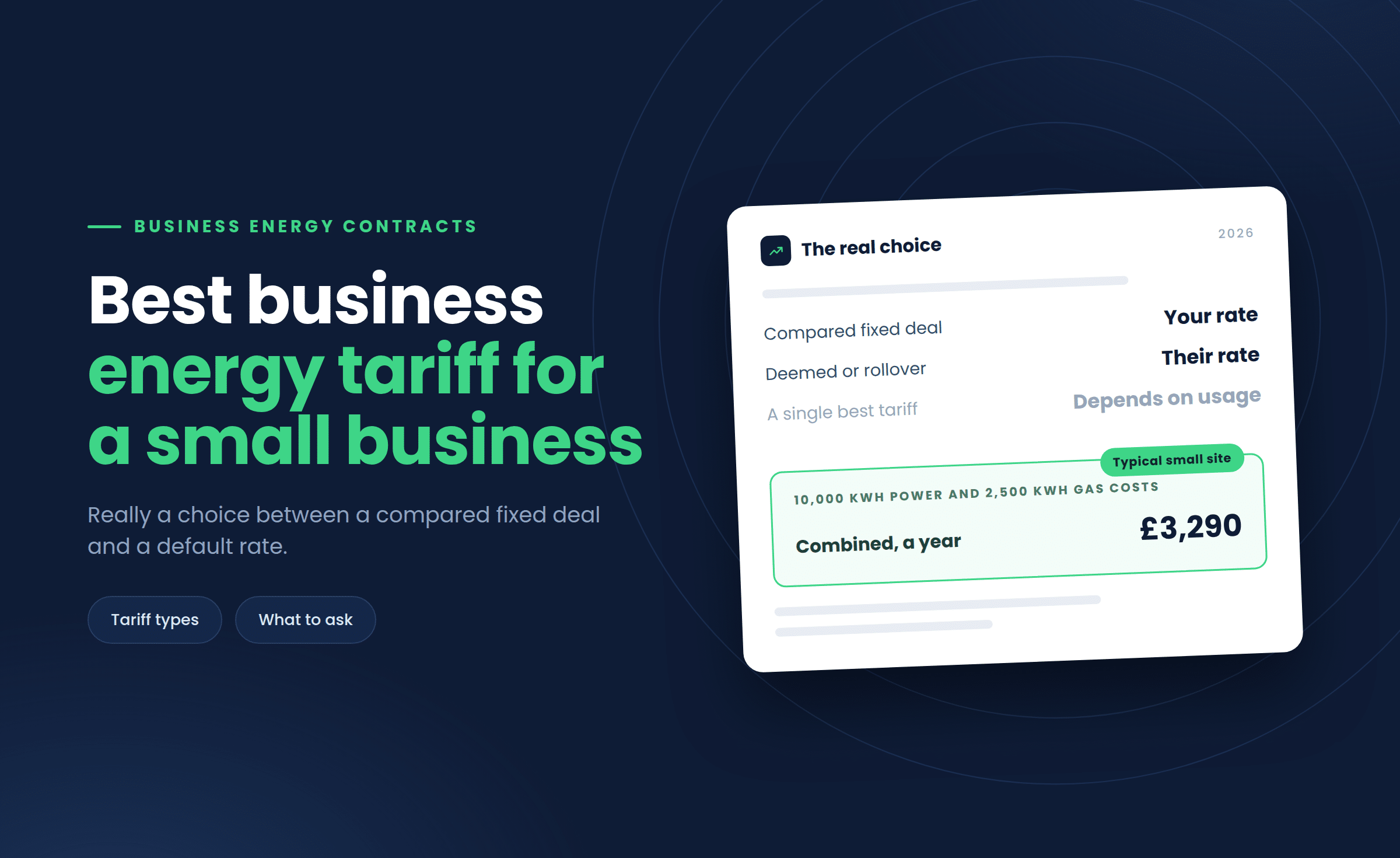
Leaving a contract to lapse onto an out-of-contract rate typically costs 40% to 80% more than a negotiated deal. Our guide to business energy contracts and renewals covers the terms and timing worth checking.
Utility Saving Expert is a broker, and we are upfront that we earn a fee from suppliers when a comparison leads to a switch, disclosed to you as required under Ofgem’s microbusiness rules. Our job is to run the comparison fairly so you can see where the competitive rates sit for your business right now.