
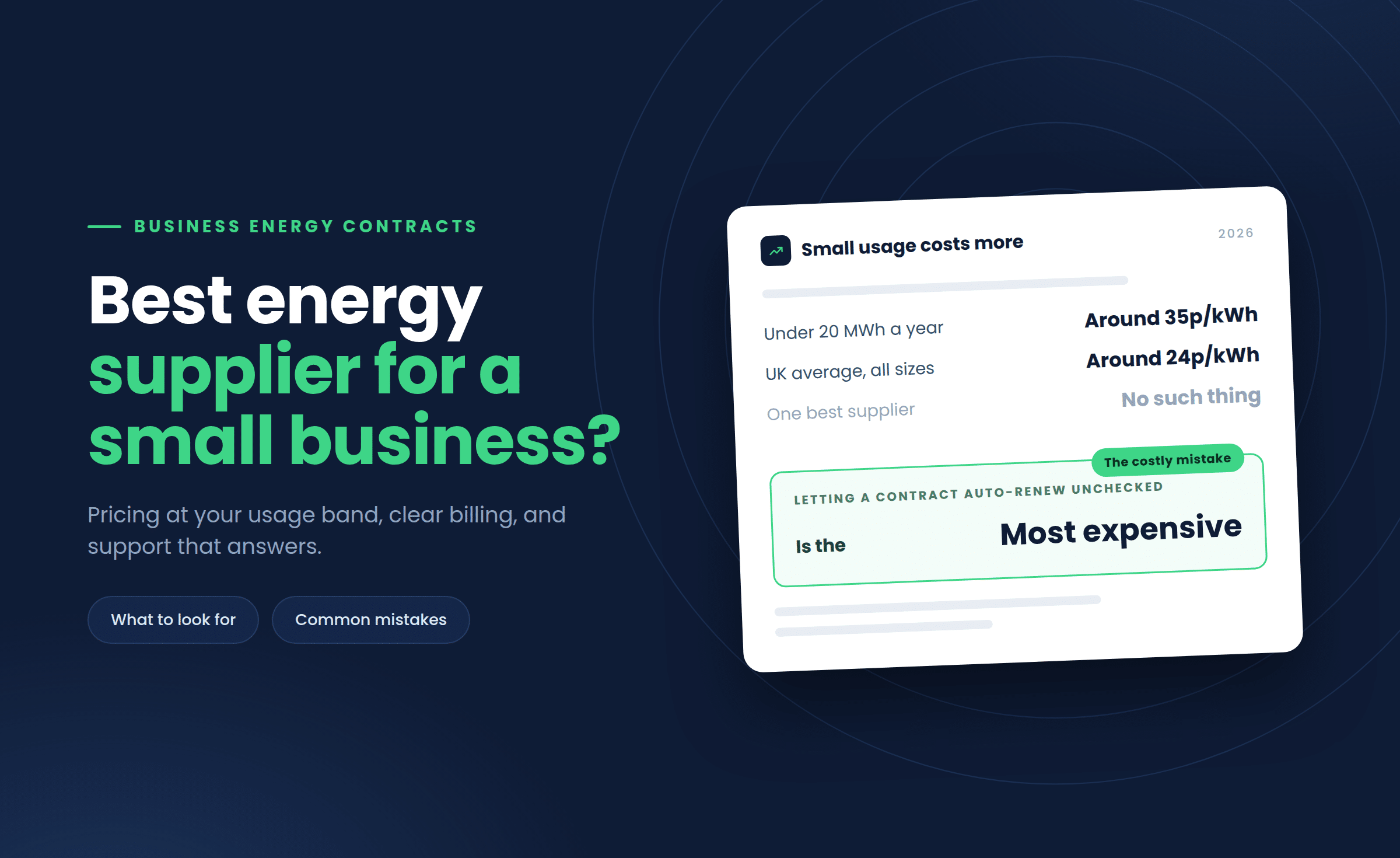
There is no universal best small business energy supplier, because the right choice depends on your usage, sector and how you want to be served, not a fixed ranking. What matters is judging suppliers on the criteria that fit a small business: fair pricing at low volumes, clear billing and decent support when something goes wrong.
Small businesses often get a rougher deal than they should, mostly because low-volume usage means higher unit rates and less bargaining power than a large account. That does not mean you are stuck accepting whatever is offered.
A small cafe, a two-person office and a small retail unit all have different priorities even at similar volumes. Knowing what separates a good supplier from an average one at your scale changes the outcome.
This is not a ranked top five with star ratings, because business energy pricing does not work that way. It is a framework for judging the business energy suppliers active in this market so you can compare with confidence.
What should a small business look for in an energy supplier?
Look for competitive pricing at your specific usage band, clear billing, and support that does not require a call centre queue every time something is wrong.
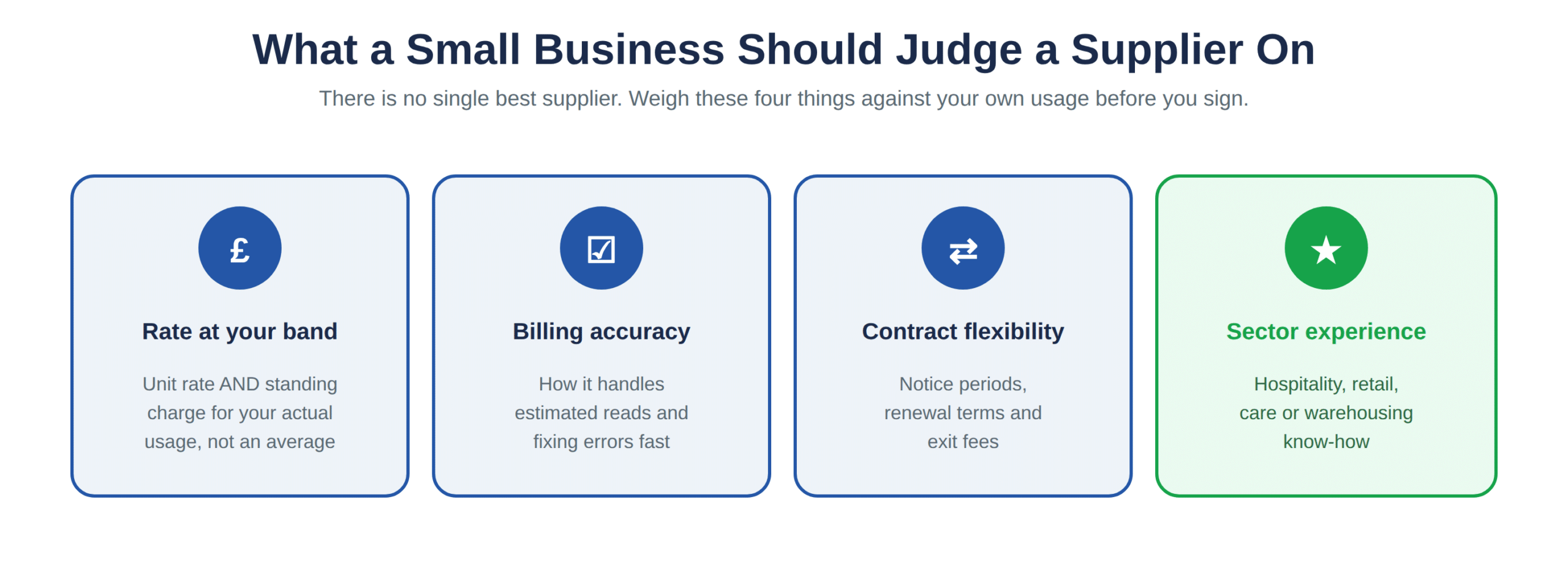
What to weigh beyond price
Service quality has a bigger practical impact on small businesses than large ones, because you have less time and fewer staff to chase a billing error. Our guide to micro business energy covers the protections that apply if you fall under Ofgem’s microbusiness definition, which most small businesses do.
- Rate at your band: unit rate and standing charge for your actual usage, not a headline average.
- Billing accuracy: how the supplier handles estimated reads.
- Contract flexibility: notice periods and renewal terms.
- Sector experience: hospitality, retail, care or warehousing.
Which suppliers are active in the small business market?
British Gas Business, EDF, E.ON Next, Scottish Power, SSE, Octopus and Utilita all serve small commercial customers, alongside specialists like Yu Energy and Valda.
Positioning, not a price ranking
| Supplier | Typically strongest for |
|---|---|
| British Gas Business | Established accounts, wide service network |
| EDF Business | A range of contract lengths for SMEs |
| E.ON Next Business | Digital account management for smaller sites |
| Octopus Business | Smaller, tech-forward account handling |
| Utilita Business | Prepayment and smart metering options |
| Yu Energy | Specialist SME and multi-site accounts |
Naming these is factual, not a ranking or price endorsement. None publish a fixed small-business tariff, so two suppliers on the same row can quote very differently for the same site depending on timing and credit score.
How do small business energy rates compare across the market?
A very small business under 20 MWh a year currently averages around 35p per kWh for electricity, against a UK average of around 24p across all sizes, so small usage genuinely costs more per unit.
What a typical small business pays
This is not suppliers penalising small businesses. Standing charges, meter costs and admin are largely fixed, so they weigh more heavily on a smaller bill.
Compare live business electricity and business gas rates against a recent bill, since your own quote is the only figure that reflects your usage and standing charge.
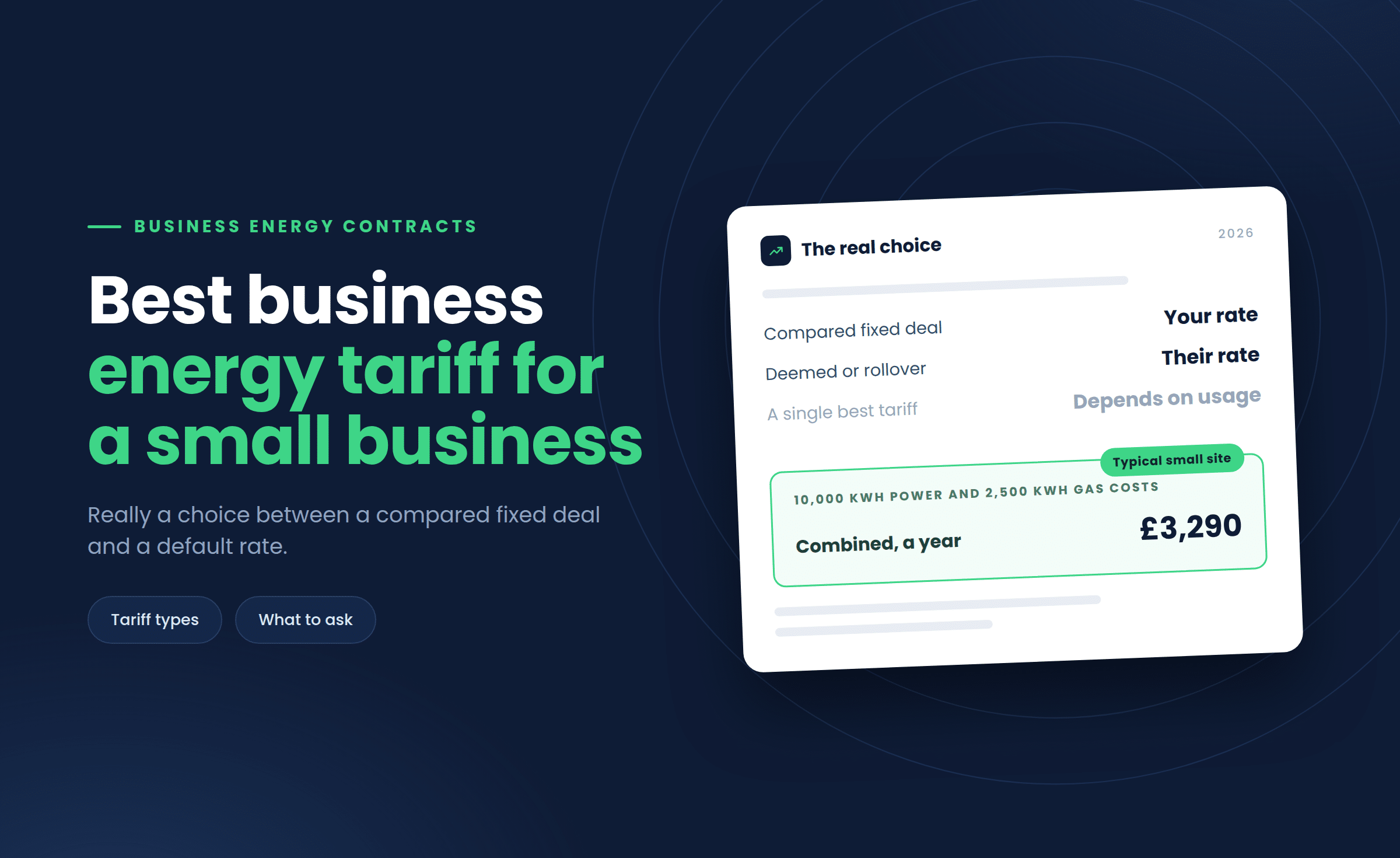
A typical small business using around 10,000 kWh of electricity and 2,500 kWh of gas spends roughly £3,300 combined a year. There is no single cheapest option, as our guide to the cheapest business energy supplier explains.
What mistakes do small businesses make when choosing a supplier?
The most common mistakes are letting a contract auto-renew without checking the market, focusing only on unit rate while ignoring the standing charge, and leaving the switch too close to the renewal deadline.
Common pitfalls to avoid
Small businesses are more likely to miss a renewal window, since there is no dedicated procurement person watching the calendar. A rolled-over contract usually reverts to an out-of-contract rate, often 40% to 80% higher, so our guide to business energy renewals is worth reading early.
- Ignoring the standing charge: because the unit rate looks attractive.
- Signing a long term blind: without checking the exit terms first.
- Missing MPAN details: not keeping them handy for a quick comparison.
- Trusting the auto-renewal: assuming your supplier will offer the best rate.
How do you switch to a better supplier as a small business?
Gather a recent bill, compare across a wide panel of suppliers, and give yourself at least 4 to 6 weeks before your contract ends to complete the switch.
The switch, step by step
The process is simpler than most owners expect. You do not deal with each supplier separately, since a comparison checks a whole panel against your usage in one go, as our guide to switching business energy sets out.
- Pull your bill: for your MPAN or MPRN and current rates.
- Compare the panel: checking both unit rate and standing charge.
- Sign and switch: let the transfer run its course over 4 to 6 weeks.
As a broker, we disclose our commission on any switch, and Ofgem’s microbusiness rules mean you can take a dispute to the Energy Ombudsman if you qualify. Being upfront about that is part of a fair comparison.