
There is no single supplier that always offers the cheapest standing charge on business electricity. The lowest daily charge shifts by region, meter type and how each supplier structures its tariffs, so a live comparison is the only reliable way to find it.
Searching for the one cheapest supplier is a bit like asking which supermarket is always cheapest. The honest answer changes by product, location and week.
Business electricity is quoted by postcode and meter, not from a published national price list. Whatever is cheapest for a warehouse in the North East will not necessarily be cheapest for a retail unit in London, which is why a standing charge needs comparing per site.
Here is how supplier standing charges actually differ, what drives that difference, and how to run a proper comparison rather than guessing from a brand name.
What makes one supplier’s standing charge lower than another’s?
Standing charges differ because suppliers pass through different network costs, price risk differently, and sometimes deliberately undercut on this figure to look cheaper on a headline comparison.
Fixed network costs, variable margin
The underlying distribution charges set by your local network operator are largely fixed for a given region and meter. Everything a supplier adds on top, margin, service costs and billing systems, varies enormously, and Elexon settlement costs feed in behind the scenes.
Some suppliers price aggressively on the standing charge and recover margin through the unit rate instead. Others do the reverse, which is exactly why comparing the total matters more than either line.
Which suppliers typically compete on standing charge?
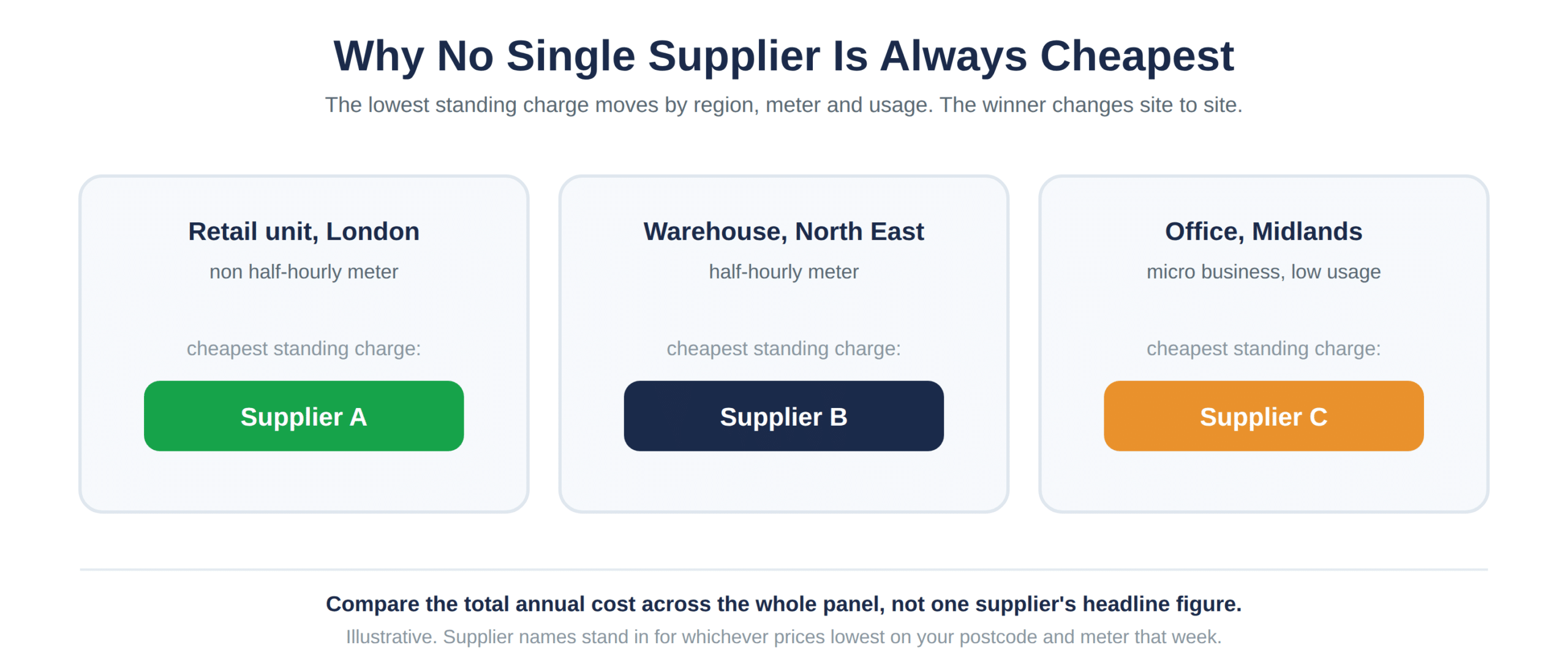
No single supplier is consistently cheapest. Across a full panel, household names and smaller specialist suppliers all price standing charges differently for an identical site, and the cheapest option moves between them as market conditions shift.
Why brand loyalty rarely pays
Larger suppliers focus on different sectors and meter profiles, and smaller specialists can occasionally undercut them for specific sites. Comparing the full panel of business energy suppliers is the only way to see who leads on your postcode and meter today.
A typical small business will not notice a supplier’s standing charge strategy on the bill itself. It only shows up once you break the total down and compare it against another quote line by line.
Does region affect which supplier is cheapest?
Yes. Network charges vary by distribution region, so the same supplier can be competitive in one part of the UK and expensive in another, purely because of underlying distribution costs.
Size and usage band matter too
Business size and usage band matter at least as much as any single brand. The 2026 average electricity rates below, from DESNZ data, show how much rates move by size before a supplier is even chosen.
| Business size | Annual usage | 2026 average rate (p/kWh) |
|---|---|---|
| Very small | 0 to 20 MWh | 35.02p |
| Small | 20 to 499 MWh | 28.76p |
| Small / medium | 500 to 1,999 MWh | 28.08p |
| Medium | 2,000 to 19,999 MWh | 25.00p |
| Large | 20,000 to 69,999 MWh | 23.93p |
| Very large | 70,000 to 150,000 MWh | 21.93p |
Does a low standing charge always mean a cheaper bill?
No. A supplier undercutting on standing charge sometimes recoups the difference through a higher unit rate, so the fair comparison is always the total annual cost, never either figure alone. The same trap applies to a zero standing charge tariff, where the daily cost moves into the unit rate entirely.
The headline-figure trap
This is exactly the trap covered in our guide to unit rate versus standing charge. A business chasing the lowest standing charge can end up on a worse overall deal than one that ignored it completely.
How do you run an accurate standing charge comparison?
Compare like for like: same contract length, same start date, and the total annual cost including standing charge, unit rate, CCL and VAT, not the headline figures in isolation.
A four-point checklist
- Get your usage: your EAC from a recent bill before requesting quotes.
- Match the term: a 1-year and a 3-year deal are not directly comparable.
- Ask for the total: the full annual cost on every quote, not just two headline rates.
- Re-run near renewal: supplier pricing shifts constantly.
Some suppliers focus on smaller SME sites while others specialise in half-hourly accounts, so a comparison across the full panel avoids missing one that does not market itself to your size. Our guide on how to switch business energy supplier covers what happens once you have picked a winner.
A medium business has more at stake in getting this right than a micro site, simply because the pounds behind any percentage saving are larger. Ofgem’s business energy advice sets out your rights through the switch.