
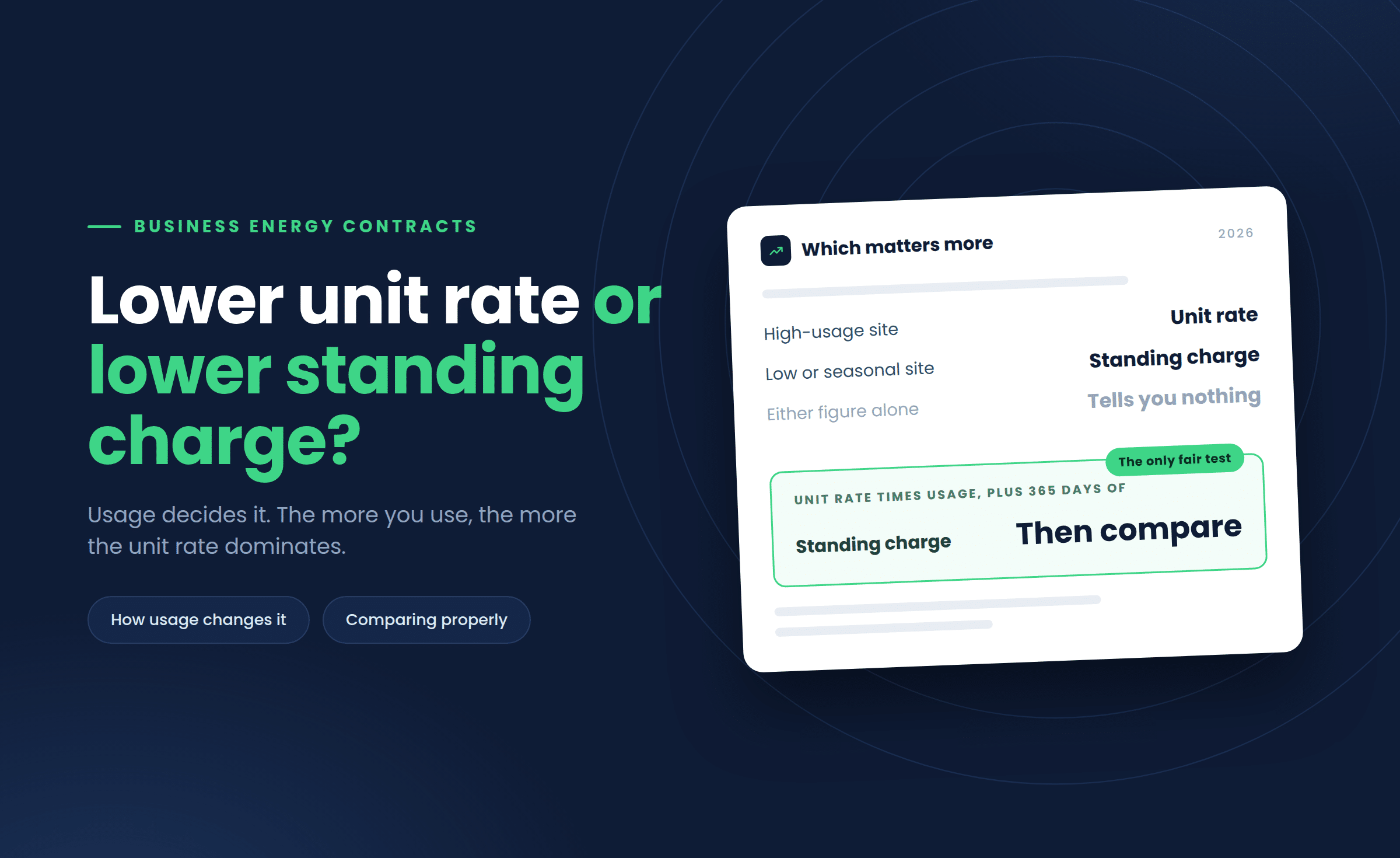
For most businesses, the unit rate matters more than the standing charge, because it is charged on every unit of gas or electricity used and volume usually swamps a fixed daily fee. Very low usage sites are the exception, where a high standing charge can end up dominating the bill.
Every business energy quote is built from two very different numbers: a unit rate charged per kWh, and a standing charge charged per day whatever you use. Suppliers can price these two elements quite differently.
A tariff that looks cheaper on the headline unit rate can lose out once the standing charge is added, and the reverse happens just as often. Two quotes with the same total can arrive at that figure in completely different ways.
If you are comparing two offers side by side, it helps to know which figure is actually doing the work on your bill. That depends far more on how much energy you use than on which supplier you pick.
What’s the difference between a unit rate and a standing charge?
The unit rate is the price per kWh for the gas or electricity you actually use. The standing charge is a fixed daily fee for having a live connection, charged whether the meter moves or not.
Two numbers on every bill
Unit rates scale with consumption: use more, pay more. Standing charges do not move across a billing period, which is why they are quoted in pence per day, as our guide to what a standing charge is explains.
- Unit rate: pence per kWh, multiplied by everything you consume.
- Standing charge: pence per day, fixed regardless of usage.
- Both quoted: before the Climate Change Levy and VAT are added on top.
How much does usage change which one matters more?
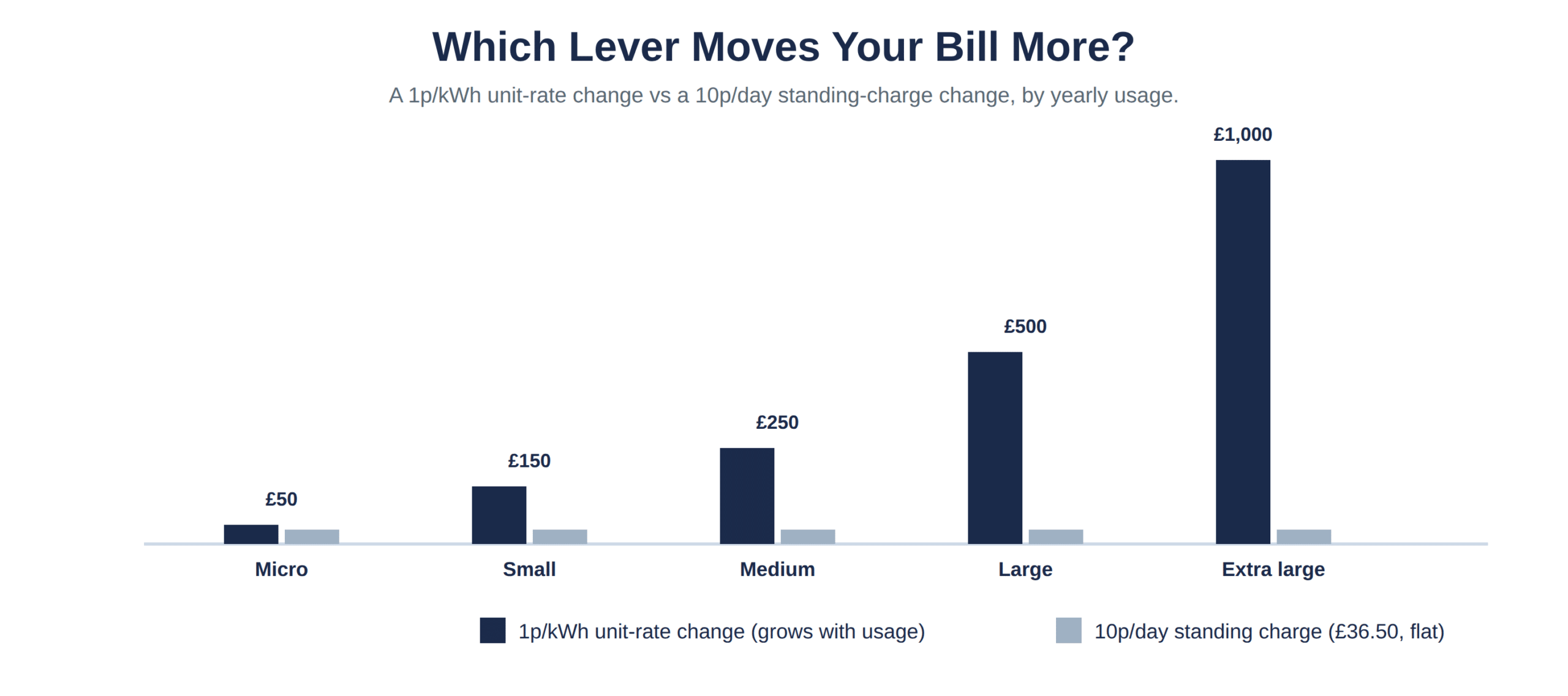
The more energy a site uses, the more the unit rate dominates the bill. A 1p/kWh difference is worth far more each year to a heavy user than the same difference in standing charge could ever be.
The arithmetic by size
| Business size | Typical annual electricity usage | Annual impact of a 1p/kWh change |
|---|---|---|
| Micro | Up to 5,000 kWh | £50 |
| Small | Up to 15,000 kWh | £150 |
| Medium | Up to 25,000 kWh | £250 |
| Large | Up to 50,000 kWh | £500 |
| Extra large | Up to 100,000 kWh | £1,000 |
A 10p/day difference in standing charge works out at roughly £36.50 a year whatever the usage. Once you are above small-business levels, the unit rate is almost always the bigger lever.
When does a lower unit rate save the most money?
A lower unit rate saves the most for medium, large and very large sites, where usage is high enough that even a small per-unit saving multiplies into hundreds or thousands of pounds a year.
Current unit rates by size
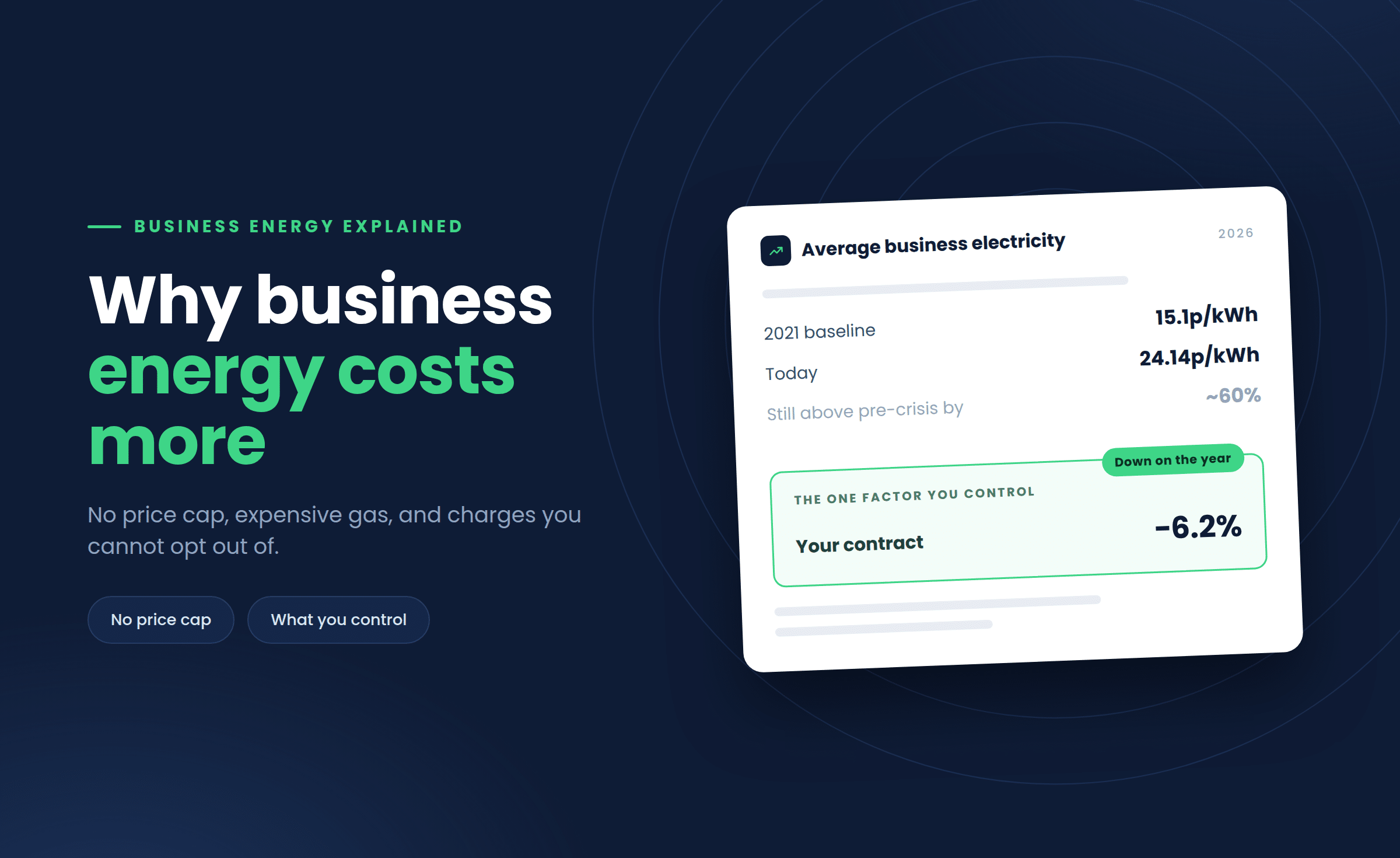
UK average business electricity for 2026 runs from around 35.02p/kWh for very small users down to 21.42p/kWh for extra large sites, with the average at 24.14p/kWh. A business electricity comparison is the only way to know your actual number.
Best available 2026 rates on a two-year fixed deal start from around 26.2p/kWh for electricity and 7.9p/kWh for gas, though the figure you are offered depends on region, meter type, consumption and supplier.
Could a lower standing charge ever be the better deal?
Yes, for very low usage or seasonal sites. A business that barely draws any power, such as a small storage unit or a seasonal outlet, can find the standing charge makes up a disproportionate share of the total bill.
The low-usage exception
This is common among micro businesses and premises open only part of the year. For these sites a cheap standing charge can matter as much as the unit rate, sometimes more, and our guide to the cheapest standing charges is worth a look.
The trade-off is that suppliers offering a very low standing charge often build the difference into a slightly higher unit rate, so the total, not either headline number, is what to judge on. Ofgem’s standing-charge guidance explains what the daily charge actually covers.
How do you compare two tariffs properly?
Compare the total annual cost, not either headline figure in isolation. Multiply the unit rate by your expected annual usage, add 365 days of standing charge, then add CCL and VAT before judging which quote actually wins.
What are AQ and EAC?
AQ (Annual Quantity) is the estimated yearly gas usage figure, and EAC (Estimated Annual Consumption) is the electricity equivalent, both pulled from historical readings tied to your MPAN. The Climate Change Levy is charged per kWh, so it sits on the unit-rate side of the sum, as the government’s CCL guidance confirms.
- Pull your usage: EAC for electricity, AQ for gas, from a recent bill.
- Multiply: that figure by each quote’s unit rate.
- Add the standing charge: multiplied by 365 (or 366 in a leap year).
- Add CCL and VAT: then compare final totals side by side.