
The Energy Bill Discount Scheme was a UK government support scheme that ran from 1 April 2023 to 31 March 2024, giving businesses a discount on wholesale energy costs when prices rose above a set threshold. It has now closed, and there is no blanket scheme that has replaced it.
If you have landed here hoping to claim it, the short answer is that you cannot. The scheme ended in March 2024, and support since then works differently, through the market and a small number of targeted schemes rather than an automatic discount.
It is still worth understanding what the scheme was, because it shapes how business support is talked about today. This guide explains how it worked, why it ended, and what actually helps a business energy bill now.
The most useful thing to know upfront: with no automatic discount in place, comparing and buying well is the lever every business still controls.
Has the energy bill discount scheme ended?
Yes, the scheme ran for exactly one year, from 1 April 2023 to 31 March 2024, and closed on that date. No equivalent universal replacement has followed it.
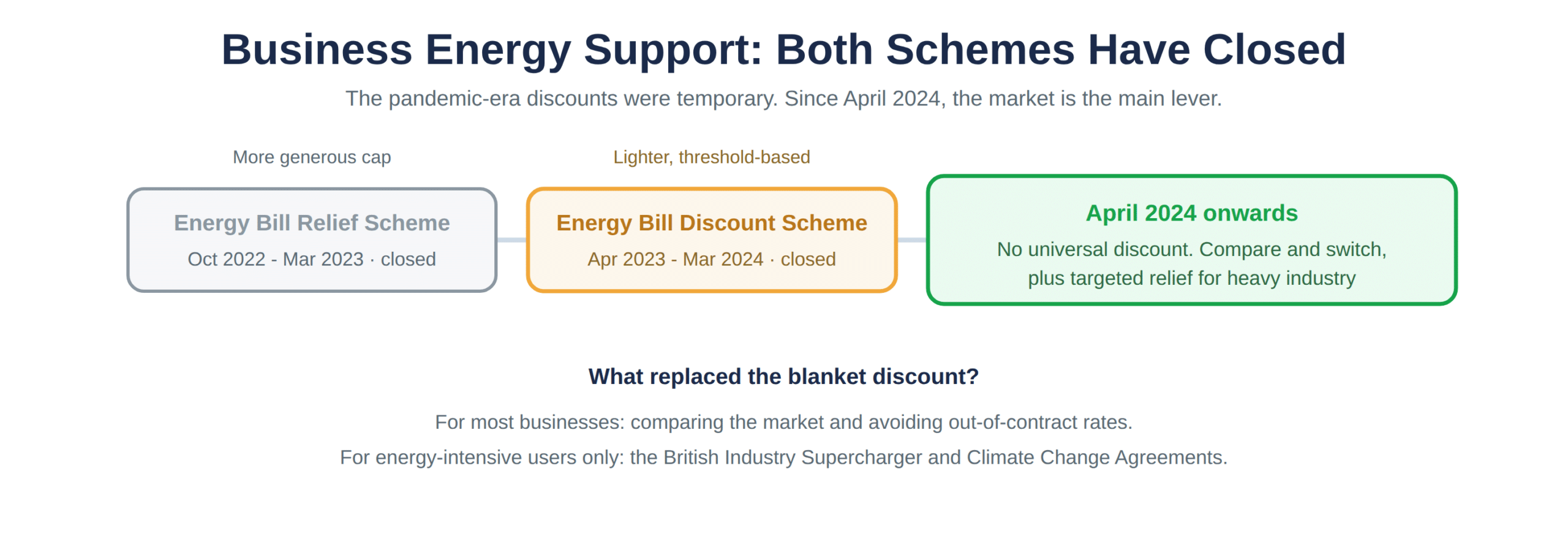
How it fitted with the earlier scheme
It replaced the more generous Energy Bill Relief Scheme, which had capped wholesale costs from October 2022 to March 2023. The discount scheme was deliberately lighter, because the government judged the earlier cap too expensive to continue.
Both were temporary responses to the wholesale price spike after Russia’s invasion of Ukraine. As prices eased, the support was wound down rather than extended.
That history matters because it explains why there is no scheme to claim today. The support was always framed as emergency relief for an exceptional spike, not a permanent subsidy on business energy.
How did the discount actually work?
It applied a per-unit discount to your wholesale energy price, automatically, only when the wholesale rate rose above a set floor. Below that floor there was no discount, and the discount was capped at a maximum per megawatt-hour.
The standard discount rates
The discount was calculated and applied before your bill arrived, so most businesses did not need to do anything to receive the standard rate, as the government’s EBDS guidance set out. It was worth relatively little unless wholesale prices climbed high.
| Fuel | Max discount | Applied when wholesale reached |
|---|---|---|
| Electricity | Up to £19.61 per MWh | £302 per MWh |
| Gas | Up to £6.97 per MWh | £107 per MWh |
Because the discount only kicked in above the floor, its real value depended entirely on where wholesale prices sat that year. Sites on deemed or out-of-contract rates were eligible, as were fixed and flexible contracts.
What was the higher rate for energy-intensive businesses?
Energy and Trade Intensive Industries could apply for a much larger discount, reflecting how exposed heavy manufacturing is to energy costs. Unlike the standard rate, this one had to be applied for rather than being automatic.
The ETII rates and who qualified
Qualifying sectors were the energy-intensive industries the Energy Intensive User Group represents, such as steel, glass, chemicals and cement. Our guide to manufacturing energy costs covers why they are so exposed.
| Fuel | Max ETII discount | Applied when wholesale reached |
|---|---|---|
| Electricity | Up to £89 per MWh | £185 per MWh |
| Gas | Up to £40 per MWh | £99 per MWh |
Why did the government end business energy support?
The blanket schemes were extremely expensive, and as wholesale prices fell from their 2022 peak the case for universal support weakened. The government chose to target the remaining help rather than pay a discount to every business.
From blanket support to targeted schemes
The clearest survivor is the British Industry Supercharger, which reduces network charges for the most energy-intensive users. It is narrow and sector-specific, not a discount every business receives.
Alongside it, longer-standing measures like Climate Change Agreements still offer a reduced Climate Change Levy to qualifying sites. None of these is a like-for-like replacement for the discount scheme.
What support is available for business energy now?
There is no automatic bill discount today. The biggest saving most businesses can secure is by comparing the market and avoiding out-of-contract rates, with targeted relief only for the most energy-intensive sites.
The levers still in your control
Comparing business energy suppliers before renewal is the practical equivalent of the old discount for most businesses, since an out-of-contract rate can cost far more than any scheme ever saved. Our guide to business energy renewals covers the timing.
For very heavy users, checking eligibility for the Supercharger and Climate Change Agreements is worth doing. For everyone else, a well-timed contract is where the saving now sits.
It is a mindset shift rather than a loss. Under the schemes the discount arrived automatically, whereas now the equivalent saving comes from actively comparing and not letting a contract lapse onto a deemed rate.